Introduced in July 2017, India's GST replaced multiple cascading indirect taxes with a unified consumption tax structure. Yet unlike Singapore's single flat rate, India operates five primary GST slabs (0%, 5%, 12%, 18%, 28%) with product-specific variations and a dual tax architecture that applies Central GST (CGST) plus State GST (SGST) domestically, or Integrated GST (IGST) for interstate and cross-border transactions. Misclassifying your offerings under the wrong HSN or SAC code can trigger incorrect tax rates, denied input tax credits, and penalties that disrupt operations.
This guide addresses the GST obligations Singapore firms face when entering India: mandatory registration requirements for foreign companies, operational impacts on pricing and working capital, cross-border transaction rules for imports and services, and digital compliance obligations including e-invoicing and monthly return filings.
Key Takeaways
- Since July 2017, India's GST has unified VAT, excise duty, and service tax into one destination-based system — changing how foreign firms account for indirect tax entirely
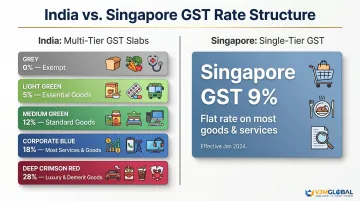
- India uses multiple tax slabs (0%, 5%, 12%, 18%, 28%) versus Singapore's flat 9%, making product classification critical
- Singapore companies must register for GST regardless of turnover threshold—no exemption for foreign entities
- ITC can reduce your effective tax burden, but only if your suppliers file correctly — their non-compliance becomes your problem
- Non-compliance triggers late fees, interest charges, ITC denial, and criminal liability for deliberate fraud
India's GST Framework: Key Differences from Singapore's GST
Dual Tax Structure vs. Single-Tier System
India operates a dual GST architecture: domestic sales within a state attract CGST (levied by the central government) plus SGST (levied by the state government), while interstate transactions and imports attract IGST. Singapore's GST, by contrast, is a single-tier tax administered entirely by IRAS with no state-level component.
India's multi-slab rate structure creates classification complexity absent in Singapore's flat-rate system:
| GST Slab | Typical Applications | Singapore Equivalent |
|---|---|---|
| 0% | Essential food grains, exports | Zero-rated supplies |
| 5% | Household necessities, basic services | N/A |
| 12% | Processed foods, standard services | N/A |
| 18% | IT services, professional services, most B2B supplies | 9% (all supplies) |
| 28% | Luxury goods, tobacco, automobiles (plus cess) | N/A |
Every supply must be classified under the correct HSN code (for goods) or SAC code (for services, under Chapter 99). Singapore firms used to applying a flat 9% rate will need dedicated classification support before starting Indian operations—misclassification is one of the most frequent compliance errors foreign companies make.
Cascading Tax Elimination Through Input Tax Credit
The structural difference goes beyond rates. Before GST, India's indirect tax regime imposed levies at multiple supply chain stages with no consistent credit mechanism — taxes were effectively taxed again downstream. The pre-GST regime included:
- Central Excise Duty
- Service Tax
- State VAT
- Central Sales Tax
- Various state-level surcharges and cess
These applied separately, inflating final costs by an estimated 25–30%.
GST with full Input Tax Credit (ITC) eliminated this cascading. Businesses can now offset GST paid on inputs against their output GST liability, so only the net value addition is taxed. This directly affects how Singapore firms should model India pricing: cost assumptions based on pre-2017 structures will significantly overstate the effective tax burden.
Registration Threshold and Mandatory Foreign Company Registration
Domestic Indian businesses register for GST only when annual aggregate turnover exceeds ₹20 lakh (~SGD 33,000) in most states, or ₹10 lakh in special category states. Goods-only suppliers may qualify for a higher ₹40 lakh threshold.
Singapore companies face a different rule entirely. Under CGST Act Section 24(v), non-resident taxable persons must register regardless of turnover. A single taxable transaction is enough to trigger mandatory registration — there is no threshold exemption for foreign entities. Compare that to Singapore's SGD 1 million annual turnover threshold, and the operational implication is clear: any Singapore firm transacting in India needs GST registration from day one.
GST Registration Requirements for Singapore Companies in India
Two Registration Pathways: Regular Taxpayer vs. Non-Resident Taxable Person
Singapore firms entering India face two registration routes depending on operational structure:
1. Regular Taxpayer Registration (for Indian subsidiaries, branches, or liaison offices):
- Applies when operating through an Indian subsidiary, branch office, or liaison office
- Requires separate state-wise GSTIN for each state of operation
- No validity limitation; registration remains active until cancelled
- Full ITC eligibility on business inputs
- Standard monthly/quarterly filing obligations (GSTR-1, GSTR-3B, annual GSTR-9)
2. Non-Resident Taxable Person (NRTP) Registration (for short-term projects or one-time events):
- Applies for occasional taxable supply without a fixed Indian establishment
- No turnover threshold—mandatory regardless of transaction value
- Must apply at least 5 days before commencing business in India
- Valid for the period specified (maximum 90 days, extendable once for additional 90 days)
- Requires advance tax deposit equivalent to estimated liability for the entire registration period
- No ITC eligibility on local procurements or imported services
- Monthly filing via GSTR-5 by the 20th of the following month
- Must appoint an Indian resident as authorized signatory (with valid PAN and Indian mobile number)
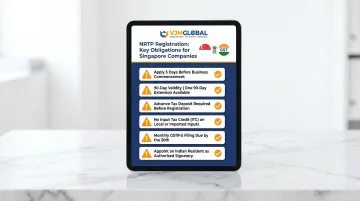
The advance deposit requirement creates immediate working capital pressure. Singapore companies must fund their full projected GST liability before operations begin, with no input credit to offset it.
OIDAR Registration: Mandatory for Singapore Digital Service Providers
Singapore companies supplying Online Information Database Access and Retrieval (OIDAR) services directly to Indian consumers face mandatory GST registration with no turnover exemption.
OIDAR qualifying services include:
- Cloud services and SaaS platforms
- Digital content (e-books, music, video streaming)
- Online gaming and virtual goods
- Website hosting and data storage
- Internet advertising
- Automated online education (virtual classrooms)
- Software and updates delivered electronically
OIDAR registration requirements:
- Compulsory under Section 24(xi) for any foreign provider supplying to non-taxable Indian recipients (B2C)
- The Reverse Charge Mechanism covers B2B OIDAR supplies — the Indian business recipient pays GST directly
- Registration authority: Principal Commissioner of Central Tax, Bengaluru West
- Monthly filing via GSTR-5A by the 20th of the following month
- Form: GST REG-10 (Simplified Registration Scheme)
Singapore tech firms, SaaS providers, and digital content companies must assess OIDAR exposure immediately. Even one transaction with an Indian consumer triggers full registration and filing obligations.
Multi-State Registration Complexity
India's GST system requires separate GSTIN for each state where a business maintains a place of business or makes taxable supplies. A Singapore firm establishing warehouses in Maharashtra, offices in Karnataka, and distribution centers in Tamil Nadu needs three separate registrations, each with independent filing obligations.
Multi-state registration implications:
- Separate GSTR-1, GSTR-3B, and GSTR-9 filings per state
- State-specific compliance tracking and deadline management
- Increased administrative burden and working capital requirements
- Inter-state stock transfers require e-way bills and IGST tracking
Singapore companies should map their intended Indian operational footprint carefully before registration. Consolidating operations into fewer states during initial setup materially reduces compliance complexity.
VJM Global has helped foreign companies — including those from Singapore — navigate multi-state GST registration in India, handling document preparation, GST portal coordination, and authorized representative appointment so leadership can focus on the business itself.
How India's GST Impacts Day-to-Day Business Operations
Pricing Models: B2B vs. B2C and Rate Classification
GST fundamentally affects how Singapore companies price their India offerings. Unlike Singapore's uniform 9% rate, India's rate variability requires product-specific pricing strategies:
B2B pricing considerations:
- GST-registered Indian business customers can claim ITC on purchases
- GST becomes cost-neutral for them—focus pricing on pre-tax value
- Competitive positioning depends on value delivery, not tax burden
- Most professional, IT, and consulting services attract 18% GST
B2C pricing considerations:
- End consumers cannot claim ITC—GST is a real end-cost
- Must build applicable GST slab into final retail price
- Price elasticity varies significantly across 5%, 12%, 18%, 28% slabs
- Misclassification can make products uncompetitive or trigger compliance issues
Example: A Singapore SaaS company selling project management software to Indian enterprises would typically charge 18% GST. If the Indian customer is GST-registered and uses the software for business purposes, they claim full ITC—the tax is cost-neutral. But if selling the same software to individual freelancers or consumers (B2C OIDAR scenario), the 18% GST becomes a real price premium the provider must factor into market positioning.
Input Tax Credit: The Supplier Compliance Dependency
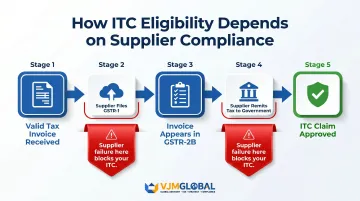
ITC is GST's core mechanism for avoiding tax-on-tax—businesses offset tax paid on inputs against tax collected on outputs. But ITC eligibility depends entirely on supplier compliance, creating vendor risk that doesn't exist in Singapore's GST system.
ITC claim conditions under CGST Act Section 16:
- Recipient must possess valid tax invoice or debit note
- Supplier must report invoice in their GSTR-1 outward supplies statement
- Invoice details must appear in recipient's GSTR-2B auto-populated statement
- Supplier must have actually paid the tax to government—not just collected it
- Recipient must pay supplier within 180 days (or reverse ITC with interest until paid)
- ITC must be claimed by 30th November following financial year, or annual return date (whichever earlier)
Critical risk: If your supplier fails to file GSTR-1 or doesn't remit collected tax to the government, your ITC claim is legally barred—even if you paid the supplier in full including GST. This creates direct dependency on vendor compliance systems.
Singapore companies building India supply chains must implement:
- Vendor GST compliance verification before onboarding
- Monthly GSTR-2B reconciliation to identify missing supplier invoices
- Advance notice to suppliers of ITC dependency
- Alternative vendor qualification when compliance failures appear
Supply Chain Optimization: National Market Benefits
Pre-GST, companies structured warehousing state-by-state to minimize Central Sales Tax and state VAT. This tax-driven distortion often created logistics inefficiency—maintaining inventory in 15+ locations purely for tax reasons.
GST enables supply chain decisions based purely on logistics efficiency:
- Interstate goods movement via single e-way bill (mandatory for consignments above ₹50,000)
- IGST on interstate sales is fully creditable—no tax penalty for centralized distribution
- Companies can consolidate to 2-3 regional hubs serving entire country
- Reduced inventory holding costs and faster delivery times
For Singapore firms establishing India operations—whether regional offices, service delivery centers, or distribution partnerships—this represents significant operational simplification compared to pre-2017 requirements. The working capital picture, however, deserves equal attention.
Working Capital Impact: Accrual-Based GST Liability
Under CGST Act Section 12, GST liability arises on invoice date—whichever is earlier between invoice issuance (or last date invoice should be issued per law) and payment receipt. This creates working capital pressure significantly different from Singapore's approach.
Singapore firms must budget for:
- GST payment to government before collecting from customers when selling on credit terms
- Typical B2B payment cycles in India: 30-90 days
- Cash outflow for GST on day of invoicing; cash inflow 60 days later
- Higher working capital requirements than comparable Singapore operations
Example: A Singapore IT consulting firm invoices ₹10 lakh (SGD ~16,500) for services delivered on 15th March with 60-day payment terms. ₹1.8 lakh GST (18% rate) must be remitted to government by 20th April via GSTR-3B, but the client's payment arrives only on 15th May. That 55-day funding gap must be covered from working capital.
Services Sector Impact: 18% Standard Rate with ITC Pass-Through
Singapore companies providing IT services, consulting, financial advisory, legal services, or professional services in India face 18% GST on services. While B2B clients recover this through ITC, B2C clients bear the full cost.
Service pricing competitiveness considerations:
- Domestic Indian competitors also charge 18%—level playing field on tax
- Quality differentiation and value delivery drive competitive positioning
- Contract structuring (milestone billing, retainer models) affects cash flow timing
- Cross-border service arrangements may trigger Reverse Charge Mechanism (RCM) obligations—a separate compliance layer addressed in the next section
GST on Cross-Border Transactions: Imports, Exports and Services
Importing Goods from Singapore: IGST at Port Plus ITC Recovery
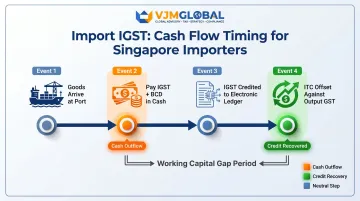
Goods imported into India from Singapore attract IGST at the applicable slab rate (based on HSN classification) in addition to Basic Customs Duty (BCD). Both are payable at port of entry before clearance.
Key mechanics:
- IGST on imports must be paid in cash only—ITC cannot be used at import stage
- Full ITC on import IGST available to GST-registered importers for use in taxable supply chains
- Creates cash flow timing issue (pay at import, claim credit later) rather than permanent cost
- Even under schemes like EPCG or Advance License, BCD may be exempt but IGST remains payable
Example: Electronics manufacturer imports components worth ₹50 lakh (SGD 82,500) from Singapore. If HSN rate is 18%, pays ₹9 lakh IGST at port (plus applicable BCD). The ₹9 lakh IGST appears in the electronic credit ledger after payment and can be offset against output GST on finished goods sold in India—eliminating it as a net cost, though the upfront cash outflow requires working capital planning.
Exporting Goods to Singapore: Zero-Rated with Refund Options
Exports from India are zero-rated under IGST Act Section 16—no GST charged on exports, and exporters can claim refund of ITC paid on inputs used in exported goods.
Two refund routes:
1. Letter of Undertaking (LUT)/Bond Route:
- Export without paying IGST
- Claim refund of unutilized ITC accumulated on inputs
- Shipping bill/airway bill serves as refund application
- Common for regular exporters with ongoing export activity
2. IGST Payment Route:
- Pay IGST at time of export (using ITC or cash)
- Claim refund of IGST paid
- Applies only to notified classes of services under Section 16(4)
Compliance requirements:
- Export proceeds must be realized in convertible foreign exchange within FEMA time limits
- Failure to realize proceeds triggers refund repayment with interest within 30 days
For Singapore firms with India-based manufacturing exporting finished goods back to Singapore or third countries, zero-rating keeps GST entirely out of export pricing—which directly protects margins when competing against suppliers from other jurisdictions.
Cross-Border Services: Place of Supply and Reverse Charge Mechanism
Where goods have clear physical rules (port of entry, shipping bills), services require a different test. Place of supply rules determine whether GST applies—and the governing principle is that tax follows the location of consumption.
Services from Singapore to India (Import of Services):
- Services supplied by Singapore company to Indian entity where recipient is in India = import of services
- Indian recipient liable to pay GST under Reverse Charge Mechanism (RCM)
- RCM must be paid via electronic cash ledger only (cannot use ITC to pay RCM)
- After paying RCM, Indian recipient can claim ITC on the amount paid (subject to standard ITC conditions)
- Applies broadly to: management fees, royalties, software licenses, consulting, technical services
Example: Singapore parent company charges ₹20 lakh annual management fee to Indian subsidiary. Indian subsidiary must self-assess and pay ₹3.6 lakh GST (18% rate) under RCM via cash payment to government. They can then claim ₹3.6 lakh as ITC against their output GST liability—so there's no net GST cost, but the quarterly cash drain and self-assessment filing requirement are real operational considerations Singapore parent companies often underestimate.
Services from India to Singapore (Export of Services):
- Services supplied by Indian entity to Singapore firm qualify as export of services (zero-rated)
- No GST charged on invoice
- Requires payment in convertible foreign exchange to qualify for zero-rating
- Indian service provider can claim ITC refund on inputs used in service delivery
OIDAR B2C: No Zero-Rating for Consumer Supplies
While B2B OIDAR supplies from Singapore to Indian businesses fall under RCM (Indian business pays), B2C OIDAR supplies from Singapore to Indian consumers do not qualify for zero-rating.
The Singapore provider must:
- Register for GST in India (OIDAR NRTP registration)
- Charge and collect IGST on all B2C supplies
- Remit IGST to Indian government via GSTR-5A monthly filing
- Bear full compliance obligation despite having no physical presence in India
For Singapore SaaS or media platforms scaling into India's consumer market, this means building GST registration and monthly GSTR-5A filing into the India launch plan—not as an afterthought, but from day one.
GST Compliance Obligations: Filing, Returns and Penalties
Monthly and Annual Filing Requirements
| Return | Purpose | Frequency | Due Date | Applicability |
|---|---|---|---|---|
| GSTR-1 | Outward supplies (sales details) | Monthly or Quarterly | 11th (monthly); 13th after quarter (quarterly) | Regular taxpayers |
| GSTR-3B | Summary return with tax payment | Monthly or Quarterly | 20th (monthly); 22nd/24th after quarter | Regular taxpayers |
| GSTR-9 | Annual return | Annual | 31st December following FY | Regular taxpayers (turnover > threshold) |
| GSTR-5 | NRTP return | Monthly | 20th of following month | Non-resident taxable persons |
| GSTR-5A | OIDAR provider return | Monthly | 20th of following month | Foreign OIDAR providers |
GSTR-1 details every outward supply (invoice-level data)—buyer GSTIN, invoice number, value, tax amount, HSN/SAC code. This data auto-populates in buyers' GSTR-2B, enabling their ITC claims.
GSTR-3B is the summary return where tax liability is calculated and paid. Mismatches between GSTR-1 and GSTR-3B create compliance red flags and can trigger ITC denial for buyers.
Filing discipline is critical: Late or incorrect GSTR-1 filing by suppliers directly denies ITC to all their customers. For Singapore firms operating in India, this means your suppliers' filing discipline affects your tax costs.
E-Invoicing: Mandatory Above ₹5 Crore Turnover
Businesses with annual aggregate turnover exceeding ₹5 crore must generate e-invoices via the Invoice Registration Portal (IRP). Each B2B invoice receives a unique Invoice Reference Number (IRN) and QR code.
Key requirements (effective August 2023):
- All B2B invoices above threshold must be IRP-registered
- Invoices receive digitally signed IRN and QR code
- Data auto-flows to GST portal (GSTR-1 pre-population)
- Requires ERP/accounting software capable of IRP integration
30-day reporting deadline (effective 1 April 2025):
- Businesses with turnover ≥ ₹10 crore cannot report e-invoices older than 30 days from date of reporting
- Previously applied only to ₹100 crore+ businesses; threshold lowered significantly
- Singapore firms' Indian subsidiaries likely exceed ₹10 crore—must build 30-day discipline into invoicing workflows
India-compliant accounting software or ERP integration with IRP connectivity must be confirmed before operations begin—retrofitting mid-operation disrupts billing cycles and creates compliance gaps. At VJM Global, we help Singapore firms assess and implement the right e-invoicing setup as part of the India entry process.
Late Filing Fees and Interest Penalties
Late filing fees (per CGST Act Section 47):
- ₹50 per day per return (₹25 CGST + ₹25 SGST) for regular returns
- ₹20 per day per return for nil returns
- Maximum cap of ₹5,000 per return applies
Interest on delayed tax payment (Section 50):
- 18% per annum on unpaid tax from due date until payment
- Applies even if delay is unintentional or due to cash flow issues
- Compounds quickly for businesses with significant monthly liabilities
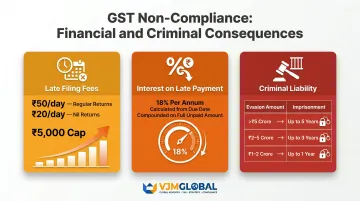
Example: Company with ₹2 lakh monthly GST liability delays payment by 60 days. Interest: ₹2,00,000 × 18% × 60/365 = ₹5,917—plus ₹50/day late filing fee (₹3,000 for 60 days) = ₹8,917 total penalty.
Financial penalties are recoverable. Criminal liability is not—and that's the more serious risk for company officers.
Criminal Liability: Section 132 Serious Offences
GST fraud carries criminal prosecution under CGST Act Section 132:
| Tax Evasion Amount | Maximum Imprisonment | Nature of Offence |
|---|---|---|
| > ₹5 crore | Up to 5 years + fine | Cognizable and non-bailable |
| ₹2-5 crore | Up to 3 years + fine | Non-cognizable and bailable |
| ₹1-2 crore (fake invoicing) | Up to 1 year + fine | Non-cognizable and bailable |
Key offences attracting prosecution:
- Issuing invoices without actual supply (fake invoicing)
- Availing ITC using fake invoices
- Collecting tax from customers but failing to pay government beyond 3 months
- Suppressing turnover to evade tax
- Falsifying financial records
Minimum 6-month imprisonment applies for offences involving amounts over ₹1 crore. This creates personal criminal liability risk for directors and officers—not just corporate penalties.
For Singapore parent companies, GST failures in Indian subsidiaries flow upstream: they disrupt consolidated financial reporting, trigger tax authority scrutiny, and create audit qualifications that affect the parent entity's standing. Establishing monthly compliance reviews and a clear escalation path between your Indian finance team and Singapore headquarters is the most practical safeguard.
Frequently Asked Questions
How does GST impact businesses in India?
GST replaced multiple indirect taxes—VAT, excise, and service tax—with a unified system, eliminating cascading costs and simplifying interstate trade. In return, it introduced digital compliance obligations, multi-rate classification complexity, and working capital timing issues that require disciplined invoicing, ITC reconciliation, and monthly filing practices.
How does GST impact small businesses in India?
Small businesses with turnover below ₹1.5 crore can opt for the Composition Scheme, paying a flat-rate tax (0.5–3% by business type) with quarterly filings instead of monthly returns. The trade-off: they cannot collect GST from customers, cannot claim ITC, and still face digital compliance and supplier dependency challenges.
Do Singapore companies need to register for GST in India?
Yes. Singapore companies with taxable supply activity in India must register, with no turnover exemption for non-resident taxable persons. OIDAR service providers supplying Indian consumers also register regardless of turnover. Whether you register as a regular taxpayer or Non-Resident Taxable Person depends on whether you operate through a permanent establishment or on an occasional basis.
What is the GST rate on services provided by Singapore companies to Indian clients?
Most professional, IT, consulting, and business services attract 18% GST. The Indian recipient typically pays this via Reverse Charge Mechanism if the Singapore company is not registered in India. If the Indian recipient is GST-registered and uses services for business purposes, they can claim full ITC on the RCM payment, though it creates compliance and cash flow obligations for the recipient.
Can Singapore companies claim Input Tax Credit in India?
Yes, GST-registered entities in India—including Indian subsidiaries of Singapore firms—can claim ITC on business inputs. Claims depend entirely on supplier compliance: if a supplier fails to report invoices in GSTR-1 or remit tax, ITC is denied even if the buyer paid in full. Rigorous vendor qualification and regular GSTR-2B reconciliation are essential.
What happens if a Singapore company fails to comply with India's GST requirements?
Non-compliance triggers late filing fees (₹50/day per return), 18% per annum interest on unpaid tax, ITC denial, monetary penalties, and potential criminal prosecution for fraud. GST registration can also be cancelled, disrupting Indian operations and creating reputational and audit complications for the Singapore parent.