Introduction
India has emerged as a strategic expansion destination for Singapore-based businesses, driven by complementary trade ties, the Singapore-India Comprehensive Economic Cooperation Agreement (CECA), and India's expanding consumer and technology sectors. In FY 2024-25, Singapore was the largest source of FDI into India, contributing 30% of total equity inflows — USD 14.94 billion annually and USD 174.88 billion cumulatively since April 2000.
Singapore entrepreneurs are well-acquainted with ACRA registrations and the Lion City's business-friendly environment. India operates on a different legal framework entirely — and first-time entrants regularly hit avoidable roadblocks:
- FDI compliance under FEMA with mandatory RBI reporting timelines
- Sector-specific restrictions that vary by industry and ownership structure
- Multi-authority registrations spanning the Ministry of Corporate Affairs (MCA), Income Tax Department, and state-level bodies
What follows is a practical legal checklist for Singapore-based founders, investors, and companies — covering business structure selection, FDI approvals, incorporation filings, and post-setup compliance obligations.
Key Takeaways
- Singapore entrepreneurs can enter India through multiple structures — a Private Limited Company (subsidiary) is most common, offering tax efficiency and operational flexibility
- Most sectors allow foreign investment via the automatic route — no prior government approval needed, though RBI filings remain mandatory
- Core legal steps: reserve a company name via SPICe+, obtain DSC and DIN, file with the RoC, then secure PAN, TAN, and GST registration
- Ongoing compliance covers Companies Act filings, annual RBI reporting, GST returns, and labour law registrations once you start hiring
- End-to-end incorporation typically takes 3–5 weeks when documentation is properly prepared, apostilled, and submitted
Why Singapore Entrepreneurs Are Expanding to India
India's position as the world's 5th largest economy at approximately USD 3.5 trillion nominal GDP, combined with structural trade advantages Singapore companies hold under CECA, makes it a strategic expansion destination. The market offers scale, treaty-backed access, and a steadily improving regulatory environment.
The scale of Singapore-India bilateral investment is substantial:
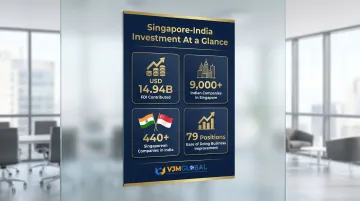
- Singapore contributed USD 14.94 billion in FDI to India in FY 2024-25
- Approximately 9,000 Indian companies are registered in Singapore
- More than 440 Singaporean companies operate in India
- India's Ease of Doing Business ranking improved 79 positions — from 142nd in 2014 to 63rd in 2020
Singapore entrepreneurs benefit from CECA provisions, active since 2005. The agreement provides:
- More than 3,000 tariffs zeroed and another 2,000+ reduced
- Preferential access in engineering, banking, telecommunications, and real estate development
- Easier movement of professionals and mutual recognition of qualifications
These treaty benefits — layered with the India-Singapore Double Taxation Avoidance Agreement (DTAA) — directly affect which business structure makes the most financial sense. Choosing the right entry vehicle is where legal requirements begin, and it's the first item on the checklist below.
Business Structures Available to Singapore Entrepreneurs
For Singapore companies entering India, the choice of legal structure shapes everything downstream: FDI compliance, liability exposure, tax treatment, and how freely you can operate. Getting this decision right early prevents costly restructuring later.
Each structure below suits a different stage of market commitment — from exploratory presence to full commercial operations.
Wholly Owned Subsidiary (Private Limited Company)
This is the most commonly used structure for Singapore companies entering India. It functions as a separate Indian legal entity with full operational capabilities: able to raise funds, employ staff, enter contracts, and conduct commercial activities.
Requirements:
- Minimum 2 directors (at least one must be an Indian resident who has stayed in India for 182+ days in the previous financial year)
- Minimum 2 shareholders (can be foreign individuals or entities)
- Maximum 200 shareholders
Foreign-owned subsidiaries incorporated as Private Limited Companies qualify as domestic companies for Indian tax purposes — paying an effective rate of approximately 25.17% under Section 115BAA, versus the 40% base rate applied to branch offices.
Branch Office
A Branch Office is suitable for companies already conducting business that want to replicate specific activities in India. It is not a separate legal entity from the parent company.
Characteristics:
- Requires RBI approval before establishment
- Restricted to activities the parent company already engages in
- Cannot undertake manufacturing or retail activities
- Parent company bears full liability for branch operations
Liaison Office
A Liaison Office (also called Representative Office) is appropriate only for market research, business promotion, or facilitating the parent company's trade.
Limitations:
- Cannot earn income in India
- Requires RBI approval
- Initial validity of 3 years, renewable for another 3 years through designated AD Category-I bank
- Commonly used by Singapore companies testing market viability before committing to a full subsidiary
Limited Liability Partnership (LLP)
LLPs are available to foreign investors only in sectors where 100% FDI is permitted under the automatic route, with no FDI-linked performance conditions.
Restrictions:
- FDI in LLPs permitted only through Government approval route
- Prohibited sectors: Agricultural/plantation activity, print media, real estate business
- Cannot make downstream investments
- Limitations on profit repatriation and fundraising make them less suitable for growth-stage businesses
Comparison Framework
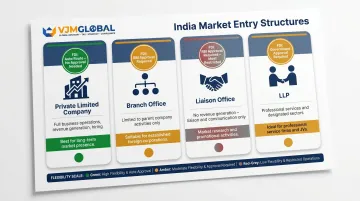
| Structure | Purpose | FDI Approval Needed | Operational Scope | Recommended For |
|-----------|---------|---------------------|-------------------|-----------------|
| Private Limited Company | Full commercial operations | No (automatic route in most sectors) | Unrestricted business activities | Singapore companies planning substantive revenue operations |
| Branch Office | Extension of parent operations | Yes (RBI approval) | Limited to parent company's existing activities | Established businesses replicating specific services |
| Liaison Office | Market research, promotion | Yes (RBI approval) | No commercial/revenue activities | First-time entrants testing market viability |
| LLP | Partnership-based operations | Yes (Government approval) | Commercial activities in eligible sectors | Limited use cases due to approval complexity |
The Legal Requirements Checklist for Singapore Entrepreneurs
This checklist covers the six steps Singapore entrepreneurs must complete — from reserving your company name through obtaining operational licences. Each step builds on the last, and filing errors at any stage are the most common reason incorporations get delayed.
Step 1 – Reserve the Company Name
The proposed company name must be unique, not similar to existing trademarks or company names, and must comply with MCA naming guidelines.
Process:
- Name reservation is done via the SPICe+ form on the MCA portal
- The parent Singapore company name can be used if no conflict exists
- Names must not be identical or similar to existing registered companies
- Certain words require prior approval (e.g., "Bank," "Insurance," "National")
Step 2 – Obtain Digital Signature Certificates (DSC) and Director Identification Numbers (DIN)
All proposed directors must obtain:
Digital Signature Certificate (DSC):
- Required for signing all electronic filings with MCA
- For Singapore nationals, requires apostille-attested and notarised identity and address documents
- Both India and Singapore are parties to the Hague Apostille Convention (India since 2005, Singapore since 2021)
Director Identification Number (DIN):
- Unique identifier issued by the RoC for each director
- At least one director must be an Indian resident
- Up to 3 DINs can be allotted through the SPICe+ form itself
Critical for Singapore nationals: Passport copies and address proof must be notarised and apostilled before submission — this step is frequently overlooked and causes significant delays.
Step 3 – File Incorporation Documents with the Registrar of Companies (RoC)
The SPICe+ (Simplified Proforma for Incorporating Company Electronically Plus) filing process is an integrated form covering:
- Company incorporation
- PAN (Permanent Account Number) application
- TAN (Tax Deduction Account Number) application
- EPFO (Employees' Provident Fund) registration
- ESIC (Employees' State Insurance) registration
Key documents required:
- Memorandum of Association (MoA) — defines the company's objectives and scope
- Articles of Association (AoA) — internal management rules
- Identity and address proofs of all directors and shareholders
- Proof of registered office address
- Declaration by professionals (Chartered Accountant, Company Secretary, or Cost Accountant)
For Singapore shareholders and directors, all supporting documents must be notarised and apostilled before submission. Missing this triggers outright rejection — meaning the entire filing must be corrected and resubmitted from scratch.
Step 4 – Open a Bank Account and Bring in Foreign Capital
Once incorporated, the company must:
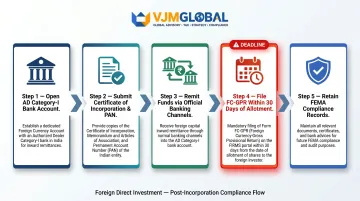
- Open an account with an Authorised Dealer (AD) Category-I bank in India
- Banks require the Certificate of Incorporation, PAN, and director identification documents
- Remit all foreign investment from Singapore through official banking channels
- File the FC-GPR form within 30 days of share allotment via the RBI FIRMS portal
- Late FC-GPR filing attracts compounding penalties under FEMA — this deadline is strictly enforced
Step 5 – Obtain GST Registration
GST registration is mandatory for businesses with:
- Annual turnover exceeding INR 20 lakh (INR 10 lakh for special category states)
- Any interstate supplies of goods or services
- Import/export activities
Critical for Singapore companies: GST applies to services received from foreign entities under the Reverse Charge Mechanism (RCM). If the Singapore parent provides services to the Indian subsidiary, the Indian entity must self-assess and pay IGST — a distinction not present in Singapore's GST framework.
Step 6 – Register for Other Applicable Licences
Sector-specific and operational registrations apply depending on business nature:
Common registrations:
- Import Export Code (IEC) from DGFT for trade businesses
- Professional Tax registration (state-specific, varies by location)
- Shops and Establishments Act registration (state-specific)
- FSSAI licence for food businesses (45–60 working days processing time via the FSSAI portal)
- MSME/Udyam registration for cost benefits and scheme access
VJM Global works with Singapore companies across all six steps — handling incorporation filings, RBI compliance, GST registration, and sector-specific licences so nothing falls through the cracks.
FDI Rules and FEMA Compliance for Singapore Businesses
The Foreign Exchange Management Act (FEMA), administered by the RBI, governs all cross-border capital flows into and out of India. FEMA compliance is the single area where Singapore entrepreneurs most frequently face penalties due to unfamiliarity.
Understanding which FDI route applies to your sector is the starting point — it determines how capital enters India and what reporting follows.
FDI Routes: Automatic vs. Government Approval
Automatic Route:
- No prior government approval needed
- Applies to most sectors at varying FDI caps (typically 100%)
- Singapore investment flows directly; only post-facto RBI reporting required
Government Approval Route:
- Requires clearance from relevant Ministry before investment
- Applies to sensitive sectors including:
| Sector | FDI Cap | Approval Threshold |
|---|---|---|
| Defence | 100% | Beyond 74% |
| Multi-Brand Retail | 51% | Up to 51% |
| Broadcasting (News TV) | 49% | Up to 49% |
| Digital Media (News) | 26% | Up to 26% |
| Banking (Private) | 74% | Beyond 49% |
| Pharmaceuticals (Brownfield) | 100% | Beyond 74% |
Singapore exemption: Press Note 3 (2020) mandates Government approval for investments from entities in countries sharing a land border with India (China, Pakistan, Bangladesh) — this does not apply to Singapore.
Singapore entrepreneurs should verify their sector's FDI cap and route before selecting a structure.
Key FEMA Filing Obligations
| Filing | Purpose | Deadline | Portal |
|---|---|---|---|
| FC-GPR | Report shares issued to non-residents | 30 days from allotment | RBI FIRMS |
| FC-TRS | Report share transfer between resident and non-resident | 60 days from transfer or funds receipt | RBI FIRMS |
| FLA Return | Annual return on Foreign Liabilities and Assets | July 15 each year | RBI online portal |
Penalties for non-compliance: Up to three times the sum involved in contravention, or INR 2 lakh if amount is not quantifiable. Late Submission Fee (LSF) is available for minor delays; serious contraventions require compounding proceedings.
Singapore Advantage: CECA and DTAA Benefits
Under CECA, Singapore-resident companies and professionals enjoy specific benefits in sectors like financial services, education, and professional services.
The India-Singapore DTAA provides reduced withholding tax rates:
| Income Type | Treaty Withholding Rate |
|---|---|
| Dividends | 10% |
| Interest | 10% (banks/financial institutions) / 15% (others) |
| Royalties & Fees for Technical Services | 10% |
Important limitations:
- Limitation of Benefits (LOB): To avoid "shell company" classification, annual expenditure in Singapore must be at least SGD 200,000 for the 24 months preceding the benefit claim
- Principal Purpose Test (PPT): Introduced via Multilateral Instrument in 2020, denies treaty benefits if one of the principal purposes was obtaining those benefits
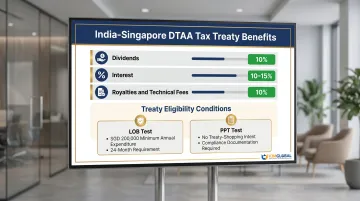
Structuring these flows correctly — particularly where LOB and PPT tests apply — requires careful documentation and advance planning. VJM Global's international tax advisory team works with Singapore parent companies to structure dividend, interest, and royalty remittances in a way that satisfies treaty eligibility requirements from day one.
Ongoing Compliance Obligations After Incorporation
Once your Indian subsidiary is incorporated, the compliance calendar starts immediately. Foreign-owned companies face a steady stream of mandatory filings across corporate law, tax, and labour regulations — each with its own deadlines and penalties.
Annual Companies Act Compliance
Mandatory for all companies:
- Annual return filing with RoC (Form MGT-7)
- Financial statements filing (Form AOC-4)
- Board meeting minutes and resolutions
- Director KYC updates
- Statutory audit by ICAI-registered Chartered Accountant — mandatory regardless of turnover or company size
Tax Compliance Obligations
Corporate Income Tax:
- Foreign-owned subsidiaries can opt for Section 115BAA at effective rate of approximately 25.17%
- Advance tax payments (quarterly)
- Corporate tax return filing by due date
TDS (Tax Deducted at Source):
- Quarterly TDS return filing
- TDS deduction on salaries, professional fees, rent, and other payments
GST Returns:
- Monthly/quarterly GST returns depending on turnover
- Annual GST return filing
Transfer Pricing Documentation:
- Required for all international transactions between Indian subsidiary and Singapore parent
- Form 3CEB (Accountant's report) mandatory
- Penalties: 2% of transaction value for failure to maintain documentation
- One of the most audited areas for foreign-owned subsidiaries
Labour Law Registrations
Tax obligations apply from day one, but labour law registrations kick in as soon as you start hiring. Thresholds vary by scheme:
| Scheme | Threshold | Coverage |
|---|---|---|
| EPF (Employees' Provident Fund) | 20 or more employees | No wage ceiling |
| ESIC (Employees' State Insurance) | 10 or more employees (in applicable areas) | Wages up to INR 21,000/month |
| Professional Tax | State-specific thresholds | Varies by state |
| POSH (Prevention of Sexual Harassment) | 10 or more employees | Mandatory policy and Internal Complaints Committee |
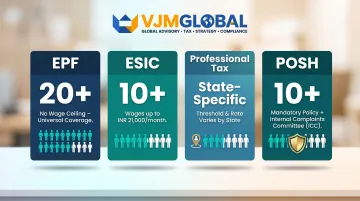
VJM Global handles these recurring obligations for foreign-owned subsidiaries — from RoC filings and transfer pricing documentation to GST returns and payroll compliance — so Singapore founders can focus on the business rather than the paperwork.
Conclusion
Starting a business in India as a Singapore entrepreneur is a well-defined process with clear legal pathways. Success requires careful sequencing: selecting the right structure, completing FEMA-compliant capital remittance, filing with the correct authorities, and maintaining ongoing statutory compliance.
Singapore companies have a structural advantage through CECA and the India-Singapore DTAA. That advantage only holds, however, if entry is executed correctly from a legal standpoint. Rushing incorporation or skipping RBI filings can create compliance liabilities that are costly to unwind.
The typical end-to-end timeline is 3–5 weeks when documentation is properly prepared, but delays commonly occur due to:
- Missing apostille attestation on Singapore documents
- Incomplete director/shareholder KYC
- Name conflicts or rejection
- Delayed DSC or DIN procurement
Avoiding these delays starts with the right advisor. VJM Global's team of 100+ accounting and business setup professionals has guided foreign companies through every stage of India entry — from initial consultation through incorporation, RBI filings, GST registration, and ongoing compliance. With 30+ years of experience and a 95% client retention rate, the firm brings practical, jurisdiction-specific expertise to Singapore-origin investors navigating Indian regulatory requirements.
Frequently Asked Questions
How can a foreigner start a business in India?
Foreigners can start a business in India by incorporating a Private Limited Company or LLP (in eligible sectors under automatic FDI route), obtaining necessary approvals under FDI policy, and complying with FEMA requirements for capital remittance and RBI filings through the FIRMS portal.
Can a Singapore company open a subsidiary in India without government approval?
Yes, in most sectors. FDI from Singapore follows the automatic route under India's FDI policy, meaning no prior Ministry approval is needed. However, RBI reporting via FC-GPR within 30 days of share allotment remains mandatory, and certain sensitive sectors still require Government approval.
What is the minimum capital required to start a company in India as a foreign investor?
There is no statutory minimum paid-up capital for a Private Limited Company under the Companies Act, 2013. The capital must be sufficient to meet operational needs and must be remitted through proper banking channels with corresponding RBI reporting via FC-GPR form.
How long does it take to register a company in India as a Singapore national?
The incorporation process typically takes 3–5 weeks if all documents (notarised, apostilled) are in order. Delays are common due to document deficiencies, name conflicts, or missing apostille attestation. Obtaining DSC and apostille for Singapore documents adds time if not prepared in advance.
Does a foreign-owned company in India need to file a separate return with the RBI?
Yes. Foreign-owned companies must file the Annual Return on Foreign Liabilities and Assets (FLA Return) by July 15 each year. Event-based filings are also required: FC-GPR within 30 days of share issuance, and FC-TRS (Foreign Currency Transfer of Shares) within 60 days of any share transfer involving non-residents.
How does the India-Singapore DTAA benefit Singapore entrepreneurs doing business in India?
The DTAA reduces withholding tax rates on dividends (10%), interest (10–15%), and royalties/technical service fees (10%) paid from India to Singapore, preventing double taxation. These benefits apply when the Singapore entity meets beneficial ownership conditions — including the Limitation of Benefits (LOB) test, which requires at least SGD 200,000 in annual operating expenditure, and the Principal Purpose Test (PPT) under the treaty.