The biggest hurdle is the Foreign Business Act (FBA), which restricts foreign ownership across huge swathes of the Thai economy. Many UK founders assume the rules mirror what US citizens enjoy under the Treaty of Amity. They don't.
This article covers the legal ownership rules, the structures available to you, the registration steps, realistic costs, and where professional support actually earns its keep.
Key Takeaways
- UK nationals can start a Thai business; foreign ownership caps at 49% in most restricted sectors.
- No Treaty of Amity for UK citizens: use BOI promotion or a Foreign Business Licence for majority ownership.
- Get a Non-Immigrant B visa and work permit before working in or signing for your Thai company.
- Local compliance support clears Thai-language filings faster and prevents avoidable setup delays.
Can a UK Citizen Legally Start a Business in Thailand?
Yes. UK nationals can incorporate or invest in a Thai company. The catch is the Foreign Business Act 1999, which governs how much of that business you're allowed to own depending on what it does.
Under the FBA, a company counts as "foreign" once foreigners hold 50% or more of its capital shares. Foreign-classed companies face extra restrictions that Thai-majority companies don't.
The Three-List System
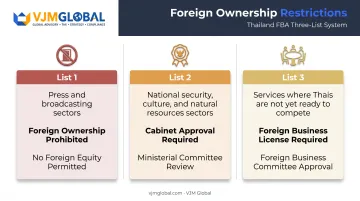
The FBA sorts restricted activities into three lists:
| List | What it covers | Can foreigners get in? |
|---|---|---|
| List 1 | Press, broadcasting, and similarly sensitive activities | No: prohibited outright |
| List 2 | National security, Thai arts/culture/handicrafts, natural resources | Only with ministerial/Cabinet approval |
| List 3 | Activities where Thais "aren't ready to compete," including rice milling and many services | Approval via the Foreign Business Committee |
If your business idea sits in List 1, forget a Foreign Business Licence: there's no route in, full stop.
Your Two Paths to Majority Ownership
If your sector is restricted, there are two legitimate ways to hold more than 49%:
- BOI promotion: Board of Investment approval for eligible activities, often bundled with tax incentives.
- Foreign Business Licence (FBL): A case-by-case permit granted through the Foreign Business Committee.
The Treaty of Amity Myth
Many US-focused guides mention the Thai-US Treaty of Amity, which lets American citizens own up to 100% of a Thai company in most sectors. That treaty is bilateral between Thailand and the United States. It does not extend to UK nationals, a detail that trips up a lot of British founders who've read the wrong guide.
One constant regardless of nationality: Thailand's standard corporate income tax rate is 20% on net profit, as confirmed by the Revenue Department. British or Thai-owned, the tax bill works the same.
Choosing the Right Business Structure as a UK Founder
Thai Private Limited Company (Co., Ltd.)
For most UK founders, a Thai private limited company (Co., Ltd.) is the default structure. Current requirements (updated 7 February 2023) mean you need:
- At least 2 shareholders at all times
- At least 1 director (no nationality restriction)
- Foreign ownership capped at 49% unless you've secured BOI or FBL approval
For unrestricted sectors, this cap doesn't apply. Still check your activity against the Foreign Business Act (FBA) lists before assuming you're clear.
BOI-Promoted Company vs Foreign Business Licence
Both routes unlock majority or full foreign ownership, but they work differently:
| Factor | BOI Promotion | Foreign Business Licence |
|---|---|---|
| Eligibility | Specific promoted activities only | Broader, case-by-case for List 2/3 activities |
| Processing time | 40-90 working days depending on investment size | 60-day statutory review, sometimes extending to ~3 months in practice |
| Key benefit | 100% ownership, corporate income tax (CIT) exemptions up to 13 years, 50% CIT reduction for 5 years | 100% ownership for otherwise-restricted activities |
| Extra perks | Relaxed foreign employee ratios, import duty exemptions | None beyond the ownership grant itself |
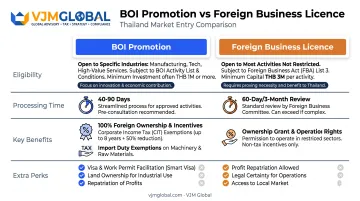
BOI promotion tends to suit tech, manufacturing, and export-oriented businesses. FBLs are more common where your activity doesn't fit a promoted category but you still need majority control.
Other Options: Branch, Rep Office, or Thai Partnership
If BOI or FBL isn't realistic for your business, three fallback structures exist:
- Branch office: Still can't touch FBA-reserved activities without its own FBL.
- Representative office: Can't act for third parties or generate local revenue; mainly used for market research or liaison work.
- Partnership with a Thai majority shareholder: The simplest workaround for restricted sectors, but you give up control by design.
Step-by-Step: Registering Your Company in Thailand from the UK
You need a Non-Immigrant B visa before you can legally work in or sign documents for your company. Without it, you cannot complete the work and filing steps that follow.
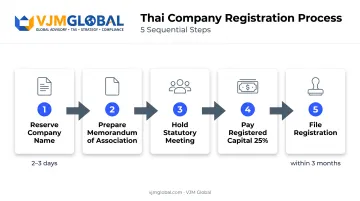
The Registration Sequence
- Reserve your company name: Takes 2-3 working days; the reservation is valid for 30 days with no extension.
- Prepare the Memorandum of Association: File this once your name is approved.
- Hold the statutory meeting: Adopt company regulations, confirm shareholding, and appoint directors and the auditor.
- Pay in at least 25% of registered capital: All shares must be subscribed.
- File for company registration: Directors must file within 3 months of the statutory meeting.
Work Permits and the 4:1 Ratio
Once incorporated, you'll need a work permit before you actually start working. Thai regulations generally require:
- 4 Thai employees per work permit
- 2 million baht in registered capital per work permit
The application itself usually takes 3-7 days, but plan to finish the full process within 90 days or before your Non-Immigrant B visa expires.
Tax Registration Deadlines
- Register for a tax ID within 60 days of incorporation.
- Register for VAT within 30 days once taxable turnover crosses 1.8 million baht.
Thai-Language Filings
Most government forms — from the MOA to work permit applications — are in Thai. UK founders new to Thai bureaucracy often lose weeks, not days, to translation errors and resubmissions. Budget for a qualified Thai translator or local filing support before you start the sequence.
How Much Does It Cost to Start a Business in Thailand?
Plan for two separate outlays: registered capital injected into the company, and government fees for registration, licences and permits. All figures below are in Thai baht.
Registered capital requirements vary by structure and activity:
- Ordinary Thai company (unrestricted activity): no general statutory minimum
- Foreign company outside Foreign Business Act (FBA) restricted lists: 2 million baht
- Foreign company in an FBA-restricted activity: at least 25% of estimated annual operating expenses over 3 years, minimum 3 million baht
- Per work permit for foreign staff: 2 million baht in registered capital (separate from the permit fee)
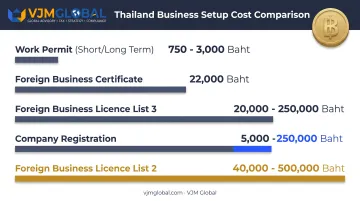
Set-up cost ranges (per Thailand's Board of Investment):
| Item | Cost |
|---|---|
| Company registration | 5,000-250,000 baht |
| Work permit (up to 3 months) | 750 baht |
| Work permit (6-12 months) | 3,000 baht |
| Foreign Business Licence (FBL) — List 2 | 40,000-500,000 baht |
| Foreign Business Licence (FBL) — List 3 | 20,000-250,000 baht |
| Foreign Business Certificate | 22,000 baht |
VAT registration becomes mandatory once your annual turnover exceeds 1.8 million baht. Factor this into your pricing and invoicing setup early.
Common Challenges UK Entrepreneurs Face in Thailand
UK founders tend to hit the same friction points:
- Ownership restrictions: List 2 or List 3 activities mean a Thai majority partner or a BOI/FBL application that can take months
- Thai-language bureaucracy: Government forms, statutory filings, and bank documents are typically Thai only; translation mistakes cause real delays
- Visa and work permit sequencing: Signing contracts or starting operations before a Non-B visa and work permit are in place can jeopardise the whole application
Those issues are why generic cross-border advice falls short. VJM Global delivers entity formation and compliance across 16+ markets, applying each jurisdiction's own regulators and statutory rules.
For UK founders handling tax, entity structuring, or payroll alongside a Thailand plan, that market-specific approach matters. If Thailand is one piece of a wider expansion, talk through the overall structure with a firm that works across borders, even where local Thai registration sits outside a given provider's footprint.
Frequently Asked Questions
How much does it cost to start a business in Thailand?
Registered capital starts from 2 million baht for a foreign-owned company outside restricted activities, rising to 3 million baht for restricted sectors. Set-up fees typically range from 5,000-500,000 baht depending on structure and licences needed.
Can a foreigner start a business in Thailand and own 100% of it?
Yes, but only through BOI promotion, a Foreign Business Licence, or by operating in a non-restricted sector. UK nationals cannot use the Treaty of Amity — that route is exclusive to US citizens.
Which businesses are most profitable in Thailand?
Tourism-adjacent services, export-led manufacturing, and BOI-promoted tech ventures often perform best for foreign owners. Strong local demand, ownership incentives, and tax breaks are the usual drivers.
Can a foreigner live permanently in Thailand?
Not through business ownership alone. Long-term residence runs through separate visa routes like the 10-year LTR visa or a retirement visa for those aged 50+, neither of which grant ownership rights on their own.
How long does it take to register a company in Thailand?
Name reservation takes 2-3 working days. A standard private limited company often completes in about 1-2 weeks once documents are ready. BOI applications take 40-90 working days; FBLs often run to around 3 months.
Do I need a Thai partner to start a business in Thailand?
Only if your activity falls under the FBA's restricted lists and you haven't secured BOI promotion or an FBL. Outside those restrictions, or with either approval in hand, full foreign ownership is possible without a Thai partner.