Introduction
Many Singapore-based investors expanding into the Middle East, Africa, or the broader MENA region struggle to find the right corporate structure — one that anchors regional operations while reducing tax exposure and staying operationally flexible.
Since the UAE's 2021 Companies Law opened mainland entities to 100% foreign ownership, the Dubai Mainland holding company has become a go-to structure for Singapore investors. It's a legal parent entity registered with the Department of Economic Development (DED) that owns subsidiaries, assets, and shares without engaging in direct trading activity.
Despite broad coverage of Dubai holding structures generally, the specific regulatory, tax, and operational considerations for Singapore-based investors are rarely addressed in one place. Questions around foreign ownership eligibility, the Singapore-UAE Double Taxation Avoidance Agreement (DTAA), the mainland-versus-free-zone decision, and ongoing compliance obligations remain scattered across multiple sources.
This guide consolidates that information into a practical roadmap for Singapore investors evaluating or executing a Dubai Mainland holding company setup.
Key Takeaways
- Post-2021 reforms allow 100% foreign ownership for most mainland activities, including Singapore investors
- Mainland structures suit investors needing direct UAE market access or managing subsidiaries across MENA
- The Singapore-UAE DTAA provides 0% withholding tax on dividends and interest, enhancing repatriation efficiency
- Setup costs typically range AED 25,000–40,000+ before office rental
- Ongoing compliance includes annual renewal, mandatory audit, 9% corporate tax filing above AED 375,000, and Economic Substance Regulations (ESR) reporting
What Is a Dubai Mainland Holding Company?
A Dubai Mainland holding company is typically structured as a Limited Liability Company (LLC) or other legal entity registered with the DED. Its core function is to own shares in subsidiary companies, hold assets such as real estate or intellectual property, and manage corporate structures at the governance level — rather than manufacturing goods or delivering services directly to customers.
The holding company appoints management, sets strategic policy, and exercises control over subsidiaries, while each subsidiary handles day-to-day commercial operations independently. This separation supports centralized governance, efficient capital allocation, and cleaner tax treatment across a group structure.
Compared to free zone and offshore alternatives, mainland registration offers distinct operational advantages:
- Trade directly with the UAE local market without intermediary arrangements
- Bid on government contracts in the company's own name
- Own UAE real estate directly within the holding structure
- Engage subsidiaries that need genuine domestic market access, not just internationally focused activity
Free zone entities cannot access these markets without establishing a separate local distribution arrangement — making mainland the preferred structure when UAE domestic engagement is part of the investment strategy.
Why Singapore Investors Choose Dubai Mainland for Holding Structures
The Singapore-UAE Strategic Corridor
Singapore-UAE bilateral trade reached S$27.94 billion in goods (2025) and S$12.8 billion in services (2023, 22% year-on-year growth), according to Enterprise Singapore. With over 600 Singapore firms operating in the UAE and cumulative Singapore investment growing 13% to S$4.9 billion, Dubai serves as a natural bridge for Singapore businesses expanding into the GCC, Africa, and South Asia.
100% Foreign Ownership Advantage
Singapore nationals qualify as foreign investors under UAE law. Federal Decree-Law No. 26 of 2020 (effective early 2021) opened the majority of mainland business activities — including holding structures — to 100% foreign ownership, eliminating the previous 51% local sponsor requirement.
Restricted activities still requiring Emirati partnership:
- Security, defense, and military activities
- Telecommunications
- Banking, insurance, and currency production
- Commercial agencies
- Hajj and Umrah organizing
- Fishing and marine activities
- Activities of "strategic impact" (Cabinet-determined)
Before committing to a structure, verify your intended business activity against the DED's current eligibility list to avoid inadvertently triggering a partnership requirement.
Singapore-UAE Double Taxation Avoidance Agreement
The Singapore-UAE DTAA provides exceptional tax efficiency for cross-border capital flows. Under the treaty (as amended by the 2014 Second Protocol, effective 1 January 2017):
| Income Type | Withholding Tax Rate |
|---|---|
| Dividends | 0% |
| Interest | 0% |
| Royalties | 5% |
| Capital gains on shares | Generally not taxable |
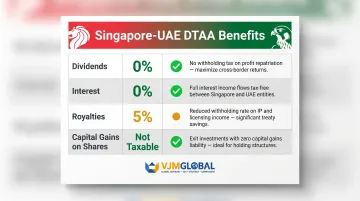
Source: IRAS treaty text
This allows Singapore investors to repatriate profits from a Dubai holding company to Singapore without withholding tax erosion — a critical advantage over many other jurisdictions.
UAE Participation Exemption for Corporate Tax
The UAE's 9% corporate tax regime (effective June 2023) includes a Participation Exemption that improves the holding company structure's tax efficiency. Dividends received by a UAE holding company from qualifying subsidiaries are exempt from UAE corporate tax when:
- The holding company owns at least 5% of the subsidiary
- The shareholding is held for at least 12 months
- The subsidiary is subject to corporate tax at a statutory rate of at least 9% in its country of residence
This exemption makes the Dubai mainland holding structure highly efficient for Singapore investors managing portfolios of regional subsidiaries, particularly in higher-tax jurisdictions across India, East Africa, or the broader Gulf region.
Access to 137 Double Taxation Treaties
The UAE has concluded 137 double taxation agreements with key trade partners globally. That treaty depth matters practically: a holding company in Dubai can access reduced withholding rates on dividends from Indian, African, or MENA subsidiaries that Singapore-direct ownership cannot unlock. For investors running multi-country portfolios, the difference shows up directly in repatriated returns.
Dubai Mainland vs. Free Zone: What Singapore Investors Need to Know Before Deciding
Practical Differences for Singapore Investors
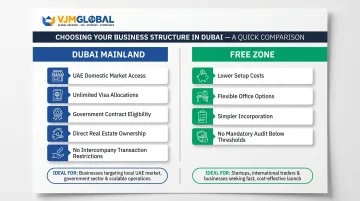
Mainland gives you:
- Direct access to the UAE domestic market without restrictions
- Unlimited employee visa allocations (not tied to office package tiers)
- Eligibility for government contracts and tenders
- Ability to own UAE real estate in the company's name
- No restrictions on intercompany transactions with other UAE entities
Free zone gives you:
- Lower initial setup costs
- No mandatory physical office requirement in some zones
- Simpler incorporation process
- Often no mandatory audit below certain revenue thresholds
Cost and Compliance Differences
Mainland costs and requirements:
- Physical office lease registered with Ejari (mandatory)
- Minimum capital requirement of AED 300,000 for LLC structures
- Mandatory annual external audit under UAE Commercial Companies Law
- Higher licensing fees
Free zone costs and requirements:
- Lower entry costs (often 30–40% less than mainland)
- Flexible office options (flexi-desk, virtual office)
- No mandatory audit below certain thresholds (varies by free zone)
These differences in cost and compliance obligations are what typically drive the final decision for Singapore investors — which brings us to the scenarios where mainland wins outright.
When Mainland Is the Right Choice
Choose a Dubai Mainland holding company structure when:
- Your subsidiaries will operate in the UAE domestic market
- You plan to own UAE real estate directly
- Government contract eligibility is strategically important
- Your expansion strategy requires full operational flexibility across the UAE
If your subsidiaries operate purely internationally without needing UAE domestic market access, a free zone structure may offer comparable benefits at lower cost and complexity.
How to Set Up a Holding Company in Dubai Mainland: Step-by-Step Process
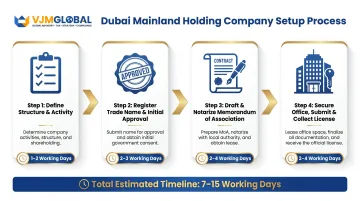
The Dubai Department of Economic Development (DED) manages the mainland company formation process. Typical timelines range from 7–15 working days when documentation is complete and in order. Singapore investors can engage a registered business setup advisor to manage parallel submissions and reduce turnaround. The Dubai Department of Economic Development (DED) manages the mainland company formation process. Typical timelines range from 7–15 working days when documentation is complete and in order. Singapore investors can engage a registered business setup advisor to manage parallel submissions and reduce turnaround. Here's how the process typically unfolds:
Step 1: Define Structure and Choose Business Activity
Determine your holding company's legal form — typically an LLC for small-to-mid-size structures. Select the appropriate business activity code from the DED activity list (investment holding, IP holding, property management, etc.) and confirm that your chosen activity qualifies for 100% foreign ownership.
Activity classification determines licensing fees, capital requirements, and ongoing compliance obligations. Getting this right from the start prevents costly restructuring later.
Step 2: Register Trade Name and Obtain Initial Approval
Submit your proposed trade name to the DED. Names must comply with UAE naming conventions:
- No offensive or religious content
- Must include legal form abbreviation (e.g., "LLC" or "L.L.C")
- Cannot conflict with existing registered names
- Cannot imply government affiliation without authorization
Initial approval signals that the government has no objection to your business formation but does not authorize operations. This stage typically takes 1-2 working days.
Step 3: Draft and Notarize the Memorandum of Association
The Memorandum of Association (MoA) is your company's core governing document. It defines:
- Company objectives and permissible activities
- Shareholder structure and ownership percentages
- Capital contributions and distribution rights
- Scope of authority over subsidiaries
- Management appointment procedures
Draft the MoA in both Arabic and English, then notarize it before submitting to the DED. Any future changes to ownership structure or business activities require MoA amendments and re-notarization. VJM Global's business setup team can assist Singapore investors in drafting MoAs that align with both UAE regulatory requirements and the investor's broader corporate governance framework.
Step 4: Secure Office Space, Submit Documents, and Collect License
A physical office lease registered through the Ejari system is mandatory for all mainland holding companies. The Ejari registration — managed by Dubai Land Department — validates your tenancy contract and is a prerequisite for license issuance.
Once you have secured and registered your office, submit:
- Completed MoA (Arabic and English, notarized)
- Shareholder KYC documents (passports, proof of address)
- Initial approval certificate
- Office lease agreement with Ejari registration
- Corporate documents if a Singapore entity is a shareholder
After DED review and approval (typically 3-5 working days), your trade license is issued. You can then open a corporate bank account and begin acquiring subsidiaries or assets under the holding entity.
Documents, Costs, and Ongoing Compliance for Singapore Investors
Required Documents from Singapore Investors
Standard documentation includes:
- Valid passport copies of all shareholders and directors
- Proof of Singapore residential address (utility bill, bank statement)
- Singapore business registration certificate (if a Singapore company is a shareholder)
- MoA/Articles of Association of the parent entity
- No Objection Certificate or board resolution authorizing the investment
- Passport-size photographs
Check the current DED document checklist before submission, as requirements are updated periodically — requirements for the second item below may also vary by activity.
Setup Costs
Approximate costs for a Dubai Mainland holding company (AED):
| Component | Range |
|---|---|
| Trade name approval | 600–2,000 |
| Initial approval | 120–1,500 |
| MoA drafting and notarization | 1,500–4,000 |
| Activity and licensing fees | 10,000–25,000 |
| Total (before office) | 25,000–40,000+ |
Physical office rental costs vary widely based on location and size, typically ranging from AED 15,000 to AED 60,000+ annually for minimal commercial space in accessible business districts.
Minimum Capital Requirements
| Entity Type | Minimum Paid-Up Capital |
|---|---|
| Mainland LLC | AED 300,000 |
| Public Joint Stock Company (PJSC) | AED 10,000,000 |
Both thresholds are subject to change by activity classification — confirm with DED before incorporating.
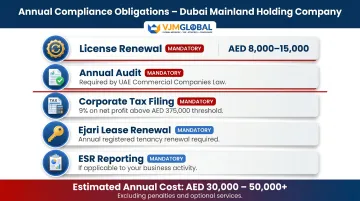
Ongoing Annual Compliance Obligations
Annual costs and requirements:
- License renewal: AED 8,000–15,000
- Annual audit: Required under UAE Commercial Companies Law for all entities, regardless of revenue level
- Corporate tax filing: Register with the Federal Tax Authority; 9% corporate tax applies to taxable income above AED 375,000
- Ejari lease renewal: Re-register the office lease annually through the Ejari portal to maintain compliance
- ESR reporting: File annual Economic Substance Regulations notifications if your holding activities qualify as a Relevant Activity under UAE ESR rules
Total annual maintenance costs typically range from AED 30,000–50,000+, depending on office size, visa allocations, and audit complexity. VJM Global provides ongoing accounting, tax compliance, and corporate governance support for foreign-owned mainland entities.
Corporate Banking for Singapore Investors
To open a UAE corporate bank account, you'll need to appear in person or submit a notarized power of attorney. Account opening takes at least two months — timelines stretch based on shareholder profiles and the complexity of your business activity.
UAE banks with Singapore presence:
- Emirates NBD: Maintains a Singapore branch offering corporate banking, trade finance, and treasury services
- First Abu Dhabi Bank (FAB): Operates a foreign company branch in Singapore with corporate and investment banking services
These existing relationships can simplify fund transfers and correspondent banking between Singapore and the UAE. When applying, banks typically require your trade license, MoA/AOA, shareholder and director passports, proof of address, and a brief description of business activities.
Common Pitfalls and Misconceptions for Singapore Investors
Mainland and Free Zone Structures Are Not Interchangeable
A free zone holding company cannot directly conduct business with UAE mainland entities without establishing an additional local distribution arrangement.
If your subsidiaries are mainland-registered or need to access the UAE domestic market, defaulting to a free zone structure (often to save on entry costs) creates operational complications and additional licensing expenses.
The Local Sponsor Requirement No Longer Applies to Most Activities
Many Singapore investors believe a local UAE partner is required for all mainland companies. Post-2021 reforms eliminated this requirement for most business activities, but restricted and regulated activities (financial services, media, certain healthcare sectors) still require an Emirati partner. Choosing the wrong activity classification may trigger this requirement, so verify your specific activity eligibility with the DED before proceeding.
UAE Corporate Tax Applies — Filing Is Mandatory
A common assumption is that Singapore's favorable 17% corporate tax rate somehow extends to a Dubai entity, or that profits flow freely without UAE reporting obligations. That's not the case. The UAE's 9% corporate tax applies to mainland holding companies with taxable income exceeding AED 375,000.
Compliance obligations apply regardless of whether any tax is actually owed:
- Register with the Federal Tax Authority
- File annual corporate tax returns
- Maintain transfer pricing documentation for related-party transactions
Failing to register or file can result in penalties even when no tax liability exists.
Frequently Asked Questions
Can a Singapore citizen own 100% of a Dubai Mainland holding company?
Singapore nationals qualify as foreign investors under UAE law and can own 100% of a mainland holding company for most business activities under the 2021 Commercial Companies Law reforms. Certain restricted activities — financial services, telecommunications, and insurance — still require an Emirati partner. Confirm your activity's eligibility with the DED before proceeding.
What is the difference between setting up a holding company in Dubai Mainland vs. a free zone for Singapore investors?
Mainland holding companies allow direct access to the UAE local market, ownership of UAE real estate, and government contract eligibility. Free zone entities offer lower setup costs and no mandatory physical office but cannot trade directly with mainland entities without a separate local distribution arrangement.
Does the Singapore-UAE double taxation agreement benefit investors holding a Dubai Mainland company?
The Singapore-UAE DTAA provides 0% withholding tax on dividends and interest and 5% on royalties, reducing the tax drag on cross-border income flows. Consult a tax advisor to confirm which income types are covered and how the treaty applies to your specific structure.
What documents does a Singapore investor need to set up a holding company in Dubai Mainland?
You'll typically need a valid passport, proof of address, Singapore business registration certificate (if applicable), MoA of any parent entity, and a board resolution or No Objection Certificate. The DED may request additional documents depending on your activity and structure.
What are the ongoing annual compliance costs for a Dubai Mainland holding company?
Annual costs cover license renewal, mandatory audit, corporate tax filing, and office lease renewal. Total annual maintenance costs typically range from AED 30,000–50,000+, depending on office size, visa allocations, and audit complexity.
Can a Dubai Mainland holding company own shares in a Singapore-registered company?
A Dubai Mainland holding company can legally hold shares in foreign entities, including Singapore-registered companies — making it a viable structure for investors who want the Dubai entity to become the parent of an existing Singapore business. Review Singapore ACRA requirements and tax implications with a qualified advisor before proceeding.
Ready to explore a Dubai Mainland holding structure for your Singapore-based expansion? VJM Global's cross-border tax and business setup team can assess your existing entities, map the optimal holding structure, and guide you through mainland registration. Contact us at [email protected] or call +91 98915 76441 to schedule a consultation.