Introduction
Many Singaporean entrepreneurs struggle with navigating Dubai's complex company formation landscape—from choosing the right jurisdiction to understanding ownership rules and managing the setup process remotely. Federal Decree-Law No. 26 of 2020 transformed the UAE's business landscape by removing the historic 51% Emirati ownership requirement for most mainland activities. Yet confusion persists around free zone restrictions, corporate tax obligations, and Economic Substance Regulations.
Those complexities aside, the commercial case is strong: zero personal income tax, a 0–9% corporate tax rate with qualifying free zone exemptions, and direct access to the 2 billion+ MENA and Africa consumer market. Singapore-UAE bilateral merchandise trade reached SGD 27.94 billion in 2025, reflecting the depth of cross-border investment between the two economies.
The Singapore-UAE Double Taxation Agreement eliminates double taxation risk, and Singaporeans enjoy visa-free entry for up to 90 days, making exploratory trips and client meetings straightforward to arrange.
This guide walks through the exact decisions, step-by-step process, cost breakdowns, and common mistakes involved in setting up a business in Dubai from Singapore, with decision frameworks and cost data to help you avoid costly restructuring later.
Key Takeaways
- Singapore entrepreneurs can complete Dubai free zone registration entirely remotely without requiring a local UAE partner or sponsor
- Three structure options exist: Mainland (unrestricted UAE trade), Free Zone (0% tax, trade restrictions), or Offshore (holding structures only)
- Total setup costs range from AED 12,000–30,000+ depending on structure and office type
- Full registration takes 2–4 weeks in free zones; bank account opening adds 4–12 weeks
- The Singapore-UAE tax treaty (DTAA) caps royalties at 5% and dividends/interest at 0% — keeping profit repatriation tax-efficient
Why Singapore Entrepreneurs Are Choosing Dubai for Business Expansion
Dubai offers a compelling tax advantage over Singapore: UAE corporate tax is 9% above AED 375,000 versus Singapore's 17% headline rate. Qualifying Free Zone Persons pay 0% on qualifying income, creating significant tax savings for eligible activities. The UAE levies zero withholding tax on all outbound payments—dividends, interest, and royalties—making profit repatriation to Singapore highly tax-efficient.
Dubai recorded 1,826 FDI projects in 2024, representing an 11% increase from 2023, with estimated capital of AED 52.3 billion (USD 14.24 billion). The emirate ranked #1 globally for greenfield FDI for the fourth consecutive year — meaning new foreign entrants are arriving faster here than anywhere else on earth. For Singapore entrepreneurs, that momentum translates into ready infrastructure, established professional networks, and a government actively competing for your business.
Singapore-specific advantages:
- Visa-free entry: Singapore passport holders can stay up to 90 days within any 180-day period — no entry visa needed for setup trips or client meetings
- DTAA protection: The Singapore-UAE tax treaty prevents double taxation, capping royalties at 5% and dividends/interest at 0%
- Regional gateway: Dubai puts roughly 2 billion consumers across MENA and Africa within reach, with one-third of the global population inside a four-hour flight
- Established trade corridor: Bilateral merchandise trade grew from SGD 24.05 billion to SGD 27.94 billion in 2025, demonstrating deepening commercial ties
Mainland, Free Zone, or Offshore: Choosing the Right Structure
Mainland: Full UAE Market Access
Registered under the Department of Economic Development (DED), mainland entities allow direct trade anywhere in the UAE without distributor restrictions. Federal Decree-Law No. 26 of 2020 now permits 100% foreign ownership for over 1,000 activities in Dubai, eliminating the historic local sponsor requirement.
Key requirements:
- Minimum 200 sq ft physical office (approximately 18-20 sq meters)
- Subject to 9% UAE corporate tax on profits exceeding AED 375,000
- Best for businesses targeting the UAE domestic market directly
Trade-off: Higher setup costs and mandatory physical office space versus free zones, but unrestricted local market access.
Free Zone: Tax Optimization with Trade Restrictions
The UAE offers over 40 free zones, each industry-specific. Popular options for Singaporeans include DMCC (commodities, trading, tech), IFZA (general-purpose, flexible activities), and DIFC (financial services).
Key benefits:
- 100% foreign ownership with no local sponsor requirement
- Potential 0% corporate tax for Qualifying Free Zone Persons on qualifying income
- 100% repatriation of capital and profits
- Lower entry costs and flexible office arrangements (flexi-desks from AED 12,900 annually)
Critical limitation: Free zone companies cannot sell directly to UAE mainland customers without a licensed mainland distributor or establishing a mainland branch. Free zone goods moving to the mainland become subject to UAE customs duty.
This is the most popular route for Singaporean entrepreneurs focused on regional export or service delivery outside the UAE.
Offshore: Holding Structures Only
Registered in jurisdictions like RAK ICC, offshore companies provide 100% foreign ownership and confidentiality protections but cannot conduct business inside the UAE. They have no physical office requirement and are suited for:
- International holding structures
- Asset protection vehicles
- Regional IP holding entities
Banking limitation: Offshore entities face significant restrictions opening local UAE bank accounts.
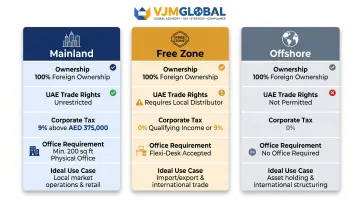
Structure Comparison
| Factor | Mainland | Free Zone | Offshore |
|---|---|---|---|
| Ownership | 100% foreign (most activities) | 100% foreign | 100% foreign |
| UAE Trade Rights | Unrestricted mainland access | Requires distributor/branch | No UAE business permitted |
| Corporate Tax | 9% above AED 375,000 | 0% (qualifying) or 9% | 0% (no UAE income) |
| Office Requirement | Minimum 200 sq ft physical | Flexi-desk accepted | None |
| Ideal Use Case | Direct UAE market sales | Regional HQ, export, services | Holding, asset protection |
Singapore-Dubai Dual Structure Strategy
Some Singaporean businesses maintain their Singapore entity for APAC operations while registering a UAE free zone entity for MENA. This dual structure works well when:
- Accessing different investor bases or banking relationships
- Leveraging the Singapore-UAE DTAA for cross-border service fees or royalties
- Segregating regional operational risks
- Meeting client preferences for local billing entities
Navigating the tax implications of dual-entity structures — particularly DTAA positioning, transfer pricing, and compliance across both jurisdictions — requires specialist advice. VJM Global's cross-border tax and business setup advisory team works with businesses structuring operations across the UAE, Singapore, and India to ensure each entity is correctly positioned from day one.
Step-by-Step: How to Set Up a Business in Dubai from Singapore
Most free zones allow the entire setup process to be completed remotely or with a single UAE visit — making Dubai genuinely accessible for Singaporean founders. The seven steps below walk through the full process, from activity selection to banking.
Step 1: Identify Your Business Activity and License Type
The UAE offers over 2,000 approved business activities, with Dubai's DED listing over 3,000 activities. Your chosen activity determines the license type:
- Commercial License – for trading businesses
- Industrial License – for manufacturing/production
- Professional License – for services and consultancies
Many free zones are industry-specific — DMCC for commodities and precious metals, DIFC for financial services, IFZA and SHAMS for general trade and consultancy. Locking in your activity first narrows down the right jurisdiction quickly.
Step 2: Choose Your Jurisdiction — Free Zone or Mainland
Shortlist the right free zone based on:
Industry alignment:
- Commodities/trading → DMCC
- Financial services → DIFC
- General trade/consultancy → IFZA, SHAMS
Cost structure:
- IFZA packages start from AED 12,900 (zero visa quota)
- DMCC packages start from AED 31,000 (flexi-desk)
- Mainland setups typically start at AED 18,500
Visa quota needs:
- Flexi-desks typically allow 1–3 visas
- Physical offices support more visa allocations
- Calculate your team size before committing
Remote setup capability:
- Most free zones allow full remote registration for Singaporean applicants
- Check if the zone has Singapore representative offices or partner networks
Step 3: Register Your Trade Name
UAE naming conventions require:
- Unique name not already registered
- Avoid religious, political, or offensive references
- Align with legal structure (LLC, FZCO, etc.)
- Singaporean business owners naming the entity after a person must provide proof of ownership
Submit your proposed name to the DED (mainland) or free zone authority for approval. Name reservation typically costs AED 1,000 and remains valid for 30–60 days depending on the authority.
Step 4: Submit Documents and Obtain Initial Approval
Standard documents required from Singaporean applicants:
- Valid passport copy
- Proof of Singapore residential address
- Passport-size photographs (recent)
- Completed application forms
- Business plan or activity description (some free zones)
For existing Singapore companies expanding to Dubai:
- Certificate of Incorporation from ACRA
- Board resolution authorizing UAE entity formation
- Shareholders' agreement (if applicable)
Initial Approval confirms the UAE government has no objection to the business being established and allows you to proceed with office lease and visa applications—but does not yet grant the right to operate commercially.
Step 5: Secure Your Office Space
All Dubai businesses require a registered physical address. Free zone options include:
| Office Type | Annual Cost (AED) | Typical Visa Quota |
|---|---|---|
| Flexi-desk | 12,900 – 19,000 | 1–3 visas |
| Serviced office | 35,000 – 140,000 | 3+ visas (varies by size) |
| Dedicated office | 140,000+ | Unlimited (varies by free zone) |
Singaporean founders setting up remotely typically opt for flexi-desk or shared office arrangements to minimize initial costs. The office type determines visa quota—critical for team planning.
Step 6: Pay Licensing Fees and Receive Your Trade License
Submit the following for final approval:
- Initial approval receipt
- Signed lease agreement
- Memorandum of Association (if required by jurisdiction)
- Sector-specific regulatory approvals:
- CBUAE (Central Bank of UAE) for financial services
- TDRA (Telecommunications and Digital Government Regulatory Authority) for telecom activities
After fee payment, the trade license is issued—the primary document authorizing business operations. Free zone registration typically takes 1–2 weeks; mainland registration may take 4–8 weeks depending on activity and approvals.
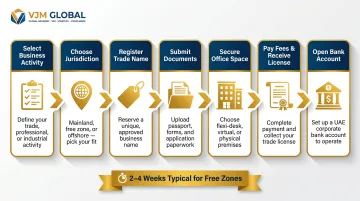
Step 7: Open a Corporate Bank Account
Opening a UAE corporate bank account is often the most time-consuming step for non-residents, including Singaporeans, due to enhanced due diligence requirements.
Traditional banks:
- Emirates NBD, Mashreq, HSBC Middle East
- Typical timeline: 2–4 weeks (often longer in practice)
- Require extensive KYC documentation, business plans, and source of funds verification
Digital/neo-banks:
- Wio Bank offers corporate account opening in approximately 3 working days for UAE-licensed companies (mainland or free zone)
- Accepts DMCC, DDA, DIFC, and Meydan free zone licenses
- Fully digital onboarding with approval in 24–72 hours
- Requires valid UAE trade license and Emirates ID
Documentation typically required:
- Trade license and initial approval
- Memorandum and Articles of Association
- Passport copies of shareholders and directors
- Proof of residential address
- Business plan and financial projections
- Reference letters from existing banks
Build banking setup into your launch timeline from day one. Singaporean entrepreneurs who treat it as an afterthought often face 4–8 week delays before they can receive or make payments.
How Much Does It Cost? Dubai Business Setup Costs for Singaporean Entrepreneurs
Cost Breakdown by Structure
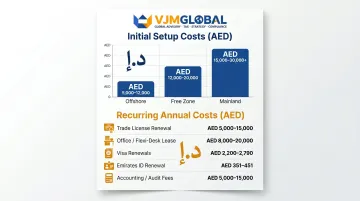
| Structure | Cost Range (AED) | What's Included |
|---|---|---|
| Offshore | 5,000 – 12,000 | Registration, initial approvals |
| Free Zone | 12,000 – 20,000 | License, registration, flexi-desk (1 year) |
| Mainland | 15,000 – 30,000+ | License, registration, name reservation |
Excludes: Office rent (if upgrading from flexi-desk), visa fees (~AED 3,000–5,000 per visa), and professional service fees.
DMCC Free Zone — Official Pricing
DMCC's official fee schedule shows:
- Company registration: From AED 9,000 (one-time)
- Standard license: AED 20,285 (annual)
- General trading license: AED 50,265 (annual)
- Flexi-desk: AED 16,000–19,000 (annual)
- Employment visa (2-year): AED 2,972–4,220 per visa
Setup packages range from AED 31,000 (Crypto/Gaming/AI Centre) to AED 43,780 (Jump Start with flexi-desk).
IFZA Free Zone — Published Pricing
- Zero visa quota: AED 12,900
- 1 visa quota: AED 14,900
- 2 visa quota: AED 16,900
- 3 visa quota: AED 18,900
For Singaporean consultants, traders, and service businesses with lean headcount, IFZA's tiered pricing makes it one of the lowest-cost licensed structures available in the UAE.
Recurring Annual Costs
Budget for these recurring costs beyond the initial setup year:
- Trade license renewal fees (typically same as initial license cost)
- Office/flexi-desk lease renewal (annual)
- Visa renewals (AED 2,200 for 1-year, AED 2,790 for 2-year per DMCC)
- Emirates ID renewal (AED 351–451 per person)
- Accounting and audit fees (AED 5,000–15,000 annually depending on complexity)
Most free zone packages bundle first-year costs at a reduced rate — renewals in year two are typically billed at full market rates.
Singapore-UAE DTAA Tax Impact
The Singapore-UAE DTAA caps withholding tax on royalties at 5% and dividends/interest at 0%. The UAE currently levies 0% withholding tax domestically on all outbound payments, so profit repatriation to Singapore is tax-free regardless of treaty protections.
Beyond the rates themselves, the DTAA provides legal certainty against future treaty shopping challenges — specifically the Principal Purpose Test (PPT) introduced via the Multilateral Instrument (MLI). That protection matters if your structure is ever scrutinized by either tax authority.
Common Mistakes Singaporean Business Owners Make When Setting Up in Dubai
Choosing the Wrong Structure for the Intended Business Model
Many Singaporeans default to a free zone entity without realizing that selling directly to UAE-based clients requires either a mainland license or a local distributor arrangement. This leads to expensive restructuring later when they discover they cannot invoice UAE customers directly.
Solution: Map out your target customer base before incorporation. If 30%+ of revenue will come from UAE mainland clients, consider mainland registration or budget for a distributor relationship.
Underestimating Banking Timelines
UAE bank account opening for non-residents can take 4–12 weeks and requires substantial KYC documentation. Singaporean entrepreneurs who launch operations before securing a bank account face real delays—inability to receive payments, pay suppliers, or process payroll.
Solution: Initiate bank account applications immediately after obtaining initial approval. Consider digital banks like Wio for faster onboarding (3 working days) while maintaining traditional bank applications as backup.
Treating the Dubai Entity as a "Mailbox" Company
Beyond operational readiness, there's a regulatory risk that catches many first-time Dubai entrants off guard.
The UAE's Economic Substance Regulations (ESR) require certain businesses to demonstrate genuine economic activity in the UAE. This means being directed and managed locally, with core income-generating activities performed on the ground, adequate full-time employees physically present, and real operating expenditure incurred.
ESR applies to nine defined activities, including:
- Holding company business
- Intellectual property business
- Headquarters business
- Distribution and service centre business
Non-compliance carries escalating penalties: AED 50,000 for the first year, rising to AED 400,000 plus potential license suspension for consecutive failures.
Singaporean owners who set up in Dubai purely for tax reasons without genuine operations need to assess their ESR exposure carefully. If your activity triggers ESR, you'll need to demonstrate real substance — including regular board meetings held in the UAE, local employees performing core functions, and operating expenditure incurred in-country.

Frequently Asked Questions
How much does it cost to register a company in Dubai?
Offshore setups range from AED 5,000–12,000, free zone registrations from AED 12,000–20,000, and mainland licenses from AED 15,000–30,000+. These figures cover license fees and registration but exclude office rent, visa costs (approximately AED 3,000–5,000 per visa), and annual renewal fees.
Can a foreigner open a company in the UAE?
Yes. Singaporeans can own 100% of a UAE free zone or offshore company without a local sponsor. Under Federal Decree-Law No. 26 of 2020, full foreign ownership is now permitted for most mainland activities — Dubai alone covers over 1,000 eligible business activities.
How do I register a company in the UAE?
Choose a structure and jurisdiction, register a trade name with the relevant authority, obtain initial approval, submit required documents (passport, address proof, business plan), secure office space, pay licensing fees, and open a corporate bank account. The process can be completed remotely for most free zones.
Do I need to be physically present in Dubai to set up a company?
Most free zones allow full remote registration for Singaporean applicants. Bank account opening may require a UAE visit at traditional banks, though digital banks like Wio offer fully remote onboarding once you hold a UAE trade license.
How long does it take to set up a company in Dubai from Singapore?
Free zone company registration typically takes 2–4 weeks once all documents are submitted; mainland registration may take 4–6 weeks. Bank account opening is an additional 4–12 weeks, though digital banks like Wio can complete the process in approximately 3 working days.
What business can I start with AED 50,000 in Dubai?
AED 50,000 covers a basic free zone license with a flexi-desk and 1–2 visas, suitable for consulting, e-commerce, trading, or IT services. Budget working capital for operations — inventory, marketing, and initial payroll — separately.