On paper, UK company formation is fast. Companies House typically registers an online application within 24 hours. But speed on the incorporation certificate doesn't guarantee the structure actually works for tax and banking purposes. Outcomes depend on who's appointed director, how shares are held, and whether central management and control genuinely supports UK tax residency.
This guide walks through the exact steps, documents, tax considerations, common pitfalls, and how a UK Holdco stacks up against keeping the structure in the UAE or elsewhere.
Key Takeaways
- UK Ltd companies incorporate in 24–48 hours with no director or shareholder residency requirement
- UK–UAE tax treaty and zero UK dividend withholding tax simplify profit repatriation to a UAE parent
- Central management & control, PSC filings, and identity verification decide if HMRC treats the structure as UK-resident
- Coordinated UAE–UK compliance support cuts setup delays and tax-residency risk
How to Set Up a Holding Company in the UK from the UAE
From the UAE, the path is a fixed sequence: choose the entity and what it will hold, incorporate at Companies House, appoint officers and secure a UK registered office, complete HMRC and PSC duties, then open a UK bank account and document the ownership chain.
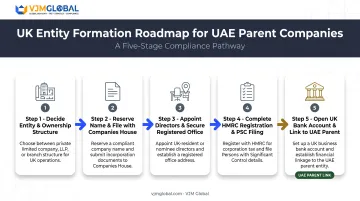
Step 1: Decide on the UK Entity Type and Ownership Structure
A Private Limited Company (Ltd) is the standard vehicle for a UK holding structure. It can be owned directly by a UAE individual or UAE entity, or through an intermediate SPV layer.
Before filing anything, decide what the UK Holdco will actually hold:
- Shares in UAE or other overseas trading subsidiaries
- UK or international real estate
- Intellectual property licensed to operating companies
- Investment portfolios or securities
This decision shapes the share structure and the Articles of Association from day one. A holding company built to eventually sell subsidiary shares tax-efficiently needs different share classes than one designed purely to collect rental income or royalties.
Step 2: Reserve a Company Name and File Incorporation Documents with Companies House
Once the structure is decided, the filing itself is fairly mechanical:
- Check name availability through the Companies House register to confirm uniqueness
- Prepare Memorandum and Articles of Association (model articles work for most simple holding structures)
- Complete the IN01 form, covering registered office, SIC code, director details, PSC information, and statement of capital
- Submit online from anywhere, including the UAE, with no need to travel
HMRC automatically issues a Corporation Tax Unique Taxpayer Reference (UTR) by post roughly 15 days after registration, sent to the company's registered address.
Step 3: Appoint Directors, Shareholders, and Secure a UK Registered Office
Neither directors nor shareholders need UK residency or citizenship. A UAE national, or a UAE-registered entity, can hold both roles without restriction.
What is mandatory: a physical UK registered office address. It doesn't need to be a working office, and there's no requirement for staff, equipment, or operational presence there.
It only needs to be an address where post reaches someone acting for the company. PO Boxes alone will not satisfy the rule.
For UAE owners, the friction is usually the registered office plus identity and KYC paperwork across two jurisdictions. VJM Global, for example, provides the UK registered office, handles company secretarial filings, and coordinates KYC between the UAE parent and the UK entity in one engagement.
Step 4: Complete HMRC Registration and Statutory Registers
Within three months of starting business activity, the company must register for Corporation Tax with HMRC. Note that a holding company earning interest or dividends can count as "active" even without trading, so don't assume incorporation alone keeps the clock from starting.
The company must also maintain statutory registers, including the Register of People with Significant Control (PSC). Anyone holding more than 25% of shares or voting rights, or with the power to appoint or remove board majority, typically qualifies as a PSC.
Since 18 November 2025, identity verification is a legal requirement for directors and PSCs. UAE-based owners can complete this remotely through GOV.UK One Login using a biometric passport, or through an Authorised Corporate Service Provider.
Step 5: Open a UK Corporate Bank Account and Link Ownership to the UAE Parent
UK banks generally request:
- Certificate of incorporation and Memorandum/Articles of Association
- Proof of identity and address for UAE-based shareholders
- Source-of-funds documentation
- Details of the ownership chain back to the UAE parent
Some providers accept remote onboarding with certified documents and video verification. Traditional high-street banks often still require a video or in-person interview, depending on the risk profile of the structure.
Once the account is open, formalize the link with share certificates and intercompany agreements between the UAE parent and the UK Holdco. That paper trail supports treaty relief claims and the substance position if HMRC asks questions later.
What You Need Before You Start: Requirements and Documents
Incomplete paperwork is the single biggest cause of delay for UAE-based owners setting up a UK entity remotely. Gathering everything upfront saves weeks later.
Core document checklist:
- Passport copies and proof of address for all UAE-based directors and shareholders
- Parent company documents (trade licence, memorandum of association) if a UAE entity will be the shareholder
- Signed UK registered office agreement
Compliance readiness to prepare in parallel:
- Ultimate beneficial owner (UBO) and persons with significant control (PSC) declarations, since Companies House will not accept a blank filing
- AML source-of-funds evidence, particularly for shareholders holding 10% or more
- Appointment of a UK company secretary or agent to manage ongoing filings and deadlines
Cross-border firms such as VJM Global typically fold UAE and UK requirements into one intake process, so you are not chasing documents on two separate tracks.
Key Tax and Structuring Factors for UAE-Based Investors
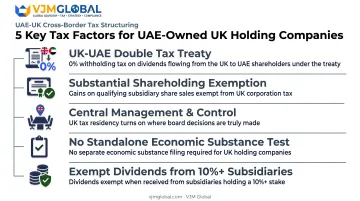
The UK-UAE Double Taxation Agreement
The treaty, in force since December 2016, is the main reason UK Holdcos appeal to UAE investors. Under the agreement, dividends generally carry 0% source-state withholding tax where the beneficial owner resides in the other state.
That 0% rate stops double taxation when profits move from UK operating subsidiaries back to the UAE parent, which improves net returns and makes group cash flow more predictable.
Interest and royalties can also qualify for 0% withholding, but only where Article 11’s beneficial-owner conditions are met. Check the payment type before assuming treaty relief applies automatically.
Substantial Shareholding Exemption
The Substantial Shareholding Exemption (SSE) can exempt gains from selling a qualifying trading subsidiary from UK corporation tax entirely.
In practice, a UK Holdco can dispose of subsidiary shares without corporation tax leakage at the holding-company level—if the stake qualifies.
Typical SSE conditions include:
- At least a 10% shareholding held continuously for 12 months
- The investee meeting HMRC’s trading company or trading group tests
- Not a passive investment portfolio (those usually fail the trading tests)
Central Management and Control
This is the test that determines UK tax residency for non-UK-incorporated companies, and it's where UAE owners most often trip up.
If board decisions are effectively made from the UAE rather than through genuine UK-based decision-making, tax authorities can challenge residency—and with it, treaty benefits.
Proper board minutes and documented UK decision-making protect the structure. A UK-incorporated company is generally UK resident by statute regardless, but weak governance still invites scrutiny.
No Standalone Economic Substance Test
Unlike several offshore and free-zone jurisdictions, the UK does not impose a standalone Economic Substance Test. That simplifies compliance compared with some Gulf and Crown Dependency structures, though CMC and governance evidence still matter in practice.
Exempt Dividends From Subsidiaries
Most dividends a UK company receives from subsidiaries where it holds 10% or more fall into exempt classes under Corporation Tax Act 2009, Part 9A. That supports group-level tax efficiency when profits are upstreamed into the Holdco.
Common Mistakes UAE-Based Investors Make When Setting Up a UK Holding Company
Four mistakes come up repeatedly:
- Treating incorporation as purely administrative. Filing the IN01 without first mapping the UAE parent–UK Holdco shareholding chain creates rework later, especially when the structure must change for SSE eligibility.
- Failing to evidence central management and control. Without board minutes showing where decisions are made, the UK residency position and treaty benefits are open to challenge.
- Overlooking inheritance tax on UK-situs shares. Those shares can fall within UK IHT if the ultimate owner later becomes UK tax resident.
- Missing PSC or director identity verification deadlines. Late filings can freeze the company at Companies House until the gap is resolved.
UK Holding Company vs Alternative Jurisdictions for UAE-Based Owners
A UK Holdco isn't automatically the right fit for every UAE investor. The best jurisdiction depends on where the underlying subsidiaries and income actually sit.
| Jurisdiction | Best fit when... | Key trade-off |
|---|---|---|
| UK Ltd Holdco | Group needs global treaty reach, established banking credibility, and no formal Economic Substance Test | Corporation tax at UK rates on taxable profits; central management and control must be genuinely demonstrated |
| UAE Free Zone (ADGM/DIFC) | Income and subsidiaries are primarily Gulf/regional, and the investor wants the 0% qualifying free zone regime | Narrower treaty network and less established global banking recognition than a UK entity |
| Singapore | Strong Asia-Pacific subsidiary base, comparable treaty network, no dividend withholding tax | Higher substance and local executive presence expectations than a UK company |
| Netherlands or Ireland | EU-facing group needing EU Parent-Subsidiary Directive benefits | More complex substance and reporting obligations; generally higher setup and compliance costs |
A UK structure earns its place when treaty breadth and banking access matter more than staying inside a formal substance-filing regime. VJM Global can run UK formation with UAE-side compliance in one engagement, so dual-jurisdiction coordination does not fall entirely on the owner.
Frequently Asked Questions
How do you set up a holding company in the UAE?
It involves choosing a Mainland or Free Zone jurisdiction, reserving a trade name, preparing the Memorandum and Articles of Association (MOA/AOA) and licence documents, and registering with the DED or relevant Free Zone authority. Most structures carry no mandatory minimum paid-up capital.
What is a UK holding company?
It's a UK-incorporated company whose primary purpose is holding shares, assets, IP, or investments in subsidiaries rather than trading directly. It benefits from zero UK withholding tax and the UK's extensive treaty network.
Do I need to be a UK resident to own or direct a UK holding company?
No. Neither directors nor shareholders need UK residency or citizenship. A UK registered office address is mandatory, but that's a physical address requirement, not a residency one.
How long does it take to set up a UK holding company from the UAE?
Companies House incorporation typically takes 24-48 hours once documents are ready. Bank account opening and KYC checks can add anywhere from one to several weeks, depending on the provider.
Does the UK charge withholding tax on dividends paid to a UAE parent company?
No. The UK doesn't levy withholding tax on dividends paid to shareholders in any country, including the UAE.
Can I open a UK business bank account without visiting the UK?
Some banks and fintech providers allow remote account opening with certified documents and video verification. Traditional banks may still require an in-person or video interview depending on the structure's risk profile.