Introduction
More UAE-based entrepreneurs and multinational groups are incorporating UK holding companies to anchor their international structures. The reasons are practical: access to global banking, credibility with investors, and a stable base for managing subsidiaries across Europe and beyond.
The UK offers clear advantages for these structures:
- No withholding tax on outbound dividends
- Broad exemption on dividend income received
- Substantial Shareholding Exemption on qualifying disposals
UAE-linked structures still face specific traps. Treaty interpretation and Controlled Foreign Companies (CFC) exposure can erode those benefits if planning is weak. So can the so-called "60% tax trap" when substance is thin.
This guide covers corporation tax treatment, treaty relief, capital gains rules, and the compliance obligations a UAE business must meet to run a UK holding company efficiently in practice.
Key Takeaways
- UK holding companies pay zero withholding tax on outbound dividends and generally receive inbound dividends tax-free
- UK-UAE Double Taxation Agreement sets treatment of dividends, interest, royalties, and capital gains between both countries
- Substantial Shareholding Exemption can make qualifying subsidiary disposals entirely free of UK corporation tax
- Genuine substance and documented transfer pricing are essential: without them, exemptions and treaty access can be challenged
- UK-resident individuals face an effective 60% marginal tax rate on income between £100,000 and £125,140
Why UAE Businesses Set Up a UK Holding Company
A UK holding company gives a UAE group something the free zone structure alone often can't: instant credibility with international banks, investors, and trading partners. Common-law contract certainty and a well-understood corporate framework make it easier to consolidate ownership of multiple trading subsidiaries under one roof.
The Dividend Advantage
The UK doesn't apply withholding tax on dividends paid to shareholders, regardless of where they're based. This means a UK holdco can distribute profits to a UAE parent entity or individual shareholder without UK tax being deducted at the point of payment.
On the receiving side, most dividends a UK holding company gets from UK or overseas subsidiaries are exempt from corporation tax under the dividend exemption regime in CTA 2009 Part 9A.
In practice, profits can often flow up through a UK holdco and back out to the UAE without triggering UK tax at either stage, provided the arrangement is genuine.
Where treaty access adds value:
- Reduces withholding leakage when subsidiaries sit in countries with a UK tax treaty
- Supports lower rates on interest and royalty flows from treaty jurisdictions
- Gives structural flexibility the UAE's own (still-growing) treaty network doesn't always match
VJM Global helps UAE groups incorporate and structure UK holding companies, including entity formation, registered office, and initial compliance, while UAE-side Economic Substance and Ultimate Beneficial Owner filings run in parallel.
Those benefits still depend on genuine commercial substance and correct group structuring from day one. HMRC has specific anti-avoidance rules aimed at arrangements built purely for tax advantage, which we'll cover shortly.
UK Corporation Tax, Dividends and Capital Gains for Holding Companies
Most holding companies have limited trading income of their own. Their tax profile is shaped almost entirely by dividends, capital gains, management fees, royalties, and intra-group interest.
Current UK corporation tax rates:
| Profit Level | Rate |
|---|---|
| Up to £50,000 | 19% (small profits rate) |
| £50,000 – £250,000 | Main rate with marginal relief |
| Above £250,000 | 25% (main rate) |
These thresholds are divided by the number of associated companies in a group, which matters for larger UAE-linked structures with several subsidiaries.
Dividend Exemption: Not Always Automatic
Dividends received by a UK holding company are generally exempt from corporation tax, but the exemption comes with conditions. Anti-avoidance provisions can disapply it where a distribution forms part of an artificial arrangement designed mainly to secure a tax advantage. A UK holdco receiving dividends from a genuine trading subsidiary rarely has a problem. One built around circular or contrived payments is a different story.
The Substantial Shareholding Exemption (SSE)
SSE is the single biggest reason groups route acquisitions and exits through a UK holdco. When it applies, a disposal of shares can be entirely free of UK corporation tax: no tax on the gain at all.
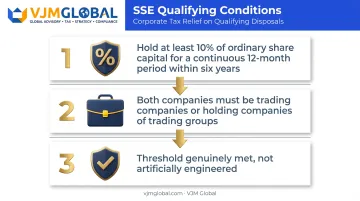
To qualify:
- The UK company must hold at least 10% of the ordinary share capital in the target for a continuous 12-month period within the six years before disposal
- Both the investing company and the investee must be trading companies, or holding companies of trading groups
- The 10% threshold must have been genuinely met, not engineered through temporary arrangements
For a UAE group planning to eventually sell a European or UK trading subsidiary, structuring the sale through a UK holdco with SSE in mind can be the difference between a clean, tax-free exit and an unexpected corporation tax bill.
Interest Deductibility and VAT
The Corporate Interest Restriction limits deductions where a group's net interest and financing costs exceed £2 million in a 12-month period. Below that, restrictions don't apply. Above it, deductions are typically capped at 30% of UK tax-EBITDA.
Intra-group loans between UK and UAE entities also need proper transfer pricing documentation to support the interest rate charged.
VAT recovery is a separate design choice. A purely passive holding company that only collects dividends generally cannot recover VAT on its costs. One that charges genuine management fees to subsidiaries can register for VAT and recover related input tax — a distinction worth building into the group structure early.
Is There a UK-UAE Tax Treaty, and How Does It Affect Holding Company Taxation?
Yes. The UK-UAE Double Taxation Convention has been in force since December 2016. It allocates taxing rights over dividends, interest, royalties, capital gains, and business profits between the two countries.
Because the UK already applies 0% domestic withholding tax on dividends, the treaty adds little extra value on that specific point. Its real relevance lies elsewhere:
- Interest and royalties: the treaty can reduce or eliminate source-state taxation depending on the conditions met
- Residency tie-breaks: resolving which country a company is actually tax resident in when there's a dispute
- Permanent establishment risk: determining where a business is genuinely being run from
Permanent Establishment: The Practical Risk
If key management and control of a UK holding company is actually exercised from the UAE (board decisions made there, directors based there, strategy set there), HMRC or UAE authorities could dispute where the company is really resident. Get this wrong, and the company risks being taxed in the "wrong" jurisdiction, or in both.
The treaty doesn't automatically resolve dual-residency disputes with a single test. Competent authorities from both countries have to agree case by case, looking at where senior management actually operates, where the board meets, and the substance behind the structure.
The Principal Purpose Test
The treaty includes a Principal Purpose Test. It can deny treaty benefits entirely if obtaining a tax advantage was one of the main purposes behind a structure.
Commercial rationale is what survives scrutiny. A UK holdco set up to genuinely manage international subsidiaries holds up; one that exists purely to strip tax out of a UAE group looks very different to HMRC.
For UAE-resident individual shareholders, the practical upside is significant when the structure is done properly. The UAE has no personal income tax and the UK applies no dividend withholding tax, so treaty-supported structuring can allow tax-efficient repatriation of profits, provided residency and substance rules are genuinely satisfied.
The "60% Tax Trap" and CFC Rules: Two Risks UAE-Linked Groups Must Watch
The UK's "60% Tax Trap" Explained
The UK personal allowance (currently £12,570) gets gradually withdrawn once adjusted net income passes £100,000, disappearing entirely by £125,140. For every £2 earned above £100,000, £1 of allowance is lost.
Combined with the 40% higher rate that applies across this band, each additional £1 earned creates £1.50 of taxable income , an effective marginal rate of 60% on that slice.
Why this matters for UAE business owners:
- A director or shareholder who becomes UK tax resident falls squarely into this trap
- Drawing a UK salary or bonus from the holding company that pushes personal income into the £100,000–£125,140 band triggers the spike
- The cost isn't on total income (just that narrow band), but it's easy to hit without realising
Planning pointers:
- Structure profit extraction through dividends rather than salary where possible
- Time income recognition to avoid landing in the band in a single tax year
- Keep personal UK income below the threshold while remaining UAE tax resident, where that's genuinely the case
Personal extraction is only half the picture. At entity level, UK CFC rules create a second exposure for the same UAE-linked groups.
Controlled Foreign Companies (CFC) Rules
CFC rules stop UK companies from parking profits in low-taxed offshore subsidiaries. If a UK holding company controls a UAE free zone company paying 0% or 9% corporate tax, those profits could potentially be attributed back to the UK parent and taxed there instead.
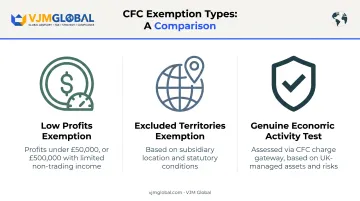
Three main exemptions can help:
- Low Profits Exemption: broadly available where profits stay under £50,000, or under £500,000 with limited non-trading income
- Excluded Territories Exemption: depends on the subsidiary's location and specific statutory conditions, not just low-tax status
- Genuine economic activity test: assessed through the CFC charge gateway, based on whether UK-based activity manages the subsidiary's assets and risks
A UAE subsidiary with real staff, physical premises, and independent decision-making is far less likely to trigger a CFC charge than a shell entity run entirely from London.
Cross-check UAE Economic Substance Regulations compliance alongside these UK exemption tests. Both regimes reward the same thing: genuine operational presence over paper structures.
Compliance, Substance and Common Structuring Mistakes
HMRC expects demonstrable substance behind a UK holding company. That means UK-based directors actively involved in real decisions, board meetings genuinely held in the UK (not just on paper), and proper minute-keeping. Without this, residency status, treaty access, and key exemptions can all be challenged.
Those gaps show up quickly in practice. Common errors seen in UAE-to-UK holding structures:
- Assuming all income flowing through the holdco is automatically tax-free
- Missing corporation tax registration or filing CT600 returns late
- Charging management fees to subsidiaries without transfer pricing documentation to back them up
- Extracting dividends before UK/UAE residency status has actually been settled
- Treating board meetings as a formality rather than genuine decision-making sessions
Getting this right needs coordinated compliance on both sides of the structure: UK formation and ongoing filings, plus UAE-side duties that do not fall away just because a UK holdco now sits at the top of the group.
VJM Global helps UAE businesses with UK corporation tax registration, CT600 filing, transfer pricing files, and dual-jurisdiction compliance so the structure stays defensible if HMRC asks questions.
Frequently Asked Questions
What are the tax implications of using a UK holding company for UAE businesses?
Dividends received are generally exempt from UK corporation tax, and outbound distributions face no UK withholding tax. Disposals of qualifying subsidiaries may also be exempt under the Substantial Shareholding Exemption (SSE), provided genuine commercial substance is in place.
Is there a tax treaty between the UK and the UAE, and how does it affect holding company taxation?
Yes, the UK-UAE Double Taxation Agreement has been in force since 2016. Its main relevance for holding companies is reducing tax on interest and royalties and resolving residency or permanent establishment disputes.
What is the UK's "60% trap" and how could it affect UAE businesses with a UK holding company?
The 60% trap is the effective marginal rate created when the personal allowance tapers away between £100,000 and £125,140 of income. It matters most for directors or shareholders who become UK tax resident or draw UK salary from the structure.
What are the advantages of setting up a UK holding company for UAE businesses?
Key advantages include credibility with international banks and investors, no dividend withholding tax, potential tax-free exits under SSE, and access to the UK's extensive treaty network for reducing withholding on cross-border income.
Do UAE businesses need to pay UK withholding tax when repatriating dividends back to the UAE?
No. The UK does not levy withholding tax on outbound dividends regardless of where the recipient is based, including UAE parent companies or individual shareholders.
What level of substance is required to keep a UK holding company compliant and treaty-eligible?
HMRC expects UK-based directors genuinely involved in decision-making, board meetings actually held in the UK, and proper documentation of those decisions. Weak substance puts residency status and exemptions at risk.