Introduction
You've incorporated a company in India. Maybe you're waiting on a project approval, testing market conditions, or holding an asset until the timing is right. But the business hasn't started trading yet.
This is a common spot for foreign investors, NRIs, and OCIs. Many either let the non-trading entity drift into non-compliance, racking up penalties, or shut it down entirely and lose the incorporation date, name, and future optionality.
There's a third option: dormant company status under Section 455 of the Companies Act, 2013. It's a legally recognised middle ground that requires formal registration with the Registrar of Companies, not a status you can self-declare.
This guide covers what dormant status means, the registration steps, the ongoing compliance you can't skip, and how to reactivate the company once you're ready to trade.
Key Takeaways
- Dormant status needs formal ROC approval under Section 455, not just a self-declared assumption
- Registration means filing Form MSC-1 with a special resolution and auditor's certificate attached
- Annual Form MSC-3 filing remains mandatory, along with maintaining minimum directors
- Staying non-compliant for five consecutive years triggers mandatory strike-off proceedings
What Is a Dormant Company Under Indian Law?
Under Section 455 of the Companies Act, 2013, a dormant company is one formed for a future project, to hold an asset or intellectual property, or one classified as "inactive" - meaning no significant accounting transaction for two consecutive financial years.
What counts as a "significant accounting transaction"? Almost everything except these four exclusions:
- Payment of fees to the Registrar of Companies
- Payments required to comply with any law
- Allotment of shares to meet statutory requirements
- Payments for maintaining the registered office or records
Two Routes Into Dormant Status
There isn't just one path here.
- Voluntary route (Section 455(1)): You apply proactively via Form MSC-1 before the two-year inactivity threshold is reached.
- ROC-initiated route (Section 455(4)): If financial statements or annual returns go unfiled for two consecutive years, the ROC can classify the company as dormant on its own initiative, after giving notice.
Dormant vs. Shell Company
These terms get confused constantly, but they're not the same thing. A dormant company is a defined, ROC-recognised status with clear eligibility rules.
According to an official government clarification, "shell company" has no formal legal definition under the Companies Act. It's typically used to describe entities without genuine business operations, often flagged for regulatory scrutiny. Dormant status, by contrast, is transparent, applied for, and time-bound.
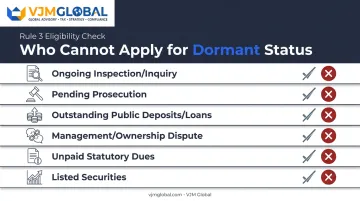
Eligibility isn't automatic, though. Who can't apply? Rule 3 blocks the voluntary route if any of these exist:
- An ongoing inspection, inquiry, or investigation
- A pending prosecution
- Outstanding public deposits or loans (secured or unsecured, with limited exceptions)
- A management or ownership dispute
- Unpaid statutory dues to government or local authorities
- Listed securities on a stock exchange
This status typically suits foreign subsidiaries waiting on project clearances, NRIs and OCIs holding an entity for future investment, or companies pausing while restructuring.
Why Foreign Businesses and NRIs Choose to Register a Dormant Company
Closing an Indian company outright feels final, and it is. Re-incorporating later means a new name search, fresh incorporation date, new PAN, and starting the compliance clock from zero. Dormant status avoids that.
Three practical reasons why this matters:
- You keep the corporate shell intact. The company name, incorporation date, and structure stay exactly as they were, which matters for foreign entities planning a phased India entry over several years.
- Compliance costs drop, but the entity survives. Filing obligations shrink compared to an active company, while the legal entity remains alive and ready to resume trading.
- The company's name keeps assets and IP protected. If the entity holds a registered office, trademark, or other asset, dormancy preserves that ownership without the irreversible step of striking off.
For a promoter in the US, UK, or Australia managing an India entity from a distance, this is often the difference between "pause and revisit next year" and "start from scratch in three years."
Step-by-Step Process to Register a Dormant Company in India
Reaching dormant status requires a short sequence of filings, not one submission. Skipping a step usually means the ROC kicks the application back.
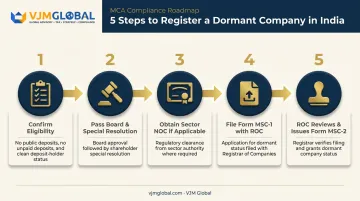
- Confirm eligibility first. Check for pending litigation, inspections, outstanding loans, unpaid statutory dues, or public deposits. Any of these disqualifies the voluntary route.
- Pass a board resolution. Follow this with a special resolution, or consent from shareholders holding at least three-fourths in value, authorising the dormant application.
- Get sector-specific NOC where relevant. If a regulator like RBI or SEBI oversees the company's activity, obtain a no-objection certificate before filing.
- File Form MSC-1 with the ROC. Attach the special resolution, a statement of affairs certified by a chartered accountant, and an auditor's certificate confirming no significant accounting transactions occurred.
- Wait for ROC review. Once satisfied, the Registrar issues Form MSC-2, entering the company in the register of dormant companies.
There's no fixed statutory processing window for MSC-2. The rules simply say the Registrar issues it "after considering" the application, so build in some flexibility rather than assuming a fixed number of days.
Where this gets tricky: Auditor certificates and the statement of affairs need to precisely reflect that every transaction during the dormancy period falls within the four permitted exclusions. Foreign promoters unfamiliar with Indian filing conventions often trip up here, or miss the special resolution's exact wording requirements.
VJM Global's business setup team works with US, UK, and Australian clients on MCA filings and ROC coordination, including the documentation and resolution drafting these applications require.
Ongoing Compliance Requirements for Dormant Companies in India
Dormant doesn't mean dormant on paperwork. Directors, auditors, and filings all continue.
Corporate governance stays active:
- Minimum directors must be maintained: 3 for a public company, 2 for a private company, 1 for an OPC
- An auditor remains appointed even though there's no trading activity to audit in the usual sense
- Statutory registers and minute books must still be kept current
The MSC-3 Annual Filing
Every dormant company must file Form MSC-3 (Return of Dormant Company) within 30 days of the end of each financial year, along with financial statements audited by a chartered accountant.
Miss this deadline and fees escalate fast:
- Delays up to 30 days: roughly double the normal fee
- Delays beyond 180 days: up to 12 times the normal fee
Registered office details also stay under scrutiny. Any change in address or directors must be notified to the ROC within 30 days, same as an active company.
Tax and Banking Considerations
A dormant company isn't exempt from income tax filing. The Income-tax Act requires a return regardless of income level, so most dormant companies file a nil or minimal return via ITR-6 each year.
If a bank account remains open, keep transactions to a minimum. Significant banking activity can undermine the dormant classification itself, since it may count as a "significant accounting transaction" under the rules.
Beyond these annual filings, there's a hard limit on how long a company can stay dormant. Under Rule 8(4) of the Companies (Miscellaneous) Rules, 2014, five consecutive years of dormancy triggers mandatory ROC strike-off proceedings. Dormant status isn't meant to be permanent.
For foreign owners managing this from overseas, missing an MSC-3 deadline or a directors' KYC filing is an easy way to accumulate penalties without noticing. VJM Global's ongoing MCA and ROC compliance support helps foreign-owned dormant companies keep filings current while owners focus on their home-market operations.
Risks, Penalties, and Reactivating a Dormant Company
What Happens If You Don't Comply
Skipping MSC-3 filings triggers late fees that scale with delay length. Worse, if the company breaches Rule 3 eligibility conditions after gaining dormant status, the ROC can strike it off the dormant register entirely under Section 455(6). That's separate from (and can lead into) the five-year strike-off trigger under Rule 8(4).
One thing dormancy doesn't erase: historic liability. Directors remain responsible for pre-dormancy debts and obligations. Even if the company is eventually dissolved under Section 248, Section 248(7) preserves any existing director or member liability, meaning it can still be enforced as though the company never dissolved.
Dormancy vs. Voluntary Strike-Off
Not every non-trading company should stay dormant. Consider closure instead when:
- There's genuinely no intention to ever reactivate the entity
- There's no meaningful asset value worth preserving
- There's no foreseeable use case in the next few years
Continuing dormant status when none of these apply just adds annual filing costs for a shell you'll never use.
Reactivating When You're Ready to Trade
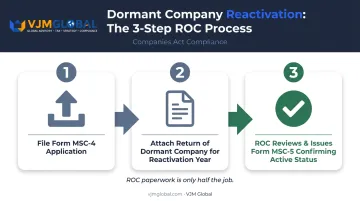
Bringing the company back to active status follows its own filing sequence:
- File Form MSC-4, the application seeking active status
- Attach the return of dormant company for the year of reactivation
- The ROC reviews and issues Form MSC-5, confirming restoration to active status
The ROC paperwork is only half the job. Before resuming trade, also:
- Update or reactivate GST registration
- Reopen operational bank accounts for regular transactions
- Refresh contracts, vendor agreements, and compliance calendars that lapsed during dormancy
Frequently Asked Questions
How do I activate a dormant company?
File Form MSC-4 with the ROC along with the return of dormant company for that financial year. Once approved, the ROC issues Form MSC-5 confirming the company's restoration to active status.
How much does a dormant company cost?
Costs include ROC filing fees for MSC-1 and MSC-3, plus professional fees for auditor certification and the statement of affairs. These annual compliance costs are typically lower than for an active company.
Who is responsible for a dormant company?
Directors and the company secretary, where appointed, remain fully responsible for compliance, record-keeping, and statutory duties even though the company isn't trading.
What is the difference between a dormant company and a shell company?
A dormant company is a formal, ROC-recognised status granted under Section 455 with clear eligibility rules. "Shell company" has no legal definition and is typically used to describe entities under regulatory suspicion.
Can a dormant company have a bank account in India?
Yes, but transactions through it should stay minimal. Significant banking activity can count as a significant accounting transaction, which risks the company's dormant classification.
What happens if a dormant company doesn't file compliance for 5 years?
The ROC must initiate strike-off proceedings under Rule 8(4) after five consecutive dormant years without reactivation. This ends the company's legal status, though pre-existing director liabilities remain enforceable.