Introduction
Singapore has emerged as one of Asia's most prominent crypto and blockchain hubs, attracting foreign founders, Web3 startups, and multinational companies from across the globe. This momentum stems from a clear regulatory stance from the Monetary Authority of Singapore (MAS), robust fintech infrastructure, and strong access to Asian capital markets.
With 38 active MAS-licensed Digital Payment Token (DPT) service providers as of May 2026—including global names like Coinbase, OKX, and PayPal—Singapore has proven itself a top-tier regulated jurisdiction for crypto businesses.
Interest in Singapore as a crypto base spans a wide range of founders and investors:
- Indian entrepreneurs and NRIs seeking a credible Asian foothold
- US and UK investors looking for regulatory clarity
- Blockchain developers building infrastructure
- Foreign companies that need a regulated base to operate across Southeast Asia
That clarity comes with real compliance obligations. Singapore expects formally structured, properly licensed operations — not informal or loosely governed setups.
This guide walks through the full process — from entity formation and MAS licensing to tax obligations and ongoing compliance — so you can plan your entry with confidence.
Key Takeaways
- Singapore is legally permissive but tightly regulated—you can operate crypto services, but only with the right MAS licence
- The Payment Services Act (PSA) and Securities and Futures Act (SFA) govern crypto businesses, depending on your activity type
- Setup requires incorporating a private limited company with ACRA, then applying for the appropriate MAS licence — either SPI or MPI for DPT services
- Expect 12–24 months from incorporation to licence approval, with startup costs typically ranging from USD 100,000–500,000+
- Ongoing compliance (AML/CFT, Travel Rule, audits, MAS reporting) requires dedicated resources from day one
What Makes Singapore an Attractive Base for a Crypto Business?
Singapore's appeal as a crypto jurisdiction starts with its legal foundation. The country operates under a stable English common law system, giving international founders predictability and familiarity. MAS functions as a clear, respected regulator — sidestepping the ambiguity that plagues many competing jurisdictions.
The tax environment is equally competitive: a flat 17% corporate income tax rate with no capital gains tax on asset disposals, meaning long-term digital asset appreciation is generally not taxed.
Beyond regulatory clarity, Singapore offers access to a dense ecosystem of banking partners, fintech investors, and digital asset service providers. The city-state ranked 4th globally in the Global Financial Centres Index (GFCI 38) in September 2025 and 2nd worldwide in the fintech sub-ranking after New York. This reflects decades of deliberate policy development and financial infrastructure investment.
That ecosystem strength translates into real advantages for crypto operators:
- Over 1,700 licensed fintech firms and SGD 3.8 billion in fintech startup funding
- 40% of fintech firms in Singapore use blockchain for payments, trading, or security
- Direct access to ASEAN markets and broader Asian capital flows
For foreign founders from India, the USA, the UK, and Australia, Singapore offers a globally recognised, credible base for crypto operations. That clarity, however, comes with a firm requirement: Singapore demands genuine compliance from day one. Unlicensed operation exposes both the company and its directors to criminal liability, so launching without the right licences in place is not an option.
Types of Crypto Businesses You Can Start in Singapore
The type of crypto business you intend to run directly determines your regulatory obligations and licensing pathway. Not all crypto businesses require the same licence—or any licence at all.
Main business types and their regulatory implications:
- DPT exchange or trading platform: Requires PSA licence (SPI or MPI depending on transaction volume)
- Crypto custody service: PSA licence required for holding customer digital assets
- Crypto payment gateway: PSA licence if facilitating DPT payments for merchants
- DeFi or staking platform: May require PSA licence depending on the services offered and how much control the platform holds over user assets
- Blockchain infrastructure/development company: Typically no licence required if only providing technology services without handling customer funds
- NFT marketplace: May require PSA licence if the platform facilitates trading of NFTs that function as DPTs or capital markets products
- Crypto fund or asset manager: Requires CMS licence under the SFA if managing investment portfolios containing capital markets products

Across all these categories, one classification question consistently catches founders off guard: token labelling. Calling a token a "utility token" does not automatically exempt it from regulation. MAS applies a substance-over-form analysis, examining the economic rights a token confers—profits, ownership, debt—to determine whether the SFA applies. A token marketed as utility but offering profit participation or governance rights may still be classified as a security or collective investment scheme.
Singapore's Regulatory Framework: What Every Founder Must Understand
The Primary Regulator and Licence Tiers
MAS is the primary regulator, and the Payment Services Act (PSA) is the central statute governing most crypto activities. The PSA defines three licence tiers relevant to crypto:
| Licence Type | Monthly Transaction Threshold | Base Capital Requirement |
|---|---|---|
| Money-Changing Licence | Money-changing only | SGD 100,000 |
| Standard Payment Institution (SPI) | Up to SGD 3 million (single service) or SGD 6 million (2+ services) | SGD 100,000 |
| Major Payment Institution (MPI) | Above SGD 3 million (single service) or SGD 6 million (2+ services) | SGD 250,000 |
For most crypto businesses, the choice is between SPI and MPI. The threshold is determined by average monthly transaction volume over a calendar year.
When the Securities and Futures Act (SFA) Applies
The SFA applies when digital tokens qualify as capital markets products (CMPs), specifically:
- Securities: shares, debentures, units in a business trust
- Collective Investment Schemes (CIS): pooled investment vehicles
- Securities-based derivatives contracts
MAS's Guide on the Tokenisation of Capital Markets Products (November 2025) confirms that classification is based on economic substance, not technological form. Companies whose tokens constitute CMPs require a Capital Markets Services (CMS) licence and must comply with prospectus and financial adviser requirements.
Fit-and-Proper Assessment
Licensing the business is only half the equation — the people behind it face equal scrutiny. All directors, shareholders holding 5%+, 12%+, or 20%+ stakes, and key management personnel must pass MAS's fit-and-proper assessment. Criteria include:
- Honesty, integrity, and reputation: no criminal convictions, no adverse regulatory history
- Competence and capability: demonstrated relevant experience in financial services or technology
- Financial soundness: no bankruptcy or insolvency
International founders with regulatory history elsewhere must disclose this fully. Non-disclosure or false declarations can result in licence refusal or revocation.
AML/CFT Obligations Under MAS Notice PSN02
MAS Notice PSN02 sets out comprehensive AML/CFT requirements for DPT service providers:
- Customer Due Diligence (CDD): identity verification before establishing business relationships
- Enhanced Due Diligence (EDD): for high-risk customers and politically exposed persons
- Transaction monitoring: real-time systems to detect suspicious activity
- Travel Rule compliance: For DPT transfers of SGD 1,500 or more, both originator and beneficiary information must be collected and transmitted. Required fields include name, account number, and at least one of: residential address, national identity number, or date and place of birth
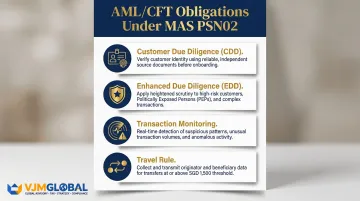
MAS inspections verify that written controls match actual operations — filed policies alone are not sufficient. Expect examiners to test your transaction monitoring systems and CDD workflows in practice.
Criminal Liability for Unlicensed Operation
PSA Section 5 imposes severe penalties for providing unlicensed DPT services:
- Individuals: fine up to SGD 125,000 or imprisonment up to 3 years, or both
- Corporations: fine up to SGD 250,000
- Continuing offence: additional fines of SGD 12,500 (individuals) or SGD 25,000 (corporations) per day
Founders who launch before securing a licence face compounding daily fines on top of criminal exposure. Apply for an in-principle approval or exemption before processing any transactions.
How to Set Up a Crypto Business in Singapore — Step by Step
This section walks through the practical execution stages. Common mistakes that delay or derail the process:
- Underestimating AML/CFT requirements
- Treating licensing as a post-launch task
- Using opaque offshore ownership structures that delay MAS approval
Step 1: Incorporate Your Company with ACRA
The standard vehicle is a private limited company (Pte. Ltd.) under the Companies Act.
Incorporation requirements:
- At least 1 Singapore-resident director (Singapore citizen, PR, or ordinarily resident person)
- Company secretary appointed within 6 months
- Registered local address
- Minimum paid-up capital of SGD 1 (though MAS imposes much higher capital requirements for licensed entities)
ACRA fees:
- Name reservation: SGD 15
- Incorporation: SGD 300
- Total minimum cost: SGD 315
Foreign founders who are not Singapore residents must appoint a local nominee director. Choose a corporate service provider that understands crypto and Web3 compliance — not just generic incorporation services. For Indian founders or NRIs structuring cross-border entry into Singapore, VJM Global's international business setup team can advise on holding structure, entity design, and documentation preparation ahead of ACRA filing.
Step 2: Determine the Correct Licence and Regulatory Category
Before applying, conduct a regulatory analysis of your business model to determine which framework applies:
- PSA (DPT services) — for digital payment token exchanges, OTC desks, and custody providers
- SFA (capital markets products) — for tokenized securities, digital asset fund management, or investment platforms
- Exemptions — available in limited circumstances; confirm with qualified Singapore counsel before relying on any
Common mistake: founders assume their business is exempt and begin operations. If MAS later determines a licence was required, they face enforcement action and must halt operations while applying.
Step 3: Prepare and Submit the MAS Licence Application
Application requirements:
- Detailed business plan and financial projections
- AML/CFT policies and procedures aligned to PSN02
- Technology risk management framework aligned to MAS TRM Guidelines
- Fit-and-proper declarations for all relevant individuals
Application fees (non-refundable):
| Licence Type | 1 Payment Service | 2+ Payment Services |
|---|---|---|
| SPI | SGD 1,000 | SGD 1,500 |
| MPI | SGD 1,500 | SGD 2,000 |
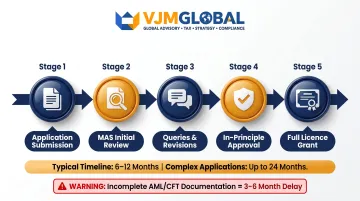
Realistic timelines: MAS processing times for DPT service provider licences range from 6 to 12 months, though complex applications can take over 2 years depending on application quality and business complexity.
Critical miss: applications with incomplete AML/CFT documentation or no Travel Rule compliance solution are returned for revision — each round-trip typically adds 3 to 6 months. Specialist compliance counsel engaged before submission consistently produces faster approvals than self-prepared filings revised after rejection.
Step 4: Build and Implement the AML/CFT and Technology Compliance Framework
AML/CFT compliance must be operationally live — actual customer onboarding procedures, working transaction monitoring systems, and documented staff training. A policy document alone is insufficient. MAS conducts inspections to verify that written controls are reflected in real operations.
The Travel Rule adds a separate technical requirement: integration with counterparty VASPs to exchange customer data in real time. This must be built into the technology stack before the licence is granted, not retrofitted afterward.
Step 5: Open a Corporate Bank Account
Securing a corporate bank account is one of the most practically difficult steps for crypto companies in Singapore, even post-licensing. Major banks (DBS, OCBC, UOB) apply stringent due diligence to crypto-related businesses.
Practical approach:
- Engage a bank early — ideally before or alongside the MAS application
- Present a clear business model, credible compliance framework, and evidence of regulatory engagement
- Alternative options include digital bank accounts and licensed payment institution accounts
For foreign-owned entities, assembling the financial documentation banks require — audited accounts, corporate structure charts, source-of-funds evidence — is frequently the bottleneck. VJM Global's accounting and back-office team supports this preparation for international founders navigating Singapore's banking onboarding process.
Step 6: Establish Operations, Governance, and Go Live
With banking in place, the final stage is formalizing governance and preparing for live operations.
Board-level governance requirements:
- MAS expects active director oversight of risk management, compliance, and technology
- At least one director should have relevant financial services or technology experience
Trigger for upgrading from SPI to MPI: Crossing the monthly transaction volume thresholds (SGD 3 million for a single service, SGD 6 million for two or more services) requires prompt notification and application to MAS. Operating above SPI thresholds without an MPI licence is a breach of PSA Section 5.
Tax, Banking, and Ongoing Compliance Obligations
Tax Treatment of Crypto Businesses
Singapore's tax treatment of crypto businesses is highly favourable compared to many jurisdictions:
- Corporate income tax: flat 17% on chargeable income
- No capital gains tax: passive holding gains are generally not taxed
- Active trading: crypto profits from active trading or business activity are treated as income and taxed at 17%
- The characterisation of gains as capital versus income is a factual question — IRAS assesses this based on trading frequency and intent
- Startup tax exemption: New qualifying companies receive 75% exemption on the first SGD 100,000 and 50% on the next SGD 100,000 of chargeable income for the first three years — a maximum exemption of SGD 125,000 per year.
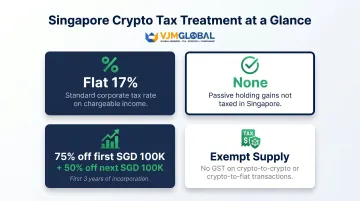
Since 1 January 2020, the supply of DPTs functioning as a medium of exchange qualifies as an exempt supply under the GST Act. Crypto-to-crypto and crypto-to-fiat exchanges carry no GST liability, removing a layer of indirect tax friction from exchange operations.
Foreign-owned crypto companies should ensure income is correctly characterised from the outset — IRAS can reclassify passive gains as trading income if the facts support it, triggering unexpected tax liability.
Ongoing MAS Reporting Obligations
Licensed entities must comply with ongoing reporting requirements:
- Annual audited financial statements filed with MAS and ACRA
- Periodic returns on transaction volumes and AML/CFT metrics
- Mandatory notification to MAS of any material changes to the business under PSA Section 15, including:
- Ownership changes
- Key personnel changes
- Business activities
- Technology infrastructure changes
- Civil or criminal proceedings
- Operational irregularities that materially impede operations
Failure to notify is a licence breach and can result in enforcement action.
Change-of-Control Rule
PSA Section 28 requires that any acquisition of 20% or more of voting shares in a licensed entity requires prior MAS approval. Founders planning future fundraising rounds or acquisitions must build this condition into their transaction agreements from the outset. Thresholds of 5% and 12% also trigger fit-and-proper assessment requirements.
Annual licence fees apply on top of the one-time application costs:
| Licence Type | Base Fee | DPT Service Component |
|---|---|---|
| SPI | SGD 5,000 | N/A |
| MPI | SGD 10,000 | + SGD 10,000 |
For an MPI providing only DPT service, the total annual fee is SGD 20,000.
Conclusion
Singapore offers a credible, well-structured environment for crypto businesses, but the regulatory requirements are substantive. Founders who treat licensing and compliance as an afterthought will face delays, enforcement action, or outright rejection.
Clarity on business type, regulatory category, and compliance infrastructure before committing capital is more important than speed to market. The 12–24 month licensing timeline is a given, and the quality of preparation determines whether it's the shorter or longer end.
That preparation is easier when you have advisors who understand both your home jurisdiction and Singapore's requirements. Founders from India, the USA, the UK, or Australia face distinct structuring considerations — from home-country tax obligations to cross-border fund flows — that affect entity design before a single Singapore filing is made.
VJM Global works with foreign founders on cross-border accounting, international tax planning, and business setup, helping ensure the structure is sound from incorporation through to live operations.
Frequently Asked Questions
How much does it cost to start a crypto company?
Incorporation fees with ACRA start at SGD 315. MAS licence application costs range from SGD 1,000–2,000 depending on licence type. Minimum capital requirements are SGD 100,000 for SPI and SGD 250,000 for MPI. Including legal/compliance advisory fees and technology infrastructure, total setup costs typically start from USD 100,000 (approximately SGD 135,000) and can exceed USD 500,000 for larger operations.
How much is a Singapore crypto license?
MAS licence application fees are SGD 1,000–2,000 for SPI and SGD 1,500–2,000 for MPI depending on the number of payment services. Annual licence fees are SGD 5,000 for SPI and SGD 20,000 for MPI (including DPT service component). The capital requirement (SGD 100,000 for SPI, SGD 250,000 for MPI) represents the larger financial commitment.
How to start a legit crypto trading business?
Incorporate as a Pte. Ltd. with ACRA, then apply for a DPT service provider licence (SPI or MPI) from MAS under the Payment Services Act. Before commencing operations, you must have a full AML/CFT compliance framework in place — covering customer due diligence, transaction monitoring, and Travel Rule compliance.
Is crypto investment legal in Singapore?
Yes, crypto investment is legal in Singapore. MAS regulates crypto service providers (exchanges, custodians, payment services) but does not prohibit individuals or companies from holding or investing in digital assets. However, companies providing crypto services to the public must hold the appropriate MAS licence.
Does Singapore tax crypto profits?
Singapore does not impose capital gains tax, so passive holding gains are generally not taxed. Crypto profits from active trading or business activity, however, are treated as income and taxed at the corporate rate of 17% — with IRAS determining capital versus income status based on trading frequency and intent.