Introduction
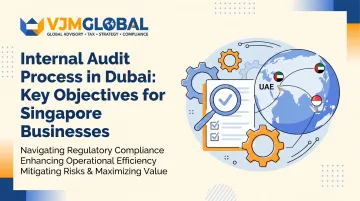
The internal audit process in Dubai is an independent evaluation of an organisation's controls, risk management, and operational compliance. For Singapore businesses operating in or expanding into Dubai, understanding how this process works in Dubai's specific regulatory context is critical to avoiding costly compliance gaps.
That context differs sharply from what Singapore businesses are used to. Under MAS oversight, a single regulator provides clear frameworks through the Companies Act and Singapore Financial Reporting Standards. Dubai operates across multiple jurisdictions: the DFSA governs DIFC entities, the UAE Federal Tax Authority oversees tax compliance, and the UAE Commercial Companies Law sets mainland corporate requirements.
This multi-regulator landscape creates compliance gaps that internal audits are specifically designed to identify and close.
Bilateral trade between Singapore and the UAE reached SGD 27.9 billion in 2025, with over 600 Singapore firms now operating across UAE sectors including fintech, healthcare, and infrastructure. The scale of this presence makes compliance readiness a practical concern, not an abstract one.
Yet many of these businesses underestimate how different Dubai's requirements are in practice — from VAT compliance obligations and corporate tax readiness (mandatory since June 2023) to banking relationships shaped by CBUAE's heightened KYC/AML standards.
Key Takeaways
- UAE internal audits evaluate controls, risk exposure, financial accuracy, and compliance with VAT and Corporate Tax rules introduced since 2023
- Not legally mandatory for most UAE companies, but now expected by banks, investors, and free zone authorities
- Five audit stages apply: planning, fieldwork, documentation, reporting, and follow-up — each adapted to UAE regulatory requirements
- Singapore businesses face dual-jurisdiction gaps, unfamiliar governance norms, and FTA enforcement that uncovered AED 1.8 billion in additional taxes in 2024
- Cross-border advisors familiar with both Singapore and UAE compliance reduce audit exposure across both jurisdictions
What Is the Internal Audit Process in Dubai?
The internal audit process in Dubai is a recurring, internally-directed review of a company's financial systems, operational workflows, risk controls, and compliance posture. It's conducted by in-house auditors or outsourced professionals who report to management or the board.
The process gives management an independent view of whether controls are functioning, risks are being managed, and operations are running as intended.
It's worth understanding how this differs from external audit, which serves a separate purpose entirely:
- Internal audit — management-facing, operationally focused, and not legally required for most UAE-registered businesses
- External audit — legally required under UAE law, focused on verifying financial statement accuracy for third-party stakeholders
Why Singapore Businesses Need Internal Audits in Dubai
Dubai's regulatory environment has grown far more complex for foreign businesses since the introduction of UAE Corporate Tax in June 2023 and ongoing enforcement of VAT compliance by the Federal Tax Authority. Both require Singapore businesses to maintain robust internal financial controls that can withstand regulatory scrutiny.
This creates a structural governance gap. Singapore businesses typically operate under the Companies Act and MAS frameworks — well-defined systems that differ fundamentally from UAE Commercial Companies Law, DFSA regulations for DIFC entities, and free zone authority requirements. Singapore teams often carry assumptions about adequate internal control that simply don't map to UAE requirements.
Without periodic internal reviews, Singapore businesses operating in Dubai commonly encounter:
- Undetected VAT filing errors that surface during FTA audits
- Misaligned intercompany transactions triggering transfer pricing risk
- Internal approval process failures discovered only during external statutory audits—by which point penalties may already apply
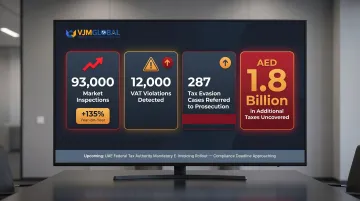
The FTA's 2024 enforcement numbers make the exposure concrete: approximately 93,000 market inspections (a 135% increase year-on-year), around 12,000 VAT violations detected, and 287 tax evasion cases referred to prosecution. The upcoming rollout of e-invoicing will push this further — enabling near-real-time transactional monitoring that leaves little room for retrospective corrections.
Internal audits also serve a strategic purpose for Singapore companies expanding into Dubai. They provide documented evidence of governance quality to:
- UAE banks with heightened KYC and AML expectations under CBUAE rules
- Local joint venture partners conducting due diligence
- Free zone authorities during licence renewals or restructuring
In practice, a well-documented internal audit trail can accelerate bank account approvals, strengthen JV negotiations, and reduce friction during free zone licence renewals — outcomes that directly affect how quickly a Singapore business can operate at full capacity in Dubai.
How the Internal Audit Process Works in Dubai
The internal audit process moves from scoping and planning, through evidence collection and testing, to findings documentation and reporting, followed by a follow-up cycle to verify corrective actions. Each stage requires alignment to UAE regulatory standards and the specific legal structure of the entity—mainland, free zone, or DIFC.
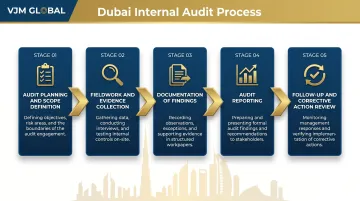
Step 1: Audit Planning and Scope Definition
The audit begins with defining scope based on a risk assessment of the company's operations in Dubai—identifying which departments, processes, or financial cycles carry the highest exposure.
This planning step should explicitly incorporate UAE-specific risks relevant to Singapore-headquartered entities:
- VAT compliance cycles and filing accuracy
- Corporate tax position and Qualifying Free Zone Person (QFZP) status
- Compliance with applicable free zone or mainland authority regulations
- Transfer pricing documentation for intercompany transactions
Planning determines how resources are allocated and which areas receive priority during fieldwork.
Step 2: Fieldwork and Evidence Collection
During fieldwork, auditors test controls, review financial records, inspect contracts, conduct process walkthroughs, and interview key staff.
When group-level policies from Singapore have not been adapted to UAE legal requirements, this stage routinely surfaces gaps. Common issues include:
- Approval hierarchies that don't align with UAE Commercial Companies Law requirements
- Payment authorisation workflows missing segregation of duties
- Reconciliation procedures not adapted to IFRS mandatory reporting standards
Fieldwork generates the evidence base that supports all subsequent findings.
Step 3: Documentation of Findings
All findings from fieldwork must be documented with supporting evidence that is specific, factual, and traceable. In the UAE context, documentation standards must align with IFRS (mandatory for UAE entities). They should also be structured to support both internal decision-making and potential FTA or DFSA reviews.
Documentation should clearly distinguish between two finding types:
| Finding Type | Definition |
|---|---|
| Material finding | A control weakness or compliance gap that could result in financial misstatement, regulatory penalty, or operational disruption |
| Minor observation | A procedural improvement suggestion with no immediate risk exposure |
Step 4: Audit Reporting
Audit findings are compiled into a structured report categorised by risk level—typically high, medium, and low—along with root cause analysis and corrective action recommendations.
Cross-border risk areas warrant dedicated coverage in the report:
- Transfer pricing arrangements with Singapore parent or other group entities
- Intercompany balances and foreign exchange exposure
- Compliance with both UAE Federal Tax Authority requirements and Singapore tax treaty obligations
- Banking relationship risks under CBUAE KYC/AML rules
The report is presented to management and, where applicable, the audit committee or board.
Step 5: Follow-Up and Corrective Action Review
The follow-up phase converts audit findings into operational improvements. Management commits to corrective actions with deadlines, and a subsequent review confirms whether those actions were implemented.
Key elements of an effective follow-up cycle include:
- Assigning named owners and firm deadlines to each corrective action
- Tracking closure status across audit rounds, not just within a single cycle
- Escalating overdue items to the audit committee before they compound into larger exposures
For Singapore businesses managing UAE operations at a distance, this structured follow-through is what separates a functioning compliance programme from a paper exercise.
Key Objectives of the Internal Audit Process for Singapore Businesses in Dubai
Objective 1: Strengthening Internal Controls Across UAE Operations
A primary objective is to assess whether financial and operational controls in the Dubai entity are functioning as designed. This covers:
- Approval hierarchies for expenditure and contracts
- Payment authorisation and segregation of duties
- Reconciliation procedures for bank accounts and intercompany balances
- Access controls for financial systems
Singapore businesses often apply parent-company control frameworks that have not been localised for UAE operational realities, creating undetected control gaps. Internal audit identifies these misalignments before they result in financial loss or compliance breaches.
Objective 2: Ensuring VAT and Corporate Tax Compliance Readiness
Internal audits serve as a critical pre-emptive tool — catching VAT filing errors and corporate tax calculation gaps before the FTA conducts its own review.
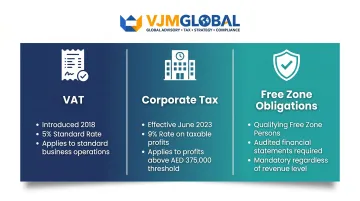
The UAE's tax landscape has changed substantially in a short time:
- VAT: Introduced in 2018 at 5%, now fully embedded in standard business operations
- Corporate Tax: Effective for financial years starting June 2023 at 9% on profits above AED 375,000
- Free Zone obligations: All Qualifying Free Zone Persons must maintain audited financial statements regardless of revenue level
The FTA's enforcement posture makes proactive compliance essential. In 2024, the authority issued 2,633 registration notices to non-compliant entities and contacted 72,000 VAT registrants regarding 131,000 overdue returns. Internal audit helps identify and correct errors before they attract penalties or enforcement action.
Objective 3: Identifying and Mitigating Operational and Financial Risk
Internal audits systematically map risks across the Dubai entity, including:
- Currency exposure from AED-SGD transactions
- Procurement fraud risk in vendor payments
- Contract compliance for leases and service agreements
- Data security and IT system access controls
For Singapore businesses with lean UAE teams, this is especially important as oversight is often limited. Internal audit provides the independent risk assessment that small operational teams cannot perform themselves.
Objective 4: Supporting Corporate Governance and Board Accountability
The audit report gives the board or parent company — often based in Singapore — an independent view of whether their Dubai entity is being managed in accordance with group policies and UAE law.
For multinational Singapore companies where parent boards are not involved in day-to-day UAE operations, this matters most. The internal audit function bridges the governance gap by confirming that local management is operating within acceptable risk parameters.
VJM Global supports Singapore businesses in structuring audit functions that satisfy both MAS-aligned parent-level governance standards and UAE FTA compliance requirements — covering everything from audit scope design to report preparation for board review.
Objective 5: Building Stakeholder and Investor Confidence
UAE banks, free zone authorities, and potential investors or joint venture partners view a structured internal audit function as a marker of organisational maturity.
Under CBUAE Rulebook requirements, all legal persons must undergo both Customer Due Diligence and Enhanced Due Diligence for any activity and any value — unlike natural persons who have transaction thresholds. For high-risk entities, banks must conduct reviews every 6 to 9 months.
A documented internal audit function provides the governance evidence that banks require during due diligence. For Singapore businesses seeking to scale their Dubai operations, regular internal audits contribute directly to their ability to raise financing, form partnerships, and renew or upgrade trade licences.
Conclusion
The internal audit process in Dubai is a structured, multi-stage discipline that goes well beyond financial checking. It is the mechanism by which Singapore businesses can verify that their UAE operations are controlled, compliant, and governed to a standard that satisfies both local regulators and parent-company expectations.
Done well, it closes the visibility gap between a Singapore head office and a UAE subsidiary — before that gap becomes a liability.
Singapore businesses should not treat internal audit as an afterthought or equate it with the external statutory audit. The objectives are distinct, the process is internally driven, and the value lies in early risk detection and corrective action before compliance failures escalate into penalties or reputational damage.
As the UAE regulatory environment tightens — e-invoicing mandates approaching and FTA enforcement intensifying — businesses with structured internal audit programs are far better placed to pass external scrutiny, avoid financial penalties, and keep their UAE operating licenses intact.
Frequently Asked Questions
What are the stages of the internal audit process in Dubai?
The five key stages are: audit planning and scope definition, fieldwork and evidence collection, documentation of findings, formal reporting with risk categorisation, and follow-up on corrective actions. Each stage requires adaptation to the UAE regulatory context, including IFRS reporting standards and jurisdiction-specific rules for mainland versus free zone entities.
Is internal audit mandatory in the UAE?
Internal audit is not legally mandated for most UAE entities, unlike external audit which is required for licence renewal. However, it is strongly recommended and in some cases expected by regulators—particularly the DFSA for DIFC-licensed financial institutions, which mandates an independent internal audit function under GEN 5.3.13.
How is Dubai's internal audit process different from Singapore's?
UAE entities must navigate VAT compliance, a corporate tax regime effective June 2023, IFRS-mandatory reporting, and mainland versus free zone rules. Singapore operates under GST, income tax frameworks, Singapore Financial Reporting Standards, and ACRA requirements—each framework creates distinct control expectations and audit focus areas.
What are the main objectives of an internal audit in Dubai for foreign-owned companies?
Core objectives include strengthening internal controls across UAE operations, ensuring VAT and corporate tax compliance readiness, and identifying operational and financial risks. Beyond that, audits support board-level governance for parent companies and build confidence with UAE banks and stakeholders who apply heightened KYC and AML due diligence standards.
How often should Singapore businesses conduct internal audits in their Dubai operations?
While there is no mandated frequency, best practice for foreign-owned entities is at least annually. Higher-risk operations—financial services, multi-entity structures, or those under FTA scrutiny—benefit from semi-annual or continuous audit programmes aligned with the business's risk profile.
Can Singapore businesses outsource their internal audit function in Dubai?
Yes. Outsourcing to a qualified UAE-based or internationally experienced audit firm is common and practical for Singapore businesses with lean UAE teams. The IIA's 2026 Risk in Focus survey found 44% of Middle East internal audit functions have just 1 to 5 staff, making co-sourcing a sensible option, provided the function remains independent and reports to senior management or the audit committee.