Introduction
Introduction
Singapore businesses expanding into India increasingly choose Chennai as their entry point. The city offers a 4-hour flight distance from Singapore, established trade corridors, strong infrastructure, and a business environment backed by the India-Singapore Comprehensive Economic Cooperation Agreement (CECA).
Registering as a foreign entity in Chennai involves regulatory requirements that differ significantly from domestic Indian incorporations. Singapore businesses must navigate FDI approval frameworks, appoint an Indian resident director, and have Singapore company documents apostilled under the Hague Convention.
This guide covers the complete process—from choosing the right company structure to filing post-incorporation compliance returns—specifically for Singapore businesses setting up in Chennai.
Why Singapore Businesses Are Choosing Chennai to Set Up Operations
Bilateral Trade and CECA Framework
The India-Singapore Comprehensive Economic Cooperation Agreement (CECA), in force since 2005, reduces tariffs on goods, facilitates services trade, and provides a framework for investment protection. This bilateral relationship is robust: India-Singapore bilateral trade stood at USD 34.3 billion in 2024-25, with Singapore accounting for 27.83% of India's total ASEAN trade.
CECA covers 16 chapters including trade in goods, investment promotion, mutual protection, and a Double Taxation Avoidance Agreement (DTAA). Both governments initiated the third CECA review in 2025 — a signal that the agreement will continue expanding market access and investment protections for Singapore businesses.
For Singapore businesses, CECA provides:
- Lower tariff barriers on goods
- Facilitated services trade including financial services
- Stronger legal protections for foreign investment
- Movement of natural persons across borders
Geographic and Logistical Advantages
Chennai sits approximately 2,900 km from Singapore—a flight time of just 4 hours. As a major southern Indian port city, Chennai serves as a natural gateway to Southeast Asian trade routes, making it ideal for Singapore companies seeking to maintain close operational ties with their home markets.
Chennai's connectivity extends beyond air travel. The city is home to 46 operational Special Economic Zones (SEZs), India's second-largest container port, and excellent road and rail networks connecting it to the rest of India.
Chennai's Economic Strengths
These logistical advantages are backed by a strong economy. Tamil Nadu contributes approximately 9.21% to India's national GDP despite occupying only 4% of India's land, and posted the highest GSDP growth rate among 25 Indian states at 11.19% in 2024-25.
Key sectoral strengths aligned with Singapore business interests:
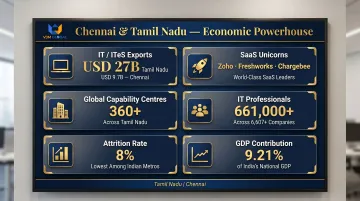
- IT/ITeS exports total USD 27 billion from Tamil Nadu (FY 2025-26); Chennai contributes USD 9.7 billion, ranking #2 nationally
- Home to SaaS unicorns Zoho, Freshworks, and Chargebee — making it a natural fit for Singapore's tech sector
- 360+ Global Capability Centres across Tamil Nadu, representing 20% of India's total GCC base
- 661,000+ IT professionals across 6,607+ software companies provide deep, accessible talent
- Lowest employee attrition rate (8%) among Indian metro cities — a significant operational advantage
- Established supply chains in automotive, electronics, and engineering components
FDI Liberalisation and Automatic Route Access
The economic case for Chennai is reinforced by India's investment policy. India permits 100% FDI under the Automatic Route in most sectors — meaning Singapore companies can invest and register without seeking prior government approval, removing a common bottleneck for foreign entrants.
Sectors requiring government approval include:
- Defence (above 74%)
- Multi-brand retail (51% cap)
- Print and digital media covering news (26% cap)
- Broadcasting news channels (49% cap)
- Banking – public sector (20% cap)
- Pharmaceuticals – brownfield investments (above 74%)
Most Singapore businesses operate well outside these restricted categories. One important exception applies across all sectors: entities from countries sharing a land border with India require government approval regardless of the industry.
Singapore was the top FDI source into India in Apr-Dec FY26 at USD 17.6 billion (37% share). Cumulatively, Singapore ranks 2nd with USD 171.92 billion invested since 2000, accounting for 23.87% of India's total FDI equity inflows.
Right Company Structure for Singapore Businesses Entering Chennai
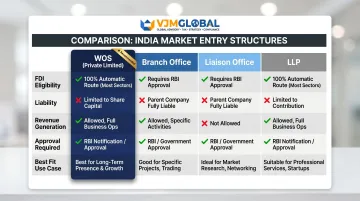
Your choice of legal structure determines your FDI eligibility, liability exposure, and operational scope in India. Here are the four primary options Singapore businesses should evaluate:
Wholly Owned Subsidiary (WOS) – Private Limited Company
The WOS is the most recommended structure for Singapore businesses seeking full operational control in India.
It is incorporated as a Private Limited Company under the Companies Act 2013, with the Singapore parent holding up to 100% of shares. Minimum requirements: two shareholders (parent holding 99.99%, nominee holding at least one share) and two directors — at least one must be an Indian resident.
What it allows:
- Full ownership and operational control
- Separate legal entity with limited liability
- Permitted in all sectors where 100% FDI is allowed under Automatic Route
- Can generate revenue, hire employees, own property, and conduct all commercial activities
- No RBI approval required for most sectors
Branch Office
A Branch Office represents the Singapore parent entity in India but does not form a separate legal entity.
Permitted activities:
- Requires RBI approval before establishment
- Cannot engage in retail trading or manufacturing
- Suitable for activities like export/import, consultancy, technical support, or research
- Income taxed in India; parent company is liable for debts
Liaison/Representative Office
The most restrictive option, suited only for market research and liaison activities.
Operational limitations:
- Cannot generate revenue or undertake commercial activities
- Requires RBI/Authorised Dealer Bank approval
- Functions solely to promote parent company interests, conduct market research, and facilitate business development
- All operational expenses must be funded by inward remittances from the parent
Limited Liability Partnership (LLP)
LLPs offer flexibility, but FDI access is restricted. Per the Consolidated FDI Policy 2020, FDI in LLPs is permitted under the Automatic Route only in sectors where:
- 100% FDI is allowed via automatic route
- No FDI-linked performance conditions exist (e.g., minimum capitalisation, lock-in periods)
Common misconception: Many Singapore businesses assume LLPs offer the same FDI flexibility as Private Limited Companies—this is incorrect.
Comparison Table
| Criteria | WOS (Private Limited) | Branch Office | Liaison Office |
|---|---|---|---|
| FDI Eligibility | 100% in most sectors (Automatic Route) | Allowed with RBI approval | Allowed with RBI approval |
| Liability | Limited to share capital | Parent company liable | Parent company liable |
| Revenue Generation | Yes, full commercial activities | Yes, but restricted (no retail/manufacturing) | No revenue generation permitted |
| Approval Required | No (for Automatic Route sectors) | Yes (RBI approval) | Yes (RBI approval) |
| Best Fit Use Case | Full-scale operations, hiring, revenue generation | Export/import, consultancy, technical support | Market research, liaison only |
Step-by-Step: How Singapore Companies Register in Chennai
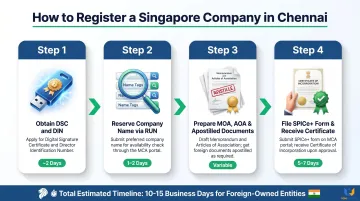
The incorporation process is handled entirely online via the MCA portal. Here's the breakdown:
Step 1: Obtain Digital Signature Certificate (DSC) and Director Identification Number (DIN)
Digital Signature Certificate (DSC): All proposed directors must obtain a DSC from an MCA-authorised certifying agency. For Singapore-based directors, this requires submitting apostilled or notarised identity and address proofs.
Director Identification Number (DIN): The DIN is now applied for as part of the SPICe+ incorporation form (not separately). Up to 5 DINs can be obtained in a single SPICe+ filing.
Timeline: DSC procurement takes approximately 2 days; DIN is allotted during incorporation processing.
Step 2: Reserve a Company Name via RUN (Reserve Unique Name)
The proposed company name must comply with MCA naming guidelines:
- Cannot be identical or deceptively similar to an existing company
- Must end with "Private Limited"
- Cannot contain prohibited words or violate trademark rights
Process:
Submit the RUN application (SPICe+ Part A) with up to two name options in order of preference. The form includes an Auto Check feature that alerts to name similarity and trademark conflicts.
Fee: INR 1,000 per submission
Validity: 20 days from approval
Timeline: 1–2 working days
The Singapore parent company name can be incorporated into the Indian entity name with proper disclosure.
Step 3: Prepare MOA, AOA, and Required Documents
Memorandum of Association (MOA): Defines business objectives and scope
Articles of Association (AOA): Internal governance rules
For foreign-owned companies, MOA and AOA must reflect FDI-permitted activities and sectoral caps (if applicable).
Required documents from the Singapore parent:
- Apostilled Certificate of Incorporation of the Singapore parent company
- Board Resolution authorising Indian subsidiary formation
- Proof of registered office in Chennai (rental agreement or utility bill)
- KYC documents for all directors: passport and address proof (apostilled if foreign national)
Important: Since Singapore acceded to the Hague Apostille Convention in January 2021, apostilled documents from Singapore do not require separate embassy legalisation. India is also a party to the Apostille Convention, streamlining the authentication process.
Step 4: File SPICe+ Form and Receive Certificate of Incorporation
With documents in order, the next step is filing the integrated SPICe+ form — the single submission that triggers incorporation across multiple government departments simultaneously.
SPICe+ (Simplified Proforma for Incorporating Company Electronically Plus) is a single integrated form that consolidates 10 services across three ministries:
| Service | Ministry/Department |
|---|---|
| Name Reservation (Part A) | MCA |
| Company Incorporation (Part B) | MCA |
| DIN Allotment | MCA |
| PAN (Permanent Account Number) | Income Tax Department |
| TAN (Tax Deduction Account Number) | Income Tax Department |
| GST Registration | GST Department |
| ESIC Registration | Ministry of Labour |
| EPFO Registration | Ministry of Labour |
| Professional Tax Registration | State Government |
| Bank Account Opening | Integrated Banks |
Linked electronic forms: e-MOA (INC-33), e-AOA (INC-34), AGILE-PRO-S, INC-9 (declaration).
Common reasons for SPICe+ rejection include incorrect NIC code selection, missing apostille certificates, and non-compliance with resident director requirements — all worth verifying before submission.
After MCA verification (typically 5–7 working days):
You receive the Certificate of Incorporation (COI) along with:
- Company Identification Number (CIN)
- PAN
- TAN
This is the moment the Indian entity is legally born.
Total timeline: 10–15 business days for foreign-owned entities, including document preparation, apostille, DSC procurement, and MCA processing.
Post-Registration Compliance Singapore Businesses Must Know
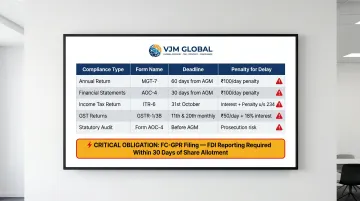
FDI Reporting: Form FC-GPR
After the Indian company receives foreign investment from the Singapore parent, it must file Form FC-GPR (Foreign Currency - Gross Provisional Return) on the RBI FIRMS portal within 30 days of allotment of shares. This is required under the Foreign Exchange Management (Mode of Payment and Reporting of Non-Debt Instruments) Regulations, 2019.
Missing this deadline triggers penalties and can block future FDI transactions — even if all ROC filings are current.
Common mistake: Many first-time foreign investors miss this deadline, assuming ROC filings are sufficient. FC-GPR is separate and mandatory.
Ongoing Annual Compliance
| Compliance | Form | Deadline | Penalty for Delay |
|---|---|---|---|
| Annual Return | MGT-7 | Within 60 days of AGM | INR 100 per day |
| Financial Statements | AOC-4 | Within 30 days of AGM | INR 100 per day |
| Income Tax Return | ITR-6 | 31 October (for non-audit cases) | Interest + penalty |
| GST Returns | GSTR-1/3B | Monthly/Quarterly | Late fees + interest |
| Statutory Audit | Audit Report | Before AGM | Non-compliance risks prosecution |
Beyond recurring annual filings, your Chennai entity will likely need several one-time registrations depending on its activities.
Additional Registrations
GST Registration:
- Mandatory above INR 40 lakh turnover for goods; INR 20 lakh for services (in Tamil Nadu)
- Interstate supply triggers mandatory registration regardless of turnover
Import Export Code (IEC):
Companies engaged in import or export activities must obtain an IEC from the Directorate General of Foreign Trade (DGFT) before commencing cross-border trade.
Shops & Establishment Registration:
Required under the Tamil Nadu Shops and Establishments Act, 1947 for businesses operating in Tamil Nadu.
VJM Global handles post-registration compliance for Singapore businesses entering India — from FC-GPR filings and ROC submissions to GST returns and statutory audits — so you don't need a full in-house finance team on the ground.
Common Mistakes Singapore Businesses Make When Registering in Chennai
Assuming No Indian Resident Director Is Required
Section 149(3) of the Companies Act 2013 mandates that at least one director must be a resident of India—present for at least 182 days in the preceding calendar year. 100% Singapore-owned companies are not exempt. Failure to appoint a resident director will block incorporation. Singapore businesses that overlook this step typically discover the gap only when MCA rejects their SPICe+ filing.
Skipping Apostille and Notarisation of Singapore Documents
All Singapore company documents submitted to Indian authorities must be apostilled under the Hague Convention. In some cases, certified English translations are also required. Both are common causes of filing delays—without properly apostilled documents, the MCA will reject the SPICe+ submission outright.
Proceeding Without Confirming FDI Route Eligibility
Some sectors require government approval via the Foreign Investment Facilitation Portal (FIFP) before incorporation. Entering the wrong NIC (National Industrial Classification) code in SPICe+ can create downstream compliance complications, affecting GST registration, EPFO/ESIC applicability, and FDI sectoral cap verification. Confirming FDI route eligibility and the correct NIC code before filing prevents these complications from compounding across every subsequent compliance obligation.
Frequently Asked Questions
Can I register my company online in India?
Yes, the entire company registration process in India is conducted online through the MCA portal, covering document submission, fee payment, and receipt of the Certificate of Incorporation — no physical visit required.
How to register a company in Chennai?
Obtain a Digital Signature Certificate (DSC) and Director Identification Number (DIN), reserve a company name via RUN, prepare the MOA and AOA, file the SPICe+ form on the MCA portal, pay applicable fees, and receive the Certificate of Incorporation issued by the ROC, Tamil Nadu.
How much does it cost to register a company in Chennai?
Government fees are NIL for authorised share capital up to INR 10 lakh; above that, fees scale based on capital amount. Additional costs include name reservation (INR 1,000), state-specific stamp duty, DSC procurement, and professional advisory fees.
Can a Singapore company own 100% shares in an Indian subsidiary?
Yes, 100% FDI is permitted in most sectors under the Automatic Route, meaning Singapore companies can hold full ownership of their Indian subsidiary without government approval. Exceptions include regulated sectors such as defence (above 74%), multi-brand retail, and certain media sectors.
Do Singapore businesses need a local Indian director to register in India?
Yes, the Companies Act 2013 mandates at least one director must be a resident of India (present for 182+ days in the preceding calendar year). Singapore companies can appoint a nominee director or hire a local professional to fulfil this requirement.
What is the India-Singapore CECA and how does it benefit Singapore businesses?
The Comprehensive Economic Cooperation Agreement (CECA), in force since 2005, reduces tariffs, facilitates services trade, and provides a framework for investment protection and dispute resolution between India and Singapore. This lowers market entry barriers and strengthens legal protections for Singapore investors operating in India.
Ready to establish your Chennai operations? VJM Global has supported businesses across the USA, UK, Australia, and Singapore with full-service company registration, FDI advisory, and post-incorporation compliance services. Our team of chartered accountants and business setup specialists ensures your incorporation is completed accurately and on time. Contact us at [email protected] or +91 9891576441 to get started.