This hybrid entity has been governed by the Limited Liability Partnerships Act since it commenced on 11 April 2005. Yet many new business owners still confuse LLPs with Limited Partnerships (LPs) and private limited companies, a mix-up that creates real compliance uncertainty. Get the entity choice wrong, and you're stuck with liability exposure or filing obligations you never anticipated.
This guide unpacks the Act's core provisions: legal status, partner liability, registration, ongoing compliance duties, and how the LLP stacks up against Singapore's other business structures.
Key Takeaways
- An LLP is a separate legal entity under the LLP Act 2005, distinct from its partners and a Limited Partnership
- Formation needs at least 2 partners and one manager ordinarily resident in Singapore
- Liability is capped at each partner's agreed contribution, except for that partner's own wrongful acts
- LLPs file an annual solvency/insolvency declaration rather than audited financial statements
- ACRA (Registrar of LLPs) administers the Act and the Bizfile registration portal
What Is the Limited Liability Partnership Act in Singapore?
The Limited Liability Partnerships Act 2005 (Chapter 163A) gave Singapore a middle option between a general partnership and a private limited company. Before 2005, professional practices and small enterprises either accepted unlimited personal liability as partners or took on the heavier compliance load of a company.
The LLP Act created a third path: a body corporate that runs like a partnership internally but shields partners the way a company shields shareholders.
Who typically uses it? Law firms, accounting practices, architectural consultancies, and SMEs that want liability protection without a full corporate compliance load.
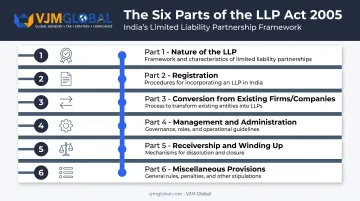
The Act is organised across several Parts:
- Nature of the LLP (legal status and capacity)
- Registration
- Conversion from existing firms or private companies
- Management and administration
- Receivership and winding up
- Miscellaneous provisions (plus seven Schedules)
LLP Act vs. Limited Partnerships Act 2008
Don't confuse the two. A Limited Partnership under the separate 2008 Act has no separate legal personality at all, and it must have at least one general partner carrying unlimited liability. An LLP, by contrast, is its own legal entity where every partner enjoys limited liability. Similar names, different legal results.
In practice, ACRA administers the LLP Act through a dedicated Registrar of Limited Liability Partnerships. That office handles registration, enforcement, and the public register.
The framework has tightened with Singapore's transparency rules. The Companies and Limited Liability Partnerships (Miscellaneous Amendments) Act 2024, which commenced on 16 June 2025, requires LLPs to keep a Register of Registrable Controllers from the moment of registration—no more 30-day grace period.
Key Legal Features of an LLP Under the Act
Separate Legal Personality and Perpetual Succession
Section 4 makes an LLP a body corporate, legally distinct from its partners, with perpetual succession. A partner leaving, retiring, or passing away doesn't dissolve the LLP or interrupt its existence.
Under Section 5, that separate status gives the LLP capacity to:
- Sue and be sued in its own name
- Own and dispose of property
- Execute deeds
A common seal is optional. Deeds can be signed by two partners, or by one partner before an attesting witness.
Limited Liability Protection
Section 12 sets the liability rule. The LLP's obligations are its own, so a partner isn't personally on the hook for the entity's debts simply by being a partner.
There's an important carve-out, though:
- A partner remains personally liable for their own wrongful act or omission
- A partner is not liable for a co-partner's wrongdoing
In other words, limited liability protects you from your partners' mistakes, not your own.
Partners, Managers and Agency
Under Section 13, every partner acts as an agent of the LLP and can bind it in ordinary business dealings, unless the counterparty already knows that partner lacks authority.
Section 29 requires every LLP to have at least one manager. That manager must be:
- A natural person
- At least 18 years old and of full legal capacity
- Ordinarily resident in Singapore
The manager is personally responsible for statutory compliance failures, including late accounts or missed declarations—so it is not a title to hand out lightly.
Registration and Compliance Requirements Under the Act
Eligibility is broad. Under Section 28, any two or more persons, individuals or corporate bodies, associated for a lawful profit-making business may register an LLP.
Registration runs through ACRA's Bizfile portal in two steps:
- Name reservation - costs S$15, and an approved name stays reserved for up to 120 days before release
- Registration lodgement - filing the registration statement with partner and manager particulars, alongside a S$100 registration fee
Most straightforward applications clear within a day of payment; more complex cases involving referral authorities can take between 14 and 60 days.
Ongoing Statutory Duties
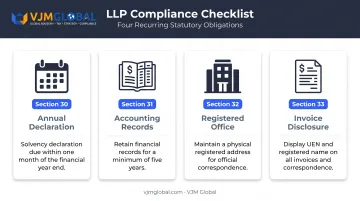
Once registered, an LLP carries several recurring obligations:
- Annual declaration under Section 30: managers must declare solvency within 15 months of registration, then at least once each calendar year. Late fees are S$300 (within 3 months) or S$600, plus fines up to S$5,000
- Accounting records under Section 31: retained for at least 5 years, sufficient to produce a true-and-fair profit-and-loss account
- Registered office under Section 32: a physical Singapore address for official notices
- Invoice disclosure under Section 33: the LLP's name, UEN, and its limited liability status must appear on business correspondence
Existing firms or private companies can also convert into an LLP under Part IV, though the rules are strict:
- A firm must bring across all its existing partners and no one else
- A private company must do the same with its shareholders, and only if no outstanding security interest sits over its assets
Navigating this process from overseas is where firms like VJM Global typically help. Foreign owners can get a clear read on whether an LLP or Pte Ltd fits, then support with entity-formation filings and the accounting and tax compliance that follow registration.
Winding Up and Dissolution Under the Act
An LLP can be wound up in one of two ways: voluntarily, by resolution of its partners, or compulsorily, through the High Court under Section 39 and the Fifth Schedule.
Grounds for court-ordered winding up include:
- Operating with fewer than 2 partners for more than 2 years
- Inability to pay debts, including an unpaid debt over S$10,000 left unsatisfied for 3 weeks after formal demand
- The court's opinion that winding up is just and equitable
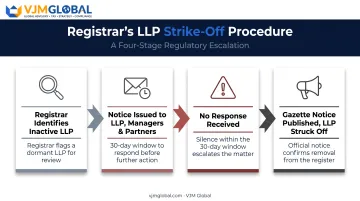
The Registrar also holds power under Section 63 to strike off an LLP believed to be defunct. The process starts with a letter giving the LLP, its managers, and partners 30 days to show cause why it shouldn't be struck off, followed by Gazette notice if no response arrives.
Striking off does not erase partners' or managers' existing liabilities, nor does it block the High Court from ordering a winding up later.
LLP vs Other Business Structures in Singapore
Choosing between an LLP, a Limited Partnership, and a private limited company comes down to liability appetite and growth plans.
| Factor | Limited Partnership | LLP | Private Limited Company |
|---|---|---|---|
| Legal personality | Not separate from partners | Separate legal entity | Separate legal entity |
| Liability | General partner unlimited; limited partner capped | All partners protected, except for own wrongful acts | Shareholders generally not personally liable |
| Routine compliance | Lighter, informal | Annual declaration, no AGM | AGM, annual return, possible audit |
| Capital raising | Limited | No share mechanism | Can allot shares to raise funds |
A private limited company remains Singapore's closest equivalent to what other jurisdictions call an LLC. It has directors, shareholders, and stricter compliance, including AGMs and audit thresholds for larger entities. In exchange, it offers far easier access to external capital and stronger market credibility with investors.
Professional service firms that want liability protection without giving up partnership-style decision-making tend to favour the LLP. Businesses chasing outside investment or planning to scale fast usually find a Pte Ltd serves them better.
Frequently Asked Questions
What is a limited liability partnership (LLP) under the Limited Liability Partnership Act in Singapore?
An LLP is a body corporate with legal personality separate from its partners, registered under the LLP Act 2005. It combines the flexibility of a partnership with the limited liability protection normally associated with a company.
What is the difference between an LLC and an LLP in Singapore?
Singapore doesn't have an "LLC" entity type. The closest equivalent is the private limited company (Pte Ltd), which differs from an LLP in shareholder structure, compliance obligations, and its ability to raise external capital.
Who administers the Limited Liability Partnership Act and where must LLPs register?
The Accounting and Corporate Regulatory Authority (ACRA) administers the Act through the Registrar of Limited Liability Partnerships. Registration is completed through ACRA's BizFile portal.
Can foreigners be partners or managers of a Singapore LLP?
Yes, foreigners can be partners, including foreign companies. However, at least one manager must be ordinarily resident in Singapore.
Does an LLP need to file audited financial statements?
No. LLPs file an annual solvency or insolvency declaration rather than audited financial statements, though proper accounting records must still be kept for at least 5 years.
Can an existing partnership or company convert into an LLP?
Yes, conversion is possible under Part IV of the Act. A firm must bring across all existing partners, and a private company must bring across all shareholders, subject to the Second and Third Schedule requirements.