Introduction
You don't need to be a US citizen or resident to form a Delaware LLC. Founders in Sydney, Melbourne, and beyond do it regularly, often to serve US clients, accept US payments, or build credibility with American customers.
Here's the catch: forming the entity is the easy part. Many founders assume that filing paperwork with Delaware automatically solves tax, banking, and compliance questions. It doesn't.
Tax treatment, EIN access, bank approval, and ongoing state filings all depend on who owns the LLC, what it does, and where it operates. Skip that analysis and you risk a dormant entity, a rejected bank application, or an unexpected IRS filing obligation.
This guide walks through the formation steps, what to prepare before and after filing, the tax and compliance factors that actually matter, and situations where Delaware might not be the right fit at all.
Key Takeaways
- Foreign nationals can own a Delaware LLC outright with a Delaware registered agent and Certificate of Formation.
- An EIN, operating agreement, and bank account usually follow; exact needs depend on ownership and activity.
- A Delaware LLC does not remove US tax duties or grant visa, work, or immigration benefits.
- IRS, FinCEN, banking, and Delaware requirements change; verify current rules before filing anything.
- Compare Delaware with the state where you'll operate; reputation alone is not a strategy.
How to Form an LLC in Delaware as a Foreign National
Step 1: Confirm That a Delaware LLC Fits the Business
Delaware suits certain business models better than others. Founders commonly choose it for:
- Remote or online service businesses with no fixed US location
- International e-commerce ventures selling into the US
- Companies that need a US entity purely to invoice clients or accept payments
Forming in Delaware is not the same as being licensed to operate elsewhere. If your business has employees, an office, inventory, or substantial activity in another state (California or New York, for example), you'll likely need to foreign-qualify there too, on top of your Delaware formation.
Delaware LLCs also aren't always the right choice. Venture-backed startups planning multiple equity classes usually need a Delaware corporation, not an LLC.
Certain regulated industries (financial services, insurance) have separate licensing hurdles regardless of entity type. If your home country taxes US LLCs unfavourably, a different structure might save headaches later.
Step 2: Choose and Verify the LLC Name
Delaware requires your LLC name to be distinguishable from every other entity already registered in the state, and it must include a designator such as "LLC," "L.L.C.," or "Limited Liability Company."
Before filing:
- Run a search on the Delaware Division of Corporations entity database
- Check the US Patent and Trademark Office for conflicting trademarks
- Confirm domain availability if you're building a website around the name
Reserving a name isn't the same as forming the LLC. A name reservation just holds the name temporarily. Availability gets rechecked at the point you actually file, so don't assume a name you reserved months ago is still guaranteed.
Step 3: Appoint a Delaware Registered Agent
Every Delaware LLC needs a registered agent with a physical Delaware street address, available during normal business hours to accept legal documents and state notices on the company's behalf.
This matters because most foreign founders have no Delaware address of their own. A registered agent solves that requirement, but their address isn't your operating address, mailing address, or bank address: it's strictly for receiving official mail and service of process.
When choosing an agent, look for:
- A track record of forwarding documents promptly
- Clear renewal pricing with no hidden fees
- Reasonable privacy practices
- Responsiveness if the state or a court needs to reach your company
Step 4: Prepare and File the Certificate of Formation
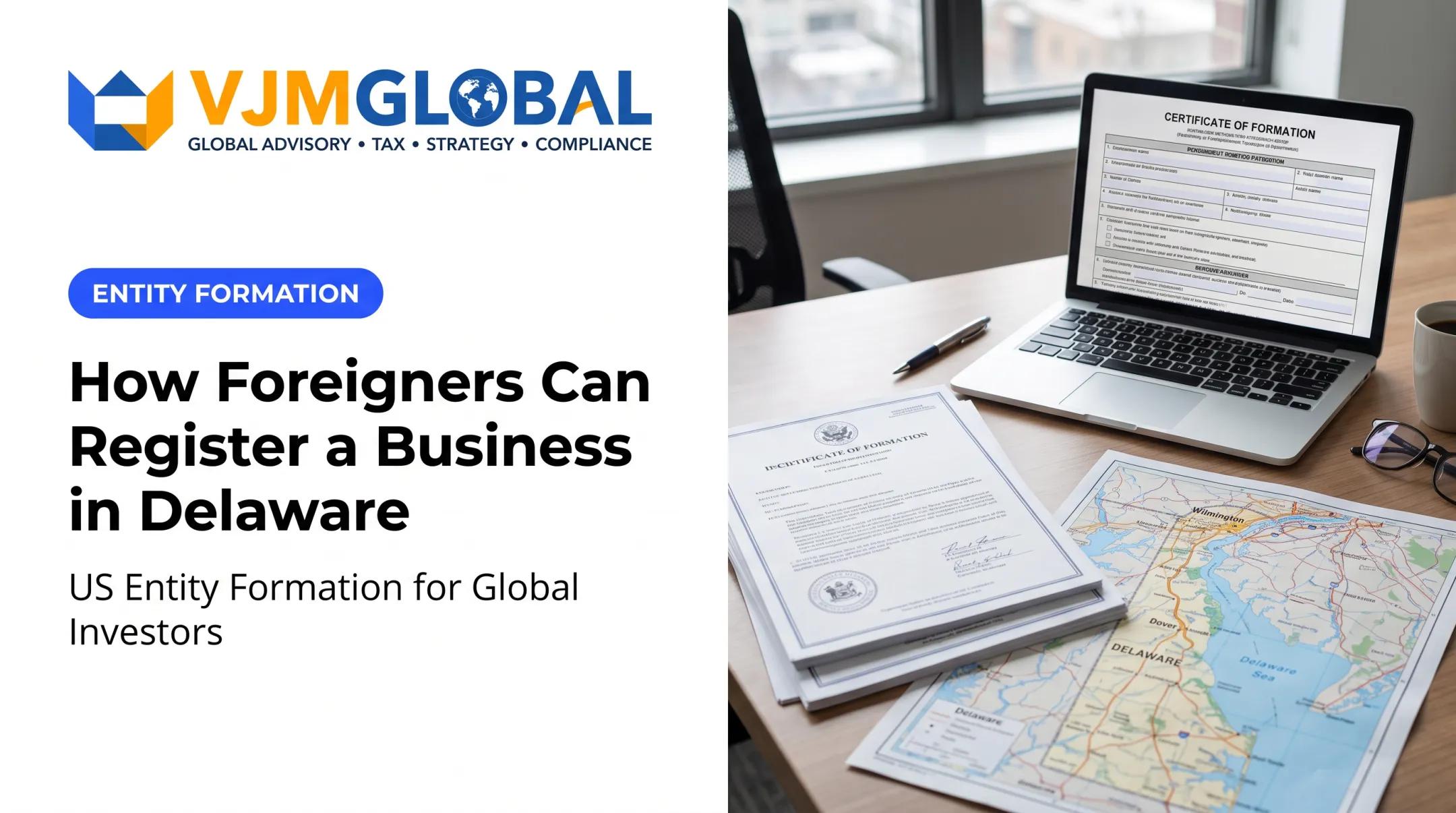
Delaware's Certificate of Formation is short. It generally requires the LLC's name, the registered agent's name and Delaware address, and the signature of an authorised person whose name is printed beneath the signature.
Delaware's current fee schedule lists the standard filing fee, plus optional expedited tiers for same-day, 24-hour, two-hour, or one-hour processing at additional cost. Fees and processing windows change, so confirm the current Delaware fee schedule before you submit payment.
Once filed, keep these on hand indefinitely:
- The filed Certificate of Formation
- Payment confirmation
- Certified copies or apostilles, if a foreign bank, investor, or government body later asks for one
Banks and overseas regulators often request certified copies months or years later. Retrieving them after the fact is slower and costlier than saving them now.
Step 5: Create the Operating and Ownership Documents
Delaware doesn't require you to file an operating agreement publicly, but that doesn't mean you should skip writing one. Under Delaware law, an LLC agreement is the document that actually governs how the company runs. Without it, disputes between members default to statutory rules that may not reflect anyone's intentions.
A solid operating agreement should cover:
- Ownership percentages and capital contributions
- Management authority (member-managed vs. manager-managed)
- Profit and loss distribution
- Voting rights and transfer restrictions
- Dispute resolution procedures
- How new members are admitted or removed
Keep this document, your passport details, tax forms, and banking application consistent. A mismatched name or address across these documents is one of the most common reasons banks and the IRS flag applications for review.
Step 6: Apply for an EIN and Establish Operations
An EIN is typically required to open a US bank account, hire staff, file taxes, and onboard certain vendors. Applicants without a Social Security Number or ITIN can't use the IRS's online EIN application. Instead, the IRS directs international applicants to apply by phone, fax, or mail.
According to the IRS instructions for Form SS-4, international applicants can call 267-941-1099 (Monday–Friday, 6 a.m.–11 p.m. Eastern time), fax the form, or mail it to the IRS's international operation in Cincinnati. Mail processing generally takes several weeks, so apply early if you're on a deadline.
Opening a bank account is a separate approval process. Banks independently check identity, beneficial ownership, source of funds, and business model. An EIN and formation certificate get you in the door, not automatic approval.

What to Prepare and Understand Before and After Formation
Preparation directly affects whether your applications get approved on the first try. Gather these items before filing and as you open banking and tax accounts:
- Passport or other government-issued ID
- Proof of residential address
- Ownership and management details
- A clear business description
- Formation documents once filed
- Source-of-funds information for banking
Suitability and Business Activity
Map out where your customers, employees, contractors, inventory, and management decisions will actually sit before choosing Delaware. That location, not your formation state, often determines licensing, sales-tax exposure, and reporting obligations back in your home country.
Entity and Ownership Structure
A single-member LLC is simpler to manage but still needs clean ownership records. A multi-member LLC needs a more detailed operating agreement covering voting and profit splits. You can own the LLC directly, through another entity, or alongside co-founders. Each option changes how taxes, banking due diligence, and beneficial-ownership reporting apply.
Registered Agent, Address, and Privacy
Don't confuse your registered-agent address with your principal business address, mailing address, or virtual office. Delaware's public filings show limited member information, but that doesn't mean privacy elsewhere. Banks and tax authorities will still ask for full beneficial-ownership details regardless of what Delaware discloses publicly.

Formation Cost and Ongoing Cost
Separate one-off costs from recurring ones:
| Cost Type | Examples |
|---|---|
| One-off | State filing fee, initial registered-agent setup |
| Recurring | Annual registered-agent renewal, Delaware annual tax, bookkeeping, licences |
According to Delaware's official franchise tax instructions, LLCs owe an annual tax due by June 1 each year, and Delaware LLCs aren't required to file a separate annual report. Late payment triggers a penalty plus monthly interest.
Always check the live Delaware page before budgeting. Older published materials sometimes show outdated figures, and service-provider packages can bundle in extra charges the state itself doesn't require.
Tax, Banking, and Ongoing Compliance Factors
Most of the real risk in a foreign-owned Delaware LLC shows up after formation: once tax classification, payment flows, and reporting obligations need to work together correctly.
Federal Tax Classification and Filing
By default, a single-member LLC is disregarded for federal tax purposes, and a multi-member LLC is taxed as a partnership — unless you elect corporate treatment. Neither outcome means "no US tax."
A foreign-owned, single-member US disregarded entity is still treated as a corporation for limited reporting purposes. It generally must file a pro forma Form 1120 with Form 5472 attached when it has reportable transactions with related parties.
Whether income counts as US-source or "effectively connected" depends on the type of income and where the work happens. There's no blanket rule that a foreign-owned Delaware LLC pays zero US tax. VJM Global's team routinely works through these classifications, including positions under the Australia–US tax treaty and similar agreements, before recommending a filing approach.
Delaware and Other State Obligations
Delaware's annual tax obligation doesn't replace requirements in states where you actually do business. If your LLC has a physical presence, employees, or substantial sales activity in another state, you may need to register, collect sales tax, or file reports there too — regardless of where you formed the entity.
Beneficial Ownership and Regulatory Reporting
FinCEN's beneficial ownership reporting rules have shifted significantly. As of FinCEN's current BOI guidance, US-formed companies are generally exempt from filing BOI reports, while certain foreign entities registered to do business in the US remain subject to reporting unless another exemption applies. Given ongoing litigation and rule changes, check FinCEN's page directly before assuming your LLC is or isn't required to file.

Banking, Payments, and Financial Separation
Opening a business account typically requires:
- Formation documents and EIN confirmation
- Identification for anyone with 10% or more ownership
- A business website, contracts, or other proof of activity
- Expected transaction volumes and source-of-funds information
Formation doesn't guarantee bank approval. Some providers require a US address, a video interview, or in-person verification — policies vary widely between institutions. Once an account is open, keep personal and business funds strictly separate, and use identical company details across your bank, tax filings, invoices, and contracts.
VJM Global works with foreign investors and multinational businesses on cross-border accounting, tax, audit, and entity-setup matters across the US, UK, Australia, and India. If you're weighing how a Delaware LLC interacts with an Australian tax position, confirm that cross-border filing, treaty analysis, and reporting support match what your business needs before you lock in a structure.
Common Mistakes, Troubleshooting, and Alternatives
Founders trip up on predictable issues:
- Assuming Delaware equals tax savings — without reviewing home-country rules first
- Using the registered agent's address as the operating or banking address
- Submitting inconsistent ownership details across formation, EIN, and bank paperwork
- Missing annual deadlines for the Delaware tax or federal filings
If an EIN application, bank application, or state filing gets rejected, check:
- Name consistency across every document
- Responsible-party identification details
- Whether your business description matches your actual activity
- Whether the address type (residential vs. registered agent) is correctly labelled
Delaware isn't automatically the best choice. If your business operates entirely in one other US state, forming there directly can save you a foreign-qualification filing.
Founders raising venture capital often need a Delaware corporation, not an LLC. Talk to a US tax professional and an adviser in your home country if ownership is complex, you plan to hire in the US, or you expect to raise investment later.
Conclusion
Forming a Delaware LLC as a foreign national comes down to a short checklist:
- Choose a compliant name
- Appoint a registered agent
- File the Certificate of Formation
- Document ownership properly
- Obtain an EIN where needed
- Set up compliant operations
The filing itself is rarely where things go wrong. Tax classification, banking approval, foreign qualification, and ongoing reporting cause far more problems later.
Verify current government requirements before you file. Get cross-border advice before assuming Delaware’s reputation will solve tax or compliance questions on its own.
Frequently Asked Questions
Can a non-US resident form an LLC in Delaware?
Yes. Non-US residents can generally form and own a Delaware LLC outright. You'll still need a Delaware registered agent, valid identification, and to handle tax, banking, and compliance requirements separately.
How do I form an LLC in Delaware?
Choose and verify a compliant name, appoint a Delaware registered agent, and file the Certificate of Formation with the state. Then draft an operating agreement, apply for an EIN if needed, and complete any post-formation registrations that apply to your activity.
What documents do I need to form an LLC in Delaware?
You'll typically need the filed Certificate of Formation, registered-agent details, government ID, ownership information, an operating agreement, and supporting documents for your EIN or bank application. Confirm exact requirements with current official sources.
Which state is best for foreigners to open an LLC?
It depends on where your business operates, who owns it, your tax profile, and whether you plan to raise investment, not your nationality. Compare Delaware directly against the state where you'll actually run the business.
Is it better to incorporate in Florida or Delaware?
It comes down to where you operate. Florida has its own filing fees and annual report requirements, while Delaware skips the annual report but charges a yearly tax. If your business runs in Florida, forming there directly may avoid a second registration.
What are the advantages of forming an LLC in Delaware?
Delaware offers an established body of business law, flexible LLC governance, and limited public visibility into ownership records. These are structural advantages. They don't guarantee tax savings or remove obligations in the state where your business actually operates.