Introduction
Singapore businesses increasingly look beyond Asia-Pacific for their next growth frontier — and the UAE mainland has become the preferred destination. Bilateral merchandise trade between the UAE and Singapore reached $18.67 billion in 2024, with over 600 Singapore-based firms already operating in the UAE across fintech, healthcare, and infrastructure.
The most commonly chosen structure for that expansion is the UAE Limited Liability Company (LLC). As a mainland entity, it opens direct access to UAE government contracts, all seven emirates, and the broader MENA region.
This guide covers everything a Singapore business owner needs to know:
- What a UAE LLC is and how it differs from free zone structures
- Why it makes strategic sense for Singapore-based expansion
- How the formation process works, step by step
- What it costs (in both AED and SGD)
- Common mistakes to avoid before you commit
Key Takeaways
- Singapore companies can own 100% of a UAE LLC in most sectors, with shareholder liability capped at capital contribution
- Key advantages: 0% personal income tax, 9% corporate tax on profits above AED 375,000, and eligibility for UAE government tenders unavailable to free zone companies
- Formation takes 6–8 weeks across three phases: pre-approval, legal documentation, and post-registration activation
- Setup costs run AED 20,000–30,000 (~SGD 7,000–10,300), plus annual office rent of AED 50,000–200,000
- Free zone structures may suit Singapore companies focused purely on international trade or digital services with no UAE-resident customer base
What Is a UAE LLC? Key Facts for Singapore Entrepreneurs
A UAE Limited Liability Company is a mainland business entity governed by Federal Decree-Law No. 32 of 2021 on Commercial Companies. Shareholders' personal liability is capped at their capital contribution — the company is a separate legal entity from its owners. Structurally, it mirrors a Singapore Private Limited (Pte Ltd) company — but operates under UAE law and registers with the Department of Economy and Tourism (DET, formerly DED) rather than ACRA.
Core Structural Facts
| Feature | UAE LLC | Singapore Pte Ltd |
|---|---|---|
| Minimum shareholders | 1 | 1 |
| Maximum shareholders | 50 | 50 |
| Foreign ownership | 100% (most sectors) | 100% |
| Governing body | DET / UAE CCL | ACRA |
| Constitutive document | Notarised MoA | Constitution |
| Name suffix | Must include "LLC" | Must include "Pte Ltd" |
Key points for Singapore owners specifically:
- No minimum paid-up capital is legally mandated, though AED 100,000–150,000 is commonly referenced for practical purposes
- Physical UAE mainland office space is mandatory — a registered tenancy contract (via Ejari) is a required document for DET registration
- The company's name must end in "LLC" per Cabinet Resolution No. 77 of 2022
Understanding these structural requirements sets the stage for one of the most consequential decisions Singapore entrepreneurs face: mainland LLC versus free zone entity.
How It Differs from a UAE Free Zone Entity
A mainland LLC can trade directly with UAE government bodies and across all seven emirates without restriction. Free zone entities cannot trade directly on the UAE mainland — to sell locally, they must either work through a licensed mainland distributor or establish a separate mainland branch. For Singapore businesses targeting UAE government contracts or broad local market access, this operational difference typically determines which structure makes sense.
Why Singapore Businesses Are Expanding to the UAE via an LLC
Two Hubs, Two Markets
Singapore anchors Southeast Asia and the Asia-Pacific. The UAE — particularly Dubai — is the gateway to the Middle East, Africa, and South Asia. These markets don't overlap, which makes a UAE LLC a genuine expansion play rather than duplication of your existing Singapore structure.
The numbers back this up: Singapore holds the largest investment position in the UAE of any GCC nation, and investment from Singapore in the UAE climbed from $2.7 billion in 2021 to $3.03 billion in 2022.
Tax Efficiency
From a Singapore company's perspective, the UAE mainland tax environment is attractive:
- 0% personal income tax on salaries and dividends
- 9% corporate tax on profits above AED 375,000 — with 0% below that threshold
- 5% VAT once annual turnover crosses AED 375,000
The Singapore-UAE Double Taxation Agreement (DTA), effective 1 September 2019, means cross-border income flows between your Singapore and UAE entities can be structured to avoid dual taxation. Note that the DTA provides relief mechanisms, not automatic exemptions — Singapore directors and shareholders still need to evaluate their IRAS position independently.
Market Access and Credibility
A UAE mainland LLC unlocks access that other structures simply cannot provide:
- Bid on UAE government tenders — an option closed to free zone entities
- Operate warehousing, retail, and wholesale across all seven emirates without a mainland distributor
- Reach a consumer base of ~11 million in the UAE and 61.2 million across the broader GCC
- Open corporate bank accounts more easily — mainland LLCs carry more credibility with UAE banks than free zone or offshore structures
Visa Sponsorship
A UAE LLC can sponsor investor visas, employee visas, and dependent visas. For Singapore founders deploying staff to the UAE, this means your entity itself handles legal residency — no separate sponsorship arrangements needed.
How to Register a UAE LLC as a Singapore Business: Step-by-Step
Formation follows three broad phases. Straightforward setups take 6–8 weeks end-to-end; regulated sectors or complex Singapore corporate ownership structures typically take longer.
Phase 1: Pre-Approval and Planning (~1–2 weeks)
Step 1: Select your business activities. The DET maintains a register of over 3,000 approved activities. Your selection determines the license type (commercial, professional, or industrial) and any additional ministry approvals required. Map your Singapore SSIC codes against the DET activity list early — amending the wrong activity code later adds cost and time.
Step 2: Reserve your trade name. The name must end in "LLC," must not duplicate an existing UAE-registered entity, and must comply with UAE naming guidelines.
Phase 2: Legal Documentation and DED Registration (~2–4 weeks)
Three parallel workstreams run concurrently:
- DED initial approval: Submit passport copies, business activity details, and trade name reservation to obtain preliminary approval.
- MoA drafting and notarisation: for a Singapore corporate shareholder, the MoA package must include a company resolution to form a UAE LLC and a Power of Attorney authorising a local representative. Both documents require attestation through the Singapore Academy of Law (SAL), followed by the UAE Embassy in Singapore. This chain adds 1–2 weeks — build it into your timeline.
- Office lease and Ejari registration: Secure physical office space and register the tenancy contract with the Ejari system (Dubai Land Department).
Document attestation note: Since 20 January 2021, legalisation of Singapore government-issued documents is handled by the Singapore Academy of Law, not the Ministry of Foreign Affairs. Step 2 is then attestation at the UAE Embassy in Singapore.
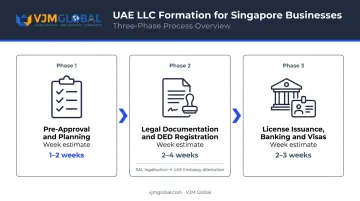
Phase 3: License Issuance, Banking, and Visas (~2–3 weeks)
Once documents are approved, the DET issues the trade license and the LLC is legally authorised to begin operations.
Two immediate priorities follow:
- Corporate bank account: Emirates NBD, ADCB, and Mashreq are commonly used for UAE business accounts. All require in-person visits or UAE-based signatories plus full KYC documentation. Singapore founders should factor travel into their timeline or arrange a local authorised representative.
- Investor and employee visas: Apply through the LLC once the trade license is issued.
VJM Global supports Singapore companies through each of these phases: document preparation, attestation coordination, DED filing, and banking introductions. Given how often delays trace back to attestation errors or missing resolutions, having professionals manage the paperwork from the start makes a measurable difference.
Key Requirements, Documents, and Costs for Singapore Companies
Setting up a UAE LLC as a Singapore business involves specific document requirements, a structured attestation process, and upfront costs that differ from individual foreign investors. Here's what to prepare.
Documents Required
Singapore corporate shareholders face additional attestation steps compared to individual foreign investors:
Standard documents (all shareholders):
- Passport copies of all shareholders and managers
- Proof of UAE office address (Ejari-registered tenancy contract)
Additional documents for Singapore-registered corporate shareholders:
- ACRA BizFile+ Business Profile
- Certificate of Incorporation
- Memorandum and Articles of Association
All Singapore corporate documents must be:
- Notarised in Singapore (via a notary public)
- Legalised at the Singapore Academy of Law (SAL)
- Attested by the UAE Embassy in Singapore
This process adds approximately 1–2 weeks to the total formation timeline.
Factor in the attestation timeline early — it directly affects how soon costs are incurred and when operations can begin.
Cost Breakdown
| Cost Item | Estimated Range (AED) | Approx. SGD |
|---|---|---|
| DED registration fees | 5,000 – 10,000 | 1,720 – 3,450 |
| Trade license fees | 10,000 – 15,000 | 3,450 – 5,170 |
| Notary and attestation | 2,000 – 3,000 | 690 – 1,035 |
| Municipality and regulatory fees | 1,000 – 3,000 | 345 – 1,035 |
| Corporate bank account setup | 2,000 – 10,000 | 690 – 3,450 |
| Employee visa (per person) | 5,000 – 7,000 | 1,725 – 2,415 |
| Total setup (excl. rent) | ~20,000 – 30,000 | ~6,900 – 10,340 |
| Annual office rent (additional) | 50,000 – 200,000 | 17,225 – 68,920 |
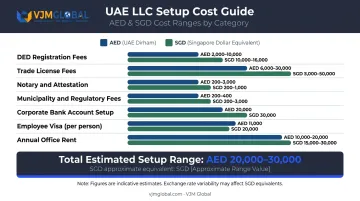
SGD conversions based on an approximate rate of 1 AED = 0.345 SGD and are subject to change.
A realistic all-in first-year budget for a lean Singapore SME setting up a UAE LLC — including a modest office and one visa — is closer to AED 80,000–120,000.
Sectors Requiring a UAE National Shareholder
100% foreign ownership is not permitted for activities on the UAE strategic list, including:
- Security, defence, and military activities
- Telecommunications
- Banks, exchange, insurance, and currency production
- Commercial agencies
- Fish and natural pearl catching
Singapore companies in these sectors must engage a UAE national majority shareholder (minimum 51%). For certain professional activity categories, a Local Service Agent (LSA) agreement offers an alternative: a UAE national assists with licensing and government liaison without holding equity. This keeps full operational and profit control with the foreign investor.
Mainland LLC vs Free Zone: The Right Structure for Singapore Businesses
Side-by-Side Comparison
| Factor | Mainland LLC | Free Zone LLC |
|---|---|---|
| Foreign ownership | 100% (most sectors) | 100% |
| UAE market access | Unrestricted | Requires mainland distributor |
| Government tenders | Eligible | Not eligible |
| Physical office | Mandatory | Flexi-desk often accepted |
| Corporate tax | 9% above AED 375,000 | 0% (qualifying free zone income) |
| Visa sponsorship | Yes | Yes |
When a Mainland LLC Is the Right Choice
A UAE LLC makes clear strategic sense when your Singapore business:
- Needs to bid on UAE government or public sector contracts
- Requires warehousing and physical distribution across multiple emirates
- Provides services directly to UAE-resident consumers or businesses
- Needs a UAE banking relationship recognised without trading restrictions
Not every Singapore business expanding to the UAE needs a mainland structure, though. A free zone setup may be the better fit in several common scenarios.
When a Free Zone May Be Better
A mainland LLC may not be justified if:
- Your entire model is international re-export or cross-border digital services with no UAE-resident customer base
- You are in early exploratory stages and cannot justify the full mainland cost commitment
- All revenue flows to and from outside the UAE
A practical test: if your business has no UAE customers, no UAE-based employees, and no government-facing contracts, a mainland LLC is likely overkill. UAE free zone rules permit full international trading at lower setup and running costs — making free zones the more efficient choice for internationally-focused operations.
Post-Formation Compliance and Common Pitfalls
Ongoing Compliance Obligations
Once your UAE LLC is operational, these are the recurring requirements:
- Annual trade license renewal — fees payable to the DET (Department of Economy and Tourism) each year
- Annual audited financial statements — UAE commercial law requires mainland LLCs to appoint a UAE-licensed auditor
- VAT registration — mandatory once taxable turnover exceeds AED 375,000; late registration attracts an AED 10,000 penalty
- Corporate tax registration — mandatory for all UAE-licensed juridical persons regardless of profit level, with annual returns due within 9 months of the financial year end
- Economic Substance Regulations (ESR) — companies conducting designated activities (finance, holding, IP, etc.) must submit an annual notification and ESR report
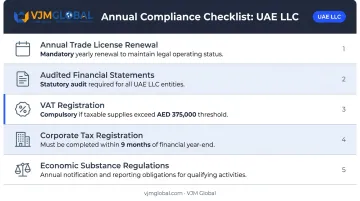
Knowing what's required is one thing — the harder part is avoiding the gaps that catch most Singapore companies off guard.
The Five Most Common Mistakes
Singapore companies consistently run into the same problems:
- Skipping attestation steps — Singapore company documents must go through the full SAL + UAE Embassy attestation chain. Missing any link causes DET rejections and 2–4 week delays
- Underestimating total costs — excluding annual office rent and visa renewals from the budget; the first-year all-in cost is significantly higher than setup fees alone
- Missing the VAT threshold — once taxable turnover crosses AED 375,000, registration is mandatory; missing it triggers an immediate AED 10,000 fine
- Wrong business activity code — activity selection directly determines license type, ministry approvals, and fees; amending it post-registration is expensive and time-consuming
- Overlooking Singapore tax exposure — a UAE LLC doesn't erase home-country obligations. Singapore-resident directors and shareholders must still assess their IRAS filing position on UAE-sourced income under the Singapore-UAE DTA
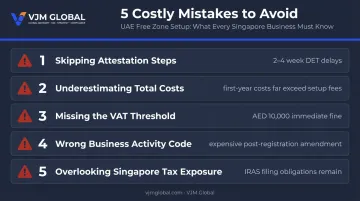
Frequently Asked Questions
What is an LLC in the UAE?
A UAE LLC (Limited Liability Company) is a mainland business entity governed by Federal Decree-Law No. 32 of 2021. Shareholders' liability is capped at their capital contribution, and the company operates as a separate legal entity from its owners.
Can a foreigner own 100% of an LLC in the UAE?
Yes, 100% foreign ownership has been permitted on the UAE mainland since November 2020 for most commercial, professional, and industrial activities. Exceptions include defence, certain telecommunications, banking, and insurance — these sectors still require a UAE national to hold majority ownership.
How do you set up an LLC in the UAE?
The process runs in sequence: reserve a trade name and get DED initial approval, then draft and notarise the Memorandum of Association. From there, secure an Ejari-registered office, submit documents to the DET for trade license issuance, and open a corporate bank account. End-to-end, expect 6–8 weeks.
How much does it cost to set up an LLC in the UAE?
Government and registration fees typically range from AED 20,000 to AED 30,000 (approximately SGD 6,900–10,340), excluding annual office rent which adds AED 50,000–200,000 depending on location and size, plus bank account setup and visa processing costs.
What is the difference between an LLC and a Ltd in the UAE?
In the UAE context, "LLC" and "Ltd" refer to the same structure — limited liability with shareholders' exposure capped at capital contribution. "LLC" is the standard designation for mainland companies under UAE commercial law; "Ltd" appears informally or in some free zone contexts but carries the same core principle.
What types of businesses can I start in Dubai with AED 50,000?
AED 50,000 can cover basic government registration and trade license fees for a professional services or consultancy LLC, but it does not cover mandatory office rent, visa fees, or bank account setup. A realistic first-year all-in budget for a lean UAE LLC — including a modest office and one visa — is closer to AED 80,000–100,000.