Introduction
More Singapore entrepreneurs are looking at Dubai than ever before. Bilateral merchandise trade between Singapore and the UAE reached SGD 27.9 billion in 2025, making the UAE Singapore's largest trading partner in the MENA region.
Geographic proximity enables direct flight access in under seven hours, while the UAE's zero personal income tax and rapidly growing GCC market create powerful commercial incentives. Over 600 Singapore companies already operate in the UAE, supported by a bilateral Comprehensive Economic Partnership Agreement concluded in 2023.
Yet a knowledge gap persists. While Singapore entrepreneurs intuitively grasp their domestic Private Limited Company (Pte Ltd) structure, the Dubai Limited Liability Company (LLC) is frequently misunderstood. Many assume it functions like a US-style pass-through LLC or mirrors Singapore's regulatory framework — leading to incorrect entity selection, setup delays, and avoidable compliance costs.
Understanding the true nature of a Dubai mainland LLC — its ownership rules, tax treatment, and market access rights — is essential before committing capital. This guide breaks down exactly how the structure works, where it differs from what Singapore entrepreneurs expect, and what to verify before you proceed.
Key Takeaways
- A Dubai LLC is the UAE's most common mainland business structure, where shareholders' liability is capped at invested capital
- 100% foreign ownership is now permitted for most commercial activities following the 2021 legal reforms, including for Singapore nationals
- Mainland LLCs trade freely across all 7 UAE emirates and the GCC market (combined GDP ~USD 2.1 trillion) without additional licenses
- Setup costs range from AED 15,000–35,000, with incorporation completed in 1–3 weeks through UAE's digital business registration portal
- Corporate tax rate of 9% on profits above AED 375,000 — versus Singapore's 17% headline rate — offers a meaningful tax advantage
What Is a Dubai LLC?
A Dubai Limited Liability Company (LLC) is a separate legal entity registered under UAE commercial law, governed by Federal Decree-Law No. 32 of 2021. The company's liabilities are distinct from the personal assets of its shareholders—meaning personal savings, property, and other holdings are shielded from business debts. This is a mainland entity regulated by the Department of Economy and Tourism (DET), not a free zone structure.
Ownership Structure and Foreign Participation
Under Article 71 of the Commercial Companies Law, an LLC requires a minimum of one shareholder and permits up to 50 shareholders. These can be individuals or corporate entities. The key reform came through Article 10: 100% foreign ownership is now the default rule for the majority of commercial and industrial activities. Singapore nationals can fully own a Dubai mainland LLC without requiring an Emirati partner.
However, nine "Strategic Impact" sectors remain restricted and may require UAE national partnership:
| Restricted Sector | Regulatory Authority |
|---|---|
| Security, defence, military activities | Ministry of Defence |
| Banking, exchange houses, financing | Central Bank of UAE |
| Insurance activities | Central Bank of UAE |
| Telecommunications | TDRA |
| Currency printing | Central Bank |
| Commercial agencies | Ministry of Economy |
| Hajj and Umrah services | Ministry of Economy |
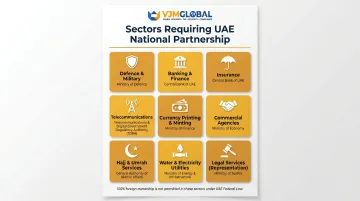
For most Singapore entrepreneurs operating in technology, professional services, trading, e-commerce, consulting, or industrial sectors, full foreign ownership applies without restrictions.
What a Dubai LLC Is NOT
Before setting up, it helps to clear up four common misconceptions:
- Not a US LLC: Unlike American LLCs, which are pass-through tax entities, a Dubai LLC is taxed at the entity level — 9% on profits above AED 375,000.
- Not a free zone company: A mainland LLC differs from a free zone entity in one critical way — free zone companies face restrictions on selling directly to the UAE mainland market, while a mainland LLC has unrestricted access across all seven emirates and the GCC.
- Not a sole establishment: UAE sole proprietorships carry unlimited personal liability. An LLC eliminates this risk entirely.
- LSA no longer required: The Local Service Agent requirement has been abolished for the majority of activities under 100% foreign ownership. Where it still applies, it's activity-specific — not a blanket rule.
Why the LLC Remains the Preferred Structure
For Singapore entrepreneurs targeting the UAE or GCC market directly, the mainland LLC offers something neither free zones nor branch offices can match: unrestricted trading rights across all seven emirates with no local market access limitations. That combination of full ownership, broad licensing, and direct market access makes it the default choice over alternative structures.
Types of Business Activities Permitted
A Dubai mainland LLC can engage in commercial trading, industrial production, and most professional services. The Department of Economy and Tourism currently approves over 2,000 business activities across its six license categories: Commercial, Industrial, Professional, Occupational, Tourism, and Agricultural.
Certain regulated sectors require additional approvals beyond DET:
| Sector | Approving Authority |
|---|---|
| Healthcare and medical services | Dubai Health Authority (DHA) / Ministry of Health |
| Education and training | Knowledge and Human Development Authority (KHDA) |
| Financial services | Central Bank / Securities and Commodities Authority |
| Telecommunications | TDRA |
| Legal services | Ministry of Justice |
| Oil and gas field services | Supreme Petroleum Council |
If your activity falls under a regulated sector, factor in the additional approval timeline — typically two to eight weeks depending on the authority.
Key Benefits of a Dubai LLC for Singapore Entrepreneurs
Limited Liability Protection
Shareholders' personal assets—including savings, property, and investments—are legally protected from business debts and claims. Liability is capped at the amount of capital each shareholder has contributed to the company. This mirrors Singapore's Pte Ltd structure, where directors and shareholders enjoy the same limited liability protection. For a Singapore entrepreneur accustomed to operating through a Private Limited Company, the LLC provides equivalent personal asset insulation under UAE commercial law.
Tax Efficiency Compared to Singapore
The UAE introduced a 9% corporate tax in 2023, applied only on taxable income exceeding AED 375,000. Compare this to Singapore's 17% headline corporate tax rate. While Singapore offers startup exemptions (75% exemption on the first SGD 100,000 and 50% on the next SGD 100,000 for three consecutive years), the UAE's Small Business Relief creates an even more favourable outcome.
UAE Small Business Relief: Businesses with revenue up to AED 3 million can elect to be treated as having zero taxable income—effectively a 0% tax rate through 31 December 2026. This relief is available to UAE resident persons and eliminates corporate tax entirely for qualifying small businesses.
| Tax Category | UAE (Mainland LLC) | Singapore (Pte Ltd) |
|---|---|---|
| Corporate tax rate | 9% (above AED 375,000) | 17% |
| Small business effective rate | 0% (revenue ≤ AED 3M) | Approx. 4.25–8.5% (with startup exemptions) |
| Consumption tax | 5% VAT | 9% GST |
| Personal income tax | 0% | 0–24% (progressive) |
| Capital gains tax | 0% | 0% (generally) |
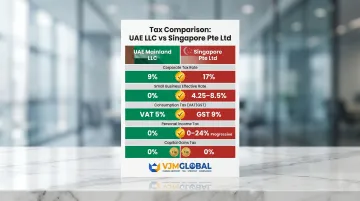
The UAE's zero personal income tax creates an additional tax advantage for Singapore entrepreneurs drawing salary or dividends from the Dubai LLC.
100% Foreign Ownership for Most Activities
Singapore entrepreneurs can now fully own a Dubai mainland LLC without an Emirati partner for the vast majority of commercial activities. This reform—enacted through Federal Decree-Law No. 32 of 2021—removed a historical barrier that previously required foreign investors to cede 51% ownership to a UAE national.
The only exceptions are the nine strategic-impact sectors listed earlier. Full foreign ownership is operational across:
- Technology and software businesses
- Consulting and professional services
- Trading and distribution
- Manufacturing
- E-commerce
GCC Market Access
A Dubai mainland LLC can trade with customers across all seven UAE emirates and the wider GCC—Bahrain, Kuwait, Oman, Qatar, Saudi Arabia—without needing additional licenses or local distributors. Free zone entities cannot match this: they are restricted from selling directly to the UAE mainland market without additional permits or a distributor arrangement.
The GCC market represents approximately 59 million people with a combined GDP of roughly USD 2.1 trillion. Non-hydrocarbon sectors expanded by 3.7% in 2024, with projected GCC growth of 4.5% in 2026. For Singapore entrepreneurs targeting regional B2B or B2C customers, the mainland LLC's unrestricted access directly reduces both friction and licensing costs.
Visa and Residency Benefits
Setting up a Dubai LLC entitles founders and employees to apply for UAE residence visas. Two pathways are particularly relevant for Singapore entrepreneurs:
- Green Visa (5 years): Available to investors establishing or participating in commercial activities, with no UAE national sponsor required.
- Golden Visa (10 years, renewable): Requires a minimum AED 2 million investment in a fund, national bank deposit, or enterprise capital. Paying at least AED 250,000 annually in UAE taxes also qualifies.
Both visa categories allow Singapore entrepreneurs to hold long-term UAE residency without surrendering Singapore citizenship. In practice, this means access to UAE banking, regional travel convenience, and a formal operational base in the Middle East—while keeping existing Singapore business ties intact.
Dubai LLC vs. Singapore Private Limited Company: Key Differences
Regulatory Body and Legal Framework
A Singapore Pte Ltd is registered with the Accounting and Corporate Regulatory Authority (ACRA) under the Companies Act 1967. A Dubai LLC is registered with the Department of Economy and Tourism under UAE Commercial Companies Law (Federal Decree-Law No. 32/2021).
Both are credible international structures, but the UAE framework requires less documentation for routine post-incorporation compliance compared to Singapore's ongoing ACRA filings.
Taxation Comparison
Singapore applies a 17% corporate tax rate with partial exemptions on the first SGD 200,000 for qualifying startups. The UAE applies 9% corporate tax on profits above AED 375,000, with Small Business Relief offering 0% effective tax for businesses earning up to AED 3 million annually through 2026.
Singapore's GST currently stands at 9% (as of 2024), while the UAE's VAT is 5%—a 4-percentage-point consumption tax advantage. The absence of personal income tax in the UAE creates an added tax advantage for business owners paying themselves dividends or a salary.
Ownership and Directorship Rules
A Singapore Pte Ltd requires at least one director who is ordinarily resident in Singapore — a citizen, permanent resident, or Employment Pass holder physically present in the country.
A Dubai LLC has no local residency requirement for directors or managers. The general manager does not need to be a UAE citizen or resident, so Singapore entrepreneurs can manage the entity remotely or appoint non-resident directors without restriction.
Here's a quick side-by-side view:
| Factor | Singapore Pte Ltd | Dubai LLC |
|---|---|---|
| Governing body | ACRA | Department of Economy and Tourism |
| Corporate tax rate | 17% (exemptions apply) | 9% (0% under AED 3M through 2026) |
| Consumption tax | GST 9% | VAT 5% |
| Resident director required | Yes | No |
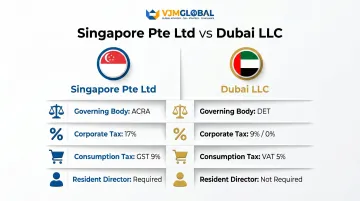
Key Use Case Difference
These structural differences point to distinct use cases depending on where your business generates revenue.
Choose a Singapore Pte Ltd when your core market is Singapore, Southeast Asia, or global trade routed through Singapore's established financial and logistics infrastructure. Its common law system, English-language courts, and regional trade agreements favour ASEAN-focused operations.
Choose a Dubai LLC when you want direct access to Middle East, Africa, and South Asia (MEASA) markets, need to reduce tax exposure on regional profits, or plan to establish a physical operational presence in the Gulf. The mainland LLC structure works best when the UAE is your primary revenue market or regional hub.
How to Set Up a Dubai LLC
Step-by-Step Process
The UAE government's Basher platform can complete mainland LLC incorporation in as little as 15 minutes. The process breaks down into six steps:
1. Select Business Activity Choose from over 2,000 DET-approved activities and determine the appropriate license type (Commercial, Professional, Industrial, Tourism, Agricultural, or Occupational).
2. Reserve Trade Name Apply via DET or the Basher platform. The name must be unique, include the "LLC" suffix, and comply with DET naming guidelines (no offensive terms, government entity names, or restricted words). Fees: AED 620–2,000.
3. Obtain Initial Approval Obtain a "no objection" certificate from DET. You'll need passport copies of all shareholders, a visa/entry stamp copy, and the trade name reservation certificate.
4. Prepare and Notarise Memorandum of Association (MOA) The MOA outlines shareholding percentages, profit distribution, and management powers. Notarise it electronically via DET or through a public notary. Notary fees: AED 300–2,000.
5. Secure Business Location (Ejari) A mainland LLC requires a physical office or warehouse. The tenancy contract must be registered with Dubai Land Department (Ejari). Market fee: 5% of annual rent.
6. Collect Trade License Submit all documents for final processing and receive the commercial trade license.
Typical timeline: 1–3 weeks if documents are in order. DET offers an "Instant License" option for certain activities, issuing the license in 5 minutes without MOA or Ejari for the first year only (both required for second-year renewal).
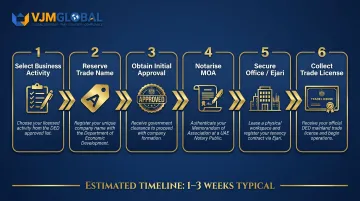
Required Documents for Singapore Entrepreneurs
Singapore nationals can incorporate a Dubai mainland LLC as foreign nationals without needing prior UAE residency. Standard requirements include:
- Passport copies of all shareholders
- Proof of address (utility bill or bank statement)
- Memorandum of Association (notarised in Arabic with English translation)
- Tenancy agreement for registered office (Ejari-registered)
If a shareholder is a Singaporean corporate entity, the company certificate and corporate documents may require apostille or attestation. Both Singapore (since September 2021) and the UAE (since June 2024) are members of the Hague Apostille Convention.
Singapore-issued documents require an apostille from the Singapore Academy of Law before use in the UAE. Arabic translation may also be required for UAE government departments.
Cost and Ongoing Compliance
Setup costs typically range from AED 15,000 to AED 35,000+, covering:
- Trade name reservation (AED 620–2,000)
- Trade license fees (varies by activity and number of activities)
- MOA notarisation (AED 300–2,000)
- Ejari registration (5% of annual rent)
- Government processing fees
Ongoing obligations include:
- Annual license renewal: License must be renewed annually with DET
- Mandatory audit: All UAE mainland LLCs must have financial statements professionally audited annually under Federal Decree-Law No. 32 of 2021
- UAE VAT registration: Register when taxable supplies exceed AED 375,000 annually; voluntary registration threshold is AED 187,500
- Corporate tax filing: Annual tax return required if taxable income exceeds AED 375,000 (or if electing Small Business Relief)
Cross-border compliance — covering UAE corporate tax, Singapore tax residency, and transfer pricing between the two jurisdictions — adds meaningful complexity for Singapore entrepreneurs. VJM Global's advisory team handles exactly this overlap, from initial document preparation through annual tax filings in both markets.
Dubai LLC vs. Free Zone: Which Suits Singapore Entrepreneurs Better?
Core Structural Difference
A Free Zone LLC (FZ-LLC) is incorporated within one of Dubai's 40+ designated free zones (such as DMCC, DIFC, or JAFZA). Free zones offer 100% foreign ownership, simplified setup procedures, and sector-specific incentives. However, free zone companies are restricted from trading directly with the UAE mainland market without a local distributor or additional mainland license.
A Mainland LLC has full UAE-wide and GCC market access without additional permits.
When a Mainland LLC Is the Better Choice
A Mainland LLC is the right structure if your business requires direct access to UAE customers, government contracts, or a physical presence across multiple emirates. Choose this route when your operations involve:
- Selling goods or services directly to UAE consumers or businesses
- Bidding on government contracts or public-sector projects
- Running a physical retail or service presence across multiple emirates
- Requiring activity permits unavailable in specific free zones
The unrestricted trading rights eliminate the cost and friction of dual licensing.
When a Free Zone Entity May Be Preferred
If your business is export-oriented, e-commerce-driven, or operates in a specific sector (commodities trading under DMCC, financial services under DIFC, media under DMC), a Free Zone entity may offer lower setup costs, sector-specific support, and simpler regulatory requirements.
The table below summarizes the key differences at a glance:
| Feature | Mainland LLC | Free Zone LLC |
|---|---|---|
| Market access | Unrestricted across all 7 UAE emirates + GCC | Restricted mainland trading (requires additional license or distributor) |
| Ownership | 100% foreign ownership (except strategic-impact sectors) | 100% foreign ownership |
| Setup cost | AED 15,000–35,000+ | From AED 9,000 (DMCC); AED 63,000+ (DIFC) |
| Activity flexibility | 2,000+ approved activities | Limited to free zone-approved activities |
| Visa eligibility | Yes (Green Visa, Golden Visa pathways) | Yes (varies by free zone) |
| Office requirement | Physical office (Ejari mandatory) | Flexi-desk available in most free zones |
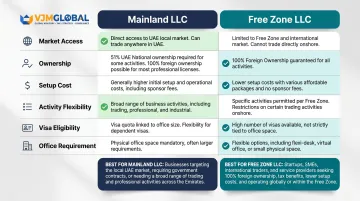
If your revenue will primarily come from UAE mainland customers, the Mainland LLC's unrestricted trading rights justify the higher setup costs. For international trade, digital services, or sector-focused businesses (fintech, commodities), a Free Zone entity is likely the better fit.
Frequently Asked Questions
What does LLC mean in Dubai?
LLC stands for Limited Liability Company—the most common mainland business structure in the UAE. Shareholders' liability is limited to their invested capital, and the company operates as a distinct legal entity under UAE Commercial Companies Law (Federal Decree-Law No. 32/2021).
How much does LLC cost in Dubai?
Setup costs typically range from AED 20,000 to AED 30,000, covering trade license fees, MOA notarisation, and initial government approvals. Annual renewal fees and office lease costs add to the total, and final figures vary by activity type and the number of licensed activities.
How to create LLC in UAE?
Reserve a trade name with DET, prepare and notarise the Memorandum of Association, submit documentation for initial approval, obtain any sector-specific approvals, and receive the trade license. The process typically completes in 1–3 weeks via the digital Basher platform.
What is the difference between LLC and Freezone in UAE?
A Mainland LLC gives you direct trading access across the UAE and GCC, but requires a physical office and compliance with mainland regulatory requirements. Free Zone companies offer 100% foreign ownership and sector-specific perks, but cannot sell directly into the UAE mainland market without a local distributor or additional permits.
Is an LLC a private company?
Yes, a Dubai LLC is a private company—it is not publicly listed, shares cannot be freely traded on a stock exchange, and the maximum number of shareholders is capped at 50. Similar to Singapore's Private Limited Company (Pte Ltd) structure.
What is the benefit of LLC in UAE?
A Dubai LLC offers meaningful structural and tax advantages for Singapore entrepreneurs:
- Personal asset protection through limited liability
- 100% foreign ownership eligibility in most sectors
- Unrestricted access to UAE and GCC markets
- Zero personal income tax; 9% corporate tax (0% on revenue up to AED 3 million via Small Business Relief)
- Ability to sponsor employee and investor visas, including the 10-year Golden Visa