Introduction
Singapore nationals can register a company in a Dubai free zone with 100% ownership—no local sponsor or UAE partner required. Unlike mainland UAE setups historically requiring a 51% local shareholder, all UAE free zones permit full foreign ownership by design, placing Singapore nationals on equal footing with UAE citizens.
Dubai free zones offer real advantages for Singapore-based entrepreneurs targeting regional expansion. There's no personal income tax, and qualifying free zone companies can access 0% corporate tax—a sharp contrast to Singapore's 17% rate—even as the UAE's broader 9% corporate tax took effect in June 2023.
The GCC-Singapore Free Trade Agreement (GSFTA), in force since 2013, strengthens the case further. It eliminates tariffs on goods traded between Singapore and GCC member states and reduces cross-border friction for service businesses—a direct benefit for Singapore nationals operating out of Dubai.
This guide covers the complete registration process, required documents, suitable free zones, cost breakdowns, and pitfalls to avoid—tailored specifically for Singapore passport holders.
Key Takeaways
- 100% foreign ownership with no local sponsor requirement
- Licence-only registration takes 7–14 days; add 2–12 weeks if you need visas and a business bank account
- Entry-level costs start from AED 12,000–15,000 for basic licence and flexi-desk
- Singapore passport holders benefit from visa-on-arrival access and faster KYC approvals
- Pick the wrong licence type and banks will push back—match your licence to your actual business activity from day one
Why Singapore Nationals Register Companies in Dubai Free Zones
Strategic market access drives much of the interest. Dubai free zones serve as gateways to Middle East, African, and South Asian markets—regions commercially harder to access directly from Singapore.
The trade numbers reflect this momentum. Bilateral goods trade between Singapore and the UAE reached S$24 billion in 2024, with services trade at S$12.8 billion in 2023 (22% YoY growth). Singapore investments into the UAE grew to S$4.9 billion in 2023, while UAE investments into Singapore surged 83% YoY to S$10.7 billion.
Tax and Ownership Advantages
Dubai free zones offer distinct financial benefits:
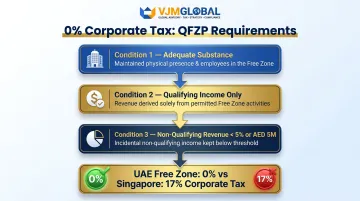
- Corporate tax exemptions: Qualifying Free Zone Persons (QFZPs) can access 0% corporate tax on qualifying income, compared to Singapore's flat 17% rate
- 0% personal income tax: No individual income tax in the UAE versus Singapore's progressive rates
- 100% profit repatriation: No capital controls or currency restrictions
- Full foreign ownership: No forced local partnerships or shareholding requirements
The UAE introduced a 9% corporate tax effective June 2023 (Federal Decree-Law No. 47 of 2022). Free zone companies qualify for 0% only if they meet strict QFZP conditions—maintaining adequate substance in the free zone, deriving qualifying income only, and keeping non-qualifying revenue below 5% of total revenue or AED 5 million (whichever is lower).
GCC-Singapore Free Trade Agreement
The GCC-Singapore Free Trade Agreement (GSFTA), signed December 2008 and effective September 2013, governs bilateral trade relations. Key provisions include:
- Immediate duty-free access for Singapore imports into GCC states
- 99% tariff elimination on Singaporean exports to the GCC
- Mutual government procurement access
- Recognition of Singapore MUIS Halal certification standards
One point worth clarifying before registration: there is no bilateral UAE-Singapore CEPA. The UAE's CEPA program covers India, Israel, Indonesia, and others—not Singapore. For Singapore nationals, the GSFTA remains the operative trade framework, and understanding its scope helps set realistic expectations for customs treatment and market access.
Step-by-Step: How to Register a Dubai Free Zone Company as a Singapore National
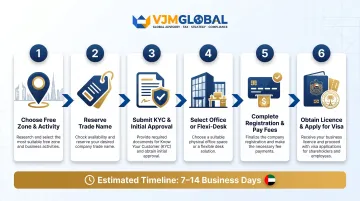
The registration process follows a consistent path across most UAE free zones. Singapore nationals face no nationality-based restrictions and receive the same treatment as other foreign nationals. Processing typically takes 7–14 business days for a licence-only setup.
Step 1: Choose Your Free Zone and Business Activity
Select a free zone based on your industry, budget, and operational needs. Licence categories include:
- Commercial: Trading, import/export, distribution
- Professional: Consulting, advisory, professional services
- E-commerce: Online retail, digital services
- Industrial: Manufacturing, light assembly
Critical decision: Match your licence type to your actual revenue model. Selecting "general trading" when your real activity is consulting creates serious friction during bank account opening and compliance reviews. Free zone authorities and banks scrutinize mismatches.
Step 2: Reserve a Trade Name
Trade name reservation requires checking availability through the free zone authority. Names must:
- Avoid restricted words (government references, religious terms)
- Include the legal form suffix (FZE for single-shareholder, FZ-LLC for multiple shareholders)
- Not infringe on existing trademarks
Singapore nationals with existing brand registrations elsewhere should verify the name is available and appropriate for UAE use.
Step 3: Submit Initial Approval Application and KYC Documents
Initial approval requires:
- Completed application form
- Passport copies (minimum 6 months validity)
- Proof of residential address (utility bill or bank statement within 3 months)
- Business plan or CV (for professional licences)
The Singapore passport is widely recognized as low-risk by UAE authorities, which often speeds up the KYC approval process. For trading or financial services activities, expect requests for source-of-funds documentation.
Step 4: Select Office Space or Flexi-Desk
All free zone companies must maintain a registered address within the free zone. Options include:
- Flexi-desk: Shared workspace, lowest cost, suitable for solo operators (typically 1–2 visa quota)
- Private office: Dedicated space, required for larger teams (visa quota scales with office size)
- Virtual office: Some free zones offer this for minimal physical presence needs
Office type directly determines your visa quota — flexi-desks support 1–2 visas, while private offices can unlock 5–15+ depending on square footage.
Step 5: Complete Registration and Pay Fees
Upon initial approval, submit formal registration documents:
- Memorandum and Articles of Association
- Board resolution appointing manager/director
- Share capital information
- Registration and licence fees (varies by free zone; see cost section below)
Errors or missing documents at this stage are the most common cause of delays, so review each requirement against your specific free zone's checklist before submitting.
Step 6: Obtain the Trade Licence and Apply for Residence Visa (If Required)
Once fees are paid and documents approved, the free zone authority issues:
- Trade licence
- Incorporation certificate
- Shareholder certificates
Singapore nationals planning to relocate or obtain UAE residency can then apply for an investor visa, which involves:
- Medical fitness test
- Emirates ID registration
- Passport stamping at immigration
Visa processing adds approximately 2–4 weeks to the overall setup timeline. Singapore passport holders enter the UAE visa-free for up to 90 days — enough time to complete all in-person steps without pre-arranging entry permits.
Key Documents Singapore Nationals Need for Dubai Free Zone Registration
Key Documents Singapore Nationals Need for Dubai Free Zone Registration
Standard Required Documents
Most free zone authorities require:
- Valid Singapore passport (minimum 6 months validity)
- Proof of residential address (utility bill, bank statement, or official letter within 3 months)
- Passport photograph (white background, recent)
- Completed application forms (provided by chosen free zone)
Activity-Specific Additional Documents
Depending on business activity or free zone:
- CV or professional profile (common for consulting/professional licences)
- Business plan outlining activities and projected revenues
- Source-of-funds documentation (particularly for trading, financial services, or share capital above AED 50,000)
What Singapore Nationals Do NOT Need
Common misconceptions cleared:
- ❌ No UAE local sponsor required
- ❌ No UAE national shareholder required
- ❌ No prior UAE residency required
100% foreign ownership is permitted by law in all UAE free zones.
Once incorporated, you'll also take on ongoing compliance obligations — these apply regardless of where you're based.
Post-Registration Compliance Documents
After company formation, key ongoing requirements include:
- UBO (Ultimate Beneficial Owner) register must be filed and updated within 15 days of any ownership change
- Annual audited financial statements (mandatory for QFZPs regardless of revenue)
- Trade licence renewal (annually)
For Singapore nationals managing cross-border operations, VJM Global's international advisory team can help you understand how UAE free zone compliance intersects with your broader tax and reporting obligations.
Best Dubai Free Zones and Estimated Costs for Singapore Nationals
Recommended Free Zones by Use Case
DMCC (Dubai Multi Commodities Centre)
- Best for: Trading, commodities, consulting, crypto
- Key advantage: Premium Dubai address, strong banking narrative
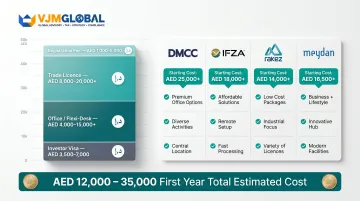
- Starting cost: AED 43,000+ (Jump Start package with flexi-desk)
- Timeline: E-licence in 2–3 working days
IFZA (International Free Zone Authority)
- Best for: Consultants, agencies, e-commerce, service businesses
- Key advantage: Cost-effective, remote-friendly setup
- Starting cost: AED 12,900 (basic licence, zero visa quota)
- Note: Contact IFZA directly for current rates — pricing is not listed on their official site
RAKEZ (Ras Al Khaimah Economic Zone)
- Best for: SMEs, trading, light industrial
- Key advantage: Lowest-cost entry point
- Starting cost: AED 6,000 (Basic Package); AED 16,500 (All-Inclusive with 1 visa)
- Timeline: Instant licence available (marketed as 5-minute issuance)
- Location note: RAKEZ is in Ras Al Khaimah, not Dubai proper
Meydan Free Zone
- Best for: Digital services, online businesses, lean operations
- Key advantage: Dubai address with flexible multi-year packages
- Starting cost: AED 15,000–30,000 (estimated annual range)
- Timeline: Fawri (instant) licence in 60 minutes; regular licence in 3–5 days
- Note: Exact pricing requires enquiry—cost calculator does not display base fees publicly
First-Year Cost Breakdown (Typical Setup)
Here's what Singapore nationals typically spend in their first year, covering the core cost components across most free zones.
| Cost Component | Amount (AED) | Notes |
|---|---|---|
| Free zone registration fee | 1,000–5,000 | One-time |
| Annual trade licence fee | 8,000–20,000+ | Varies by free zone and activity |
| Office/flexi-desk | 4,000–15,000+ | Flexi-desk lowest; private office higher |
| Investor visa (if required) | 3,500–7,000 | Per visa, includes medical and Emirates ID |
| Total first-year cost | 12,000–35,000 | Licence + flexi-desk package range |
Timelines
Plan your timeline based on how much of the setup you need to complete before operations begin.
- Licence-only setup: 3–10 business days
- Setup with 1-2 visas: 2–4 weeks
- Traditional UAE bank account: 4–12 weeks (high variability)
- EMI (Electronic Money Institution) account: 5–15 business days (faster interim solution)
Common Mistakes and Misconceptions to Avoid
Misconception #1: Singapore Nationals Need a UAE Local Partner
Reality: 100% foreign ownership is standard in all UAE free zones. This confusion stems from mainland UAE rules, which historically required a 51% UAE national partner — a restriction removed by the 2021 Companies Law amendment. Free zones have always permitted full foreign ownership and are unaffected by that history.
Mistake #2: Choosing the Wrong Licence Type to Save Money
Selecting a vague or inaccurate licence category creates serious problems:
- Banking friction: Banks probe mismatches between licence type and actual business activity during account opening
- Compliance reviews: Free zone authorities flag discrepancies during annual renewals
- Example: Registering a "general trading" licence when your real activity is consulting leads to account opening rejections
Choose a licence that matches your real business model, even if it costs slightly more upfront. Fixing a mismatch later — new licence, re-filing, banking delays — typically costs far more than the initial difference.
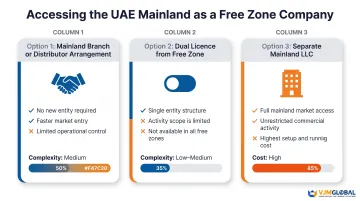
Mistake #3: Misunderstanding Free Zone vs. Mainland Trading Restrictions
A free zone company cannot freely trade within the UAE mainland without additional structures:
- Option 1: Register a separate mainland branch or distributor arrangement
- Option 2: Obtain a dual licence (available in some free zones, allowing limited mainland activity)
- Option 3: Establish a separate mainland LLC
If your primary customers are in the UAE domestic market rather than international, evaluate whether a mainland company is the more practical structure — despite the higher setup cost.
Frequently Asked Questions
How much does it cost to register a company in Dubai free zone?
First-year costs range from AED 12,000 to AED 35,000 for a typical setup including licence and flexi-desk. Costs vary significantly by free zone, licence type, and whether visas are included. Verify current pricing directly with the specific free zone authority.
Can a foreigner start a company in Dubai?
Yes. Foreigners, including Singapore nationals, can start a company in Dubai—specifically in a free zone with 100% foreign ownership—without needing a UAE national partner or local sponsor.
What is the difference between an LLC and a free zone company in the UAE?
A mainland LLC historically required a UAE national partner (or is subject to local ownership rules) and allows trading anywhere in the UAE. A free zone company (FZE or FZ-LLC) permits 100% foreign ownership but is generally restricted to international trade and operations within the free zone.
Do Singapore nationals need a visa to enter the UAE for business setup purposes?
No. Singapore passport holders receive visa-free entry to the UAE for up to 90 days within a 180-day period, allowing them to travel to Dubai to complete in-person registration steps without pre-arranging a visa.
Can a Singapore national own 100% of a Dubai free zone company?
Yes. 100% foreign ownership is a defining feature of UAE free zones and applies to all nationalities, including Singapore nationals, with no requirement for a UAE national shareholder.
What are the tax implications for Singapore nationals with a Dubai free zone company?
UAE free zones can offer corporate tax exemptions under the UAE's 9% corporate tax regime (effective June 2023), and the UAE levies no personal income tax. Singapore nationals should consult a tax advisor about their Singapore obligations — particularly the foreign-sourced income (FSI) exemption, which requires a minimum 15% headline tax rate in the foreign jurisdiction (the UAE's 9% rate may not qualify).