Introduction
Singapore businesses are eyeing the UK market steadily, drawn by shared common-law roots and the ease of doing business with a jurisdiction that speaks the same commercial language. Many start their research by typing "UK LLC" into Google.
Here's the catch: the UK doesn't have an LLC. That US-style structure simply doesn't exist under UK company law.
This causes real confusion. Founders assume the entity, the filing process and the compliance obligations will mirror what they've read about US LLCs. Then they discover the UK's actual equivalent, the Private Limited Company (Ltd), works quite differently.
This guide clarifies what you're actually forming, who can own it, what tax obligations follow, and where Singapore founders most often trip up during setup.
Key Takeaways
- The UK has no "LLC" entity; the closest equivalent for non-residents is the Private Limited Company (Ltd)
- Singapore citizens and companies can own 100% of a UK Ltd with no residency restriction, under the Companies Act 2006
- From 18 November 2025, mandatory identity verification (ECCTA) applies to all directors and PSCs, including those in Singapore
- Forming a UK company creates no automatic right to live or work in the UK, and doesn't change your personal tax residency
- Overseas founders avoid most delays on registered office, banking, and tax registration with experienced UK formation support
There's No Such Thing as a "UK LLC": What Singapore Founders Actually Need to Know
"LLC" — Limited Liability Company — is a legal structure defined by US state law. It has no equivalent category under the UK's Companies Act 2006.
The Act defines the private company limited by shares, commonly written as "Ltd." Section 3 limits members' liability through the company's constitution. That gives Singapore founders the same protection they expect from an "LLC," through a different legal vehicle.
How a UK Ltd Compares to a Singapore Pte Ltd
If you've registered a Pte Ltd in Singapore, the UK Ltd will feel recognisable:
- Separate legal personality from its owners
- Limited liability protection for shareholders
- Flexible director and shareholder arrangements (one person can hold both roles)
The differences worth noting:
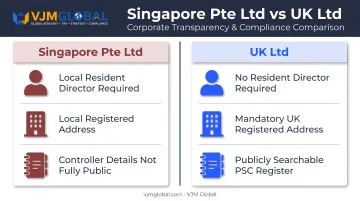
| Feature | Singapore Pte Ltd | UK Ltd |
|---|---|---|
| Local resident director | Required | Not required |
| Registered office | Local address | Mandatory UK address |
| Ownership register | Controller details not fully public like UK PSC | PSC register publicly searchable |
When an LLP Makes More Sense
If you're running a professional services firm (accounting, consulting, legal advisory) and want partners rather than shareholders, a Limited Liability Partnership (LLP) may fit better. It pairs partnership-style flexibility with limited liability, and Companies House treats it as distinct from a limited company.
Branch vs. Fresh Ltd
Already have a Singapore Pte Ltd and just need a UK footprint? You have two routes:
- Register a UK branch of your existing Singapore company via Companies House Form OS IN01 — required only if you're opening a physical UK establishment
- Incorporate a standalone UK Ltd as a fresh entity
The branch route applies only if you will have a genuine physical UK presence. Trading into the UK without one does not trigger it.
Can a Singapore-Based Business Register a UK Limited Company?
Yes. Non-UK residents, including Singapore individuals and companies, can register and own a UK limited company with no nationality or residency restriction.
The Core Legal Requirements
- One director, minimum age 16, any nationality
- One shareholder, who can be the same person as the director
- A unique company name that passes the Companies House availability check
- At least one SIC code describing your business activity
The Registered Office Sticking Point
Every UK Ltd needs a UK registered office address. A Singapore address doesn't qualify, and since 4 March 2024, a PO Box alone no longer counts either. Most non-resident founders solve this with a virtual office or formation agent address.
Identity Verification: What Changed in November 2025
From 18 November 2025, Companies House made identity verification compulsory for all new directors and PSCs, Singapore-based founders included. You verify either through:
- GOV.UK One Login (free, online), or
- An Authorised Corporate Service Provider (ACSP)
What It Costs
Companies House's own filing fees are modest: online incorporation costs £100, paper filing £124, and same-day software filing £156 (Companies House fees). Formation agents typically charge more on top for registered office provision, document handling and ongoing support, so budget for those separately.
None of this gets you a UK visa, work permit or residency. Incorporation is a commercial act; immigration is a completely separate process.
Step-by-Step: How Singapore Businesses Can Set Up a UK Company
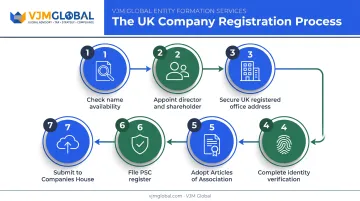
The sequence is straightforward once you know the checkpoints:
- Check name availability: search Companies House's register to confirm your chosen name isn't taken
- Appoint director(s) and shareholder(s): can be the same person, of any nationality
- Secure a UK registered office address: a virtual office or formation agent solves this for non-residents
- Complete identity verification: via GOV.UK One Login or an ACSP
- Adopt Articles of Association: most non-resident founders simply use Companies House's standard Model Articles rather than drafting bespoke ones
- File the PSC register: most solo Singapore founders register themselves as the sole Person with Significant Control
- Submit to Companies House: either directly via WebFiling or through a formation agent
Standard online filings are usually processed within 24 hours; paper filings take 8 to 10 days.
The Step Founders Forget
Once incorporated, you must register for Corporation Tax with HMRC within 3 months of starting to trade. Miss this window and penalties follow.
Where Cross-Border Support Helps
Coordinating a UK registered office, identity verification and HMRC registration from Singapore involves a fair amount of back-and-forth across time zones. Firms like VJM Global handle entity formation and compliance across 100+ countries, including the UK and Singapore. They can manage the process end-to-end through Companies House and HMRC, so founders aren't chasing forms manually from another continent.
Tax Obligations Singapore Business Owners Should Plan For
A UK company run from Singapore creates tax duties on both sides. Plan for corporation tax, VAT, treaty treatment of cross-border income, and where management and control actually sits.
UK Corporation Tax
UK-resident companies pay corporation tax on profits at these rates:
- 19% on profits of £50,000 or less (small profits rate)
- 25% on profits above £250,000 (main rate)
- Marginal relief applies between those two thresholds
VAT and Making Tax Digital
Registration becomes mandatory once rolling 12-month taxable turnover exceeds £90,000, or you expect to cross that threshold in the next 30 days. Once registered, Making Tax Digital requires you to keep digital records and file returns through compatible software.
The UK-Singapore Double Taxation Agreement
The UK-Singapore Double Taxation Agreement generally taxes business profits only in the company's residence state, unless the enterprise operates through a permanent establishment elsewhere. Treaty dividend caps run at 5% (for qualifying corporate shareholders holding 10%+ voting power) or 15% otherwise.
Structuring dividends versus salary across both jurisdictions gets complicated fast. Get professional advice before you draw income out of the company.
The "Management and Control" Trap
If every board decision gets made from a laptop in Singapore, HMRC may still argue the company is UK tax resident based on where central management and control actually sits. This isn't about where the company is registered. It's about where decisions genuinely happen.
Singapore's Side of the Equation
Singapore's territorial system generally doesn't tax foreign-sourced income unless it's remitted back to Singapore. That said, income from a trade actually carried on in Singapore is taxed on accrual regardless. Structuring needs to account for both sets of rules simultaneously, not just the UK side.
Banking, Compliance and Common Pitfalls for Singapore-Owned UK Companies
Getting a Business Bank Account
Traditional UK banks like HSBC and Barclays run identity verification through their apps, but their onboarding pages don't clearly confirm eligibility for founders with no UK residential footprint. Fintech providers such as Wise Business, Revolut Business and Tide tend to offer more realistic remote onboarding, though each has its own conditions:
- Wise Business asks for director residency details but doesn't explicitly guarantee Singapore-based eligibility
- Revolut Business requires UK, Swiss or EEA residency for the account applicant
- Tide allows non-UK-based applicants if they're a director of a registered company, but still asks for a UK contact number
Check current eligibility directly before assuming any provider will work for your situation.
Ongoing Compliance You Can't Skip
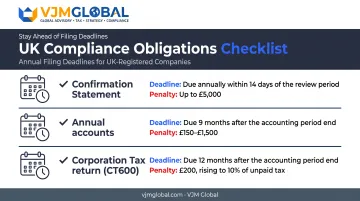
| Obligation | Deadline | Penalty for Missing It |
|---|---|---|
| Confirmation Statement | Annually, within 14 days of review period | Fine up to £5,000, risk of strike-off |
| Annual accounts | 9 months after accounting period end | £150 to £1,500, doubling after repeat lateness |
| Corporation Tax return (CT600) | 12 months after accounting period end | £200 upfront, rising to 10% of unpaid tax |
Where Singapore Founders Trip Up Most
- Using a Singapore address as the registered office (not accepted)
- Missing the 3-month Corporation Tax registration window after trading starts
- Assuming incorporation grants UK visa or residency rights (it doesn't)
Cross-border providers can handle bookkeeping, payroll and CT600 preparation so you don't need an in-house UK finance team. VJM Global, which has supported 250+ UK businesses, offers this ongoing back-office support for Singapore-owned entities.
Frequently Asked Questions
Can non-residents form a UK limited company?
Yes. There's no nationality or residency restriction under the Companies Act 2006. The only mandatory UK-based requirement is the registered office address.
What is the 5-year rule for non-residents in the UK?
It is the UK's temporary non-residence rule under the Statutory Residence Test. It applies to personal tax residency if you return within 5 years of leaving—not to company ownership—and rarely affects Singapore founders who have never lived in the UK.
Can non-UK residents open a business account in the UK?
It's possible but often difficult with traditional banks. Fintech providers have made remote account opening more realistic for Singapore-based directors, subject to standard KYC documentation.
Is there an official UK equivalent to an LLC?
No direct legal equivalent exists. The Private Limited Company (Ltd) is the closest structure, offering similar limited liability protection.
Does forming a UK company allow a Singapore founder to live or work in the UK?
No. Incorporation is a commercial act only. Living or working in the UK requires a separate visa application, such as the Innovator Founder or Skilled Worker route.
How is a UK Ltd taxed differently from a Singapore Pte Ltd?
UK Corporation Tax ranges from 19% to 25%, with VAT above £90,000 turnover. Singapore uses its own corporate tax system and territorial income rules. The UK–Singapore DTA helps stop the same profits being taxed twice in both countries.