Introduction
Search "register an LLC in the UK" and you'll hit a wall. The UK doesn't have one.
Singapore founders eyeing UK expansion often carry the LLC label over from US market reading, only to find the UK runs on different structures: the private limited company (Ltd) and the limited liability partnership (LLP).
That choice shapes how much tax you pay, whether banks and investors take you seriously, and how your Singapore parent company's liability gets ring-fenced.
UK-Singapore trade ties give the decision real weight. Trade in goods and services between the two countries reached £29.0 billion in the four quarters to Q1 2026, with £19.7 billion in UK exports alone.
This article breaks down Ltd versus LLP so you can pick the structure that fits your expansion plans.
Key Takeaways
- The UK has no US-style LLC; your real choice sits between a Ltd company and an LLP
- A Ltd company offers separate legal status, stronger credibility, and access to the UK-Singapore Double Taxation Agreement
- LLPs suit professional joint ventures with pass-through taxation but carry less weight for trading businesses
- Most Singapore companies entering the UK to trade or set up a subsidiary should default to a Ltd structure
- Your final decision hinges on business activity and tax strategy, not terminology familiarity
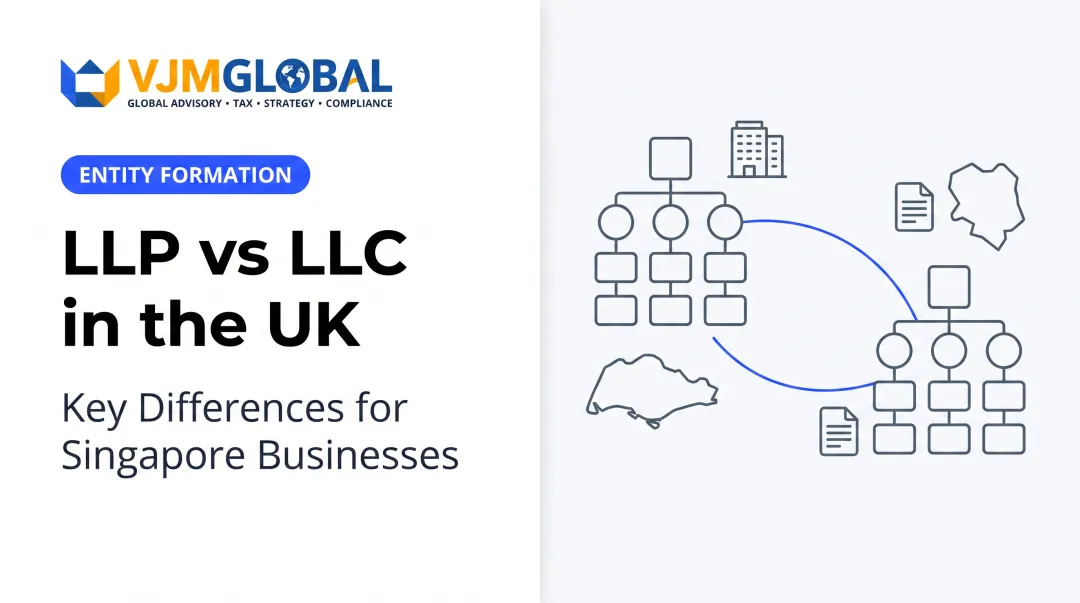
LTD vs LLC in the UK: Quick Comparison
Here's how the two structures stack up side by side.
| Factor | Ltd Company | LLP (closest "LLC" equivalent) |
|---|---|---|
| Legal basis | Companies Act 2006 | Limited Liability Partnerships Act 2000 |
| Formation minimum | 1 shareholder, 1 director | 2 members, including 2 designated members |
| Incorporation fee | £100 online (£124 by post) | £100 online (£124 by post) |
| Processing time | Usually within 24 hours online | Same-day option if filed by 3pm |
| Taxation | Corporation tax on profits, plus dividend tax on distributions | No entity-level tax; partners taxed individually on their share |
| Annual filings | Accounts, confirmation statement, statutory registers | Accounts (even if dormant), confirmation statement |
| Best fit | Subsidiaries, trading entities, capital raising | Professional joint ventures, pass-through structures |
Three differences matter most in practice:
Legal status: A Ltd company is a separate legal entity under the Companies Act 2006 and remains the UK's most widely used structure by a wide margin. An LLP is also a body corporate, but it's built around partners rather than shareholders.
Compliance load: Both structures file a confirmation statement annually (£50 digital, £110 paper) and submit accounts to Companies House. Ltd companies must also maintain statutory registers and appoint at least one director, obligations LLPs don't carry.
Suitability: A Singapore parent setting up a UK subsidiary or trading arm fits naturally with Ltd. A Singapore professional firm forming a joint venture with a UK counterpart is usually better served by an LLP.
What Is a UK Ltd Company?
A UK Ltd company is a private limited company incorporated under the Companies Act 2006. It holds its own legal identity, separate from its owners, meaning the company itself is liable for its debts, not the shareholders. For Singapore businesses entering the UK as a subsidiary or standalone trading entity, it is the structure most choose first.
Why it works for cross-border founders:
- Caps your Singapore parent's exposure at its share investment, not the UK entity's debts
- Builds credibility with UK banks, suppliers, and investors who already know the Ltd structure
- Lets you use the UK-Singapore Double Taxation Agreement so the same income is not taxed twice
There are two flavours. A Private Limited Company (Ltd) cannot offer shares to the public and suits most Singapore subsidiaries. A Public Limited Company (PLC) can make public share offers but needs at least £50,000 in allotted share capital before it can trade, which is overkill for most market entrants.
Where Ltd Companies Fit in Your Expansion
For a Singapore parent, a UK Ltd subsidiary ring-fences liabilities while giving you a genuine foothold in UK and EU-adjacent markets. It's the structure of choice across:
- Retail and e-commerce operations selling directly to UK consumers
- Fintech firms needing UK regulatory standing
- Consulting practices billing UK clients through a local entity
- Manufacturing subsidiaries coordinating UK distribution
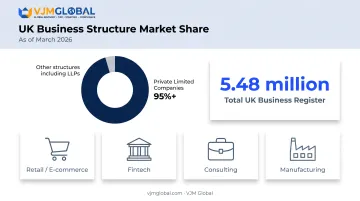
The numbers show how dominant this structure is. Private limited companies make up more than 95% of the 5.48 million entities on Companies House's total register as of March 2026. For Singapore entrants who need clear standing with UK counterparties, that dominance is a practical signal, not just a statistic.
What Is the UK Equivalent of an LLC? (Understanding LLPs)
The UK has no formal "LLC," but the Limited Liability Partnership comes closest. An LLP combines the liability protection of a company with the flexibility of a partnership. Members aren't personally liable for the LLP's debts beyond their investment, yet the entity itself doesn't pay corporation tax.
Core advantages:
- Pass-through taxation: each partner is taxed individually on their share of profits, avoiding corporation tax plus dividend tax on the same profits
- Flexible profit-sharing: members agree their own split rather than following a fixed shareholding formula
- Simpler governance: no formal board of directors required
LLPs come in two broad flavours: general trading LLPs, and professional-service LLPs common among law, accounting, and consultancy firms.
When an LLP Makes Sense for Singapore Firms
An LLP fits Singapore professional service firms entering the UK through a joint venture with an established UK firm, rather than launching a standalone trading entity. Picture a Singapore law practice teaming up with a UK firm on cross-border mandates, or a consultancy pooling resources with a UK-based partner.
Historical data backs this pattern. ICAEW research found management consulting, solicitor practices, and advisory firms among the most common LLP categories. One survey put accountancy and law firms at 17% of respondent LLPs alone.
Trading businesses rarely choose this structure. Without conventional share capital, it is harder to raise outside investment or bring on new shareholders later.
If your Singapore business plans to sell products, hire a sales team, or scale through investment rounds, an LLP will likely feel restrictive fast.
LTD vs LLC: Which Structure Is Right for Your Singapore Business?
The right UK structure depends on four practical factors:
- Nature of your business activity: are you trading, manufacturing, or delivering a professional service?
- Tax planning goals: do you want corporate-level certainty, or pass-through treatment for partners?
- Need for external credibility: will you need bank facilities, investor capital, or share-based incentives?
- Long-term exit plans: do you eventually want to sell the business or bring in new shareholders?
Choose a Ltd company if:
- You're setting up a trading subsidiary of your Singapore parent
- You need credibility with UK banks, suppliers, or investors
- You plan to raise capital by issuing shares
Choose an LLP if:
- You're entering via a professional joint venture with a UK partner
- Pass-through taxation and simpler compliance matter more than share-based fundraising
- Your business model doesn't depend on outside equity investment
A Representative Case: Untangling Tax Exposure Before Incorporating
VJM Global has supported more than 250 UK businesses, including Singapore-origin companies weighing up exactly this choice. A common pattern: a Singapore founder assumes "LLC" terminology applies, researches partnership structures, and only later realises that their trading model (selling products, hiring UK staff, needing bank credit) actually calls for a Ltd company, not an LLP.
The fix usually starts with mapping the business activity against both structures rather than chasing the tax label alone. Once a trading subsidiary is the right fit, UK Ltd incorporation moves fast. Companies House typically approves online filings within 24 hours, so a Singapore parent can have a UK entity operational within days.
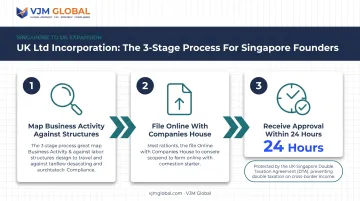
From there, the UK-Singapore Double Taxation Agreement, in force since 1997 and updated by the OECD's Multilateral Instrument, stops the same profits being taxed twice across both jurisdictions.
The quick takeaway: for most Singapore companies, Ltd offers the clearest path to credibility and growth. LLPs remain a solid but niche fit for professional tie-ups.
If you're still weighing your options, VJM Global's cross-border team can walk through your specific tax exposure and liability structure before you file anything with Companies House.
Conclusion
Singapore businesses building a genuine trading presence or subsidiary in the UK are generally better served by a Ltd company. It offers separate legal status, stronger credibility with banks and partners, and a direct route to relief under the UK-Singapore Double Taxation Agreement.
Businesses forming professional partnerships should still weigh an LLP on its own merits, particularly if pass-through taxation and simpler governance matter more than fundraising flexibility.
Either way, "LLC" isn't the question to ask. The real question is what your business does and which UK structure supports that. Professional guidance from a team like VJM Global, which handles UK entity formation for Singapore companies regularly, helps you avoid costly missteps from incorporating first and sorting the tax consequences later.
Frequently Asked Questions
Which is better, Pte Ltd or LLC?
There's no universal winner. A Pte Ltd or UK Ltd suits businesses prioritising credibility and fundraising. An LLP suits professional partnerships that want flexibility and pass-through taxation.
Are there LLCs in Singapore?
Singapore doesn't use the term "LLC," but its Private Limited Company (Pte Ltd) serves the same function: limited liability plus a separate legal identity from its owners.
Does the UK have an LLC equivalent?
Not directly. The closest structures are the Ltd company, used for trading entities, and the LLP, used for partnership-style businesses.
Can a Singapore company own 100% of a UK Ltd company?
Yes. UK Ltd companies allow full foreign ownership, so a Singapore parent can hold 100% of the shares without needing a local UK partner.
What is the difference between LTD and LLP in the UK?
A Ltd company pays corporation tax at the entity level, then shareholders pay dividend tax. An LLP pays no corporation tax; partners are taxed individually on their share of profits.
Do Singapore companies pay UK corporation tax on a UK Ltd subsidiary?
Yes, on UK-sourced profits, at the standard UK corporation tax rate. The UK-Singapore Double Taxation Agreement then prevents that same income from being taxed twice.