
Introduction
Millions of people start new businesses every year — from first-time founders in the US (where 5.47 million business applications were filed in 2025 alone, according to the US Census Bureau) to experienced operators and foreign investors entering new markets like India.
Accessibility has improved. Barriers are lower, funding options are broader, and remote operations are now standard. But accessibility does not equal simplicity.
The data tells the real story: BLS figures show that while 80.7% of US businesses survive year one, only 69% make it to year two. The majority of those failures trace back not to bad ideas, but to rushed or incomplete setups — skipped validation, wrong legal structures, cash flow ignored until it became a crisis.
This checklist addresses that directly. It covers what starting a business actually involves — validating your idea, choosing the right legal structure, securing funding, managing compliance, and stabilizing early operations — in the order it needs to happen.
Key Takeaways
- Validate demand and pricing before registering anything — every other investment follows from this step.
- Business structure affects taxes, liability, and flexibility — get professional input before operations begin.
- Legal registration, licenses, tax compliance, and insurance are non-negotiable before you launch.
- Most early failures trace to cash flow problems, not bad products — track the numbers from day one.
- Sequence matters: plan first, then register, build operations, and go to market — skipping steps is where most founders lose time and money.
What to Know Before You Start a New Business
Before the business plan, the pitch deck, or the first client call — the early stage demands something most founders underestimate: accurate expectations about what they're actually signing up for.
Time, Money, and Energy
Most founders significantly underestimate all three:
- Time: In the early months, you will be across operations, sales, compliance, and delivery simultaneously — often before a single hire is in place.
- Income timeline: Most businesses take several months to generate consistent revenue. Plan financially for a gap of 6–18 months before the business becomes self-sustaining.
- Skill demands: A service business leans on technical expertise; a distribution or retail model leans on systems and logistics management. These require different skills and different hires — know which category you are in before you launch.
The Systems vs. Heroics Trap
Stretched time and capital create pressure to handle everything personally. That instinct is understandable — and it's exactly where many early-stage businesses stall.
The difference between a sustainable business and burnout often comes down to one decision made early: whether the founder builds repeatable systems or tries to personally manage everything as it grows. A simple process document for onboarding a client or filing a compliance return is worth more than heroic effort every single time that task recurs.
Early Decisions That Matter When Starting a New Business
Most early-stage failures are not caused by lack of effort. They are caused by decisions made — or deferred — in the first few months that compound over time.
True Startup and Operating Costs
Many founders calculate launch costs but ignore the 6–12 months of operating expenses required before the business becomes self-sustaining. This gap is where undercapitalisation kills otherwise viable businesses.
CB Insights analysed 400+ startup post-mortems and found that 70% of failed startups ran out of capital — ranking it as the single most cited cause of failure, above product-market fit problems.
Budget for both phases: launch and runway.
Competitive Pricing Reality
Setting prices low to "win customers early" is one of the most persistent early mistakes. The problem: a price floor set at launch is extremely difficult to raise later without losing the customers you worked hard to acquire.
Pricing must account for:
- Cost of delivery (time, materials, overhead)
- Gross margin required for sustainability
- Future scalability at that price point
- What the customer actually values — not just what feels competitive
McKinsey's pricing research shows that a 1% price increase translates, on average, to an 8.7% improvement in operating profits. Most founders significantly underestimate how much pricing decisions shape long-term financial health.
Legal Structure and Compliance Friction
Choosing the wrong business structure — or deferring the decision until after revenue starts — creates tax and liability complications that are costly to reverse. For businesses entering a new market, this is especially true: entity type, registration requirements, and local compliance obligations vary significantly by jurisdiction. Get professional input before trading begins.
How to Start a New Business — Step-by-Step Checklist
The following eight steps are sequential. The order matters because skipping steps creates problems that are harder to fix later.
Step 1 — Identify the Problem, Customer, and Opportunity
Define the specific problem your business will solve and who, precisely, experiences it. "Everyone" is not a target customer. The clearer your problem and customer profile, the easier every decision that follows.
To assess whether the problem is worth building around, look for evidence that people are already spending time or money trying to solve it imperfectly — that is a strong signal of real demand.
Step 2 — Validate Demand, Pricing, and Viability
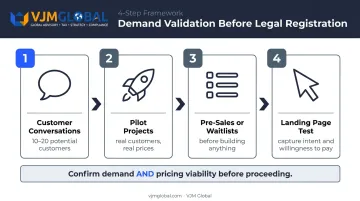
Validation should happen before legal setup or product development. Common approaches:
- Direct conversations with 10–20 potential customers about the problem and what they currently do about it
- Small test runs or pilot projects with real customers at real prices
- Pre-sales or waitlists before building anything
- A basic landing page that captures intent and willingness to pay
Validation must confirm not just that people want the solution, but that they will pay enough to cover costs and produce a margin. Validating demand while missing the pricing test is one of the most common and costly mistakes at this stage.
Step 3 — Define the Business Model and Pricing Structure
Decide how the business will make money:
| Model | Best for | Cash flow pattern |
|---|---|---|
| One-time sales | Products, transactional services | Lumpy, volume-dependent |
| Retainer/subscription | Ongoing services, SaaS | Predictable, compounding |
| Project-based fees | Professional services | Milestone-driven |
| Commission/referral | Marketplaces, agency models | Variable |
Map whichever model you choose against your fixed costs, variable costs, and expected cash flow cycles. The model must sustain the business long-term, not just attract the first few customers.
Step 4 — Register the Business and Meet Legal Requirements
Core registration steps applicable across most markets:
- Choose a legal business structure (sole trader, partnership, LLC, private limited company, LLP, etc.)
- Register the business name with the relevant authority
- Obtain a tax identification number
- Register for applicable taxes (GST, VAT, sales tax — depending on jurisdiction)
- Secure any industry-specific licences or permits
- Obtain appropriate business insurance (liability, professional indemnity, property)
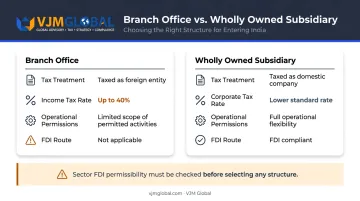
For foreign nationals or companies entering a new market, additional regulatory steps apply. In India specifically, foreign entities must choose from structures including a Private Limited Company, Wholly Owned Subsidiary, LLP, Branch Office, Liaison Office, or Project Office — each with different operational permissions, tax treatment, and FDI compliance requirements.
A Branch Office, for example, is taxed as a foreign entity at up to 40% income tax, whereas a Wholly Owned Subsidiary is taxed as a domestic company — a distinction that directly affects long-term cost structure. Entities must also check FDI permissibility in their sector before selecting a structure, as some sectors require prior government approval.
VJM Global's business setup services cover entity registration, tax compliance (including GST, PAN/TAN, and RBI filings), FEMA advisory, and back-office infrastructure — ensuring the legal foundation is complete and correct from day one.
Step 5 — Build the Offering and Operating Process
Define exactly what is included in your product or service offering — and what is not. Unclear scope is one of the leading causes of early-stage customer dissatisfaction and unprofitable delivery.
Then document the core delivery process, even simply. A basic written workflow:
- Reduces your dependency on being personally across every delivery
- Allows you to bring in support without quality dropping
- Creates the foundation for scaling later
You do not need a polished operations manual on day one. You need enough documentation that someone else could follow the process.
Step 6 — Set Up Financial Systems and Track Cash Flow
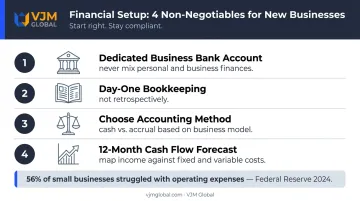
The Federal Reserve's 2024 Small Business Credit Survey found that 56% of employer firms struggled with paying operating expenses, and 51% reported uneven cash flows. Most of these problems are detectable in advance — if the financial systems are in place to see them.
Non-negotiable financial setup steps:
- Open a dedicated business bank account — mixing personal and business finances creates compliance problems and makes performance tracking nearly impossible
- Set up bookkeeping from day one, not retrospectively
- Choose your accounting method (cash or accrual) based on your business model
- Build a 12-month cash flow forecast mapping expected income against fixed and variable costs
The forecast does not need to be precise. It needs to exist — so you can see potential shortfalls before they become crises.
VJM Global supports clients through this setup using QuickBooks as a core accounting platform, integrating with payment gateways and e-commerce platforms to consolidate financial data from the start.
Step 7 — Go to Market and Build Trust
Identify the one or two channels most likely to work for your specific customer (referrals, direct outreach, partnerships, or digital marketing) and focus there first. Spreading early resources across too many channels produces weak results across all of them.
Credibility signals matter especially in the early months, before reputation builds organically:
- A professional website with clear service or product descriptions
- Transparent pricing (or at minimum, a clear pricing process)
- Verifiable reviews, testimonials, or case studies
- Consistent, responsive communication
PwC's 2025 Customer Experience Survey found that 52% of consumers stopped using or buying from a brand because of a bad experience — meaning trust infrastructure is not a nice-to-have for a new business; it is a direct driver of customer retention from day one.
Step 8 — Monitor Performance, Maintain Compliance, and Stabilise
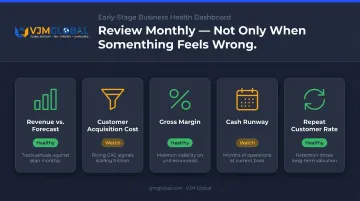
Once operational, track the metrics that signal whether the business is healthy:
- Revenue vs. forecast
- Cost of customer acquisition
- Gross margin
- Cash runway
- Repeat customer rate
Review these monthly at minimum, not only when something feels wrong.
Ongoing compliance obligations must be met consistently: tax filings, annual returns, payroll obligations, regulatory renewals. Missing these creates disproportionate costs for early-stage businesses.
The penalties are concrete. The IRS charges up to 25% of unpaid tax for failure to file; the UK's Companies House imposes penalties that double if accounts are late two years in a row.
For founders who want to focus on growth rather than compliance administration, VJM Global's ongoing accounting and compliance services cover income tax, GST filings, ROC compliance, payroll, and cross-border transaction advisory — without the overhead of a full-time finance team.
Conclusion
Starting a new business is not about moving fast. It is about doing the fundamentals right, in sequence.
Clarity on the problem, validated demand, a sound legal foundation, and disciplined financial management are what determine whether a business survives its first two years — not the speed of launch.
The businesses that last are the ones that treat documentation, compliance, and financial structure as ongoing commitments — not one-time setup tasks. Use this checklist as a working reference. Return to each element as your business scales, and you will catch the gaps before they become costly problems.
Frequently Asked Questions
What do you need to start a new business?
At minimum: a validated idea, the right legal structure and registrations, a dedicated business bank account with basic bookkeeping, and a clear plan for acquiring your first customers. Without all four, the business is exposed to operational and compliance risk before it has the revenue to absorb it.
What is the first step to starting a new business?
Validation — before registration, before product development, before spending. Confirming that a real problem exists, that a willing customer wants it solved, and that your pricing model works is the foundation everything else is built on.
How much money do you need to start a new business?
It varies significantly by business type and market, but founders should budget for both launch costs and at least 6–12 months of operating expenses before the business becomes self-sustaining. Undercapitalization is one of the leading causes of early failure — 70% of failed startups ran out of capital, according to CB Insights.
What legal requirements do I need to meet when starting a business?
Core requirements across most markets include:
- Registering your business structure
- Obtaining a tax identification number
- Registering for applicable taxes
- Securing required licenses or permits
- Obtaining appropriate business insurance
Requirements vary by country, industry, and business type — and are more complex for foreign nationals entering regulated markets like India.
How long does it take to register a new business?
Basic registration — name, structure, tax ID — can often be completed within a few days. UK Companies House online registration typically completes within 24 hours. Full setup, including licenses, insurance, banking, and compliance systems, generally takes four to eight weeks to complete properly.
Do I need an accountant or lawyer when starting a business?
Professional advice isn't legally required in all cases, but the cost of getting structure, tax setup, or compliance wrong almost always exceeds the cost of hiring an expert. An accountant helps with structure, financial planning, and tax setup; a lawyer handles contracts, IP, and compliance. For foreign entities entering India, professional guidance is essential given the multi-layered regulatory requirements under FEMA, the Companies Act, and India's FDI policy.