If you're an entrepreneur, small business owner, or community group exploring low-capital financial entity structures in India, this guide is for you. Getting the process right matters. Mistakes here don't just delay paperwork, they can trigger penalties, block deposit-taking, or erode member trust before the company even gets going.
One issue trips up almost every first-time applicant: confusing a Nidhi Company with an NBFC, or assuming RBI approval is needed. It isn't. The Ministry of Corporate Affairs (MCA) governs Nidhi Companies, not the RBI, and understanding that distinction from day one saves considerable time and money.
This guide covers what a Nidhi Company actually is, why entrepreneurs choose it, the exact registration steps, and the compliance obligations that follow.
TL;DR
- A Nidhi Company is a public company that takes deposits from and lends only to its own members
- Registration has two stages: SPICe+ incorporation, then Form NDH-4 within 120 days
- Post-2022 applicants need 200 members and ₹20 lakh Net Owned Funds for NDH-4 approval
- Incorporation alone does not authorise deposit collection; Central Government approval is required separately
- Over 8,400 Nidhi Companies operate actively across India, per MCA data
What Is a Nidhi Company?
A Nidhi Company is a public company incorporated under Section 406 of the Companies Act, 2013, and regulated by the Nidhi Rules, 2014. Its sole legal object is cultivating thrift and savings among members through mutual borrowing and lending.
Think of it as a closed financial loop. Members deposit money, other members borrow it, and the transactions never touch anyone outside that circle. This keeps external financial risk low, since there's no exposure to public deposits or open-market lending.
That members-only restriction is what separates a Nidhi from other financial entities.
How a Nidhi Compares to Other Structures
| Entity | Regulator | Who it can serve |
|---|---|---|
| Nidhi Company | MCA / Central Government (Section 406) | Members only — deposits and loans stay within the group |
| NBFC | Reserve Bank of India | General public, under RBI licensing and capital norms |
| Cooperative Society | State Registrar of Cooperative Societies | Members, under state cooperative law |
| Chit Fund Company | Respective State Governments | Subscribers, under separate chit fund legislation |
One live illustration is EC Nidhi Limited, registered in Kerala under the Registrar of Companies, Ernakulam. It appears as an active company on Economic Times' corporate database.
That listing shows the model in practice: a public company running a closed, member-only savings and credit system. It is an illustration only, not an endorsement of any particular offering.
Why Choose Nidhi Company Registration in India: Benefits & Eligibility
Entrepreneurs choose the Nidhi structure for one main reason: it's dramatically cheaper and less burdensome to set up than an NBFC. There's no RBI licensing process and no prudential capital norms to satisfy before you can start.
As of 3 June 2026, 8,439 Nidhi Companies were listed as active on the MCA's Corporate Data Management portal, a sizeable base of community-driven savings vehicles operating across the country.
Core benefits:
- Simpler setup than NBFC registration
- Lower financial risk — transactions stay within the member base
- Lower registration and compliance costs than other deposit-taking categories
Conditions to Meet After Incorporation
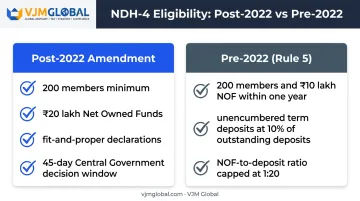
Companies incorporated after the 2022 amendment must file Form NDH-4 within 120 days of incorporation. To get approval, you need:
- At least 200 members
- Net Owned Funds (NOF) of at least ₹20 lakh
- Fit-and-proper declarations from every promoter and director
The Central Government has 45 days to decide; no response within that window means deemed approval.
Companies incorporated before the 2022 amendment follow the older Rule 5 benchmark instead:
- 200 members and ₹10 lakh NOF within one year
- Unencumbered term deposits worth at least 10% of outstanding deposits
- NOF-to-deposit ratio not exceeding 1:20
Baseline Incorporation Requirements
Regardless of which NOF test applies later, every Nidhi Company starts with:
- Minimum 7 shareholders
- Minimum 3 directors, with at least one resident in India for 182+ days in the financial year
- Minimum paid-up equity capital of ₹10 lakh
- Mandatory public company status
Miss the member-count or ratio conditions, and consequences follow quickly:
- Barred from accepting further deposits
- Must file Form NDH-2 within 30 days of the financial year's close to request a Regional Director extension
- Fines up to ₹5,000, plus ₹500 per day of continuing default
This entire framework is governed by Section 406, the Nidhi Rules 2014, and amendments made in 2019, 2022, and 2024, each one tightening thresholds and closing earlier loopholes.
Step-by-Step Nidhi Company Registration Process
Nidhi Company registration happens in two distinct stages. First, you incorporate as an ordinary public company through the SPICe+ web form. Second, you apply for Nidhi status itself through Form NDH-4. Skip that second stage, and you can't legally accept a single deposit.
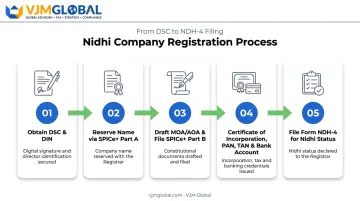
Step 1: Obtain DSC and DIN
Before filing anything, every proposed director needs a Digital Signature Certificate (DSC) and a Director Identification Number (DIN) from MCA-recognised agencies. No e-form can be submitted without these, so this is always the first move.
Step 2: Reserve the Company Name via SPICe+ Part A
Propose up to two names for MCA approval. Once approved, the name stays reserved for 20 days. Important constraint under the 2024 Nidhi Amendment Rules: you cannot use "Nidhi Limited" in the proposed name until the company is declared a Nidhi under Section 406(1). Choose an interim name for incorporation, then update it after Nidhi status is granted.
Step 3: Draft MOA & AOA and File SPICe+ Part B
The Memorandum of Association must restrict the company's objects strictly to receiving deposits from, and lending to, members. The Articles of Association must avoid authorising any Rule 6 prohibited activity. SPICe+ Part B also needs:
- Identity proofs for subscribers and directors
- Registered office documents
- Director declarations (INC-9 and, where applicable, DIR-2)
Step 4: Obtain Certificate of Incorporation, PAN, TAN & Open a Bank Account
Once the Registrar approves your documents, it issues the Certificate of Incorporation along with the company's CIN. PAN and TAN follow through the same SPICe+ process, and you'll need a company bank account before proceeding further. Documentation queries from the ROC are often where delays creep in at this stage—teams like VJM Global handle that back-and-forth so filing stays on track.
Step 5: File Form NDH-4 for Nidhi Status Declaration
Within 120 days of incorporation, file Form NDH-4 with proof of member count (minimum 200), Net Owned Funds (minimum ₹10 lakh), and fit-and-proper declarations from promoters. Until this is approved, the company legally cannot accept deposits or begin Nidhi business, even though it already exists as an incorporated entity.
Compliance, Fees & Restrictions for Nidhi Companies
Registration is only the start. Nidhi Companies face extra ongoing filings on top of standard company compliance.
| Filing | Purpose | Deadline |
|---|---|---|
| NDH-1 | Compliance return for the first (and, where applicable, second) financial year | Within 90 days of financial year close |
| NDH-3 | Recurring half-yearly return | Within 30 days of each half-year |
| AOC-4 | Annual financial statements | Within 30 days of the AGM |
| MGT-7 | Annual return | Within 60 days of the AGM |
NDH-1 is not an annual filing. It mainly covers the first year or two after incorporation; NDH-3 is the return that recurs every six months.
Government fees depend on authorised capital, SPICe+ filing charges, and stamp duty on the MOA, which varies by state.
Because these figures shift with capital structure and location, use the MCA portal’s live fee calculator before you budget. VJM Global can scope a cost estimate to your state and capital structure instead of a generic figure.
What a Nidhi Company Cannot Do
Filings and fees are only part of the picture. Rule 6 of the Nidhi Rules also bars several activities outright:
- Running chit funds, hire-purchase, leasing, or insurance business
- Issuing preference shares or debentures
- Opening current accounts for members
- Lending to, or accepting deposits from, non-members
- Advertising for deposits beyond limited private circulation to members
- Paying brokerage or incentives to mobilise deposits
Branch Expansion Rules
A Nidhi Company can open branches only after three consecutive years of net profit. Even then, it is limited to three branches within its own district. A fourth branch in the same district, or any branch outside it, needs prior Regional Director approval.
Common Misconceptions & When Nidhi Registration May Not Be Right for You
A few assumptions about Nidhi companies keep circulating. Clearing them up early prevents wasted filings and the wrong entity choice.
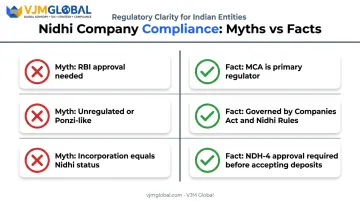
Myth: Nidhi Companies need RBI approval or a licence.
Reality: The MCA is the primary regulator. The RBI only issues deposit-related directives for notified Nidhis, which stay largely exempt from core RBI Act provisions because they deal only with member-shareholders.
Myth: Nidhi Companies are unregulated or "Ponzi-like."
Reality: They operate under the Companies Act and Nidhi Rules. NOF thresholds and the NDH-4 fit-and-proper test protect depositors before a company can collect deposits.
Myth: Incorporation equals Nidhi status.
Reality: This one catches people out most often. A company can be fully incorporated as a public company and still be legally barred from accepting a single deposit until Form NDH-4 is approved by the Central Government.
When the structure doesn't fit:
- The model needs to serve the general public, not only a closed member base
- External equity or non-member debt is part of the funding plan
- National scale matters more than a community-based approach
In these cases, an NBFC, a Section 8 Company, or a cooperative society usually fits better than a Nidhi.
Conclusion
Nidhi Company registration is a two-stage process: incorporate as a public company through SPICe+, then secure Nidhi status through Form NDH-4. Skip either stage or misjudge the timelines, and you risk losing deposit-taking rights altogether.
Getting eligibility thresholds, compliance filings, and prohibited activities right from day one keeps the company legally able to operate and preserves member trust.
If you're considering this structure for your community or business, VJM Global supports entrepreneurs through the documentation, compliance timelines, and post-registration filings Nidhi Companies require—so a self-filed form isn't left to chance under ROC scrutiny.
Frequently Asked Questions
Is a Nidhi Company legal in India?
Yes. Nidhi Companies are fully legal entities recognised under Section 406 of the Companies Act, 2013, and regulated by the Nidhi Rules, 2014.
What are the licence fees for a Nidhi Company in India?
Costs include MCA registration and SPICe+ filing fees based on authorised capital, state-specific stamp duty, and professional fees. Rates change periodically, so verify current figures on the MCA portal or with a registration expert.
Is RBI approval required to register a Nidhi Company in India?
No. Nidhi Companies are regulated by the Ministry of Corporate Affairs, not the RBI. The RBI only retains limited authority over deposit-related directives for notified Nidhis.
How many members are required to start a Nidhi Company?
You need at least 7 members, including 3 directors, at incorporation. That number must grow to at least 200 members within the applicable NDH-4 window afterward.
What is the minimum capital required for Nidhi Company registration?
Minimum paid-up equity capital is ₹10 lakh at incorporation. Within the NDH-4 window, Net Owned Funds must reach at least ₹20 lakh for post-2022 applicants.
How long does it take to register a Nidhi Company in India?
SPICe+ incorporation typically takes a couple of weeks when documents are ready, followed by a 120-day window to file and secure NDH-4 approval. Exact timing depends on MCA processing speed.