Introduction
US manufacturers are carrying a significant AR burden right now. Census Bureau Quarterly Financial Report data shows all-manufacturing trade receivables reached $1.1 trillion in Q1 2026 — roughly 54% of quarterly sales. That's an enormous amount of working capital tied up in unpaid invoices, and it's growing: receivables rose by approximately $73 billion in a single quarter from Q4 2025 to Q1 2026.
The Federal Reserve's 2024 Business Payments Study found that 73% of businesses still relied on checks for payments, with nearly half citing high cost as a primary pain point. For manufacturers managing distributor networks, extended payment terms, and complex purchase order structures, these pressures compound fast.
Outsourcing accounts receivable addresses all three problems at once. For US manufacturers, it stabilizes cash flow, protects distributor relationships, and frees finance teams from the reactive collections work that crowds out higher-value work. This guide covers the key benefits, what to look for in a provider, and how to implement the transition without disrupting operations.
TL;DR
- AR outsourcing means delegating invoice management, collections follow-up, reconciliation, and dispute resolution to a specialized third-party firm
- Immediate benefits: faster collections, reduced Days Sales Outstanding (DSO), and internal teams freed from manual AR tasks
- Three measurable advantages: improved cash flow, lower operational overhead, and manufacturing-specific expertise
- Without structured AR management, aging receivables grow, bad debt increases, and finance teams spend their time chasing payments instead of focusing on growth priorities
- Key to value: track the right KPIs, integrate your ERP, and treat AR outsourcing as a continuous financial partnership — not a one-time fix
What Is Accounts Receivable Outsourcing for Manufacturers?
AR outsourcing is the practice of delegating invoice generation, payment tracking, collections, and dispute handling to an external firm that specializes in receivables management — so internal teams can focus on operations.
For manufacturers, the tasks typically outsourced include:
- Invoice processing across distributor and channel partner networks
- Aging receivables follow-up on outstanding balances
- Payment reconciliation matching incoming payments to open invoices
- Dispute resolution tied to purchase orders, contract pricing, or delivery terms
Manufacturing AR isn't generic. Multi-tier pricing structures, volume discounts, contract-specific payment terms, and distributor relationships all demand consistent, knowledgeable follow-up.
An outsourced AR function handles that complexity without the overhead of building the function in-house.
The result is more predictable cash flow and a leaner internal team, both of which matter in a capital-intensive industry.
Key Advantages of Outsourcing AR for Manufacturing
Advantage 1: Faster Collections and Improved Cash Flow
Outsourced AR teams bring structured follow-up workflows and dedicated collections specialists who pursue outstanding invoices without the distractions that routinely pull in-house finance staff at manufacturing companies. Collections align with production and delivery schedules, real-time reconciliation catches discrepancies before they escalate into disputes, and aging receivables get actively worked rather than passively tracked.
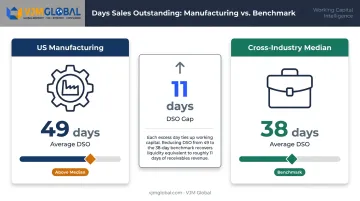
Delayed payments don't just affect accounting performance. They affect whether a manufacturer can purchase raw materials, fund payroll, and execute production runs on schedule. The implied DSO for US manufacturing sits at approximately 49 days based on Q1 2026 Census QFR data — meaningfully above APQC's cross-industry median of 38 days. That 11-day gap represents significant working capital tied up longer than it needs to be.
Manufacturers with faster, more predictable collections can plan procurement cycles with greater confidence — reducing reliance on short-term credit facilities that carry their own costs and risks.
KPIs impacted:
- Days Sales Outstanding (DSO)
- Aging receivables percentage
- On-time payment rate
- Bad debt write-off ratio
When this matters most: Highest impact for manufacturers managing multiple distributor relationships, extended payment terms of 30–90 days, or seasonal demand spikes that create invoice backlogs.
Advantage 2: Lower Operational Costs Without Sacrificing Control
Maintaining an in-house AR team requires ongoing investment in salaries, software licenses, benefits, and training — costs that scale with invoice volume and are hard to reduce during slow periods. APQC benchmarks the median total cost to perform order-to-cash processes at $2.32 per $1,000 of revenue, a figure that includes personnel, systems, overhead, and external costs.
The staffing side of this is getting more expensive. Robert Half's 2026 data puts the midpoint salary for AR Specialists at $60,250, with accountant and auditor unemployment at just 1.0% — meaning qualified AR professionals are genuinely difficult to hire and retain. Robert Half reports that talent shortages caused project delays for 75% of finance leaders surveyed.
Specialized AR firms operate at economies of scale, spreading technology costs and staffing across multiple clients. Manufacturers gain enterprise-level AR capabilities without the infrastructure investment.
Cost savings extend well beyond headcount:
- Elimination of AR software subscriptions
- Reduced management overhead
- No recruitment or retention costs in a tight talent market
- Compliance burden shifts to the outsourcing provider
KPIs impacted:
- AR department operating cost as a % of revenue
- Cost per invoice processed
- Staff hours on collections vs. strategic finance activities
When this matters most: Mid-sized manufacturers who lack the volume to justify a large dedicated AR team, but face billing complexity that exceeds what a part-time resource can manage.
Advantage 3: Manufacturing-Specific Expertise and Scalability
Manufacturing AR involves complexities that generic finance outsourcing isn't built to handle: volume discounts, contract-specific pricing, multi-location invoice management, purchase order reconciliation, and distributor-level dispute resolution. Specialized AR firms bring teams trained in these workflows.
APQC's benchmark shows a 92% median for invoices processed error-free the first time across industries — meaning 1 in 12 invoices still contain errors. In manufacturing, where a single billing discrepancy can trigger a dispute that pauses payment from a major distributor for weeks, that error rate compounds quickly.
The NACM's June 2026 Credit Managers' Index recorded manufacturing-sector readings of 50.2 for disputes and 52.7 for customer deductions — both active pressure points.
NACM distinguishes disputes (usually surfaced before payment is due) from deductions (often discovered only when payment arrives short). Both require human judgment, documentation, and follow-up that automation alone cannot reliably provide.
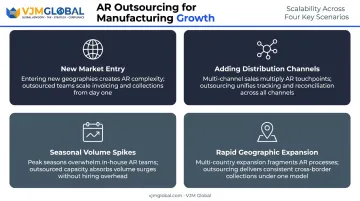
Scalability compounds this benefit. Manufacturers entering new markets, adding distribution channels, or managing seasonal volume spikes can scale AR capacity immediately — without hiring ahead of demand or cutting headcount when volumes normalize.
KPIs impacted:
- Invoice accuracy rate
- Dispute resolution time
- Collections staff utilization
- Scalability response time during volume spikes
When this matters most: Manufacturers with multi-channel distribution, seasonal production patterns, or businesses going through rapid growth or geographic expansion.
What Happens When AR Outsourcing Is Ignored
Under-resourced in-house AR teams fall behind — and the problems compound quickly. Invoice errors accumulate, follow-ups become inconsistent, and finance staff end up chasing overdue invoices instead of managing cash flow strategically.
For manufacturers, the consequences are operational, not just financial:
- Cash gaps from inconsistent distributor collections push manufacturers toward short-term borrowing to fund raw material procurement — adding cost and financial risk
- High invoice error rates increase dispute frequency, damage long-term buyer relationships, and extend payment cycles further
- No visibility into AR performance data leaves finance leadership unable to make informed decisions about credit limits, payment terms, or customer risk — allowing bad debt to accumulate
- Finance team burnout and turnover make an already difficult AR process harder to sustain over time
The scale of the exposure is real. Atradius's 2024 US payment practices survey reported average bad debts across B2B invoices at 8%, with manufacturing-adjacent sectors among the most affected. For a manufacturer running on tight margins, 8 cents lost per dollar invoiced isn't an abstraction — it's the difference between a profitable quarter and a cash shortfall.
How to Get the Most Value from AR Outsourcing
AR outsourcing delivers results in proportion to how well it's integrated into your operations. Providers need direct visibility into production schedules, customer contracts, and billing terms — without that context, even experienced teams will hit avoidable errors.
Practical steps to maximize value:
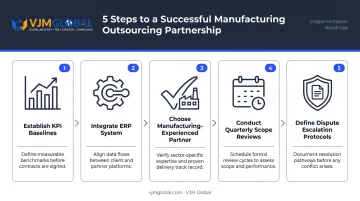
Establish KPI baselines before outsourcing begins. Document current DSO, aging buckets, and dispute rates so progress is measurable. Review these monthly with your provider.
Integrate your ERP or accounting system. Manual data handoffs between your internal systems and the outsourcing firm recreate the same bottlenecks you're trying to eliminate. Confirm your provider supports your platform — whether that's QuickBooks, SAP, NetSuite, or Xero — before signing anything.
Choose a partner with manufacturing AR experience. Verify they understand purchase order matching, contract pricing, multi-tier distributor billing, and dispute escalation. Generic finance outsourcing applied to manufacturing billing tends to produce exactly the errors you're trying to fix.
Conduct quarterly scope reviews: as production scales, AR complexity shifts. Check every quarter whether the current arrangement still fits your billing volume and customer mix.
Define dispute escalation protocols upfront. Establish documentation requirements, escalation timelines, and communication standards with your provider before disputes arise — not after the first one lands.
The manufacturers who get the most from outsourced AR are the ones who stay engaged: reviewing metrics, refining scope, and treating the provider as an extension of their finance team rather than a third-party vendor.
Conclusion
For US manufacturers, outsourcing accounts receivable is a structural decision — one that addresses what manual AR processes rarely deliver: faster cash recovery, lower operating costs, and financial visibility that internal teams can actually act on.
The advantages build over time. As providers learn a client's billing environment and distributor relationships, the results sharpen:
- DSO drops as collections become more consistent
- Finance teams shift from reactive chasing to strategic planning
- Contract and billing exceptions get resolved faster
- The return on the relationship grows as the provider learns your business
AR outsourcing should be treated accordingly — reviewed regularly, aligned with production realities, and measured against clear operational KPIs. Done right, it becomes an ongoing financial partnership that scales with the business.
Frequently Asked Questions
What does outsourcing accounts receivable for manufacturing typically include?
It covers invoice generation, payment tracking, collections follow-up, dispute resolution, and reconciliation — tailored to manufacturing's billing structures, including purchase order matching, contract pricing, and distributor payment terms. The scope can be customized based on invoice volume and complexity.
How does outsourcing AR improve cash flow for US manufacturers?
Outsourced AR teams apply structured follow-up workflows and real-time reconciliation that reduce DSO, accelerate payment recovery, and give finance teams more predictable cash inflows. For manufacturers with a ~49-day implied DSO, even a modest improvement frees significant working capital.
What is the difference between AR outsourcing and AR automation for manufacturers?
AR automation uses technology to streamline rule-based processes internally. AR outsourcing transfers responsibility to an external team that provides human expertise for dispute resolution, deduction management, and complex manufacturing billing scenarios that automation alone cannot reliably handle. Many manufacturers benefit from both.
How do I choose the right AR outsourcing partner for my manufacturing business?
Evaluate partners on manufacturing-specific billing experience, ERP integration capability, data security protocols, and KPI-based performance reporting — making sure they understand purchase order matching and distributor billing structures before you sign.
What are the risks of not outsourcing accounts receivable in manufacturing?
Without structured AR management, manufacturers face growing aging receivables, rising bad debt write-offs, and billing errors that strain distributor relationships. Finance teams get pulled into reactive collections work, leaving little bandwidth for strategic priorities.
How much does outsourcing accounts receivable cost for manufacturing companies?
Common pricing models include per-invoice fees (typically $3–$8 per invoice), monthly retainers, and performance-based structures. Compare total outsourcing cost against your current in-house AR spend, including salaries, software, and management overhead, to get an accurate picture.