
Introduction
UK businesses face a cash flow crisis of unprecedented scale. Late payments cost the UK economy almost £11 billion per year, forcing 38 businesses to shut down every single day because they are not paid on time. Rising operational costs, persistent payment delays, and lean finance teams managing high invoice volumes have moved accounts receivable from a back-office task to a boardroom concern.
90% of UK businesses experienced late payments in the past year, with an average delay of 32 days beyond agreed terms. For SMEs without dedicated credit control staff, that delay compounds into:
- Cash flow shortfalls that strain day-to-day operations
- Bad debt write-offs that erode margins
- Restricted growth capacity as capital stays locked in unpaid invoices
This article covers what AR outsourcing actually delivers for UK businesses, the hidden costs of managing receivables in-house, and the practices that make it work long-term.
Key Takeaways
- AR outsourcing delegates invoice management, collections, and reporting to external specialists, freeing internal teams for higher-value work
- UK businesses that outsource AR typically achieve faster payment cycles, lower overhead costs, and reduced administrative burden
- Rising DSO, cash flow instability, and bad debt risk compound quickly without structured AR management
- UK GDPR, HMRC accuracy standards, and the Late Payment of Commercial Debts Act make specialist AR support especially valuable
- Effective AR outsourcing requires clear SLAs, measurable KPIs, and quarterly performance reviews
What Is Accounts Receivable Outsourcing?
Accounts receivable outsourcing means delegating the full or partial receivables cycle—invoicing, payment tracking, credit control, collections, and reporting—to an external specialist provider.
Where it applies:
- SMEs without dedicated finance teams managing high invoice volumes
- Growing businesses experiencing seasonal billing peaks that overwhelm internal capacity
- Firms managing multiple customers on different payment terms across industries
Done well, AR outsourcing delivers predictable cash flow, cleaner financial data, reduced collection risk, and sharper visibility into what customers owe and when. The decision is strategic, not administrative.
Key Advantages of Accounts Receivable Outsourcing for UK Businesses
Advantage 1: Faster Collections and Improved Cash Flow Predictability
When collections depend on staff availability rather than disciplined processes, delays compound quickly. Outsourced AR teams run on a defined cadence:
- Invoices go out on time
- Reminders follow a set schedule
- Disputes are escalated through documented paths
- Payments are matched promptly
UK businesses feel the consequences of late payments more than most.
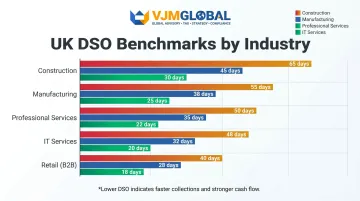
According to Shuttle's 2026 DSO benchmarks, average Days Sales Outstanding varies dramatically by sector:
| Industry | Average DSO | Good DSO | Excellent DSO |
|---|---|---|---|
| Construction | 65-80 days | 50-60 days | Under 45 days |
| Manufacturing | 55-70 days | 40-50 days | Under 35 days |
| Professional Services | 50-65 days | 35-45 days | Under 30 days |
| IT Services | 45-55 days | 30-40 days | Under 25 days |
| Retail (B2B) | 35-50 days | 25-35 days | Under 20 days |
When collections run on a disciplined cadence rather than staff availability, payment cycles shorten and working capital improves without requiring additional borrowing.
The KPIs that move include DSO, percentage of overdue receivables, debtor ageing profile, and cash conversion cycle. This advantage is most pronounced for businesses with high invoice volumes, multiple customers on different payment terms, or seasonal spikes that overwhelm internal capacity.
Faster collections also create the conditions for the next advantage: meaningful cost reduction.
Advantage 2: Measurable Cost Reduction and Operational Scalability
Outsourced AR replaces fixed overhead — salaries, training, software licences, office costs — with flexible capacity that scales with demand, not headcount. Businesses pay for outcomes or defined service packages rather than maintaining a permanent team that may be under- or over-utilised year-round.
The average UK credit controller salary is £28,028 per year. When you add employer National Insurance (13.8%), pension contributions (3-5%), software licences, training, office space, and management overhead, the fully-loaded cost reaches £35,000-£40,000 annually per person.
Published industry estimates suggest outsourcing finance functions can reduce costs by 20-50% compared to in-house delivery, depending on scope, scale, and provider location. Businesses can redirect these savings to core revenue-generating activities, technology, or growth initiatives.
Scalability as a secondary cost advantage: Outsourcing allows businesses to absorb seasonal invoice peaks (year-end or contract renewals) without emergency hiring or expensive temporary staffing.
Key metrics that improve include cost-per-invoice, overhead as a percentage of revenue, and AR headcount relative to invoice volume. This is particularly relevant for SMEs without dedicated finance teams, rapidly scaling businesses, and firms with uneven billing cycles.
Cost savings matter less, though, if your AR function creates compliance exposure — which is where specialist expertise becomes the deciding factor.
Advantage 3: Access to Specialist Expertise and UK Compliance Assurance
Outsourced AR providers bring trained specialists — not generalists stretched across multiple roles — who understand UK-specific payment practices, credit control norms, and regulatory obligations. In practice, this expertise covers three distinct compliance areas:
- HMRC accuracy: Invoicing aligned with VAT reporting standards
- Payment regulations: Collections communication compliant with the Late Payment of Commercial Debts Act 1998
- Data handling: Processes that meet UK GDPR requirements
Compliance errors in AR — incorrect VAT treatment, improper data handling, or non-compliant debt chasing — expose UK businesses to HMRC scrutiny, reputational risk, and financial penalties.
Making Tax Digital (MTD) generated £185-195 million in additional VAT revenue for the 2019-2020 period. This demonstrates that accurate AR data directly affects tax compliance outcomes. HMRC's final evaluation found that 67-76% of mandated businesses noted MTD reduced the potential for mistakes.
Statutory interest and recovery costs:
Under the Late Payment of Commercial Debts Act 1998, businesses can claim statutory interest at 8% above the Bank of England base rate plus fixed compensation:
- £40 for debts up to £999.99
- £70 for debts from £1,000 to £9,999.99
- £100 for debts of £10,000 or more
Specialist AR providers know how to apply these provisions correctly, protecting revenue while maintaining professional customer relationships.
VJM Global has supported 250+ UK businesses with outsourced accounting and AR functions, applying 30+ years of compliance and advisory experience to help UK clients navigate HMRC requirements, MTD obligations, and late payment legislation accurately.
The compliance metrics that improve include invoice accuracy rate, dispute resolution time, VAT filing accuracy, and compliance audit pass rate. This advantage is most critical during growth phases, HMRC reviews, or whenever staff turnover creates knowledge gaps in AR processes.
What Happens When AR Management Is Neglected or Handled Inconsistently
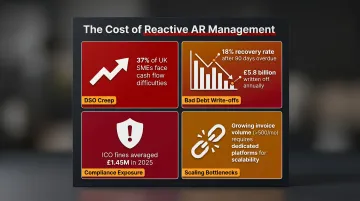
Reactive AR management—chasing invoices only when cash runs short, relying on overstretched staff, or accepting manual workarounds—creates compounding problems that are easy to ignore until they become serious.
Typical consequences:
- DSO creep and cash shortfalls: Late follow-up produces later payments, pushing businesses to borrow rather than collect. 37% of small UK firms have experienced cash flow difficulties due to late payments.
- Bad debt write-offs: Once an invoice hits 90 days overdue, the likelihood of full payment drops to around 18%. UK SMEs collectively wrote off £5.8 billion in bad debt in a single financial year.
- Compliance exposure: Errors in invoicing, data handling, or collections communications accumulate until an HMRC review or GDPR breach forces correction under pressure. ICO fines in 2025 averaged £1.45 million—nearly ten times the 2024 average.
- Scaling bottlenecks: As invoice volumes grow, unstructured AR processes break down, slowing the entire revenue cycle and restricting growth capacity.
Best Practices for Effective AR Outsourcing in the UK
AR outsourcing delivers its full value only when the partnership is structured correctly from the start. Choosing a provider is the first decision, but it is not the only one.
Define Scope and SLAs Upfront
Specify exactly which AR functions are outsourced (full cycle vs. selective tasks). Set measurable service levels covering:
- Invoice turnaround time
- Follow-up cadence
- Dispute resolution timelines
- Reporting frequency
Review these against actual performance quarterly.
Prioritise Data Security and UK GDPR Compliance
Confirm the provider's data handling protocols, storage location, access controls, and breach notification procedures. This is a non-negotiable requirement for UK businesses handling customer financial data.
UK GDPR Article 28 requirements:
- Processing data only on written instructions
- Confidentiality commitments from authorised persons
- Security measures pursuant to Article 32
- Sub-processor controls
- Assistance with data subject rights requests
- Delete or return data at contract end
- Audit rights
Ask specifically about certifications such as ISO 27001, the recognised standard for information security management.
Integrate with Existing Systems
Ensure the outsourcing partner works within your current accounting software (Xero, QuickBooks, Sage, or similar UK platforms) to avoid manual re-entry errors, maintain real-time visibility, and support faster month-end close.
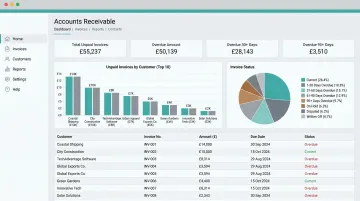
Xero and QuickBooks together account for over 70% of the UK small business accounting software market, while Sage commands an estimated 40% of the broader UK SME segment. VJM Global's accounting outsourcing teams work across all three platforms and are familiar with the compliance obligations specific to UK businesses.
Review Outcomes, Not Just Activity
Track DSO movement, overdue ratios, and dispute resolution times monthly. Treat these as business metrics, not administrative reports, and use them to renegotiate SLAs, escalate persistent disputes, or adjust follow-up cadence where performance is slipping.
Conclusion
AR outsourcing for UK businesses means building a disciplined, scalable financial process—one that delivers consistent cash flow, lowers operating costs, and keeps the business compliant without overloading internal teams.
Those gains build over time. A business that outsources AR and reviews performance rigorously will be better positioned to scale, access credit, and weather payment delays than one running the same process reactively in-house.
The right time to evaluate AR outsourcing is before cash flow pressure forces the decision—when processes can be structured correctly from the start rather than patched under stress.
Frequently Asked Questions
What does accounts receivable outsourcing typically include for UK businesses?
Full-cycle AR outsourcing covers invoice generation, payment tracking, credit control, collections, dispute management, cash application, and reporting. Scope varies by provider and can be full-cycle or selective based on business needs.
How much can UK businesses realistically save by outsourcing accounts receivable?
Industry estimates suggest outsourcing finance functions can reduce costs by 20–50% versus in-house staffing. Actual savings depend on invoice volume, current staff costs, and scope of services outsourced.
Is accounts receivable outsourcing compliant with UK GDPR and HMRC requirements?
Reputable providers operate under UK GDPR, handle data securely, and align processes with HMRC invoicing and VAT accuracy standards. Verify certifications (such as ISO 27001) and data handling protocols before engaging.
How long does it take to set up outsourced AR services for a UK business?
Most providers can onboard within a few weeks through a phased approach: process mapping, data migration, and pilot runs. Some providers offer faster activation for straightforward AR setups.
Will outsourcing accounts receivable damage relationships with my customers?
Professional AR teams communicate consistently and respectfully, often improving the client experience by removing the awkwardness of internal staff chasing long-standing customers.
What KPIs should UK businesses monitor when working with an AR outsourcing provider?
Track these metrics monthly with your provider:
- Days Sales Outstanding (DSO)
- Percentage of overdue invoices
- Dispute resolution time
- Cash application accuracy
- Bad debt write-off rate
- Ageing profile movement