Introduction
Canadian talent is genuinely attractive to US employers right now. Geographic proximity, overlapping time zones, a shared business culture, and a favorable exchange rate all make Canadian hiring a compelling option for US companies looking to scale. The Bank of Canada reported 1 USD = 1.4174 CAD as of July 2026, meaning US payroll budgets stretch further north of the border.
The catch? Canadian employment law operates nothing like US law. It's province-by-province, it doesn't recognize at-will termination, and the tax obligations catch most US employers off guard.
That's where "PEO services in Canada" becomes relevant — but the term itself creates confusion, because Canadian PEOs don't work the same way US employers expect.
This guide covers what US companies need to know before hiring their first Canadian employee:
- What "PEO services" actually means in a Canadian context
- How the Canadian model differs from what US employers expect
- How to think through the PEO vs. EOR decision
- What to evaluate before committing to a provider
Key Takeaways
- Canadian PEOs manage HR and payroll, but the client remains the legal employer — unlike US PEOs that assume co-employer tax status
- No Canadian entity? Use an EOR, not a PEO — it's the faster, lower-risk starting point
- Canada has no at-will employment — termination notice can reach 24 months under common law
- Mandatory payroll contributions (CPP, EI, provincial levies) add roughly 10–15% to gross wages
- Canadian median salaries translate to ~30–50% less in USD for software and marketing roles
What Is a PEO in Canada and What Services Do They Offer?
A Professional Employer Organization (PEO) is a third-party firm that manages HR functions — payroll, benefits, compliance, onboarding — on behalf of client businesses. The client retains operational control; the PEO handles the administrative employer side.
How the Canadian PEO Model Differs from the US
This is where US companies get tripped up. In the US, NAPEO defines co-employment as a contractual arrangement where the PEO assumes shared employer status, including tax liability. The PEO becomes the employer of record for tax purposes.
Canada works differently. Under a Canadian PEO arrangement, the client company remains the legal employer. The PEO supports HR and payroll administration in the background — sometimes described as a "paymaster" in Canadian legal contexts.
The CRA confirms that using a third-party service provider does not change the employer's payroll liability. If the PEO makes a remittance error, the employer still owns that penalty.
You'll also encounter Canadian PEOs described as "HR outsourcing firms" or "Administrative Services Organizations (ASOs)" — the terminology is inconsistent, which adds to the confusion for US companies evaluating their options.
Core Services a Canadian PEO Typically Provides
- Payroll processing across provinces (different tax rates, different remittance schedules)
- Employment contract drafting, including bilingual French/English contracts for Quebec
- Benefits sourcing and group plan administration
- Employee onboarding and offboarding
- HR policy support and performance management guidance
- Workers' compensation management
- Time-off tracking and leave administration
Canada has 10 provinces and 3 territories, each with its own employment standards, tax rates, and labor rules. A competent Canadian PEO handles this complexity so you don't have to build that expertise in-house.
PEO vs. EOR in Canada: Which Does a US Company Actually Need?
For US companies hiring in Canada, the first decision is structural: PEO or EOR. Getting it wrong creates compliance exposure from day one.
The EOR Model Explained
An Employer of Record (EOR) — also called a Global PEO or International PEO — becomes the full legal employer of your Canadian workers. The EOR's own Canadian entity handles all payroll, tax filings, statutory contributions, and employment liabilities. You direct the work; the EOR owns the compliance.
The Core Fork in the Road
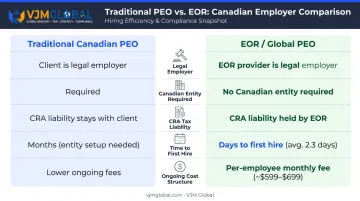
| Factor | Traditional Canadian PEO | EOR / Global PEO |
|---|---|---|
| Legal employer of record | Client company | EOR provider |
| Canadian entity required? | Yes | No |
| CRA payroll liability | Stays with client | Held by EOR |
| Speed to first hire | Months (entity setup first) | Days — Remote publishes 2.3 days avg. onboarding |
| Cost structure | Lower ongoing fees | Per-employee monthly fee (~$599–$699/month per employee) |
What Entity Setup Actually Involves
Federal incorporation in Canada costs $200 and takes one business day through Corporations Canada. But that's only step one. After that, you need:
- Provincial/territorial registration in every province where you employ staff
- CRA payroll account registration (CRA's payroll deductions remittance account)
- Provincial business licenses and health tax registrations
- A Canadian bank account
- Legal and accounting support to navigate both federal and provincial obligations
In practice, full setup across payroll registrations, provincial filings, and banking typically takes 8–12 weeks.
The Practical Recommendation
For US companies making their first Canadian hire or testing the market, an EOR is almost always the right starting point. It eliminates entity overhead, cuts time-to-hire from months to days, and transfers compliance risk to a provider with established Canadian infrastructure.
A traditional Canadian PEO makes sense once you already have a Canadian entity and need ongoing HR administration support — not before.
How Canadian Employment Law Differs from the US
Canadian employment law operates on fundamentally different principles than the US — and those differences affect every hire you make, every contract you sign, and every separation you navigate.
No At-Will Employment
Canada does not recognize at-will termination. Fasken confirms that employees are entitled to reasonable notice or pay in lieu upon dismissal without cause, and common-law notice commonly ranges from weeks up to 24 months — sometimes 24 to 28 months in exceptional cases.
Statutory minimums vary by province:
| Province | Minimum Statutory Notice |
|---|---|
| Ontario | 1 week (3 months) up to 8 weeks (8+ years) |
| British Columbia | 1 week (3 months) up to 8 weeks max |
| Alberta | 1 week (90 days) up to 8 weeks |
| Quebec | 1 week (3 months) up to 8 weeks (10+ years) |
With common-law exposure potentially reaching two years of salary, a qualified PEO or EOR helps you draft contracts that cap this liability and guides you through severance calculations when separations occur.
Termination rules are just one piece. Where an employee works also determines their day-to-day entitlements — and that varies sharply by province.
Provincial Variation in Employment Standards
Every province sets its own minimum wage, vacation entitlement, and overtime threshold:
| Province | Min. Wage | Vacation Minimum | Overtime Trigger |
|---|---|---|---|
| Ontario | $17.60/hr (→$17.95 Oct 2026) | 2 weeks (1 yr) | Over 44 hrs/week |
| British Columbia | $18.25/hr | 2 weeks (12 months) | 1.5x after 8 hrs/day or 40/week |
| Alberta | $15.00/hr | 2 weeks (1 yr) | Over 8 hrs/day or 44/week |
| Quebec | $16.60/hr | 2 weeks (1–3 yrs) | Over 40 hrs/week |
Quebec adds an additional layer: French is the official language of work. Employment contracts must be provided in French first, and employees have the right to conduct professional activities in French.
On top of provincial standards, every employer in Canada carries mandatory payroll obligations that don't exist in the same form under US federal law.
Mandatory Payroll Contributions
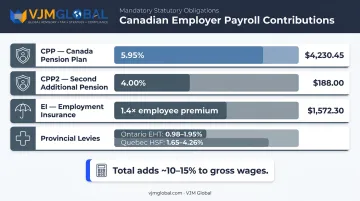
Mandatory employer contributions typically add 10–15% to gross wages before any supplemental benefits. These contributions include:
- CPP (Canada Pension Plan): 5.95% employer contribution, max $4,230.45; CPP2 adds 4.00%, max $188.00
- EI (Employment Insurance): Employer pays 1.4x the employee's EI premium; max employer contribution $1,572.30
- QPP (Quebec, instead of CPP): 6.30% employer rate, max $4,479.30; QPP2 adds 4.00%, max $416.00
- Provincial payroll levies: Ontario's Employer Health Tax (EHT) runs 0.98%–1.95%; Quebec's Health Services Fund (HSF) ranges 1.65%–4.26% depending on total payroll
These obligations apply from the first paycheck. A PEO or EOR registered in each province handles remittance directly, keeping you compliant without requiring your own Canadian payroll infrastructure.
Key PEO Services US Companies Should Expect When Hiring in Canada
Employee Onboarding and Contracts
A Canadian PEO or EOR handles the full onboarding process from day one. Core tasks include:
- Drafting employment contracts compliant with the relevant province's laws
- Collecting required documentation and verifying work eligibility
- Enrolling employees in payroll and benefits immediately
- Providing bilingual contracts for Quebec employees, with the French version primary
Payroll Processing and Tax Compliance
Canadian payroll involves more moving parts than US payroll:
- Calculating gross-to-net pay under federal and provincial tax tables
- Withholding and remitting CPP/QPP, EI, and income taxes to the CRA
- Filing T4 slips (Canada's W-2 equivalent) by the March 2 deadline
- Managing provincial payroll levies where applicable
- Handling common pay cycles — semi-monthly and bi-weekly are most common
CRA late remittance penalties run 3%–10%, scaling to 20% for repeat or gross negligence failures. Employers unfamiliar with CRA remittance schedules trigger these penalties regularly.
HR Support and Offboarding
A full-service PEO covers policy implementation, performance management guidance, and employee relations support — the day-to-day HR infrastructure most US companies don't have in place for Canadian staff.
Termination requires particular care. The provider should advise on statutory notice periods, calculate severance obligations accurately, and help draft termination documentation to reduce wrongful dismissal exposure.
Benefits of Using a PEO or EOR to Expand Into Canada
Speed to Market
An EOR lets you make your first Canadian hire in days rather than months. Given the multi-step process of Canadian entity setup — federal incorporation, provincial registration, CRA accounts, banking — EOR onboarding is far faster for companies that haven't yet established a Canadian presence.
Compliance Risk Reduction
The PEO or EOR stays current with provincial law changes, CRA requirement updates, and statutory benefit adjustments on your behalf. Misclassification errors, incorrect severance calculations, or missed remittances carry direct financial penalties and reputational damage. A provider with in-house Canadian legal expertise reduces that exposure significantly.
Cost Efficiency and Talent Access
The exchange rate math is concrete. At 1 USD = 1.4174 CAD, Canadian median salaries translate to significantly lower USD costs:
| Role | Canada Median (CAD) | Approx. in USD | US Median (USD) | Estimated Difference |
|---|---|---|---|---|
| Software Developer | ~$100,006/yr | ~$70,555 | $133,080 | ~47% lower |
| Marketing/PR Manager | ~$115,003/yr | ~$81,135 | $161,030 | ~50% lower |
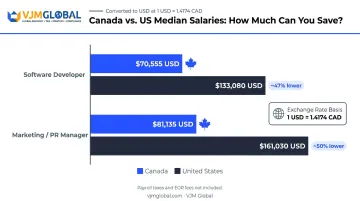
Source: Statistics Canada Job Bank (updated Nov. 2025) and BLS Occupational Outlook Handbook (May 2024). Excludes payroll taxes, benefits, and EOR fees.
Once you factor in mandatory payroll contributions and provider fees, the gap narrows but remains meaningful for most roles. A PEO also unlocks group benefit plans at competitive rates that a single US employer couldn't negotiate independently — an important factor for attracting Canadian talent who expect supplemental health and dental coverage.
How to Choose the Right Canadian PEO Provider
Key Evaluation Criteria
- Legal employer status — Is this provider a true EOR (full legal employer, no entity required) or a co-employment PEO (entity required)? This is the most important question.
- Provincial coverage — Can they support employees in all 13 jurisdictions? Quebec support specifically requires French-language contracts and QPP compliance.
- Technology platform — How do employees access payslips, benefits enrollment, and T4s? How do you access reporting?
- Pricing model — Per-employee monthly fee vs. percentage of payroll. EOR pricing from major providers typically starts around $599/month per employee.
- Customer support — When a termination or a regulatory change happens, how quickly can you reach a Canadian HR or legal specialist?
Questions to Ask When Vetting Providers
Use these as your practical checklist:
- Do you have in-house Canadian legal and HR expertise, or do you outsource compliance?
- Can you handle employees across multiple provinces simultaneously?
- How do you manage terminations and calculate severance?
- What is your process when provincial employment law changes?
- Who holds the CRA payroll account, and who bears penalty liability?
- Can you provide bilingual contracts and payroll support for Quebec employees?
These questions help narrow the field — but the right employment structure also depends on your broader business and tax position in Canada. Before committing, it's worth assessing permanent establishment risk, Canada-US tax treaty implications, and whether an EOR or entity makes more sense for your timeline and growth plans. VJM Global has spent 30+ years helping US companies navigate exactly these cross-border decisions, from market entry structure through ongoing compliance.
Frequently Asked Questions
What is a PEO in Canada and what services do they offer?
A Canadian PEO is an outsourced HR and payroll firm that manages employment administration — payroll processing, benefits, compliance, onboarding — on behalf of client businesses. Unlike the US model, the client company remains the legal employer for CRA tax purposes; the PEO does not absorb payroll liability.
Can a Canadian work for a US company remotely?
Yes, but the US company must employ that person compliantly under Canadian law. Options include establishing a Canadian entity, using a Canadian PEO (if an entity exists), or using an EOR as the legal employer in Canada. Paying a Canadian worker as a US contractor without proper structure creates both CRA and misclassification risk.
What is the difference between a PEO and an EOR in Canada?
A PEO co-administers HR alongside the client company, which must already have a Canadian legal entity. An EOR becomes the sole legal employer in Canada, making it viable for US companies without a Canadian entity. For most US companies entering Canada, EOR is the practical first step.
Do US companies need to set up a legal entity in Canada to hire employees?
A legal entity is required to use a traditional Canadian PEO, but not to use an EOR. For US companies making limited or initial Canadian hires, an EOR avoids the time and cost of entity setup: federal incorporation, provincial registration, CRA account setup, and banking arrangements.
How much does a PEO or EOR service in Canada typically cost?
EOR pricing from major providers runs $599–$699 per employee per month. Traditional PEO fees (where you already have an entity) are generally lower, often structured as a percentage of payroll or a flat per-employee fee. Compare both against the full alternative cost: entity setup, in-house Canadian HR staffing, and compliance risk exposure.