Managing all of this in-house, with a lean team and no dedicated HR function, has become genuinely unsustainable. The administrative load alone crowds out the work that actually drives revenue.
PEO services are often described in general terms, but their real impact shows up in day-to-day outcomes: fewer compliance errors, lower benefits costs, reduced employee turnover, and hours returned to leadership. This article explains where that value actually comes from — and why the case for PEO partnerships is stronger in 2026 than it has ever been.
Key Takeaways
- PEO clients grow at more than twice the rate of comparable non-PEO businesses and experience 12% lower employee turnover
- Small businesses using a PEO are roughly 50% less likely to fail annually than those managing HR in-house
- PEO co-employment gives small businesses access to large-employer benefits packages at group rates they couldn't secure on their own
- Co-employment shifts compliance liability away from the small business, cutting legal and financial exposure from regulatory missteps
- Treating PEO services as a growth investment rather than overhead consistently drives better business results
What Is a PEO Service?
A Professional Employer Organization (PEO) enters a co-employment arrangement with your business: the PEO becomes the employer of record for administrative purposes, handling payroll, tax filings, benefits administration, and HR compliance, while you retain full control over day-to-day operations, hiring decisions, and business direction.
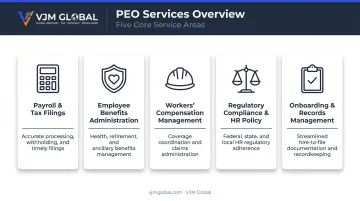
In practice, PEOs cover:
- Payroll processing and tax deposit filings (under the PEO's EIN, per IRS guidance)
- Employee benefits administration — health, dental, vision, 401(k), voluntary benefits
- Workers' compensation management
- Regulatory compliance monitoring and HR policy updates
- Onboarding, offboarding, and employee records management
PEOs are not staffing agencies. Staffing agencies source workers; PEOs manage the people you've already hired. That distinction matters when evaluating your options.
PEOs also differ from Administrative Services Organizations (ASOs), which manage vendor relationships without sharing employer liability, and from HR Outsourcing (HRO) arrangements, which handle specific HR functions without co-employment. The co-employment structure is what sets PEOs apart: it transfers shared legal and financial risk, not just administrative tasks.
Currently, 230,000 businesses across the US use PEO services, covering 4.5 million worksite employees — with 17% of employers in the 10–99 employee range already participating.
Key Advantages of PEO Services for Small Businesses
The advantages below are grounded in operational and financial outcomes — the kind that show up in measurable KPIs, not just vendor claims.
Advantage 1: Cost Reduction and Access to Enterprise-Level Benefits
Through co-employment, PEOs pool employees across all their client companies, creating the collective bargaining power of a large employer. That purchasing power translates directly into better rates on health insurance, dental, vision, 401(k) plans, and supplemental benefits — coverage a 15-person business could never secure independently.
In practice: your 15 employees join the PEO's group plan alongside tens of thousands of other worksite employees. You access the same benefit tier a 500-person company would offer, without hiring a benefits administrator or navigating insurer negotiations.
Why the benefits gap matters:
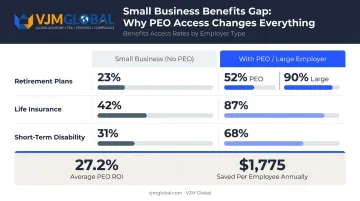
The disparity between small and large employer benefits is stark. According to BLS March 2025 data, workers at establishments under 100 employees have access to:
- Retirement benefits: 59% vs. 90% at 500+ employee firms
- Life insurance: 42% vs. 87%
- Short-term disability: 31% vs. 68%
PEO co-employment closes much of this gap. NAPEO's 2026 industry data shows that PEO clients with 10–49 employees offer retirement plans at 52% — more than double the 23% rate among comparable non-PEO firms.
The KFF 2024 Employer Health Benefits Survey found that 26% of covered workers at small firms must pay more than half of the family premium, compared to just 6% at large firms.
According to NAPEO's ROI research, businesses save an average of $1,775 per employee per year through PEO partnerships, against an average PEO cost of $1,395 per employee — producing a conservative 27.2% annual ROI from cost savings alone.
KPIs impacted: Healthcare cost per employee, benefits utilization rate, cost per hire, HR administrative overhead
When it matters most: Businesses competing against larger employers for talent, those hiring rapidly, or those spending disproportionately on fragmented benefits vendors.
Advantage 2: Compliance and Risk Management
Employment law is one of the fastest-moving areas of business regulation. In 2026, small businesses must track federal, state, and local labor law changes simultaneously — evolving overtime thresholds, expanding leave mandates, state-specific wage requirements, and industry-specific rules that carry real penalties for non-compliance.
A PEO maintains dedicated compliance specialists who monitor legislative changes in real time, update employment policies, handle tax filings, and flag risks before they become violations. You receive expert guidance without the cost of a full-time compliance officer.
The enforcement stakes are significant. The DOL's Wage and Hour Division recovered more than $259 million in back wages for nearly 177,000 employees in FY2025, averaging $1,465 per employee. The EEOC secured almost $700 million in monetary relief in FY2024 for roughly 21,000 discrimination victims. These figures aren't small-business-specific, but small businesses — with limited legal resources — face disproportionate damage when claims arise.
On the payroll tax side alone, IRS failure-to-deposit penalties start at 2% for payments just 1–5 days late, escalating to 15% after IRS notice — costs that accumulate quickly for businesses without dedicated payroll oversight.
The co-employment model adds an additional layer of protection. When a PEO is involved, liability for employment tax filings and workers' compensation is shared. For Certified PEOs (CPEOs), the IRS holds the CPEO solely liable for employment tax payments — removing that risk from the client entirely.
Multi-state complexity is a growing issue. As remote work expands, SHRM's 2025 compliance guidance notes that multistate employers must navigate varying leave laws, state-specific exemption requirements, and changing salary thresholds — a burden that scales poorly for small businesses managing it without dedicated HR support.
KPIs impacted: Compliance violation rate, legal claim frequency, workers' compensation costs, payroll error rate, tax penalty exposure
Ideal for businesses that: Operate across multiple states, are growing headcount quickly, or have no dedicated HR or legal function in-house.
Advantage 3: Time Savings and Operational Focus
For small business owners managing payroll, benefits enrollment, employee records, onboarding paperwork, and HR queries alongside everything else, the administrative load is a direct drag on growth. Every hour spent on HR tasks is an hour not spent on sales, product, or customer relationships.
A PEO removes these tasks from the owner's plate through an integrated platform. Payroll runs automatically, benefits questions route to the PEO's support team, and compliance documentation is maintained without owner involvement. The time savings translate into recovered strategic focus — not just fewer tasks.
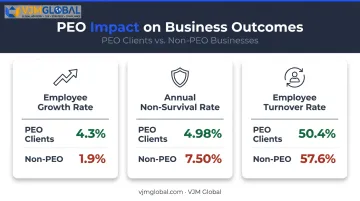
The growth data is concrete. NAPEO's 2024 white paper reports annual employee growth of 4.3% for PEO clients versus 1.9% for comparable non-clients — more than twice the rate. The same research shows PEO clients have a non-survival rate of 4.98% compared to 7.50% for non-clients, meaning non-clients are roughly 50% more likely to go out of business annually.
Employee turnover tells a similar story: 50.4% annual turnover for PEO clients versus 57.6% for non-clients — a 12% difference that compounds over time through reduced hiring costs and preserved institutional knowledge.
KPIs impacted: Owner hours spent on HR, payroll processing time, employee turnover rate, time-to-hire, revenue per employee
When it matters most: Businesses under 100 employees with no dedicated HR function, particularly when the founder or management team is personally handling HR tasks.
What Happens When PEO Support Is Absent
The consequences of managing HR in-house without adequate resources aren't always immediate — they accumulate. Common patterns include:
- Compliance gaps compound — missed regulatory updates lead to penalties that a monitoring system would have prevented
- Benefits remain uncompetitive — without group purchasing power, small businesses either overpay or offer packages that send candidates toward larger employers
- Administrative errors increase — payroll mistakes, incorrect tax filings, and benefits enrollment errors create employee dissatisfaction and legal exposure
- Owner bandwidth erodes — HR tasks consistently crowd out strategic priorities, contributing to leadership burnout
- Scaling becomes harder — without HR infrastructure, each new hire adds disproportionate complexity rather than linear capacity
BLS data shows small businesses managing benefits independently offer retirement access at just 23%, compared to 52% for PEO-enrolled firms of the same size. For candidates weighing two offers, that difference is often the deciding factor.
How to Get the Most Value from PEO Services
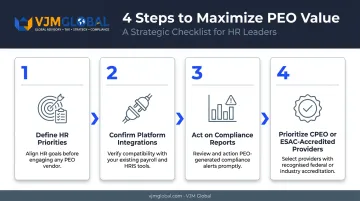
PEO partnerships deliver the strongest outcomes when treated as active strategic relationships, not set-and-forget vendor arrangements. Businesses that engage regularly with their PEO's compliance team, HR advisors, and benefits administrators see materially better returns.
Key conditions for maximizing PEO value:
- Define your HR priorities before engaging a provider. Know whether benefits access, compliance coverage, or administrative time savings is the primary need.
- Confirm platform integrations upfront. The PEO's tools should connect with your existing payroll, accounting, or ERP systems without manual workarounds.
- Act on compliance and benefits reports consistently. The data has no value if it sits unreviewed each quarter.
- Prioritize CPEO or ESAC-accredited providers. IRS CPEO status and ESAC accreditation offer independent verification of a PEO's financial and operational reliability.
US companies managing employees or contractors in India face a separate layer of complexity. A PEO handles domestic US compliance, but the Indian regulatory framework (Provident Fund, ESI contributions, TDS, state-level labor laws) requires jurisdiction-specific expertise that no US PEO covers. Firms like VJM Global complement domestic PEO arrangements by handling India-side tax compliance, payroll structuring, FEMA obligations, and financial reporting.
Selecting the right PEO means evaluating scope of services, pricing transparency, support quality, contract flexibility, and industry experience. Request references, clarify what's bundled versus billed separately, and review exit terms before committing.
Conclusion
The core value of PEO services for small businesses in 2026 comes down to three measurable outcomes: lower benefits costs, reduced compliance exposure, and more time for actual business operations. These show up concretely — in payroll savings, lower turnover, and penalties avoided.
The data is consistent across multiple independent sources. PEO-partnered businesses grow faster, retain employees longer, and survive at higher rates than comparable businesses managing HR in-house. That gap tends to widen the more actively a business uses its PEO's advisory capacity — not just for payroll processing, but for benefits strategy and compliance guidance.
For small businesses in 2026, the more useful question is a practical one: what is in-house HR management actually costing in staff time, compliance exposure, and benefits that can't compete with larger employers? That accounting often makes the case more clearly than any comparison chart.
Frequently Asked Questions
What is a PEO service?
A PEO (Professional Employer Organization) enters a co-employment arrangement with your business, handling payroll, benefits, tax filings, and HR compliance, while you retain full control over business decisions and day-to-day operations.
What is the average ROI for small businesses partnering with a PEO?
According to NAPEO's ROI research, the average annual ROI from PEO partnerships is 27.2%, meaning businesses save $1,272 for every $1,000 spent. Savings come from reduced HR overhead, lower benefits costs through group rates, and avoided compliance penalties.
What size company benefits most from PEO services?
PEOs are most impactful for businesses with 10–99 employees — a range that typically lacks dedicated HR but has enough headcount to make outsourcing cost-effective. NAPEO data shows 50% of PEO clients fall in the 10–49 employee range. Rapidly growing startups also benefit significantly.
What is the difference between a PEO and an EOR?
A PEO operates under co-employment: the client already has a legal entity, and the PEO shares employer responsibilities for that existing workforce. An EOR (Employer of Record) hires workers on behalf of a client with no legal entity in a given jurisdiction, commonly used for international hiring.
What are the downsides of using a PEO for a small business?
Potential downsides include reduced flexibility around standardized HR processes, the need to adapt to the PEO's platform and workflows, possible contract lock-in periods, and pricing variability across providers. Most concerns are manageable with thorough due diligence during provider selection.
How does PEO pricing typically work?
PEO pricing is generally structured as either a flat per-employee-per-month fee or a percentage of total payroll. The scope of included services varies significantly by provider, so businesses should always clarify what is bundled versus billed separately — and verify pricing transparency — before committing.