But getting there isn't always straightforward. Between French bureaucracy, document apostille requirements, and the language barrier, many UAE nationals stall out before they even file paperwork.
This guide walks through the SARL structure (France's version of a private limited company), the registration process via the Guichet Unique portal, required documents, realistic costs, and what happens after incorporation.
Key Takeaways
- SARL is France’s standard private limited structure for founders with two or more shareholders
- All French company registrations now run through the single digital Guichet Unique portal
- UAE nationals need not live in France but must appoint a gérant and file authenticated translations
- Registration realistically spans several weeks, depending on document readiness and bank onboarding
- Early professional support streamlines translation, Guichet Unique filing, and France–UAE tax compliance
What is a SARL Company in France?
A SARL (Société à Responsabilité Limitée) is France's equivalent of a private limited company. It's the most common structure for small and mid-sized businesses, including those owned by foreign investors.
Key features:
- Shareholders: Between 2 and 100 shareholders
- Capital: No statutory minimum share capital at incorporation; you set the amount in the articles of association
- Liability: Each shareholder's liability is limited to their contribution
- Management: Run by one or more gérants (managers), who must be natural persons but don't need to be French residents
This last point matters for UAE founders. A gérant can remain based in Dubai or Abu Dhabi and still legally manage a French SARL, as long as the registered office and filing obligations in France are met.
SARL vs. EURL vs. SAS/SASU
- SARL: 2–100 shareholders; fixed governance suited to a stable ownership group
- EURL: Single-shareholder SARL, used when one person owns the company
- SAS/SASU: More flexible governance and share transfers; often preferred for larger or more complex operations
Why UAE Entrepreneurs Choose SARL Over Other French Structures
SARL tends to fit UAE founders running:
- Family-owned SMEs with a small, fixed group of shareholders
- Joint ventures where governance rules should stay rigid and predictable
- Businesses that don't need SAS's flexible share-transfer mechanisms
If you're planning to bring in outside investors later, or want freer control over decision-making structures, SAS is usually the better fit. SARL works best when the ownership group is small and stable.
Why Register a Company in France from the UAE?
France gives UAE businesses a foothold in one of the EU's largest economies, with access to a market of 449 million people across the European Union as of January 2024.
Beyond market size, three structural advantages stand out:
- Tax treaty benefits: Under the 1990 France–UAE double taxation convention, dividends paid to a UAE-resident beneficial owner are generally taxable only in the UAE, easing profit repatriation.
- R&D incentives: France's Crédit d'Impôt Recherche offers a 30% tax credit on qualifying R&D expenditure up to €100 million, with no shareholder-nationality exclusion.
- No local shareholding requirement: A UAE national or UAE-incorporated company can own 100% of a SARL. French law does not require a French national shareholder, subject to screening in strategic sectors.
Step-by-Step Process to Register a SARL in France from the UAE
Registration runs through a defined sequence. Follow these steps in order:
- Check company name availability via the Infogreffe registry to confirm your chosen name isn't already taken
- Draft the Articles of Association (statuts): set share capital, the gérant's identity, business purpose, and governance rules. Foreign supporting documents need a certified French translation
- Open a French corporate bank account and deposit share capital. This step often takes longer for UAE shareholders, as banks run enhanced KYC checks on non-resident applicants
- Publish a legal notice of company creation in an authorised French legal-announcement journal
- File the complete application through the Guichet Unique portal: signed statuts, proof of registered address, and the capital deposit certificate
- Receive your KBIS, SIRET, and VAT numbers, confirming the company is legally incorporated
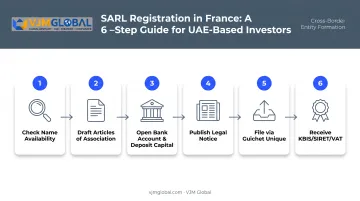
Since January 2023, all creation, modification, and closure formalities in France go through this single online portal, replacing the old system of separate CFE filings.
A note on VAT registration: If your SARL is liable for VAT, the tax office (SIE) automatically issues your intra-Community VAT number at registration, formatted as FR + a two-digit key + your nine-digit SIREN number.
Coordinating this remotely from the UAE, especially the translation and bank liaison steps, is where firms like VJM Global help cross-border clients manage the paperwork flow without flying to Paris for every signature.
Documents and Compliance Requirements for UAE Nationals
French registration authorities require a specific document set, and missing translations are the most common cause of delay.
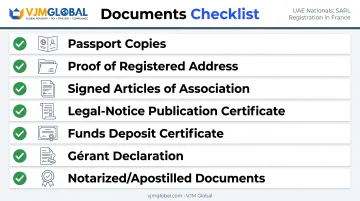
Core documents typically needed:
- Passport copies of all shareholders and the gérant
- Proof of the company's registered French address
- Signed and dated Articles of Association
- Certificate of legal-notice publication
- Certificate of funds deposit confirming share capital has been paid in
- Gérant's signed declaration (identity and non-conviction statement)
- Notarised and apostilled corporate documents, if a UAE company is the shareholder
Translation Requirements
All documents not originally in French must come with a certified translation. France requires translations from a court-approved translator, listed by a French Court of Appeal or the Court of Cassation, not just any bilingual professional.
Residency and Visa Considerations
Here's a point often missed: appointing a UAE-resident gérant doesn't automatically grant them the right to live or work in France.
If that gérant plans to manage day-to-day operations on French soil, they may need a long-stay visa tied to "entrepreneur/profession libérale" status. Managing the company remotely from the UAE does not trigger this requirement.
Cost, Timeline and Post-Registration Obligations
What You'll Pay
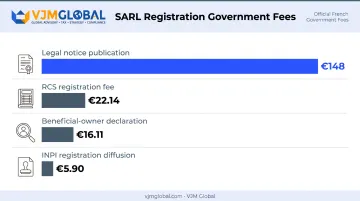
Official government fees are modest, though professional and banking costs add up. Based on the current French government fee schedule:
| Item | Cost |
|---|---|
| SARL legal notice publication | €148 (excl. tax), mainland France |
| RCS registration fee | €22.14 (excl. tax) |
| Beneficial-owner declaration | €16.11 (excl. tax) |
| INPI registration diffusion | €5.90 (incl. tax) |
Notary fees, certified translation costs, and advisory fees vary by provider and complexity, so treat these as separate line items when budgeting rather than folding them into official tariffs.
Timeline
No official government-published turnaround time exists for KBIS issuance. In practice, expect the process to stretch across several weeks.
Main bottlenecks for UAE-based applicants:
- Bank account setup
- Certified document translation
After Incorporation
Once your SARL is live, ongoing compliance kicks in:
- Annual financial statements prepared under the Plan Comptable Général (PCG), France's standard chart of accounts
- Statutory audit required only if the company exceeds two of three thresholds: €5 million balance sheet total, €10 million turnover, or 50 employees
- Corporate tax at a standard 25% rate (reduced 15% on profits up to €42,500 for qualifying SMEs under €10 million turnover)
VJM Global supports ongoing PCG-compliant bookkeeping and French tax filings for UAE-based owners, plus payroll if the SARL hires locally in France.
Frequently Asked Questions
What is a SARL company in France?
A SARL is a French private limited company with 1–100 shareholders, managed by one or more gérants. A single-shareholder SARL is often called an EURL. It is the most common structure for French SMEs and family-owned businesses.
Can a UAE national own 100% of a SARL in France?
Yes. French law doesn't require local shareholding, so a UAE national or UAE company can hold full ownership, subject to standard screening in strategic sectors.
Do I need to visit France in person to register a SARL?
Most steps can be handled remotely, often via power of attorney. Bank account opening is the exception, as banks may require identity verification that's harder to complete without an in-person visit.
How long does it take to register a private limited company in France from the UAE?
There's no official fixed timeline, but the process typically spans several weeks. Document translation and non-resident bank KYC checks are the main factors that extend it.
What is the difference between a SARL and a SAS in France?
SARL has more prescriptive governance rules and requires associate approval for share transfers. SAS offers far more flexibility in governance and generally allows freer share transfers, making it popular with investors wanting adaptable structures.
Does France have a tax treaty with the UAE to avoid double taxation?
Yes. France and the UAE signed a double taxation convention in 1989, in force since 1990, which helps UAE shareholders repatriate profits from a French company without being taxed twice.