Introduction
Belgium sits at the crossroads of the EU single market, with Euronext Brussels offering direct access to European capital. For US businesses scaling into Europe, that combination makes Belgium a serious contender for a regional headquarters or listed subsidiary.
US businesses often struggle here: "public limited company" in Belgium isn't a single box to check. The NV/SA (naamloze vennootschap/société anonyme) covers several variants, each suited to different capital levels, governance styles, and listing ambitions.
This article breaks down the main types of Belgian public limited companies, how they differ, and how a US business should think through the choice before signing a notarial deed.
TL;DR
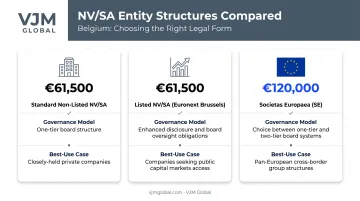
- Belgium's NV/SA requires a €61,500 minimum capital and suits capital-intensive or listed ventures
- Three main variants: standard non-listed NV/SA, listed NV/SA on Euronext Brussels, and the European Company (SE)
- Governance is flexible: single-director, one-tier board, or two-tier (management/supervisory) models
- Choose based on capital-raising goals, EU cross-border plans, and listing timelines
- Entity-formation support streamlines notarial, tax, and compliance steps for US founders
What Is a Public Limited Company in Belgium?
The NV/SA is Belgium's capital-company form, built for large-scale or publicly traded ventures. It offers full limited liability and freely transferable shares, which makes it attractive to investors who may need an exit.
Setting one up requires:
- A minimum €61,500 in share capital
- Incorporation via notarial deed
- A signed financial plan justifying the capital for the company's first two years
For US corporations, the NV/SA is the structure most groups use when a Belgian subsidiary needs to raise capital, hold significant assets, or eventually list shares. Compare that to the BV/SRL (Belgium's private company form), which has no statutory minimum capital and suits smaller ventures better.
Why Does the Type of Public Limited Company Matter for US Businesses?
Not all NV/SAs carry the same obligations. The variant you choose affects:
- Capital requirements — all NV/SAs need €61,500, but listed entities face additional funding expectations from the market
- Governance complexity — a sole-director model works fine for a private subsidiary, but a listed company can't run that way
- Access to EU capital markets — only listed NV/SAs and, in specific cases, the SE structure open that route
Picking the wrong variant creates real costs. A US parent that defaults to a listed structure when a standard NV/SA would do takes on real overhead. It then has to manage FSMA disclosure rules, a statutory auditor, and Corporate Governance Code 2020 obligations it doesn't need yet. Choosing the right type before incorporation avoids that over-engineering.
Types of Public Limited Companies in Belgium
The NV/SA varies along three axes: whether shares are listed, how governance is structured, and whether the entity needs an EU-wide footprint. These variations match company size, capital-raising intent, and cross-border scope.
Standard (Non-Listed) NV/SA
This is a privately held Belgian public limited company whose shares don't trade on any exchange.
How it works: Founders execute a notarial deed, contribute the €61,500 minimum capital, and choose between a single-director or full-board governance model under the 2019 Companies and Associations Code.
How it differs: Private shareholding and lighter disclosure obligations set it apart from listed entities — no prospectus, no continuous reporting duty.
Best suited for:
- US subsidiaries entering the Belgian or EU market
- Joint ventures needing limited liability with credibility
- Holding companies consolidating European assets
Key strengths:
- Strong credibility with banks and partners
- Access to bank financing beyond what a BV/SRL typically secures
- Flexible internal governance (sole director or full board)
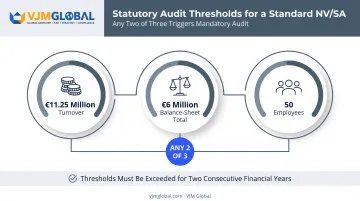
Trade-offs: Setup costs and formalities run higher than a BV/SRL. A statutory auditor becomes mandatory once the company exceeds two of three thresholds for two consecutive years: €11.25 million turnover, €6 million balance-sheet total, or 50 employees.
Listed NV/SA (Euronext Brussels)
A listed NV/SA is a public limited company whose shares trade on Euronext Brussels or another regulated market.
How it works: Listed status brings the company under FSMA supervision, prospectus obligations, and ongoing disclosure duties. Under Regulation (EU) 2017/1129, securities can't be publicly offered or admitted to trading until a prospectus is approved — typically within 10 working days, extended to 20 for certain first-time issuers.
How it differs: Public trading, stricter governance (often a two-tier board), and mandatory external audit and reporting separate this from the standard NV/SA.
Best suited for:
- US companies pursuing an IPO in Europe
- Groups seeking public capital-markets access
- Consolidating a European listed subsidiary under Belgian law
Key strengths:
- Direct access to public capital
- Enhanced brand visibility across EU investors
- Liquidity for existing shareholders
Trade-offs: The regulatory burden is real and ongoing. Listed companies must:
- Publish annual reports within four months of year-end (or 30 days before the AGM, whichever comes first)
- File half-year reports within three months
- Disclose inside information as soon as possible
Belgium's Corporate Governance Code 2020 adds another layer, so the compliance load for a first-time issuer can be substantial.
Societas Europaea (SE) – European Public Company
The SE is an EU-wide public company form. It lets a business operate — and even relocate its registered office — across member states without dissolving and re-incorporating.
How it works: Forming an SE requires a genuine cross-border element: a merger between public companies from different member states, a holding structure, a subsidiary route, or conversion from an existing NV/SA that has held a foreign subsidiary for at least two years.
How it differs: Its pan-European legal personality and Article 8 seat-mobility mechanism set it apart. A domestic Belgian startup can't simply elect SE status — there has to be a qualifying cross-border nexus under Council Regulation (EC) No 2157/2001.
Best suited for:
- US multinationals consolidating several EU subsidiaries under one Belgian-registered European entity
- Groups that may later move the registered office between member states
Key strengths:
- Simplifies cross-border restructuring
- Single corporate identity across the EU
- Seat mobility without dissolution and re-incorporation
Trade-offs: Formation is complex and capital requirements are higher (€120,000 minimum subscribed capital, versus €61,500 for a standard NV/SA). EU-law constraints also leave less flexibility than a plain NV/SA.
How to Choose the Right Type of Public Limited Company
The right variant depends on capital-raising plans, governance preferences, and EU footprint — not company size alone. Weigh these factors:
- Purpose: Is this a Belgian subsidiary, an IPO vehicle, or a multi-country EU consolidation?
- Capital available: Can you meet the €61,500 minimum (or €120,000 for an SE) plus ongoing funding needs?
- Governance complexity: Is the US parent ready to manage a sole director, or does it need a full two-tier board?
- Listing timeline: Are you planning to list on Euronext Brussels now, in three years, or never?
- Compliance capacity: Can you handle FSMA reporting and statutory audit requirements if you go public?
A US group building its first Belgian presence rarely needs a listed structure or an SE on day one. Most start with a standard NV/SA and upgrade later if capital-raising plans change.
What to Check Before Finalising a Type of Public Limited Company
What to Check Before Finalizing a Type of Public Limited Company
Before committing to a variant, run through this checklist:
- Don't default to a listed structure. A standard non-listed NV/SA — or even a BV/SRL — often meets current needs without the FSMA overhead.
- Don't overlook notarial and financial-plan requirements. Every NV/SA needs a notarial deed and a two-year financial plan; auditor requirements kick in once you cross the size thresholds.
- Budget for ongoing compliance costs. FSMA disclosure, continuous reporting, and Dutch/French translation obligations add up for listed entities.
- Work with cross-border specialists. Belgian notarial procedure, financial-plan drafting, and multi-jurisdiction tax planning are easier with a team that handles formation across markets. VJM Global helps US businesses align Belgian entity setup with international tax and entity planning.
Conclusion
Belgium's NV/SA structure gives US businesses a real path to capital access, credibility, and EU market presence. But standard, listed, and SE variants serve distinct growth stages. A local subsidiary, a capital-markets listing, and multi-country consolidation are different problems—and they need different setups.
Getting clear on these differences before incorporating saves US founders from costly restructuring later. Whether you're forming a first Belgian entity or consolidating several EU subsidiaries, choose the structure for the plans you intend to run—not only the headcount or capital you have today.
Frequently Asked Questions
What are the different types of companies in Belgium?
Belgium's Companies and Associations Code recognizes four main forms: partnerships, the limited liability company (BV/SRL), the cooperative company (CV/SC), and the public limited company (NV/SA).
What is a private limited company in Belgium?
The BV/SRL is Belgium's most flexible structure, with no statutory minimum capital and simpler governance. It suits SMEs and startups better than the capital-intensive NV/SA.
What is an LLC in Belgium?
Belgium has no direct equivalent to a US LLC. The closest structure is the BV/SRL, which offers limited liability with flexible governance, though it isn't legally or tax-equivalent to an LLC.
Who is eligible to form a private limited company in Belgium?
Any individual or corporate founder can form a BV/SRL, including non-resident US shareholders and directors. There's no residency requirement.
How much capital is required to set up a public limited company (NV/SA) in Belgium?
The statutory minimum is €61,500, and it applies whether or not the company plans to list. An SE requires €120,000.
Can a US company own 100% of a Belgian NV/SA?
Yes. Full foreign ownership is permitted, and there's no requirement for a Belgian resident director or shareholder — though registered-office and tax-substance rules still apply.