
But a growing segment — diaspora-backed ventures, established Canadian firms, and founders planning to raise public capital — are evaluating the Public Limited Company (PLC) route instead.
A PLC is a distinct entity type under the Companies Act, 2013, with materially heavier shareholder, director, capital, and compliance requirements than a private company. Canadian founders often underestimate this gap until they're mid-filing.
This guide covers when a PLC actually fits a Canadian investor's plan, the eligibility requirements, the step-by-step registration process from Canada, and the compliance obligations that follow incorporation.
Key Takeaways
- 7 shareholders and 3–15 directors minimum; one director must be India-resident (182+ days)
- Canadian citizens, NRIs, and OCIs can incorporate a PLC; FDI routes and repatriation rights vary by status
- No statutory minimum paid-up capital since 2015; Form INC-20A is mandatory before trading
- Same MCA SPICe+ portal as private companies; apostilled Canadian documents extend timelines
Why Would a Canadian Investor Choose a Public Limited Company Over Other Structures?
Public Capital Access You Can't Get Elsewhere
A PLC is the only Indian entity type that can raise capital from the public through share issuance or an eventual listing on the BSE or NSE. That capital access is the primary reason to choose it.
India's primary markets aren't a niche channel, either. In FY2025-26, Indian main boards recorded 109 IPOs, raising roughly ₹1.8 lakh crore, up 8.9% year-on-year, according to SEBI's Annual Report 2025-26. Those figures point to an active primary market Canadian investors can plan around.

Public company status also carries weight with Indian banks, regulators, and larger corporate partners who associate the "Limited" suffix with a higher governance bar. It won't get you a listing automatically. SEBI's ICDR framework and exchange eligibility rules still apply separately once you're ready to go public. But it opens a door a private company simply doesn't have.
Where a Private Limited WOS, LLP, or JV Fits Better
The trade-off is straightforward: a PLC exchanges operational simplicity for capital-raising capacity and public scrutiny.
- Private Limited WOS: the default for most Canadian founders running IT, trading, or services operations with no near-term plan to raise public capital
- LLP: a strong fit for asset-light professional services, since LLPs qualify for 100% automatic-route FDI where the sector has no FDI-linked performance conditions
- Joint Venture: useful when a local partner brings sector access, licences, or distribution a Canadian investor can't easily replicate alone
Most Canadian founders entering India for standard operations don't need a PLC at incorporation. It typically becomes relevant only when public capital-raising is genuinely part of the business plan from day one, not an afterthought.
VJM Global's India market entry advisory helps Canadian investors weigh this choice against capital-raising timeline, sector, and FDI route before any incorporation form is filed.
What Canadian Investors Need Before Registering a Public Limited Company in India
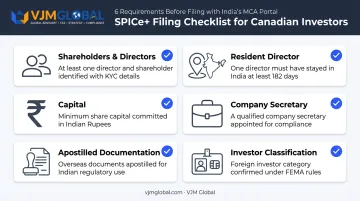
Before you touch the SPICe+ portal, get these six things sorted:
- Shareholders and directors: Minimum 7 shareholders and 3 directors (up to 15 without a special resolution). Every director needs a Director Identification Number (DIN).
- Resident director: At least one director must have stayed in India for 182+ days in the financial year. Canadian founders usually need a trusted local or nominee director before filing; this stalls more filings than any other requirement.
- Capital: The old ₹5,00,000 statutory minimum was removed by a 2015 amendment, so there is no fixed rupee floor for public companies. Most PLCs still capitalise well above that figure for IPO-readiness and lender confidence.
- Company Secretary: Mandatory whole-time appointment for listed companies and any public company with paid-up share capital of ₹10 crore or more. Smaller unlisted PLCs are not automatically required to appoint one, though most still engage secretarial support.
- Apostilled documentation: Passport, address proof, and board resolutions (for corporate shareholders) from Canadian directors and shareholders need certification. Canada's January 2024 accession to the Apostille Convention means a single apostille replaces the older consular legalisation chain.
- Investor classification: Determine upfront whether you're structuring as a foreign national, NRI, or OCI. This affects the FDI route, sector caps, and repatriation rights on your capital.
How to Register a Public Limited Company in India from Canada — Step by Step
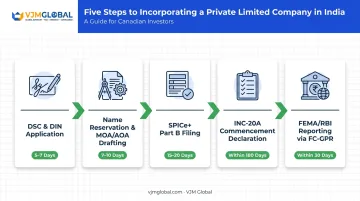
Step 1: Obtain Digital Signature Certificates and Director Identification Numbers
Every proposed director, including Canada-based ones, needs a Digital Signature Certificate before any MCA filing goes through. Non-resident directors will need to provide certified passport copies, address proof, a photograph, and contact details alongside this application.
DIN applications for up to three first directors without an existing DIN can be filed directly through SPICe+ Part B, so there's no separate standalone application needed at this stage.
Step 2: Reserve the Company Name and Draft the MOA/AOA
File SPICe+ Part A for name reservation. Under Section 4(1)(a) of the Companies Act, a public company's name must end with "Limited," and it needs to clear both the MCA and trademark databases for uniqueness.
Alongside this, draft:
- Memorandum of Association (MOA): Defines the company's objects and scope of business
- Articles of Association (AOA): Sets internal governance rules. A public company's AOA cannot use private-company transfer restrictions or the 200-member cap, so its provisions run longer and more detailed
Step 3: File SPICe+ Part B for Incorporation
This single form covers DIN allotment, PAN/TAN issuance, and registered office details in one filing. If a Canadian shareholder or parent entity is involved, attach the apostilled corporate documents at this stage.
File Form DIR-12 separately with the particulars of each appointed director. Missing or mismatched details here are a common cause of resubmission delays.
Step 4: File the Commencement Declaration Before Starting Operations
Once the Certificate of Incorporation is issued, a director must file Form INC-20A within 180 days, declaring that every subscriber to the memorandum has paid for their subscribed shares. Registered office verification must also be on file.
Until INC-20A is filed, the company legally cannot commence business or exercise borrowing powers. This filing is a hard operational gate, not optional paperwork.
A separate note on subscription rules: the well-known "90% minimum subscription" figure applies specifically to public share issues under SEBI's framework, not as a blanket rule every PLC must clear before incorporation. Don't confuse the two when planning your timeline.
Step 5: Complete FEMA/RBI Reporting for Canadian Capital Inflow
Any share subscription funded from Canada counts as foreign direct investment under FEMA. Here's the sequence:
- Obtain the Foreign Inward Remittance Certificate (FIRC) and KYC confirmation from the remitter's Canadian bank
- Allot shares to the Canadian investor
- File Form FC-GPR through the Single Master Form within 30 days of allotment, as required under RBI's reporting framework
Confirm current processing expectations with your Authorised Dealer bank before wiring funds. Older 180-day issuance circulars have been superseded, so check timelines at the point of transfer rather than assuming them.
Post-Registration Compliance and Common Mistakes to Avoid
Incorporation is the easy part. What follows is where PLCs diverge sharply from private companies.
Ongoing obligations unique to public companies:
- AGM: First meeting within 9 months of the first financial year-end; later AGMs within 6 months, and never more than 15 months apart
- Statutory audit: Appoint an auditor under Section 139; listed companies and certain prescribed classes also face auditor rotation
- Company Secretary: Mandatory once paid-up capital crosses ₹10 crore, or immediately if the company is listed
- SEBI disclosure: If shares are listed, LODR Regulation 30 continuous and material-event disclosures apply on top of Companies Act rules
Clearing incorporation is not the finish line. These are the two mistakes founders still make most often:
Two mistakes founders make repeatedly:
- Choosing a PLC only for the "Limited" name, then facing a compliance load far beyond any real IPO or public-raise plan
- Leaving the resident-director, subscription, and INC-20A steps until after filing, which can stall incorporation for weeks
Frequently Asked Questions
Can a Canadian citizen open a business in India?
Yes. Canadian citizens, NRIs, and OCIs can all incorporate and own businesses in India under the Companies Act, 2013, and current FDI policy. Sector caps and the resident-director requirement still apply.
What is an example of a public limited company in India?
Infosys Limited is a well-known example, trading on the NSE under the symbol INFY and on the BSE under scrip code 500209.
Do LLCs exist in India?
India has no direct LLC equivalent. The closest structures are the Private Limited Company and the LLP, both offering limited liability but with different compliance burdens and FDI treatment.
How many directors and shareholders does an Indian public limited company need?
A minimum of 3 directors (up to 15 without a special resolution) and 7 shareholders are required. At least one director must be resident in India for 182+ days during the financial year.
Can a foreign national serve as a director in an Indian public limited company?
Yes, provided at least one other board member satisfies the India-residency requirement. Foreign directors need a DIN plus apostilled identity and address documents from Canada.
How long does it take to register a public limited company in India from Canada?
MCA incorporation can complete in a few weeks once documents are ready. Canadian apostilles, share subscription, and the INC-20A commencement filing usually push the full timeline to about 6–10 weeks—longer than a typical private company setup.
Conclusion
A PLC is the right structure only when public capital access or an eventual listing is genuinely part of the plan. Most Canadian investors entering India are still better served by a Private Limited WOS.
The heavier requirements — 7 shareholders, resident director sourcing, INC-20A commencement, and eventual Company Secretary obligations — mean preparation before filing matters more here than for any other Indian entity type.
VJM Global has 30+ years of cross-border entity structuring experience helping Canadian investors choose and register the right Indian entity. Confirm the structure and compliance pathway that match your India entry plan before you file a single incorporation form.