Key Takeaways
- A Public Limited Company (PLC) in India is a separate legal entity under the Companies Act, 2013 that can offer shares to the general public
- PLCs require a minimum of 7 shareholders and 3 directors — including at least one India-resident director
- US companies can hold up to 100% equity under the Automatic FDI Route in most sectors
- Post-incorporation FEMA filings (FC-GPR within 30 days; FLA Return by July 15) are legally mandatory, not optional
- A PLC makes strategic sense for large-scale capital raises or shareholder bases above 200; most US companies start with a Private Limited
Most US companies entering India register a Private Limited Company — it's faster to set up and lighter on compliance. But for enterprises planning to raise public capital, list on Indian stock exchanges, or build a shareholder base beyond 200 members, a Public Limited Company (PLC) is the right structure.
This guide covers what a PLC is under Indian law, how it compares to US corporate structures, when it makes strategic sense, and what registration and compliance look like in practice. Whether you're evaluating India entry for the first time or scaling an existing operation, these are the distinctions that matter.
What Is a Public Limited Company in India?
A Public Limited Company is a statutory company form under the Companies Act, 2013. Section 2(71) defines a public company as one that is not a private company, and Section 4 requires its name to end with "Limited." From the moment of incorporation, it becomes a body corporate with perpetual succession — meaning it continues to exist independently of any changes in directors or shareholders.
How It Compares to US Structures
For US business owners, the closest analogy is a publicly traded C-Corporation — one that can issue shares broadly and faces significant regulatory disclosure obligations. Three key distinctions worth knowing:
- Listing is not required to be a PLC. Section 2(52) separately defines a "listed company" as one with securities on a recognised exchange — distinct from public company status under Section 2(71). You can operate as a PLC without ever pursuing a stock exchange listing.
- The listing path remains open if you want it. Choosing to list on the Bombay Stock Exchange (BSE) or National Stock Exchange (NSE) is a separate decision governed by SEBI regulations.
- Disclosure obligations are heavier than a Private Limited Company from day one, regardless of listing status — financial statements, board composition, and shareholder records face stricter requirements.
Limited Liability and Capital Access
Two practical benefits drive most US companies toward the PLC structure: liability protection and capital access.
Limited liability under Section 2(22) means shareholders are only liable for the unpaid amount on their shares. Personal assets of US investors remain protected even if the Indian entity faces financial difficulty.
Capital access is the more significant advantage. Unlike a Private Limited Company, a PLC can issue shares or debentures to the general public through a prospectus under Section 23. For capital-intensive operations that need a broad Indian investor base, that distinction is decisive.
Public Limited Company vs. Private Limited Company: Key Differences
Choosing between these two structures is the first decision any US company must make before engaging with Indian incorporation — and the differences go well beyond naming conventions.
Comparison Table
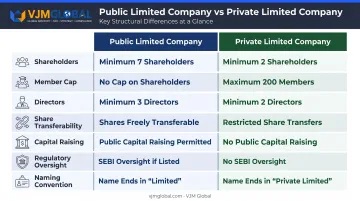
| Requirement | Public Limited Company | Private Limited Company |
|---|---|---|
| Minimum shareholders | 7 | 2 |
| Maximum shareholders | No cap | 200 |
| Minimum directors | 3 | 2 |
| Share transferability | Freely transferable (Section 58(2)) | Restricted by articles (Section 2(68)) |
| Public capital raising | Permitted via prospectus | Prohibited |
| SEBI oversight | Yes (if listed) | No |
| Name convention | Ends in "Limited" | Ends in "Private Limited" |
Compliance Burden
PLCs carry heavier regulatory obligations than private companies:
- Mandatory SEBI filings for listed entities
- Higher audit and disclosure standards
- Stricter corporate governance requirements under the Companies Act
- More rigorous annual reporting to the Registrar of Companies (RoC)
A Private Limited Company still files annual returns and holds board meetings — but the compliance calendar is lighter, which translates directly to lower administrative overhead for a US parent managing an Indian subsidiary.
FDI Applicability
Under DPIIT's Consolidated FDI Policy 2020, US companies can hold up to 100% equity in a PLC under the Automatic Route in most eligible sectors — meaning no prior government approval is needed. The same sectoral caps and conditions that apply to Private Limited Companies apply equally to PLCs.
Always verify the specific sector's FDI limit before assuming full foreign ownership is permitted.
When Should a US Company Choose a Public Limited Company?
For most US companies, a Public Limited Company isn't the right starting point — but certain situations make it the clear choice.
Choose a PLC When:
- You intend to raise capital from the Indian public through a share or debenture offering
- You're planning to list on the BSE or NSE — now or on a defined future timeline
- The project is capital-intensive infrastructure or large-scale manufacturing requiring broad investor participation
- Your anticipated shareholder base will exceed 200 members, which the Private Limited structure cannot accommodate
- You want freely transferable shares to bring in Indian institutional investors at a later stage
Stick With a Private Limited Company When:
Most technology firms, SaaS businesses, consulting agencies, and mid-sized enterprises entering India for operational purposes — not capital market access — are better served by a Private Limited Company. It's faster to set up, cheaper to maintain, and gives you full control without SEBI oversight.
That said, you're not locked in permanently. Conversion from Private Limited to Public Limited is legally permissible under the Companies Act, 2013, and your PAN and other registration certificates carry over unchanged.
VJM Global has guided 500+ American business owners through exactly this decision — evaluating which structure fits their India entry strategy before registration begins.
Statutory Requirements for Setting Up a Public Limited Company in India
Directors
A PLC requires a minimum of 3 directors, with no statutory maximum beyond 15 (extendable by special resolution).
At least one director must qualify as an Indian resident under Section 149(3) of the Companies Act, 2013, meaning they stayed in India for at least 182 days in the preceding calendar year.
This resident director does not need to be a shareholder, and their appointment does not dilute foreign ownership. US nationals can hold the remaining director positions.
VJM Global offers nominee director services as part of its pre-incorporation support, sourcing a qualifying resident Indian director before the company is registered.
Shareholders
A minimum of 7 shareholders are required, with no upper limit. These can be:
- Individual US nationals
- US corporate entities
- A combination of both
Shareholders and directors can be the same persons. All foreign shareholders fall under FEMA (Foreign Exchange Management Act) regulations governing how investment is brought into India and how it must be reported to the RBI.
Share Capital
The Companies (Amendment) Act, 2015 removed the old fixed minimum paid-up capital requirement for public companies. There is no statutory minimum paid-up capital under the current Companies Act. However, authorized share capital must be declared in the Memorandum of Association, and MCA filing fees are tied to the authorized capital amount. Use the MCA fee enquiry tool to calculate applicable fees before filing.
Documents Required
For US-based directors and individual shareholders:
- Notarized and apostilled passport copy
- Apostilled proof of overseas address (bank statement or utility bill, not older than 2 months)
- Passport-size photographs
- Digital Signature Certificate (DSC) — obtainable remotely
- Director Identification Number (DIN) — applied via SPICe+ form
For US corporate entity shareholders:
- Apostilled Certificate of Incorporation of the US parent company
- Board Resolution authorizing the India investment
- Constitutional documents of the US entity
All foreign documents must be apostilled under the Hague Convention, to which both the US and India are contracting states. State-level apostille processing varies in time and is typically the longest single step in the incorporation timeline.
Charter Documents
The Memorandum of Association (MOA) defines the company's name, objectives, and liability; the Articles of Association (AOA) governs internal management and operational rules. Together, they are the Indian equivalents of a US corporate charter and bylaws.
VJM Global prepares both documents as part of its incorporation support, including handling any objections raised by the RoC.
How to Register a Public Limited Company in India
Incorporation Process Overview
For US companies, India's registration process is fully digital — no in-person filings required. Everything runs through the MCA21 portal via the SPICe+ form (Simplified Proforma for Incorporating a Company Electronically Plus), which bundles multiple registrations into one submission:
- Incorporation, DIN allotment, PAN, and TAN
- Provisional GST registration
- EPFO, ESIC, and professional tax enrollment (via the linked AGILE-PRO-S form)
- Corporate bank account opening
Step-by-Step Process
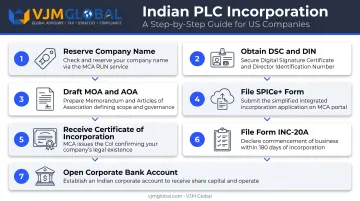
- Reserve the company name via MCA portal — must end in "Limited"
- Obtain DSC and DIN for all proposed directors
- Draft and finalize MOA and AOA with your advisors
- File SPICe+ with all supporting documents through MCA's Version 3 portal
- Receive the Certificate of Incorporation from the RoC, which includes the Corporate Identity Number (CIN)
- File Form INC-20A (Declaration of Commencement of Business) within 180 days of incorporation — mandatory under Section 10A before business operations begin
- Open a corporate bank account in India
Realistic Timeline for US Founders
The apostille process for US-based directors' documents is consistently the longest step — typically 1–3 weeks depending on the state. End-to-end — from document preparation to receiving the Certificate of Incorporation — expect 6–10 weeks when accounting for cross-border authentication, RoC review, and name approval.
Avoid advisors quoting "7-day incorporation" timelines. Those figures exclude the document authentication phase, which is entirely outside anyone's control once documents leave the US.
Key Compliance Obligations After Registration
Post-incorporation compliance is where most US-owned Indian companies face their first serious legal exposure. The filings below are mandatory, time-bound, and carry real penalties for late submission.
FEMA and RBI Reporting
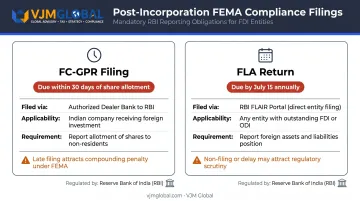
These two filings are non-negotiable for any company that has received foreign investment:
- FC-GPR (Form Foreign Currency – Gross Provisional Return): Must be filed with the RBI through an Authorized Dealer bank within 30 days of share allotment. Missing this deadline constitutes a FEMA violation — not a technicality. Compounding proceedings with the RBI are required to remediate late filings.
- FLA Return (Foreign Liabilities and Assets Annual Return): Due by July 15 every year for any Indian entity that has received FDI or made ODI in the current or previous financial years. RBI FAQ on FLA Return
Corporate Governance and RoC Filings
| Obligation | Requirement | Deadline |
|---|---|---|
| Board meetings | Minimum 4 per year; no more than 120 days between consecutive meetings | Ongoing |
| Annual General Meeting (AGM) | Required annually | By September 30 |
| Form AOC-4 | Annual financial statements filing | Within 60 days of AGM |
| Form MGT-7 | Annual return filing | Within 60 days of AGM |
| Statutory audit | Mandatory every financial year | Before AGM |
Board meetings can be conducted via video conferencing or other audio-visual means, which is a practical option for US-based management teams who cannot travel to India for every meeting.
SEBI Obligations for Listed PLCs
If you pursue listing on the BSE or NSE, SEBI's Listing Obligations and Disclosure Requirements (LODR) Regulations (last amended July 10, 2024) add a further compliance layer, including:
- Quarterly financial results disclosure
- Corporate governance reports
- Continuous disclosure of material events
Managing these obligations across FEMA, RoC, and SEBI simultaneously is where many US companies find they need local expertise. VJM Global's compliance services cover RBI reporting, RoC filings, FEMA advisory, and secretarial compliance, so US companies can meet every deadline without building a dedicated Indian team.
Frequently Asked Questions
What is a public limited company in India?
A Public Limited Company in India is a business entity incorporated under the Companies Act, 2013 that is permitted to offer shares to the general public. It is regulated by the Ministry of Corporate Affairs and, if listed, by SEBI, and its name must end with "Limited."
What is the US equivalent of an Indian Pvt Ltd company?
An Indian Private Limited Company is most comparable to a closely held C-Corporation or LLC in the US. An Indian Public Limited Company is closer to a publicly traded C-Corporation — one that can issue shares broadly and is subject to enhanced disclosure requirements.
Can I open a US LLC from India?
Yes — US state laws permit LLC formation by any person regardless of nationality or residency. Indian residents doing so must comply with FEMA's Liberalized Remittance Scheme, which allows remittances of up to USD 250,000 per financial year for permitted transactions.
What is the difference between a Public Limited Company and a Private Limited Company in India?
Key structural differences include:
- PLC: Minimum 7 shareholders and 3 directors, free share transferability, can raise public capital
- Private Limited Company: Capped at 200 members, restricts share transfers in its articles, and carries lighter compliance obligations
How many directors and shareholders are required for a Public Limited Company in India?
A Public Limited Company requires at least 3 directors and 7 shareholders. Directors can go up to 15 without a special resolution, there is no ceiling on shareholders, and at least one director must be an Indian resident under Section 149(3).
Can a US company own 100% of a Public Limited Company in India?
Yes. Under India's Automatic FDI Route, US companies can hold 100% equity in an Indian PLC in most sectors without prior government approval. Sector-specific caps under DPIIT's FDI Policy apply equally to PLCs and Private Limited Companies. FEMA compliance filings with the RBI are mandatory after share allotment.