It usually isn't the right structure.
Many Dutch founders confuse the Irish PLC with the NV, or worse, they don't realise a PLC is only needed for very specific situations. Most end up needing a Private Limited Company (Ltd) instead.
This guide breaks down exactly when a PLC applies, what it costs, how incorporation actually works, and how it stacks up against Ireland's other entity types.
Key Takeaways
- A PLC needs minimum issued share capital of €25,000, with at least 25% (€6,250) paid up before trading
- The Irish PLC broadly mirrors the Dutch NV, built for public listings or institutional capital raises
- Ireland's 12.5% corporation tax rate applies to PLCs the same as any other Irish entity
- PLCs need at least two directors (one EEA-resident or a Section 137 bond) and a qualified company secretary
- Most Dutch trading subsidiaries should use a Private Company Limited by Shares (Ltd), not a PLC
What Is a Public Limited Company in Ireland and Who Needs One
Under Ireland’s Companies Act 2014, a public limited company (PLC) is a company limited by shares. Its constitution must state PLC status and allow shares or debentures to be offered to the public, including listing on a stock exchange.
"Limited by shares" means something specific here: shareholders are only liable for whatever remains unpaid on their shares. If shares are fully paid up, personal exposure beyond that investment doesn't exist. This directly answers the question most Dutch founders ask first — no, a PLC shareholder isn't personally on the hook for company debts.
Who can form one? Any promoter, including a Dutch parent company, provided the minimum capital and director requirements are met. There's no Irish residency requirement for shareholders themselves.
PLC vs Dutch NV: The Familiar Comparison
Dutch founders already know the NV structure, and the parallels help:
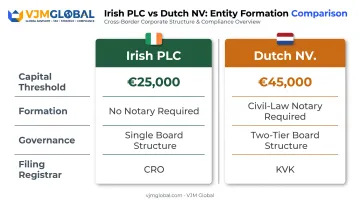
- Capital threshold: Dutch NV requires €45,000 minimum starting capital; the Irish PLC needs only €25,000
- Formation: An NV requires a civil-law notary to prepare the deed of incorporation; Ireland has no notary requirement
- Governance: NVs often use a two-tier board (management and supervisory); Irish PLCs typically operate a single board structure
- Filing: Both file public annual financial statements, but through different registrars (KVK versus the CRO (Companies Registration Office))
When should a Dutch company actually choose a PLC over a Ltd?
- Planning an IPO or public share offering within the next few years
- Raising capital from institutional investors who require PLC-level governance
- Operating in financial services where regulators mandate PLC or DAC (Designated Activity Company) status
Outside those scenarios, the Ltd remains the default for standard trading operations.
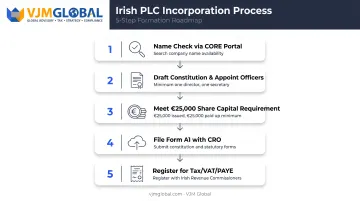
How to Set Up a PLC in Ireland: Step-by-Step Process
Step 1: Choose the Company Name and Confirm Structure Fit
Run a name-availability check through the CRO's CORE portal before anything else. The name must end in "Public Limited Company" or the abbreviation "PLC" (or the Irish-language equivalent, "cuideachta phoiblí theoranta"). This is non-negotiable — the CRO will reject filings without it.
Step 2: Draft the Constitution and Appoint Officers
The Constitution must confirm PLC status, state the proposed share capital, and divide it into fixed-amount shares. You'll also need:
- At least two directors, both aged 18 or older
- One EEA-resident director (or a Section 137 bond as an alternative)
- A qualified company secretary meeting the CRO's experience test
- At least one subscriber, noting the Companies Act 2014 allows formation by a single subscriber, not seven
Dutch founders without an EEA-resident director on hand often need help sourcing one or arranging the bond. VJM Global's cross-border formation team supports this kind of Constitution drafting and coordination as part of its broader Irish entity formation service.
Step 3: Meet Minimum Share Capital Requirements
The PLC must allot at least €25,000 in nominal share capital, with 25% paid up (€6,250) before the company starts trading or exercises borrowing powers. This is a separate hurdle from incorporation itself — more on that below.
Step 4: File with the CRO and Obtain Certificate of Incorporation
Submit Form A1 alongside the Constitution through the CORE portal. Form A1 covers the company name, registered office, directors, secretary, subscribers, share details, and a statutory declaration.
The CRO doesn't publish a guaranteed turnaround time. Processing queues fluctuate, so treat any "5-10 day" estimate with caution and check the CRO's live processing dates before committing to a launch timeline.
Step 5: Register for Tax, VAT, and Employer Obligations
Incorporation alone doesn't authorise trading. Before the PLC can conduct business or borrow money, it must obtain a Section 1010 commencement certificate via Form A4.
Once cleared to trade:
- Register with Irish Revenue through ROS for a Tax Reference Number
- Register for VAT if turnover thresholds apply
- Register as an employer for PAYE, PRSI, and USC if hiring staff locally
VJM Global's Ireland practice handles Corporation Tax registration, VAT, and payroll setup through PAYE Modernisation for entities entering the Irish market.
What Dutch Companies Need Before Incorporating a PLC in Ireland
Before you file, lock down identity documents, an Irish registered office, and director-residency cover. Banks and the CRO will ask for the same core pack.
Documentation typically required:
- Passports or national ID for all directors and subscribers
- Proof of an Irish registered office address
- A draft Constitution meeting PLC-specific requirements
- Beneficial ownership details for RBO filing
The EEA-Resident Director Question
Here's where Dutch founders often get tripped up. A director based in the Netherlands does satisfy the EEA-residency requirement, since the Netherlands is an EEA member state. The confusion arises because people assume "EEA-resident" means "Irish-resident." It doesn't.
If no director on the board is EEA-resident, the alternative is a Section 137 bond with a €25,000 face value. It must run for at least two years and be issued by a qualifying bank, insurer, or credit institution. That figure is the bond's face value, not its premium; actual provider pricing is quote-dependent and no standard cost range is published.
Banking Readiness
Opening an Irish corporate bank account for a foreign-owned entity involves risk-based AML due diligence under Central Bank guidance. Banks like AIB require identification for directors and signatories, recent proof of address, beneficial ownership details, and FATCA/CRS information.
There's no published standard turnaround for this process. Start banking conversations early rather than assuming a fixed timeline. Foreign ownership tends to add scrutiny, not remove it.

Costs, Tax, and Compliance Factors for an Irish PLC
Formation Costs
| Item | Fee |
|---|---|
| Form A1 (incorporation) | EUR 50 |
| Form A4 (commencement of business) | EUR 300 |
| Annual return (Form B1) | EUR 20 |
| Optional name reservation | EUR 25 |
These are official CRO fees. Legal and professional fees for Constitution drafting, EEA-director arrangements, or bond sourcing vary by provider and scope — no standardised market rate exists, so get itemised quotes rather than relying on generic estimates.
Tax Comparison
Ireland taxes trading income at 12.5%, with 25% applying to non-trading income such as rental or investment returns. Compare that with the Netherlands' 2026 rates: 19% up to EUR 200,000 in taxable profit, and 25.8% above that threshold.
For a Dutch group with significant EU-facing trading operations, the gap between 12.5% and 25.8% is often the single biggest reason Ireland enters the conversation at all.
Ongoing Compliance
- Audit is mandatory. PLCs cannot claim size-based or dormant-company audit exemptions, regardless of turnover.
- First annual return (Form B1) is due six months after incorporation.
- Second return is due within 18 months, with financial statements attached.
- Corporation tax return (CT1) and payment are due nine months after the accounting period ends, with ROS filing deadlines on the 23rd of that month.
This is a meaningful gap versus the Ltd structure. A Ltd can often claim audit exemption if it meets small-company size thresholds; a PLC never can. For Dutch groups weighing structures, that's a recurring cost difference worth factoring into any long-term projection, not just the initial setup budget.
PLC vs Other Irish Business Structures
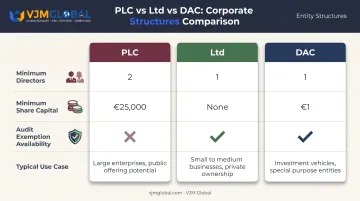
| Feature | PLC | Ltd | DAC |
|---|---|---|---|
| Minimum members | 1 | 1-149 | 1-149 |
| Minimum directors | 2 | 1 | 2 |
| Minimum share capital | €25,000 (25% paid up) | None statutory | None stated |
| Public share offering | Permitted | Not permitted | Restricted by constitution |
| Audit exemption | Never available | Available if size criteria met | Available if size criteria met |
| Typical use case | IPO, institutional capital raise | Standard trading subsidiary | Regulated activities (banking, insurance) |
If you're asking what Ireland's version of an LLC is, it's the Ltd. Ireland doesn't use "LLC" terminology at all.
For most Dutch SMEs entering Ireland to run a trading operation, the Ltd is the practical default. Reserve the PLC for genuine capital-markets ambitions or regulatory mandates. The DAC sits in between, relevant mainly for financial-services entities where the Central Bank of Ireland requires a defined objects clause.
VJM Global helps Dutch founders choose among PLC, Ltd, and DAC, then handles incorporation filing, EEA-director coordination, and post-incorporation tax and VAT registration in Ireland.
Frequently Asked Questions
Who is eligible for a private limited company?
Any individual or corporate shareholder, including a Dutch parent company, can form an Irish Ltd with just one director and one shareholder. There's no residency requirement for shareholders.
How much tax do Irish Ltd and PLC companies pay?
Trading income is taxed at 12.5%, with a 25% rate on passive income such as rents or investments. The same rates apply to both Ltd companies and PLCs.
How much does it cost to set up a Ltd company in Ireland?
CRO filing runs around €50 for Form A1, plus professional formation fees that vary by provider. Unlike the Netherlands, Ireland has no notary requirement, which typically keeps setup costs lower.
What is an LLC called in Ireland?
Ireland doesn't use "LLC" terminology. The closest equivalent is the Private Company Limited by Shares (Ltd).
What does "limited by shares" mean?
Shareholder liability is capped at whatever remains unpaid on their shares. Personal assets beyond that investment stay protected.
How does an Irish PLC differ from a Dutch NV?
The PLC has a lower capital threshold (€25,000 versus €45,000) and no notary requirement for formation. Both serve similar public-capital-raising purposes, but governance filings and board structures differ between the two jurisdictions.