Introduction
Ireland's 12.5% corporate tax rate and unrestricted access to the EU single market make it a natural landing spot for US companies eyeing Europe. But most founders underestimate what it actually costs to get there.
Setup costs in Ireland aren't a single number. They shift based on entity type, whether you need an EEA-resident director (or a bond), and whether you incorporate outright or test the market through an Employer of Record.
Many US founders budget for the incorporation fee and stop there. Then they get surprised by director bonds, cross-border banking friction, and payroll obligations that kick in the moment they hire.
This guide breaks down real cost ranges for each setup path, flags the fees specific to American founders, and shows you how to budget correctly for year one.
Key Takeaways
- Year-one costs run from under €100 DIY to several thousand euros for a full-service LTD
- US founders pay extra for EEA-director bonds, cross-border banking, and treaty filings
- Recurring costs (payroll, pensions, compliance) usually top incorporation fees within 12 months
- Entity type (LTD vs DAC vs PLC) is the biggest driver of total setup cost
How Much Does It Cost to Set Up a Business in Ireland? (Pricing Overview)
There's no fixed "one price" for incorporating in Ireland. Cost depends on your entity type, how much professional support you use, and whether you already have an EEA-resident director lined up.
Three mistakes trip up first-time US founders: underestimating the EEA-director bond requirement, ignoring VAT registration thresholds, and assuming DIY filing is always the cheapest option.
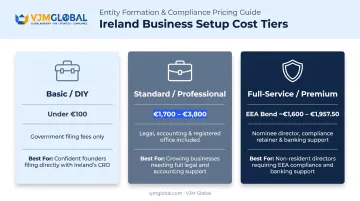
Basic / DIY Setup
Typical government fees only:
- CRO name reservation: about €25 for a 28-day hold
- Electronic Form A1 incorporation filing: about €50, per CRO's published fee schedule
- Self-managed Constitution, director appointments, and RBO filing (no legal or accounting support)
Best for: simple LTD structures with no immediate hiring plans. If you're testing an idea before committing capital, this route keeps filing costs under €100.
Standard / Professionally Supported Setup
Most US SMEs incorporating an LTD subsidiary land here. On top of CRO filing fees, year-one setup often lands around €1,700–€3,800 and typically covers:
- Legal assistance: €500–€1,500
- Accounting setup: €1,000–€2,000
- Registered office: €200–€300/year
Best for: US SMEs planning to trade and hire in Ireland shortly after incorporation.
Full-Service / Premium Setup
US corporations without an EU-based director often need this tier because Irish rules require an EEA-resident director or a qualifying bond. Costs commonly include:
- Company secretary and nominee director service (provider-quoted)
- An EEA-resident director bond of roughly €1,600 to €1,957.50 for a two-year term, based on provider quotes
- Ongoing compliance retainer (varies by scope)
- Banking setup support for cross-border accounts
Best for: US parent companies needing fast, fully compliant market entry without relocating an executive to Ireland.
Key Factors That Affect the Cost of Setting Up a Business in Ireland
Beyond the tier you choose, structural and regulatory decisions swing your total cost more than anything else.
Entity Type Chosen
- LTD (Private Company Limited by Shares): no fixed statutory minimum share capital; most founders start with a nominal amount
- DAC (Designated Activity Company): requires both authorised and issued share capital, often chosen for regulated activities or joint ventures
- PLC: needs at least €25,000 in allotted share capital, with 25% paid up before trading begins
Unless you're planning a public listing, an LTD keeps your capital requirements minimal.
Director & Residency Requirements
Ireland requires at least one EEA-resident director on every LTD board. A board made up entirely of US-based directors doesn't qualify. Your alternatives:
- Appoint an EEA-resident director, often through a nominee service
- Post a Section 137 bond of at least €25,000, running for a minimum of two years, covering potential Companies Act and tax penalties
The bond usually costs less upfront than a nominee director service, but it ties up capital for the full two-year term.
Professional & Legal Support Level
DIY filing costs under €100 in government fees. But CRO rejections for incomplete Constitutions or missed RBO filings are common, and each rejection adds weeks of delay. Professional support typically bundles Constitution drafting, ROS tax registration, and RBO filing into one process, and the fee often pays for itself in avoided delays.
Location and Registered Office
Every Irish company needs a registered office, but it doesn't have to be where you actually trade.
| Option | Typical Cost |
|---|---|
| Dublin prime office space | ~€700/sqm (Q4 2025, CBRE) |
| Virtual/compliance-only registered office | ~€200–€300/year |
Most non-resident founders skip the Dublin lease and use a virtual office until there's a real reason to take physical space.
Employment and Payroll Obligations
The moment you hire, costs compound:
- National minimum wage: €14.15/hour from January 2026
- Employer PRSI (Class A): 9.00% on weekly pay up to €552, rising to 11.25% above that
- MyFutureFund pension auto-enrolment launches 1 January 2026, starting at 1.5% employer contributions
These technically aren't setup costs, but they hit within your first payroll run.
Cost Breakdown of Setting Up a Business in Ireland: One-Time vs Recurring Expenses
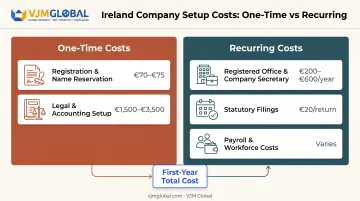
Your real first-year cost combines one-time setup fees with recurring compliance and operating costs.
| Cost item | Type | Typical range |
|---|---|---|
| Registration & name reservation | One-time | €70–€75 |
| Legal & accounting setup | One-time | €1,500–€3,500 |
| Registered office & company secretary | Recurring | €200–€600/year |
| Statutory filings | Recurring | €20/return + penalties if late |
| Payroll & workforce costs | Recurring | Varies with headcount |
Company registration and name reservation is one-time. The CRO charges about €50 for electronic A1 filing and an optional €25 for a 28-day name hold.
Legal and accounting setup covers Constitution drafting and your initial bookkeeping system. Some cross-border firms, including VJM Global, bundle entity formation with tax registration and payroll setup under one fixed-fee engagement. That gives you a single point of contact instead of coordinating a solicitor, accountant, and payroll provider separately.
Registered office and company secretary fees are recurring. Non-resident founders typically pay annual fees for a virtual registered office and nominee company secretary, since Irish law requires both regardless of where you operate day-to-day.
Statutory compliance and filings matter more than the headline fee suggests. The annual B1 return costs €20 to file electronically. Miss the 56-day deadline and penalties start at €100 plus €3 per day, capping at €1,200 per return. More than one late filing in five years costs you audit exemption for the following two years.
Payroll and workforce costs are usually the biggest recurring line item once you hire — minimum wage, employer PRSI, and pension contributions apply from your first payroll run.
US-Specific Considerations That Add to (or Reduce) Your Setup Cost
EEA-Resident Director Requirement
If none of your directors lives in the EEA, Irish company law requires a Section 137 bond. A two-year bond runs roughly €1,600–€1,957.50, based on provider quotes. That's often cheaper than flying in a nominee director or hiring a part-time EEA-resident executive to meet the rule.
The US-Ireland Double Taxation Treaty
The US-Ireland income tax treaty, in force since 1998, doesn't eliminate your US filing obligations, but it does prevent double taxation. Article 24 lets each country credit tax paid to the other. Article 7 generally limits Ireland's claim on your profits to income tied to an Irish permanent establishment.
Structured correctly, your Irish subsidiary and US parent coordinate under this treaty instead of filing duplicate claims.
Subsidiary vs Branch: Cost and Liability
- Subsidiary: a separate legal entity; liability stays ring-fenced to the Irish company's own assets
- Branch: not a separate legal entity; your US parent's global assets remain exposed to Irish branch liabilities
For most US SMEs, the subsidiary's liability protection outweighs its marginally higher setup cost.
Testing the Market Without Incorporating
Not ready to commit to full incorporation? An Employer of Record lets you hire Irish staff and run compliant payroll (PAYE, PRSI, USC) without forming a local entity first. VJM Global's EOR service covers Ireland alongside 100+ other markets, handling contracts, onboarding, and statutory contributions on a per-employee, per-month basis. It's a practical way to validate demand before you take on CRO filings, a registered office, and director bonds.
How to Budget Smartly and Avoid Common Cost Mistakes
Before finalising a budget, weigh three variables:
- Entity type
- Hiring timeline
- Whether you need a local director or EOR partner to bridge the gap
Two mistakes show up again and again:
- Incorporation fee tunnel vision: CRO filing may run only €50–€250, but payroll, pension contributions, and compliance filings usually exceed that within a year of your first hire.
- DIY with no fallback: CRO rejections for incomplete Constitutions cost weeks, not euros. Miss a VAT deadline (€42,500 services / €85,000 goods) and you add penalties on top of the delay.
Get one transparent quote that covers setup plus first-year compliance from a cross-border partner, instead of piecing together a solicitor, accountant, and payroll provider on your own.
Firms that work across both US and Irish rules (VJM Global among them) can price entity formation, tax registration, and payroll setup as one engagement. That cuts the cost of coordinating separate vendors on two continents.

Frequently Asked Questions
How much money do you need to start a business in Ireland?
A basic DIY sole trader setup can cost under €100 in government fees. A fully supported LTD subsidiary with legal, accounting, and registered office support typically runs €2,000–€5,000 for year one, before payroll costs.
Can you start a business in Ireland as a foreigner?
Yes. Non-EU and US founders can incorporate freely if the company has an EEA-resident director or a Section 137 bond. Founders relocating full-time can also pursue STEP, which needs an innovative proposal and €50,000 in funding.
Is it worth starting a business in Ireland?
The 12.5% trading tax rate and EU market access still favor most US SMEs targeting Europe. Rising minimum wage, employer PRSI, and pension auto-enrolment push up team costs, so low-margin, labor-heavy models gain less.
Do I need to live in Ireland to register a company there?
No. Shareholders and most directors don't need to reside in Ireland. The exception is the EEA-resident director requirement, which you can satisfy with a nominee director or a bond instead of relocating.
How long does it take to incorporate a company in Ireland from the US?
The CRO targets 10 working days for standard A1 filings, or 5 working days for the expedited Fé Phráinn service, assuming your documents are complete. Formation agents often speed this up by catching errors before submission.
Can a US company set up a subsidiary in Ireland without an Irish resident director?
Yes. You can appoint a nominee EEA-resident director through a formation service, or post a Section 137 bond of at least €25,000 for a minimum two-year term as an alternative.