
Introduction
A sole proprietorship is India's simplest business structure — but most guides skip the question UK entrepreneurs need answered first: can you actually use it? Unlike Private Limited Companies or LLPs, which welcome foreign investment, sole proprietorships face strict eligibility restrictions under Indian law.
UK nationals without Indian citizenship face a clear legal barrier. Even those with Overseas Citizen of India (OCI) status encounter sector exclusions and repatriation constraints that can derail the entire venture.
Understanding where you stand legally before investing time in registration is essential. This guide covers eligibility, the full registration process for those who qualify, and the alternatives most UK entrepreneurs will need to consider instead.
Key Takeaways
- A sole proprietorship has no separate legal identity from its owner—the business and proprietor are legally the same entity
- UK nationals without OCI status cannot legally register a sole proprietorship in India; even OCI holders face sector-specific restrictions and non-repatriation rules on profits
- Registration involves obtaining multiple licences (GST, Shop Act, Udyam) rather than a single incorporation process
- For most UK entrepreneurs, a Private Limited Company is the practical entry route — it permits 100% FDI under the automatic route across most sectors
What Is a Sole Proprietorship in India?
A sole proprietorship is an unincorporated business owned and operated by a single individual. The owner and the business share a single legal identity — no separation exists between personal and commercial obligations. Unlike a Private Limited Company or LLP, you don't "form" a sole proprietorship through central government registration. The business is recognised through a combination of functional licences instead.
Key characteristics that distinguish it from other Indian business structures:
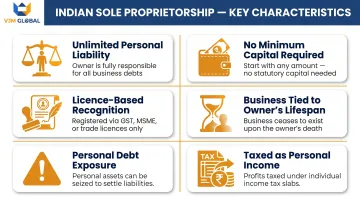
- All assets and liabilities belong personally to the owner — there is no separation between proprietor and business.
- No single authority "registers" a sole proprietorship; recognition comes through task-specific licences (GST, Shop Act, Udyam) based on your activity.
- Business debts are personal debts. If the business fails, personal assets can be seized to settle obligations.
- There is no minimum capital requirement — you can start with any amount you choose.
- The business ends with the owner's death and cannot be transferred or inherited as a separate entity.
- Business income is added to personal income and taxed under individual slab rates.
For UK entrepreneurs used to limited liability protections, this structure suits small-scale, low-risk ventures. If your India plans involve raising capital, bringing in investors, or building a long-term operation, a Private Limited Company or LLP will serve you better.
Can UK Entrepreneurs Register a Sole Proprietorship in India?
The short answer: No, unless you hold OCI status and meet specific conditions.
UK nationals who are not Indian citizens face a clear restriction. India's Foreign Exchange Management Act (FEMA) and Reserve Bank of India (RBI) regulations reserve the sole proprietorship structure for resident Indian citizens. Non-resident foreign nationals require prior RBI approval to invest in a proprietary concern, which closes the door on straightforward market entry for most UK nationals.
The OCI Exception
UK nationals who hold Overseas Citizen of India (OCI) status may be permitted to operate certain businesses in India. Since November 2017, FEMA regulations mandate that foreign citizens of Indian origin hold an OCI card to operate as a proprietor. Operating without one constitutes a FEMA violation.
Critical restrictions for OCI holders:
- Investment must be on a non-repatriation basis only—profits cannot be transferred back to the UK
- Prohibited sectors include agricultural/plantation activity, print media, and real estate business
- FDI-restricted sectors remain off-limits under the same rules that govern foreign direct investment
Note on PIO cards: The Person of Indian Origin (PIO) card scheme merged into the OCI scheme in January 2015. If you held a PIO card before that date, it is now treated as an OCI card. All new applications for UK nationals of Indian heritage go through the OCI route.
The Aadhaar Barrier
Meeting OCI and sector requirements still leaves one practical hurdle: Aadhaar enrollment requires physical presence in India and 182+ days of residency in the preceding 12 months. Since Aadhaar is mandatory for Udyam registration on the official government portal, UK-based entrepreneurs who haven't spent significant time in India face a real logistical obstacle before they can even begin the process.
VJM Global has worked with 250+ UK businesses navigating exactly this eligibility question — assessing OCI status, FEMA compliance, and sector restrictions before recommending the right structure. For UK nationals unsure whether a sole proprietorship is viable for their situation, an eligibility review identifies the fastest compliant path into the Indian market.
Step-by-Step: How to Register a Sole Proprietorship in India
There is no single central authority that "registers" a sole proprietorship in India. Instead, you establish the business identity through a combination of government-issued documents and licences. The specific registrations you need depend on the nature, location, and scale of your business.
Step 1: Choose a Business Name and Obtain PAN
Choose a unique business name. No formal approval is needed, but check trademark availability to avoid conflicts. The proprietor's personal PAN card serves as the business PAN, since sole proprietorships do not receive a separate PAN.
Step 2: Register Under the Shop and Establishment Act
Any business operating from a commercial premises must register under the state-specific Shop and Establishment Act. This registration is issued by the local municipal authority or state labour department. Banks require this licence to open a current account in your business name.
State-wise fees (2025):
- Delhi: ₹5 to ₹250 based on employees; lifetime validity
- Maharashtra (Mumbai/BMC): No registration fee
- Karnataka: ₹810 to ₹27,000 based on employees
Processing typically takes 3–7 working days. Rules vary by state, so check your local authority's requirements.
Step 3: Apply for GST Registration (If Applicable)
GST registration is mandatory when annual turnover exceeds ₹20 lakh (₹10 lakh in special category states). It is also compulsory for:
- Any inter-state supply, regardless of turnover
- E-commerce businesses
- Businesses supplying through e-commerce operators
Registration is free via the GST portal and typically takes 2–5 working days. Voluntary GST registration below the threshold can improve credibility with vendors and clients.
Step 4: Register Under Udyam (MSME Registration)
Udyam registration is free, fully online, and instant. It classifies your business as a Micro, Small, or Medium Enterprise and unlocks:
- Eligibility for government subsidies and scheme benefits
- Priority lending and collateral-free credit from scheduled banks
- Access to government tenders reserved for MSMEs
The proprietor's Aadhaar number is required for this registration. Note for UK entrepreneurs: Aadhaar is an India-issued biometric ID available only to Indian residents. If you are operating as a non-resident proprietor, consult a local compliance adviser on current exemptions or alternative verification accepted by the portal.
Step 5: Open a Business Current Account
A current account in the business name separates personal and business finances. Banks typically require at least one business registration document alongside standard KYC documents. You will generally need:
- Shop Act licence, GST certificate, or Udyam certificate (at least one)
- PAN card of the proprietor
- Aadhaar card and address proof
Taxation and Ongoing Compliance for Sole Proprietors
A sole proprietorship is not taxed as a separate entity — business income is added to your personal income and taxed under India's individual income tax slabs.
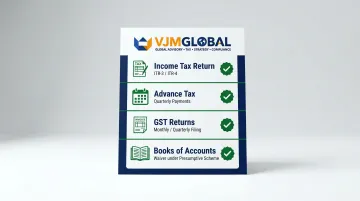
Core annual compliance obligations:
- Income Tax Return: File ITR-3 or ITR-4 (using the presumptive tax scheme under Sections 44AD or 44ADA where eligible)
- Advance Tax: Pay quarterly if total tax liability exceeds ₹10,000 annually
- GST Returns: File monthly or quarterly if GST-registered
- Books of Accounts: Maintain receipts and basic ledgers; full bookkeeping is waived under presumptive schemes
Tax audit is mandatory if turnover exceeds ₹1 crore for traders (₹10 crore where 95%+ receipts are digital) or ₹50 lakh for professionals.
UK-India Double Taxation Avoidance Agreement (DTAA)
If you're a UK resident earning business income from India, the UK-India DTAA directly affects your tax position. Under Article 7 (Business Profits), profits are taxable only in your country of residence unless a permanent establishment (PE) exists in India.
UK-resident sole proprietors without a PE in India may avoid Indian tax on business profits entirely, though this outcome depends on careful cross-border tax planning.
Presumptive Taxation Simplified:
| Scheme | Applicable To | Turnover Limit | Deemed Income Rate |
|---|---|---|---|
| Section 44AD | Businesses | ₹2 crore (₹3 crore if cash < 5%) | 8% (6% for digital receipts) |
| Section 44ADA | Professionals | ₹50 lakh (₹75 lakh if cash < 5%) | 50% of gross receipts |
Eligible proprietors declare income at these flat rates, bypassing full bookkeeping and audit requirements. For UK entrepreneurs running lean India operations, the presumptive schemes can significantly reduce your annual compliance burden.
When a Sole Proprietorship Is Not the Right Fit for UK Entrepreneurs
Most UK nationals approaching India as a foreign market cannot legally access the sole proprietorship structure. Non-OCI holders face an outright ban, and even OCI holders encounter sector restrictions and non-repatriation conditions (meaning profits cannot be sent back to the UK) that make this route unviable for commercial operations.
Structural limitations even for those who qualify:
- Personal assets in the UK are fully exposed if business debts exceed available resources
- Cannot raise investment capital, issue shares, or bring in equity partners
- The business ends with the owner — it cannot be transferred or sold as a going concern
Recommended alternatives for UK entrepreneurs:
- Private Limited Company: Allows 100% FDI under the automatic route in most sectors, with limited liability and full profit repatriation
- LLP: Suited to service businesses; requires FDI approval and at least two partners
- Branch Office: Represents the UK parent company directly in India; requires RBI approval and a proven profit track record
One misconception worth flagging: some UK entrepreneurs assume they can operate through an Indian partner's sole proprietorship, effectively sidestepping the FDI rules. This arrangement creates FEMA violations and tax liability for both parties — and Indian tax authorities have become increasingly attentive to such structures.
Choosing the right entry vehicle depends on your sector, investment size, and whether you need to repatriate profits. VJM Global works with UK entrepreneurs to match entity type to business objectives and handles the full incorporation process under DPIIT and FEMA rules.
Frequently Asked Questions
Does a sole proprietorship need to be registered in India?
There is no single mandatory registration for a sole proprietorship, but businesses must obtain relevant licences (Shop Act, GST, Udyam) to establish legal identity, open a bank account, and comply with tax obligations.
How do I register a proprietorship company in India?
Registration involves obtaining a combination of licences — typically a Shop and Establishment licence, GST registration (if turnover qualifies), and Udyam registration — rather than a single incorporation process. Most licences are issued within 3–7 working days through government portals.
How much does it cost to register a sole proprietorship company in India?
GST and Udyam registrations are free via government portals. Shop and Establishment licence fees vary by state, ranging from ₹5 to ₹27,000 based on location and employee count. Optional professional assistance for the full setup typically costs ₹3,000–₹10,000 as a one-time fee.
Can an NRI open a sole proprietorship in India?
NRIs and foreign nationals are generally not eligible to register a sole proprietorship in India. OCI holders may have limited options depending on the sector, but most NRIs and foreign nationals should establish a Private Limited Company or LLP under the FDI framework.
What is the best business structure for UK entrepreneurs entering the Indian market?
For most UK entrepreneurs, a Private Limited Company is the preferred route — it allows up to 100% FDI under the automatic route in most sectors, offers limited liability, and is recognised by banks and regulators. An LLP is a suitable alternative for service-based businesses where partners want a flexible structure.