But HMRC's simplest business structure gets complicated fast for non-residents. There's no UK National Insurance number to fall back on, tax residency status is rarely clear-cut, and many applicants aren't even sure registration is required in the first place.
This guide walks through eligibility, the exact registration steps from the UAE, the documents you'll need, UK-UAE tax considerations, common mistakes, and a few alternatives worth weighing before you commit.
TL;DR
- You don't need to live in the UK to register — only a genuine UK trading connection matters.
- Registration becomes mandatory once gross trading income exceeds £1,000 in a tax year.
- No NI number? UAE applicants use a paper-based route instead of the standard online portal.
- The UK-UAE Double Taxation Agreement governs which country taxes your profits if you keep ties to both.
- HMRC registration costs nothing; advisory support is what usually prevents double taxation and paper-filing delays.
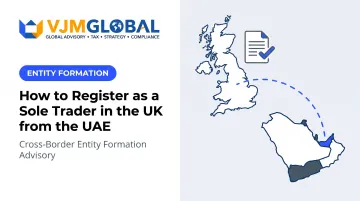
How to Register as a Sole Trader in the UK from the UAE
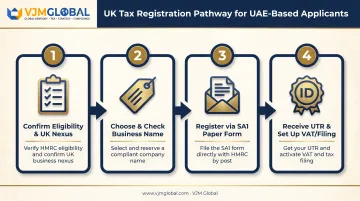
Step 1: Confirm You Need (and Are Eligible) to Register
Not every UAE-based freelancer with a UK client needs to register. HMRC looks at whether your activity counts as trading in the UK, not simply where your customers happen to sit.
- Invoicing a UK client while performing all the work from your home office in Dubai looks different, from a tax perspective, than running a business with real UK operations or a UK fixed base.
- HMRC guidance on non-residents: living abroad but trading "in the UK" usually still means Self Assessment, if you generate UK income or carry on a trade in the UK, not just send the odd invoice.
The other trigger is financial. Once gross trading income (before expenses) crosses £1,000 in a tax year, you must register for Self Assessment by 5 October following that tax year.
Below £1,000, you generally do not need to tell HMRC, unless you want to claim a trading loss or pay voluntary National Insurance.
One thing that trips people up: no UK residency, visa, or right to work is required to register as a sole trader. You're registering a trading activity, not applying to live or work in Britain.
Step 2: Choose and Check Your Business Name
You can trade under your own name or pick a separate trading name. Either way, run it through a name-availability check first.
- Avoid restricted words: "Limited," "Ltd," "LLP," or "plc" misrepresent your structure and HMRC will not accept them.
- Check for clashes with existing trademarks or well-known businesses, since a name that's too similar can trigger a legal complaint later.
- Whatever name you choose, your own legal name (or the registered trading name) needs to appear on invoices and official paperwork.
Step 3: Register for Self Assessment with HMRC (the UAE-Specific Route)
Here's where most UAE-based applicants get stuck. The standard online Government Gateway registration assumes you have a UK National Insurance number, and if you've never lived or worked in the UK, you almost certainly don't.
The workaround is HMRC's SA1 form, which:
- Accepts a postal address outside the UK
- Asks for a National Insurance number "if you have one" rather than requiring it
- Can be filled out online and printed, or posted directly from the UAE
HMRC previously pointed self-employed filers to a separate CWF1 form; that link now redirects to the standard online filing page.
If you are unsure which route applies, confirm with HMRC's non-resident helpline or a cross-border adviser before you post anything. The wrong form in the wrong department is a common cause of delay.
Attach a copy of your passport and proof of your UAE address (a recent utility bill or bank statement works). Expect HMRC to make initial contact within about 21 days, though overseas post typically adds several weeks compared to the standard online timeline.
Step 4: Receive Your UTR, Handle VAT, and Set Up Filing
Once processed, HMRC posts you a 10-digit Unique Taxpayer Reference (UTR). That number effectively replaces the company registration number sole traders never receive. It usually arrives around 15 days after registration, though overseas addresses take longer and HMRC does not publish an exact timeframe.
From there, two things need attention:
- VAT registration — compulsory once UK taxable turnover exceeds £90,000 in a rolling 12-month period, though overseas sellers can face different, stricter rules (more on this below).
- Self Assessment filing setup — get your online account and record-keeping sorted early, rather than scrambling near the deadline.
This is also when UK–UAE Double Taxation Agreement relief needs a clear plan. Getting the structure right at the start beats untangling a tax bill that has landed twice. Cross-border advisers such as VJM Global routinely handle that setup for UAE-based sole traders.
What You Need Before Registering as a UAE-Based Sole Trader
Preparation matters more when you're applying from overseas. A missing document or National Insurance (NI) number mix-up can easily add weeks to your approval.
Personal Identification & Address Proof
- Valid passport
- Emirates ID or UAE residence visa copy
- Recent UAE utility bill or bank statement as proof of address
UK-Facing Business Essentials
- UK correspondence option (mail-forwarding or registered address service)—optional for sole traders, useful for client credibility
- A plan for invoicing and receiving payments in GBP, since most UK clients expect sterling invoices
Tax & Compliance Readiness
- Clear view of UK tax exposure as a non-resident sole trader versus remaining UAE tax resident
- Familiarity with Making Tax Digital record-keeping thresholds:
- Over £50,000: digital records from April 2026
- Over £30,000: from April 2027
- Over £20,000: from April 2028
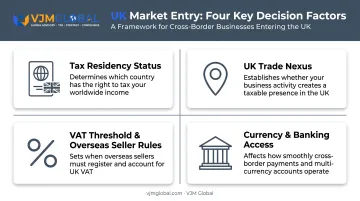
Key Factors That Affect Your Sole Trader Registration & Tax Position
Most generic guides skip the variables that actually decide how this plays out for UAE-based applicants.
Tax Residency Status
Your residency status determines which country has the primary right to tax your trading profits. Get this wrong and you risk double taxation, or missing relief you are entitled to.
The UK-UAE Double Taxation Convention sets out tie-breaker rules for dual residents. They apply in this order: permanent home, centre of vital interests, habitual abode, then nationality.
Nature & Location of Trade (UK Nexus)
HMRC assesses whether your trade is genuinely "carried on in the UK," not just where your invoices are addressed. No real UK nexus generally means no UK sole trader registration requirement. You may simply be a UAE-based freelancer with international clients.
VAT Threshold & Overseas Seller Rules
The standard £90,000 VAT threshold applies to UK-established businesses. A non-established taxable person, someone without a UK establishment, doesn't get that buffer at all.
If you're supplying taxable goods or services in the UK without a UK base, VAT registration can be required from your first sale, with notification due within 30 days.
Currency, Banking & Invoicing Access
UK banks apply extra due diligence to non-resident applicants before opening accounts. Slower banking access means slower GBP invoicing, which can stall client onboarding right when you need momentum.
Common Mistakes UAE-Based Applicants Make
Watch for these errors before you file:
- Registering as a UK sole trader without a genuine UK trading nexus
- Getting stuck at the online portal over a missing NI number instead of using the paper route
- Overlooking double tax treaty relief and risking tax charged twice on the same income
Alternatives to Registering as a UK Sole Trader
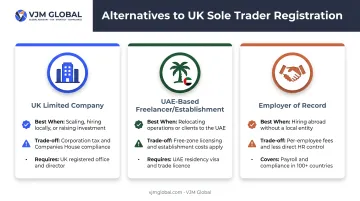
Sole trader status isn't automatically the right fit, especially where liability exposure or UK nexus is unclear.
UK Limited Company Formation
When it's better: You want limited liability, plan to scale, hire staff, or need stronger credibility with UK clients and investors.
Key trade-offs: More compliance than sole trader life, including:
- Companies House filings and statutory annual accounts
- Corporation Tax at 19% on profits below £50,000 and 25% above £250,000 (marginal relief in between)
VJM Global can handle UK formation end to end: name approval, Memorandum and Articles, Companies House registration, and HMRC setup for Corporation Tax and your UTR.
Remaining a UAE-Based Freelancer or Establishment
When it's better: Your work is performed entirely from the UAE with no genuine UK trading nexus, which preserves UAE tax residency benefits, including no personal income tax.
Key trade-offs: Some UK clients will still expect UK invoices or a VAT number, which this route can't easily provide.
Working Through an Employer of Record (EOR)
When it's better: You're effectively working for one UK company and want payroll, tax, and compliance handled without any formal UK structure.
VJM Global provides EOR across 100+ countries, including the UK–UAE corridor, with compliant contracts, payroll, statutory deductions, and offboarding.
Key trade-offs:
- Less independence than a registered sole trader
- Best suited to single-client arrangements, not multi-client freelance work
Conclusion
Registering as a UK sole trader from the UAE is legally possible and, in most cases, fairly straightforward. It only holds where you have a genuine UK trading nexus to justify the registration.
Most complications trace back to three issues:
- Getting stuck without an NI number
- Misjudging VAT or DTA rules
- Registering before checking whether it is actually required
Get your tax residency position and compliance setup right from day one to avoid double taxation and expensive rework. If the nexus, NI, or treaty position is unclear, take advice before you file with HMRC.
Frequently Asked Questions
How much does it cost to register a sole trader in the UK?
HMRC registration itself is free. Optional costs include a UK registered address service, accounting software, or professional advisory support for tax structuring.
Can a non-resident living in the UAE register as a sole trader in the UK?
Yes, provided you carry out a genuine trade connected to the UK. Applicants without a UK National Insurance number typically use the paper-based SA1 route instead of the online portal.
Do I need to register as a sole trader in the UK?
Registration is required once your UK-connected trading income exceeds £1,000 in a tax year. If there's no real UK trading nexus, you likely don't need to register at all.
Do I need a National Insurance number to register as a sole trader from the UAE?
No. You can register using HMRC's SA1 form with a passport copy and proof of your UAE address instead of an NI number.
Will I be taxed in both the UK and UAE as a sole trader?
The UK-UAE Double Taxation Agreement is designed to prevent this, and the UAE has no personal income tax. Correct structuring from the outset is essential to actually benefit from that relief.
Can I open a UK business bank account while living in the UAE?
It's possible, but expect enhanced due diligence as a non-resident applicant. Digital and fintech providers are often a faster route for GBP invoicing than traditional banks.