Introduction
Imagine a UK manufacturing company acquires a trading subsidiary in India to expand its supply chain. Overnight, the finance director faces a critical question: do we now need to prepare consolidated group accounts? This scenario is increasingly common as UK businesses expand through acquisitions and subsidiary structures, yet many directors remain uncertain about their obligations under the Companies Act 2006.
Consolidated (or group) accounts present a parent company and all its subsidiaries as a single economic entity. Internal transactions between group members are eliminated, giving a clear picture of the group's overall financial position.
Under CA 2006 Section 399, UK parent companies have a statutory duty to prepare these accounts alongside their individual company accounts, unless they qualify for an exemption.
This guide covers who must prepare consolidated accounts, the size thresholds that trigger the requirement, available exemptions, what the accounts must contain, and the step-by-step preparation process.
Key Takeaways
- UK parent companies must prepare consolidated accounts if they control one or more subsidiaries and exceed small group thresholds
- Updated thresholds apply from 6 April 2025 — a group must meet 2 of 3 size criteria to qualify as small
- Three exemptions exist: small group, UK intermediate parent, and non-UK intermediate parent
- Overseas subsidiaries must be included in UK parent consolidations
- Filing is due 9 months after year-end — directors face criminal liability for late submission
What Are Consolidated Accounts and Who Must Prepare Them?
Legal Definition and Basis
Consolidated accounts combine the financial results of a parent company and all its subsidiaries, eliminating intra-group transactions to present the group as a single reporting entity. CA 2006 s399 defines them as comprising:
- A consolidated balance sheet showing the group's state of affairs
- A consolidated profit and loss account showing group profit or loss
- Notes giving a true and fair view of the group's financial position
Parent-Subsidiary Relationships
Under CA 2006 s1162, a parent-subsidiary relationship exists when the parent:
- Holds a majority of voting rights in the subsidiary
- Has the right to appoint or remove a majority of the board
- Exercises dominant influence through the subsidiary's articles or a control contract
- Controls a majority of voting rights through agreements with other shareholders
- Actually exercises dominant influence or manages the subsidiary on a unified basis
Important: Ownership need not be 100%. Control at any level—even 51%—can create a parent-subsidiary relationship requiring consolidation.
Overseas Subsidiaries and UK Consolidation Rules
If your company is registered in the UK and has subsidiaries incorporated overseas, those entities must be included in your consolidated accounts. CA 2006 s1173(1) defines "body corporate" to include entities incorporated anywhere with separate legal personality. The subsidiary's country of incorporation does not affect this obligation. What counts is that the parent is UK-registered and exercises control.
Applicable Accounting Framework
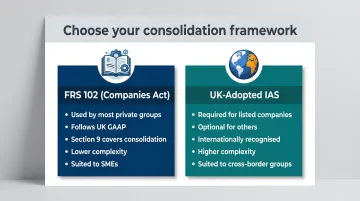
UK parent companies choose between two frameworks based on their size and market status:
| Framework | Who Uses It | Key Characteristics | Complexity |
|---|---|---|---|
| FRS 102 (Companies Act) | Most private groups | Follows UK GAAP; Section 9 covers consolidated statements | Lower — practical for SMEs |
| UK-adopted IAS | Required for listed companies; optional for others | Internationally recognised; once adopted, must continue unless circumstances change | Higher — suited to cross-border groups |
Whichever framework applies, the obligation to file on time remains the same.
Filing Obligation and Penalties
Consolidated accounts must be filed at Companies House within:
- 9 months after year-end for private companies
- 6 months after year-end for public companies
Under CA 2006 s451, failure to file on time is a criminal offence for every director who held office at the deadline. Personal penalties include:
- Fine up to level 5 on the standard scale (currently £1,000)
- Daily default fine for continued non-compliance
- No defence that accounts were not prepared
Companies House civil penalties also apply to the company itself, ranging from £150 (up to 1 month late) to £1,500 (over 6 months late).
Size Thresholds: When Does the Requirement Apply?
The obligation to prepare consolidated accounts is tied directly to group size. Under CA 2006 s399, parent companies need not prepare group accounts if the group qualifies as "small."
Updated Thresholds (Effective 6 April 2025)
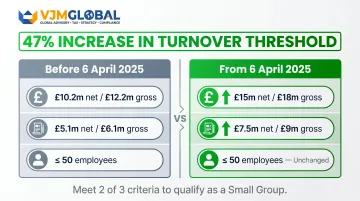
Following SI 2024/1303, groups qualify as small if they meet at least 2 of these 3 criteria:
| Criterion | Net Figure | Gross Figure |
|---|---|---|
| Aggregate turnover | ≤ £15m | ≤ £18m |
| Aggregate balance sheet total | ≤ £7.5m | ≤ £9m |
| Average employees | ≤ 50 | ≤ 50 |
Net vs Gross:
- Net figures = after eliminating intra-group transactions and balances
- Gross figures = before consolidation adjustments
- Groups must meet the net OR gross threshold for each criterion
Previous Thresholds (Pre-6 April 2025)
The previous limits were:
- Turnover: ≤£10.2m net (£12.2m gross)
- Balance sheet: ≤£5.1m net (£6.1m gross)
- Employees: ≤50
This represents a 47% increase in the turnover threshold — groups that sat just above the old limits may now qualify for exemption for the first time.
Transitional Relief
Regulation 3 of SI 2024/1303 provides an important shortcut: groups can treat the new thresholds as having applied in the prior year.
This bypasses the usual two-year qualification rule. Newly eligible groups can claim exemption in their first qualifying year beginning on or after 6 April 2025, without waiting an additional year to establish the two-year track record.
The Two-Year Rule
Generally, groups must meet the size criteria for two consecutive financial years to qualify as small. The one exception: a group's first financial year — if it meets the thresholds in year one, it qualifies immediately.
Once qualified, a single year above the limits does not immediately remove exemption. Two consecutive years above the thresholds will trigger the consolidation requirement.
Ineligible Entities
Certain entity types cannot use the small group exemption regardless of size. If your group includes any of the following, you must prepare consolidated accounts:
- Public limited companies (PLCs)
- Companies with securities on a UK regulated market
- Authorised insurance companies
- Banking companies
- E-money issuers
- MiFID investment firms
- UCITS management companies
Note: Companies listed on AIM are not considered to be on a "regulated market" and may use the small group exemption if they meet size criteria.
Exemptions from Preparing Consolidated Accounts
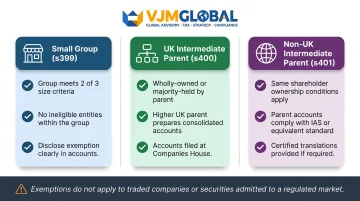
Even if your group exceeds the small group thresholds, three statutory exemption routes may apply.
Small Group Exemption (s399)
The most common route. If your group qualifies on size and contains no ineligible entities, the parent need not prepare consolidated accounts.
Conditions:
- Meets at least 2 of the 3 size criteria (turnover, balance sheet total, employee headcount)
- Contains no ineligible entities (such as traded companies or regulated financial institutions)
- Discloses the exemption in its individual accounts, citing s399
Intermediate Parent Exemption – UK Parent (s400)
A UK subsidiary that is itself a parent can avoid preparing its own consolidated accounts if a higher UK parent already consolidates it.
Conditions:
- The company must be wholly-owned by its UK parent, OR hold 90%+ shares with minority approval, OR hold 50%+ shares with no shareholder objection (served at least 6 months before year-end)
- It must be included in larger group accounts prepared by a UK parent to the same date (or earlier in the same financial year)
- Those accounts must comply with CA 2006 Part 15 or UK-adopted IAS, giving a true and fair view
- The higher parent's accounts must be filed at Companies House
- The company must disclose the exemption, the parent's name, and registered office in its individual accounts
This exemption does not apply to traded companies.
Intermediate Parent Exemption – Non-UK Parent (s401)
Where the ultimate parent is incorporated outside the UK, a similar exemption is available — but with additional filing obligations for the foreign group accounts.
Conditions:
- Same shareholder conditions as s400
- The parent's consolidated accounts must comply with UK-adopted IAS, EU-adopted IAS, or an equivalent framework
- The company must disclose the exemption, the parent's name, and country of incorporation (or principal place of business if unincorporated)
- Copies of the parent's group accounts, annual report, and auditor's report must be filed at Companies House with certified English translations if necessary
This exemption does not apply to companies with securities on a UK regulated market.
Subsidiary Exclusions (Not Full Exemptions)
The exemptions above apply at the parent level. Separately, FRS 102 paragraph 9.9 allows individual subsidiaries to be excluded from consolidation on specific grounds — though this does not remove the parent's overall obligation to consolidate:
- Immateriality — inclusion would not affect the true and fair view; two or more subsidiaries may only be excluded together if immaterial in aggregate
- Severe long-term restrictions — circumstances that substantially hinder the parent's rights over the subsidiary's assets or management
- Held exclusively for resale — the interest was acquired solely for subsequent disposal and has not been previously consolidated
Excluded subsidiaries must still be accounted for as financial instruments under FRS 102 Sections 11 and 12.
What Must Be Included in Consolidated Accounts
Scope of Consolidation
All subsidiary undertakings where the parent has control must be consolidated. Control is determined by:
- Share ownership exceeding 50%
- Dominant influence over financial and operating policies
- Ability to appoint or remove the majority of the board
This applies equally to UK and overseas subsidiaries. A UK parent with an Indian trading subsidiary and a German manufacturing subsidiary must consolidate both.
Key Consolidation Adjustments
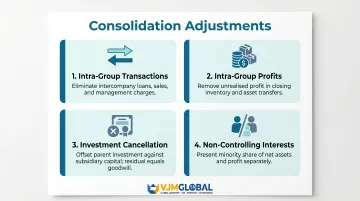
Four categories of adjustments are required to produce a true and fair group picture:
Intra-group transactions — eliminate all loans, intercompany sales and purchases, and management charges between group entities so only external activity is reported.
Intra-group profits — remove unrealised profit sitting in closing inventory from parent-to-subsidiary sales and adjust for unrealised gains on asset transfers.
Investment cancellation — cancel the parent's investment in subsidiary shares against the subsidiary's share capital and reserves, with any remaining difference treated as goodwill.
Non-controlling interests — present minority shareholders' share of net assets and profit or loss separately from the parent shareholders' interests within equity.
Goodwill on Consolidation
Goodwill arises when the purchase price exceeds the fair value of the subsidiary's net assets at acquisition. Under FRS 102:
- Goodwill is amortised over its useful economic life
- Maximum amortisation period is 10 years where life cannot be reliably estimated
- Must be tested for impairment if indicators exist
- Impairment losses are recognised immediately and cannot be reversed
Where the purchase price falls below fair value of net assets — known as negative goodwill or a bargain purchase — a different treatment applies:
- Reassess the identification and measurement of assets, liabilities, and consideration
- Recognise the excess immediately below goodwill on the balance sheet
- Release to profit or loss as non-monetary assets are recovered or over the periods expected to benefit
Key Accounting Requirements Under FRS 102 and UK GAAP
Uniform Accounting Policies
All group entities must apply consistent accounting policies when preparing consolidated accounts. If a subsidiary uses different policies, adjustments must be made on consolidation to align with group policies. Where adjustment is impracticable, full disclosure of the inconsistency is required.
Consistent Accounting Period-Ends
Group companies should prepare accounts to the same period-end. FRS 102 paragraph 9.16 allows subsidiaries to report up to three months before the parent's year-end if preparing to the same date is impracticable. When using different period-ends, adjust for significant transactions or events occurring between the subsidiary's reporting date and the parent's reporting date.
For groups managing complex multi-entity structures, applying these requirements consistently across jurisdictions can be challenging. VJM Global's accounting and compliance team supports UK businesses and international groups with consolidation, working across UK accounting standards and Companies House filing requirements.
With 30+ years of experience and 250+ UK businesses served, the firm draws on its global network as a member of EAI International to deliver technically compliant group accounts.
Step-by-Step Process of Preparing Consolidated Accounts
Gathering and Aligning Entity Financials
Start by collecting complete financial information from every entity in the group.
Collect individual financial statements and acquisition details:
- Obtain trial balances for the parent and all subsidiaries
- Request detailed transaction listings for material accounts
- Gather purchase agreements showing consideration paid
- Collect fair value assessments of identifiable assets and liabilities at acquisition date
- Determine the acquisition date for calculating goodwill
Confirm alignment across the group:
- Verify all entities report to the same period-end (or within the permitted three-month window)
- Check that accounting policies are consistent across the group
- Identify any policy differences requiring consolidation adjustments
Performing Consolidation Adjustments
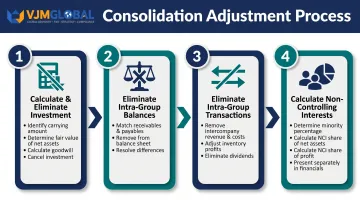
With aligned financials in hand, work through four core adjustments in sequence.
Step 1 — Calculate and eliminate investment:
- Identify the carrying amount of the parent's investment in each subsidiary
- Determine the fair value of the subsidiary's identifiable net assets at acquisition
- Calculate goodwill: Purchase consideration minus the parent's share of fair value of net assets
- Cancel the parent's investment against the subsidiary's share capital and reserves
Step 2 — Eliminate intra-group balances:
- Match inter-company receivables and payables between group entities
- Remove these balances entirely from the consolidated balance sheet
- Investigate and resolve any reconciling differences
Step 3 — Eliminate intra-group transactions:
- Identify all sales, purchases, and services between group members
- Remove these from consolidated revenue and costs
- Adjust for unrealised profits in inventory — for example, where a parent sold goods to a subsidiary at a markup and that subsidiary still holds the stock at year-end
- Eliminate dividends paid by subsidiaries to the parent
Step 4 — Calculate non-controlling interests:
- Determine the percentage of each subsidiary owned by external shareholders
- Calculate their share of the subsidiary's net assets
- Calculate their share of the subsidiary's profit or loss for the year
- Present these amounts separately in equity and the profit and loss account
Preparing and Filing the Accounts
Once adjustments are complete, compile the consolidated statements and prepare for filing.
Consolidated statements to prepare:
- Profit and loss account — showing group revenue, costs, and profit split between parent and non-controlling interests
- Balance sheet — presenting group assets, liabilities, and equity with non-controlling interests shown separately
- Cash flow statement — if required under the applicable reporting framework
Required disclosures include:
- Accounting policies applied across the group
- Subsidiary details: name, country of incorporation, voting rights held, and ownership percentage
- Goodwill movements: opening balance, additions, amortisation, impairment, and closing balance
- Non-controlling interests: share of profit/loss and share of net assets
- Related party transactions between group entities and external parties
To sign off and file:
- Obtain director approval and signatures
- Commission an audit if the group exceeds the audit size thresholds
- File with Companies House within 9 months of the financial year-end (private companies)
- Include the auditor's report where applicable
Frequently Asked Questions
What is the process of preparing consolidated accounts?
The process involves gathering individual financial statements from all group entities, performing consolidation adjustments (eliminating intra-group transactions, calculating goodwill, recognising non-controlling interests), and producing combined accounts that present the group as a single entity. These are then filed at Companies House within the statutory deadline.
Which companies are required to prepare consolidated accounts in the UK?
Any UK-registered parent company with one or more subsidiaries must prepare consolidated accounts if the group exceeds the small group thresholds under CA 2006 s399. This applies regardless of where subsidiaries are incorporated—overseas subsidiaries must be included in UK parent consolidations.
What are the current size thresholds for the small group exemption?
For accounting periods beginning on or after 6 April 2025, groups qualify as small by meeting at least 2 of 3 criteria: aggregate turnover ≤£15m net (£18m gross), balance sheet ≤£7.5m net (£9m gross), and average employees ≤50.
Do overseas subsidiaries need to be included in UK consolidated accounts?
Yes. If the parent company is registered in the UK, all subsidiaries—regardless of where they are incorporated—must be included in consolidated financial statements. The only exclusions are limited grounds under FRS 102 paragraph 9.9 (immateriality, severe restrictions, or held for resale).
Can a UK parent company avoid preparing consolidated accounts if it is itself a subsidiary?
Yes. Under CA 2006 s400 (UK parent) or s401 (non-UK parent), an intermediate parent may be exempt if already included in a higher group's consolidated accounts that meet required standards and are filed at Companies House. Specific shareholder approval conditions apply depending on ownership percentage.
What disclosures are required when claiming an exemption from consolidated accounts?
Companies claiming the small group exemption must state this in their accounts under s399. Those using the intermediate parent exemption must disclose the parent's name, registered office, country of incorporation (if outside the UK), and where its accounts can be obtained. Copies of the parent's group accounts must also be filed at Companies House.
Need expert support with UK consolidated accounts? VJM Global's accounting team provides comprehensive consolidation services, from technical compliance under FRS 102 to Companies House filing. Get in touch at [email protected] to discuss your group reporting requirements.