Introduction
India-Germany bilateral trade hit a record US$33.40 billion in 2024 — and for Indians living in Germany, that number signals something more than a headline. You sit at an unusual intersection: access to European capital, professional networks, and quality standards on one side; deep cultural familiarity with Indian markets, local contacts, and regulatory awareness on the other.
Foreign-only investors simply don't have that combination.
According to the World Bank, India recorded 6.5% GDP growth in FY2024-25, retaining its position as the fastest-growing major economy globally. Consumer spending is projected to climb from US$2.4 trillion in 2024 to US$4.3 trillion by 2030, per IBEF data. That's the scale of the consumer market you'd be entering.
This guide is written specifically for NRIs, OCIs, and Germany-based investors evaluating small business ideas in India for 2026. It covers the most viable sectors, how to register a company remotely, tax obligations, profit repatriation, and the practical challenges you'll face, with concrete answers rather than vague encouragement.
Key Takeaways
- Germany-India trade (US$33.40B in 2024) creates entry points in IT, engineering, textiles, and chemicals
- Most small business sectors qualify for NRI investment under the Automatic Route — no government approval needed
- A Private Limited Company can be registered remotely from Germany in 10–15 business days
- The India-Germany DTAA eliminates double taxation on the same income in both countries
- NRE accounts allow free profit repatriation; NRO accounts apply to India-sourced income
Why India Is a Smart Business Destination for Germany-Based Entrepreneurs
The macroeconomic case is straightforward. India's 6.5% GDP growth rate in FY2024-25 places it ahead of China, the US, and every other G20 economy. Consumer demand is expanding, infrastructure investment is accelerating, and the digital economy is maturing fast — not just in metros, but across tier-2 and tier-3 cities.
The India-Germany Trade Corridor Already Exists
The trade relationship is already substantial:
- Bilateral goods and services trade between India and Germany reached US$33.40 billion in 2024, with services adding another US$17.03 billion
- German investments in India concentrate in transportation, electrical equipment, and chemicals
- Indian investments in Germany flow primarily into IT, automotive, and pharma
That existing corridor means you're entering established trade flows, not pioneering new ones — a meaningful difference in market entry risk.
EU-India goods trade stood at EUR 118 billion in 2025, with the EU importing primarily chemicals, machinery, mineral products, textiles, and base metals from India. For NRIs exploring export-import businesses, these are the categories where demand is documented, not speculative.
Your Specific Competitive Edge
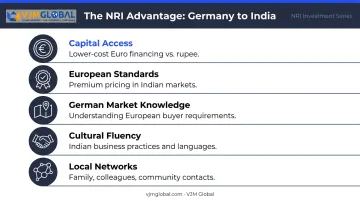
Germany-based NRIs bring something foreign investors can't replicate:
- Capital access in Euros, often at lower cost than rupee financing
- European quality standards that command premium pricing in Indian markets
- German market knowledge — knowing what European buyers actually want from Indian suppliers
- Cultural fluency in Indian business practices, languages, and regulatory norms
- Existing local networks — family, former colleagues, community contacts who can help with operations
That combination positions you to connect Indian suppliers with European buyers — and to do it with credibility on both sides.
Top Profitable Small Business Ideas in India for 2026
The right business idea depends on three variables: how much capital you have, how hands-on you can be from Germany, and what sector you already know. Ideas below are grouped by category — pick the fit, not just the trend.
Tech, IT Services, and Digital Businesses
IT outsourcing and software development studios are among the most capital-efficient businesses an NRI can run from Germany. India's tech talent pool is large, English-proficient, and significantly cheaper than German equivalents.
A small development team in Pune or Bengaluru can deliver European-standard work at a fraction of the cost, with margins that make the model very attractive even at modest scale.
High-potential options in this category:
- Software development studios serving German or European SME clients
- Digital marketing agencies targeting Indian businesses wanting European market access
- EdTech platforms focused on German language coaching, abroad education consulting, or European curriculum preparation — demand among Indian students is growing steadily
- IT outsourcing — back-office operations, data processing, customer support
The remote management angle is also the most workable here. A time zone difference of 3.5 to 4.5 hours (depending on IST vs. CET) means meaningful overlap during morning hours, and project-based work doesn't require constant real-time coordination.
Export-Import and Trading Business
India's export machine is substantial. Total merchandise and services exports in FY2025-26 reached US$860.09 billion, and the EU is one of India's largest trading partners.
For Germany-based NRIs, the model is straightforward: set up a trading company in India to handle sourcing, quality control, and export documentation; use your physical presence in Germany to manage client relationships and distribution. You're solving the biggest problem most Indian exporters face — reliable European buyer access.
Categories with established EU demand:
- Textiles and apparel
- Organic chemicals and pharmaceuticals
- Electrical machinery and equipment
- Handicrafts and home furnishings
- Spices, superfoods, and specialty food items
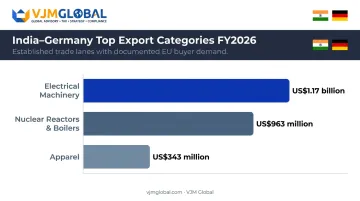
India-Germany trade data shows electrical machinery (US$1.17 billion), nuclear reactors and boilers (US$963 million), and apparel (US$343 million) as top export categories in FY26 partial data. These are established trade lanes with real buyer demand, not speculative bets.
Real Estate and Property Management
Real estate appeals to NRIs for one obvious reason: you can invest and generate income without running day-to-day operations. FEMA guidelines permit NRIs to invest in residential and commercial property in India.
India's tier-2 city boom — Indore, Coimbatore, Kochi, Surat — is creating genuine rental yield opportunities at lower entry prices than Mumbai or Delhi.
Property-linked business models gaining traction:
- Co-working space management in tier-2 cities with a trusted local operator
- Short-term rental management through platforms like Airbnb or MakeMyTrip Homestays
- Student housing near growing university clusters
Note: Real estate brokerage has restrictions for NRIs under FEMA, but property ownership for rental income and property management businesses operate under different rules. Get proper advisory before structuring.
Food, Wellness, and Lifestyle Businesses
Germany has one of Europe's strongest markets for organic food, Ayurvedic wellness products, and natural supplements. India is one of the world's largest producers. The gap between Indian production costs and European retail prices can be substantial — provided the brand positioning and EU quality compliance are handled correctly.
Viable business models here:
- Organic spice and superfood export — sourcing from Indian farms, packaging for EU compliance, selling through German distributors or directly online
- Ayurvedic wellness centers in Indian metro cities, positioned as premium offerings
- Cloud kitchens in Indian cities, especially if you have F&B experience from your time in Germany
The dual-geography setup works in your favor: establish production and supply in India, then apply your European market knowledge to build brand credibility that commands better pricing.
Renewable Energy and Green Businesses
India has committed to 500 GW of non-fossil fuel electricity capacity by 2030, and progress is real — MNRE reported 282,745 MW of cumulative installed renewable capacity as of May 31, 2026, including 157,046 MW of solar and 56,807 MW of wind.
The government is actively funding this buildout. The PM e-DRIVE scheme allocates ₹2,000 crore for public EV charging infrastructure, and there were already 29,277 operational public charging stations as of May 2025. EV annual sales are projected to reach 17 million by 2030.
NRI-appropriate entry points:
- Solar installation and maintenance services for commercial and industrial clients
- EV charging infrastructure — site acquisition, installation, and operations partnerships
- Energy efficiency consulting for Indian manufacturers seeking European export certification
Germany's leadership in renewable technology gives NRIs credible sourcing relationships for equipment and technical knowledge that many Indian competitors lack — a genuine edge in a market that's moving fast.
How NRIs in Germany Can Register a Business in India
Choosing the Right Entity Structure
| Structure | Best For | FDI Treatment |
|---|---|---|
| Private Limited Company | Scalable businesses, investor-ready structures, most NRI use cases | FDI permitted subject to sectoral caps |
| LLP | Professional services, smaller partnerships | Permitted only where 100% FDI allowed under Automatic Route with no performance conditions |
| Sole Proprietorship | Very small, India-only income; repatriation is restricted | Investment on non-repatriation basis only |
For most Germany-based NRIs wanting a scalable, investor-ready structure with clear repatriation rights, a Private Limited Company is the right choice. There is no mandatory minimum paid-up capital under the Companies Act 2013 (post-2015 amendment), so you can start with whatever operational capital your business requires.
The Registration Process
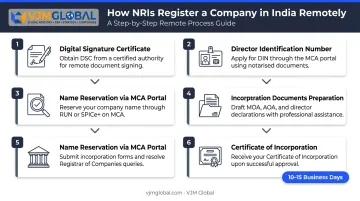
VJM Global manages the full incorporation process remotely for NRI clients. The six core steps:
- Digital Signature Certificate (DSC) — required for all directors to file MCA e-forms; valid 1–2 years
- Director Identification Number (DIN) — lifetime unique number from the Ministry of Corporate Affairs
- Name reservation via MCA portal — name cannot resemble existing companies or contain prohibited terms; must end in "Private Limited"
- Preparation of incorporation documents — Memorandum of Association, Articles of Association, director affidavits and declarations
- ROC filing and query resolution — VJM Global handles any Registrar of Companies queries during review
- Certificate of Incorporation — issued digitally by ROC via email; no physical presence required
Important structural note: Indian law requires at least one resident director (present in India for 120+ days in the preceding financial year). If you're the sole proposed director, a resident co-director must be identified before filing. VJM Global provides nominee director services specifically for this requirement.
For NRI clients based in Germany, document notarization is required — your passport must be notarized by the relevant German authority or attested by the Indian Embassy in Germany. German-language documents require notarized English translations. These can all be arranged remotely.
FEMA Compliance and Account Structure
Most small business sectors fall under the Automatic Route — NRIs can invest without prior RBI or government approval. Sectors with restrictions or caps (real estate business, print media, certain agricultural activities) require additional due diligence.
Once your route is confirmed, your account structure becomes the next critical decision.
NRE vs. NRO accounts — the practical difference:
- NRE (Non-Resident External): Funds are freely repatriable to Germany; used for bringing money into India and maintaining foreign-earned income
- NRO (Non-Resident Ordinary): Used for India-sourced income (rent, dividends, business income earned in India); repatriation capped at US$1 million per financial year subject to conditions
Open both accounts before your business starts generating income in India — each serves a distinct purpose and you'll need both running from day one.
Determining the correct investment route, handling RBI permission filings where required, and structuring capital flows correctly from the start involves layers of FEMA regulation that vary by sector. VJM Global's FEMA consultants work directly with Germany-based NRIs to navigate these requirements and avoid compliance gaps that are far more costly to fix after the fact.
Tax and Financial Considerations for NRI-Owned Businesses in India
Corporate Tax Rates
For a Private Limited Company registered in India, the applicable tax rates for AY 2026-27 are:
| Regime | Rate | Applicability |
|---|---|---|
| Standard (turnover ≤ ₹400 crore) | 25% | Default for most small businesses |
| Standard (turnover > ₹400 crore) | 30% | Larger companies |
| Section 115BAA (optional) | 22% | Any domestic company opting in |
| Section 115BAB (optional) | 15% | New manufacturing companies only |
Surcharges and a 4% Health and Education Cess apply on top. For most NRI-owned small businesses, the 22% rate under Section 115BAA is worth evaluating with your tax advisor.
GST Registration
GST registration is mandatory once annual turnover crosses:
- ₹40 lakh for businesses exclusively supplying goods (₹20 lakh in specified states)
- ₹20 lakh for service providers or mixed suppliers (₹10 lakh in specified states)
NRIs managing businesses from Germany need a GST-compliant local representative or accountant to handle monthly GSTR-3B filings and annual GSTR-9 returns. Missing return deadlines triggers penalties starting at ₹50 per day per return, so consistent local support is essential.
Profit Repatriation and the India-Germany DTAA
Business profits can be transferred from India to Germany through your NRE account after paying applicable Indian taxes. The key is structuring the arrangement correctly from the start.
The India-Germany Double Taxation Avoidance Agreement (DTAA) prevents your income from being taxed in both countries. Under Article 7, business profits are taxed where the company is resident (India), unless a permanent establishment exists in Germany — in which case only profits attributable to that PE are taxed there. Dividend payments face a maximum 10% withholding tax at source under Article 10.

To claim treaty benefits, you must provide a Tax Residency Certificate (TRC), applied for in Form 10FA with German tax authorities. VJM Global assists with TRC applications and full DTAA structuring for the India-Germany treaty.
Annual Compliance Obligations
Running a Private Limited Company in India means ongoing compliance your business must stay on top of:
- ROC filings: Annual return under Section 92 and financial statement filing under Section 137
- GST returns: Monthly GSTR-3B and annual GSTR-9
- TDS compliance: Deduction and filing obligations on payments to employees, contractors, and vendors
- Income tax return: Corporate return filed annually
- Statutory audit: Required above certain thresholds
VJM Global provides ongoing accounting outsourcing and compliance services for NRI-owned businesses, covering all of the above — essentially functioning as your finance and compliance team in India while you manage the business from Germany.
Key Challenges NRIs in Germany Face When Starting a Business in India
Operational and Management Challenges
Running a business remotely across a 3.5-4.5 hour time zone gap is manageable but requires deliberate planning:
- Hire a strong local manager early — this is the single most important operational decision
- Use technology for oversight — cloud accounting, real-time dashboards, and video check-ins reduce information gaps
- Fraud and mismanagement risk is real when the owner is absent; structure oversight mechanisms before they're needed, not after
- Government portal navigation — India's MCA, GST, and Income Tax portals can be bureaucratically complex; this is where professional advisory earns its fee
Keeping Up with Regulatory Changes
India's regulatory environment moves fast. As an NRI based in Germany, you won't naturally track changes across:
- GST amendments and rate revisions
- FDI policy updates affecting your sector
- Labor law revisions at central and state levels
Missing a compliance change isn't just a fine risk — it can create structural problems with your company's registration status. Professional advisory support is what keeps your India entity compliant while you're operating remotely.
Market Knowledge Gaps
Many NRIs have been abroad for 5-10+ years. India's consumer market in 2026 looks quite different from what you remember. Tier-2 city preferences, digital payment behavior, competitive dynamics in your target sector — these need current research, not assumptions based on your last visit.
Before committing capital, invest in:
- Current market research through Indian research firms or industry bodies
- A local distribution or operations partner who knows the actual customer
- Sector-specific validation — speak to people already in the business you're considering
Frequently Asked Questions
Can an Indian start a business in Germany?
Yes. Indians can apply for a self-employment residence permit (Aufenthaltserlaubnis) in Germany, available to both freelancers and company founders. The permit requires demonstrating economic interest, positive economic impact, and secured financing. Applicants over 45 must also show adequate old-age provision.
Can NRIs from Germany invest in a business in India?
NRIs can invest in most sectors under the Automatic Route without prior RBI or government approval, subject to FEMA regulations. They can hold shareholding in Private Limited Companies and LLPs, provided the sector permits 100% FDI under applicable conditions.
Do NRIs need special permission to repatriate profits from India to Germany?
Business profits can be repatriated through an NRE account after paying applicable Indian taxes. Repatriation from NRO accounts is capped at USD 1 million per financial year. The India-Germany DTAA prevents the same income from being taxed again in Germany.
Which small business sectors offer the best returns for NRIs investing in India in 2026?
IT and digital services, export-import trading, renewable energy, and food/wellness businesses lead in growth rates, government incentives, and suitability for remote oversight — making them practical choices for NRIs based in Germany.
What is the minimum capital required to start a Private Limited Company in India?
There is no mandatory minimum paid-up capital under the Companies Act 2013 following the 2015 amendment. Practical operational capital will depend on the business type — the legal structure itself imposes no floor.
How long does it take to register a company in India from Germany?
For an LLP, VJM Global typically completes incorporation in 10–15 business days. Private Limited Company timelines follow a comparable process. The entire procedure is handled remotely, with the Certificate of Incorporation issued digitally — no travel to India required.