
Introduction
Singapore investors have a structural advantage when entering India. The two countries share deep bilateral trade ties, and two key agreements make cross-border investment unusually efficient.
The India-Singapore Comprehensive Economic Cooperation Agreement (CECA) provides preferential market access, while the Double Taxation Avoidance Agreement (DTAA) eliminates the risk of being taxed twice on the same income. Together, these frameworks reduce both cost and friction for Singapore capital entering India.
The World Bank projects India's GDP growth at 6.3% for FY25-26 — the fastest among major economies. That growth runs on a consumer base of over 1 billion internet users and an affluent middle class expected to expand from 60 million to 100 million by 2027.
Government reforms have steadily expanded FDI access across key sectors, making it easier for foreign investors to enter at scale. For Singapore entrepreneurs, that combination of market size, digital infrastructure, and policy momentum is hard to find anywhere else.
This guide covers the most profitable sectors for Singapore investors in India, including:
- Technology & IT Services
- E-commerce & D2C
- EdTech
- Manufacturing under PLI Schemes
- FinTech
Each section addresses legal structures, compliance requirements, and practical market entry strategies.
Key Takeaways
- India's 6.3% GDP growth and Singapore's status as the #1 FDI source make this one of the strongest cross-border investment corridors in Asia
- Top sectors include IT Services, E-commerce, EdTech, PLI-backed Manufacturing, and FinTech: most allow 100% FDI under the automatic route
- The India-Singapore DTAA reduces withholding taxes; post-2017 LOB provisions mean Singapore entities need genuine business substance to qualify
- Private Limited Company structure offers full operational control and profit repatriation flexibility
- VJM Global supports Singapore investors through incorporation, GST registration, RBI filings, and ongoing compliance in India
Why India Is a Top Investment Destination for Singapore Entrepreneurs
India ranks among the fastest-growing major economies globally. The World Bank forecasts 6.3% GDP growth in FY25-26 and 6.6% in FY27, making it a structural growth market for the decade ahead.
The consumer base backs that trajectory. India's internet user base crossed 950 million active users in 2025, with over 1 billion broadband subscribers creating digital-first demand across sectors.
Demographic trends sharpen the case further. Goldman Sachs projects India's affluent population will grow from 60 million in 2023 to 100 million by 2027 at a 12-13% CAGR. That expansion is driving discretionary spending across technology, education, and consumer goods — precisely where Singapore investors have built operational depth.
Singapore's Established Investment Corridor
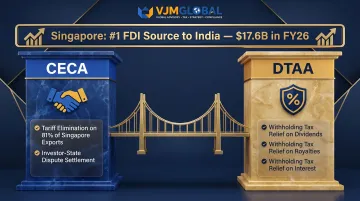
Singapore has emerged as India's largest FDI source, contributing $17.6 billion in equity inflows during Apr-Dec FY26, representing 37% of total FDI for the period. Cumulatively, Singapore ranks second with $171.92 billion (23.87% of India's total FDI since 2000), behind only Mauritius. Two bilateral agreements underpin this scale:
- CECA: Eliminates tariffs on 81% of Singapore exports to India and includes investor-state dispute settlement mechanisms
- DTAA: Provides withholding tax relief on dividends, royalties, and interest payments between the two countries
However, the DTAA landscape shifted after 2016. Capital gains on shares acquired after April 2017 are now taxed on a source basis in India, and treaty benefits require satisfaction of Limitation of Benefits (LOB) provisions—meaning Singapore entities must demonstrate genuine business operations, not shell structures. This anti-abuse framework is now standard for all treaty claims.
Government Reforms and PLI Incentives
India's FDI regime has progressively liberalized. Most sectors — including IT services, e-commerce (marketplace model), manufacturing, and EdTech — now permit 100% FDI under the automatic route, requiring no government approval.
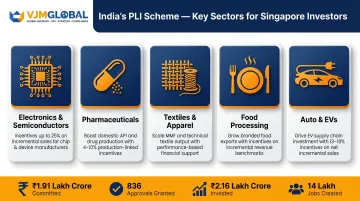
The government's Production Linked Incentive (PLI) schemes commit Rs 1.91 lakh crore across 14 strategic sectors, with cumulative investment exceeding Rs 2.16 lakh crore as of December 2025. These incentives directly benefit foreign investors in electronics, pharmaceuticals, textiles, and food processing, reducing upfront financial risk through performance-linked support.
Top Profitable Business Ideas in India for Singapore Investors
These sectors were selected based on FDI openness, growth trajectory, margin potential, scalability, and alignment with Singapore's strengths in technology, finance, and cross-border operations.
Technology & IT Services
NASSCOM reported India's tech industry reached $282 billion in revenue in FY2025, projected to exceed $300 billion in FY26. The sector is one of the world's largest software export engines.
For Singapore investors, India's talent cost advantage is the core draw: entry-to-mid-level engineers earn $8,000–$14,000 annually versus $55,000–$78,000 in Singapore—a 5–7x cost differential.
This cost arbitrage makes India ideal for building software development centers, SaaS platforms, or IT outsourcing hubs that serve global clients. Tech corridors like Bengaluru, Hyderabad, and Pune offer mature co-working infrastructure, startup ecosystems, and proximity to enterprise clients.
Key Opportunity: Singapore-based investors can establish Global Capability Centers (GCCs) or export-oriented software services companies with high margins and full operational flexibility.
| Aspect | Details |
|---|---|
| FDI Limit | 100% allowed under automatic route for IT and software companies |
| Estimated Initial Investment | ₹30–50 lakh (~$36,000–$60,000) for small-to-mid-size IT services setup |
| Key Regulatory Consideration | STPI tax exemption (Section 10A/10B) was discontinued in 2011; customs duty benefits still available for export-oriented units |

E-commerce & D2C Consumer Brands
India's e-commerce market is projected to reach $211.6 billion in 2025, growing to $326.7 billion by 2029 per IBEF data. With over 950 million active internet users and 280–300 million online shoppers, the market offers massive scale for direct-to-consumer (D2C) brands targeting urban and tier-2 consumers across lifestyle, health & wellness, fashion, and home goods categories.
Singapore investors bring global branding expertise, access to regional supply chains, and experience in omnichannel retail. India's low-cost manufacturing and logistics ecosystem enables scalable, margin-rich consumer brands.
Market Entry Models: Launch via Amazon India, Flipkart, or Meesho; build owned D2C websites via Shopify; leverage social commerce on Instagram and WhatsApp.
| Aspect | Details |
|---|---|
| FDI Limit | 100% FDI permitted for marketplace-model e-commerce; inventory-based model has restrictions per Press Note 2 (2018) |
| Key Platforms & Channels | Amazon India, Flipkart, Meesho, owned D2C sites, and social commerce via Instagram/WhatsApp |
| Key Regulatory Consideration | Press Note 2 (2018) governs e-commerce FDI; marketplace entities cannot exercise ownership or control over inventory |
EdTech & Online Learning
India's EdTech market is valued at $7.5 billion and projected to reach $29 billion by 2030 per IBEF. Structural demand drivers include a massive student population—44.6 million higher education students and 246.9 million school students—competitive exam culture, and rising demand for professional upskilling in technology, finance, and English language training.
Singapore-based investors with backgrounds in education, digital content, or SaaS platforms are well-positioned to build scalable EdTech businesses. Monetization models include subscription-based learning platforms, live tutoring marketplaces, corporate training SaaS, and vocational skills programs.
Key Insight: India's tier-2 cities alone represent a $1.8 billion EdTech opportunity, with demonstrated purchasing behavior well beyond metro markets.
| Aspect | Details |
|---|---|
| FDI Limit | 100% FDI allowed under automatic route for online education platforms |
| Target Segments | K-12 test prep, higher education, professional certifications, and corporate L&D |
| Key Competitive Moat | Proprietary content, vernacular language support, and strong teacher/tutor networks |
Manufacturing Under PLI Schemes
India's Production Linked Incentive (PLI) schemes offer ₹1.91 lakh crore in incentives across 14 strategic sectors. Covered sectors include:
- Electronics and semiconductors
- Pharmaceuticals and medical devices
- Textiles and apparel
- Food processing
- Auto components and EVs
As of December 2025, 836 applications have been approved, with cumulative investment exceeding ₹2.16 lakh crore and over 14 lakh jobs created.
Singapore investors with manufacturing backgrounds or supply chain expertise can leverage PLI benefits to establish cost-competitive production in India while accessing domestic and export markets. The electronics sector illustrates the shift: mobile phone imports have declined 77% since FY2020-21, with over 99% of domestic demand now met through local production—a direct result of PLI-driven investment.
Strategic Fit: India's manufacturing costs are among the lowest in Asia, and PLI schemes de-risk initial investment with performance-linked incentives tied to incremental sales.
| Aspect | Details |
|---|---|
| FDI Limit | 100% FDI under automatic route for most manufacturing sectors |
| PLI Benefit Structure | Incentives tied to incremental sales above a base year; structure varies by sector |
| Key Location Advantage | Special Economic Zones (SEZs) and industrial corridors offer additional tax benefits and infrastructure support |
FinTech & Digital Financial Services
India's FinTech market ranks third globally in startup funding, raising ₹7,593 crore ($889 million) in H1 2025. The Unified Payments Interface (UPI) processed 24,162 crore transactions worth ₹314 lakh crore in FY25-26—making it the world's largest real-time payment system by volume, capturing 49% of global real-time payments and 85% of India's digital payments.
Singapore investors hold a structural edge here. MAS has established cooperative frameworks with India's IFSCA, and UPI is linked internationally with PayNow—creating a ready infrastructure for cross-border FinTech plays in payments, insurtech, lending, and wealthtech.
Market Entry Models: Technology platforms (100% FDI), partnerships with Indian banks/NBFCs, or B2B financial infrastructure.
| Aspect | Details |
|---|---|
| FDI Limit | 100% FDI for technology platforms; payments and lending require RBI licensing |
| Key Sub-Sectors | Payments, digital lending (NBFC), insurtech, wealthtech, B2B financial infrastructure |
| Regulatory Body | Reserve Bank of India (RBI) for payment systems and lending; SEBI for investment-related FinTech |
Key Factors Singapore Investors Should Evaluate Before Entering India
FDI Compliance and Sector-Specific Approval Routes
Not all sectors permit 100% FDI under the automatic route—some require government approval, which adds 6-9 months to the timeline. Under the automatic route, foreign investors can invest without prior RBI or government approval. Under the government route, prior approval from the relevant ministry is mandatory.
Sectors requiring government approval include:
- Multi-brand retail trading (51% cap)
- Defence (beyond 74%)
- Banking (beyond 49% for private sector; up to 20% for public sector)
- Digital media and print media publishing news (26% cap)
- Broadcasting (49% cap)
Most sectors relevant to Singapore investors—IT services, e-commerce (marketplace model), EdTech, manufacturing, and FinTech technology platforms—allow 100% FDI under the automatic route. That said, sector classification and applicable caps should be verified before committing capital.
Legal Structure Selection
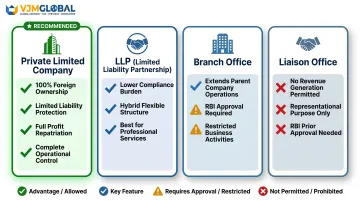
Foreign investors can enter India through four primary business structures:
1. Private Limited Company (Wholly-Owned Subsidiary)
- Most common structure for Singapore investors
- Permits 100% foreign ownership in permitted sectors
- Offers limited liability, operational flexibility, and profit repatriation rights
- Requires compliance with Companies Act 2013, annual ROC filings, and statutory audit
- Best for: Investors seeking full control, scalability, and ability to reinvest profits
2. Limited Liability Partnership (LLP)
- Hybrid structure combining partnership and corporate benefits
- Lower compliance burden than Private Limited Company
- Best for: Professional services or smaller operations
3. Branch Office
- Requires RBI approval
- Can engage in trading and services but subject to restrictions
- Best for: Extending parent company operations without separate legal entity
4. Liaison Office
- Cannot earn revenue in India
- Limited to representational and liaison activities
- Best for: Market exploration and networking
Recommendation: Private Limited Company structure is typically optimal for Singapore investors due to limited liability, ease of profit repatriation, ability to raise funding, and full operational control.
Tax Planning and DTAA Utilization
The India-Singapore DTAA covers withholding taxes on dividends (10-15%), interest (10-15%), and royalties/fees for technical services (generally 10%). Capital gains on shares acquired after April 1, 2017 are now taxable in India on a source basis.
Limitation of Benefits (LOB) Clause
The 2016 protocol amendment introduced anti-abuse provisions requiring treaty claimants to demonstrate genuine business operations in Singapore. Entities must satisfy three tests:
- Operational expenditure incurred in Singapore
- Demonstrable business presence and activities
- Economic substance — not just a registered address
Simply incorporating a shell entity in Singapore is insufficient to claim treaty benefits.
Compliance Requirements:
- Tax Residency Certificate (TRC) from IRAS (Singapore)
- Form 10F (self-declaration in India)
- Form 67 for Foreign Tax Credit claims
Recommendation: Consult a cross-border tax advisor to structure investments in compliance with LOB provisions and optimize withholding tax positions.
Operational Readiness
Non-negotiable compliance requirements include:
- GST registration: Required for all foreign entities operating in India, regardless of turnover
- PAN/TAN: Both the Permanent Account Number and Tax Deduction Account Number must be obtained before any financial transactions
- FC-GPR filing: Foreign Currency - Gross Provisional Return must be filed with RBI within 30 days of share allotment
- Companies Act 2013 compliance: Annual ROC filings, statutory audit, and board meetings
- Sector-specific licenses: FSSAI for food, RBI licensing for FinTech/NBFC, professional tax registration
Late filing penalties: FC-GPR late submission fee is ₹7,500 + 0.025% of the investment amount per year of delay, capped at 100% of investment. Non-compliance can lead to penal proceedings under FEMA Section 13.
FEMA violations and missed ROC deadlines are among the top reasons foreign investors face operational disruption in India. Engaging a market entry specialist before incorporation — not after — significantly reduces exposure to these penalties.
How to Set Up Your Business in India as a Singapore Investor
Step 1 — Pre-Entry Planning
Conduct market validation and define the business model, target customer segment, and revenue strategy. Determine the appropriate FDI route (automatic or government approval) based on sector classification. Choose the legal entity structure based on liability, taxation, and operational needs.
Key Decisions:
- Confirm sector qualifies for automatic route FDI
- Select Private Limited Company vs. LLP vs. Branch Office
- Identify location and state-level incentives
Step 2 — Entity Incorporation
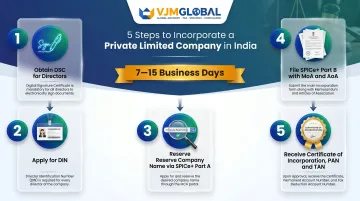
Incorporate the company with the Ministry of Corporate Affairs (MCA) via the SPICe+ (Simplified Proforma for Incorporating Company Electronically Plus) form, which integrates 10 services including name reservation, incorporation, DIN application, PAN, TAN, and optional GSTIN registration.
Typical Timeline: 7-15 business days for Private Limited Company incorporation when documents are complete.
Steps:
- Obtain Digital Signature Certificate (DSC) for directors
- Apply for Director Identification Number (DIN)
- Reserve company name via SPICe+ Part A
- File SPICe+ Part B with Memorandum of Association (MoA) and Articles of Association (AoA)
- Receive Certificate of Incorporation, PAN, and TAN from MCA
Step 3 — Post-Incorporation Compliance
Mandatory filings and registrations:
- GST registration: Required for all foreign entities making taxable supplies; no threshold exemption
- FC-GPR filing: Report foreign investment to RBI within 30 days of share allotment via RBI FIRMS portal through Authorized Dealer (AD) bank
- Bank account opening: Corporate bank account required for capital remittance
- Payroll compliance: Register for Provident Fund (PF) and Employee State Insurance (ESI) if hiring employees
- Sector-specific licenses: Complete before commencing operations
Timeline: GST registration takes 5-7 business days; bank account opening can take 2-3 weeks depending on bank processes.
Step 4 — Ongoing Compliance and Accounting
India has a complex and evolving compliance calendar that foreign investors often underestimate:
- Monthly: GST return filings (GSTR-1, GSTR-3B)
- Quarterly: TDS returns, advance tax payments
- Annual: Statutory audit, ROC annual filings, income tax return, transfer pricing documentation for intra-group transactions
- RBI reporting: Annual Activity Certificate (AAC) for branch/liaison offices; periodic foreign liabilities and assets reporting
Critical Insight: Singapore investors frequently underestimate compliance burden. Building an in-house compliance team from day one is costly and inefficient.
VJM Global addresses exactly this challenge. The firm manages the full setup and compliance lifecycle: incorporation, GST filings, RBI reporting, statutory audits, and back-office support — so Singapore companies can focus on growth while staying in full compliance with Indian regulations.
Conclusion
India offers Singapore investors a rare convergence of scale, growth, demographic opportunity, and bilateral trade facilitation. With GDP growth exceeding 6%, over 950 million internet users, and an affluent consumer class expanding to 100 million by 2027, the market presents compelling returns across Technology & IT Services, E-commerce & D2C, EdTech, Manufacturing under PLI, and FinTech.
Success depends on choosing the right sector and entering through the correct legal and FDI route. The India-Singapore CECA and DTAA provide structural advantages, but post-2017 LOB provisions require genuine business substance — not shell entities — to claim treaty benefits.
Operational readiness matters just as much as entry strategy. Full compliance across GST, FC-GPR filings, payroll, and sector-specific licenses is non-negotiable from day one.
For Singapore investors ready to establish a business in India, VJM Global provides end-to-end market entry and compliance support, including:
- Company incorporation and FDI structuring
- GST registration, FC-GPR filings, and payroll compliance
- Tax advisory under CECA/DTAA frameworks
- Accounting outsourcing and back-office management
With 30+ years of experience and a 95% client retention rate, the firm has guided 500+ American, 250+ UK, and 250+ Australian businesses through India's regulatory landscape. Contact VJM Global at [email protected] or +91 9213397070 to begin your India expansion.
Frequently Asked Questions
Frequently Asked Questions
Which business in India is most profitable?
High-margin sectors include IT/software services, FinTech, e-commerce D2C brands, and EdTech—each offering scalable models with strong unit economics. Profitability depends on execution quality, market entry timing, and how well the business model aligns with the investor's existing capabilities.
Can a Singapore company invest in India without a local Indian partner?
Yes. 100% FDI is permitted in most sectors under the automatic route, meaning Singapore investors can establish a wholly-owned subsidiary without a local partner. Regulated sectors like multi-brand retail, certain banking activities, and defence sub-sectors may require a local partner or government approval.
What is the best business structure for Singapore investors entering India?
A Private Limited Company (wholly-owned subsidiary) is typically the most suitable structure. It offers limited liability, ease of profit repatriation, ability to raise funding, and full operational control—making it well-suited for Singapore investors who need both operational control and a clear path to future fundraising.
Are there tax benefits for Singapore investors under the India-Singapore DTAA?
Yes. The DTAA reduces withholding taxes on dividends (10–15%), royalties, and interest. Post-2017 amendments introduced a Limitation of Benefits (LOB) clause, so investors must demonstrate genuine business substance in Singapore to qualify. A cross-border tax advisor can help structure treaty claims correctly.
What sectors in India allow 100% FDI under the automatic route?
IT/software, e-commerce (marketplace model), manufacturing (most sub-sectors), EdTech, and FinTech technology platforms generally allow 100% FDI under the automatic route. Sectors like multi-brand retail, print media, and certain defence sub-sectors require government approval.
How long does it take to set up a business in India as a foreign investor?
Typical Private Limited Company incorporation takes 7–15 business days via SPICe+, with additional time for GST registration, bank account opening, and RBI filings. Firms like VJM Global that specialize in India market entry can coordinate these parallel filings to shorten the overall timeline.