Introduction
Singapore entrepreneurs are moving into the UAE at a record pace. The UAE issued over 200,000 new economic licenses in 2024 alone, with Dubai recording 72,152 new business licenses in 2021—a 69% year-on-year increase—and Abu Dhabi posting 16% license growth in 2024 versus 2023.
The momentum is backed by real trade ties. Bilateral goods trade between Singapore and the UAE reached S$24 billion in 2024, and roughly 3,000 Singaporeans now live and work in the UAE. For many, it has become a strategic gateway to Gulf markets, zero corporate tax environments, and a broader Middle East footprint.
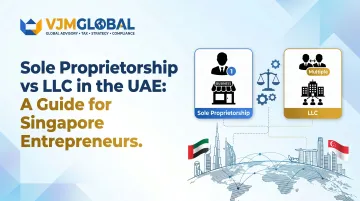
Yet before any of that happens, one structural decision shapes everything: sole proprietorship (officially a "sole establishment") or Limited Liability Company (LLC). The choice directly affects:
- Personal liability exposure
- Ownership rights and foreign control limits
- Permissible business activities
- Tax obligations
- Long-term growth potential
Generic comparison articles rarely address what this means for foreign nationals. Singaporeans face different regulatory constraints than UAE or GCC nationals—constraints that change which structure actually works in practice.
This guide addresses those gaps, offering Singapore entrepreneurs a clear roadmap to navigate UAE entity structures —covering foreign ownership rules, sponsor requirements, and the structural nuances that generic guides miss.
Key Takeaways
- Sole proprietorships offer faster, cheaper setup but restrict foreign nationals to professional/service activities only and require a Local Service Agent (LSA)
- LLCs provide limited liability protection and broader business activity options; free zone LLCs allow 100% foreign ownership without an LSA
- Sole proprietorships expose owners to unlimited personal liability for all business debts; LLCs separate personal and business assets
- LLCs carry higher setup and compliance costs but are better suited for businesses planning to hire, raise funding, or scale
- For most Singapore entrepreneurs entering the UAE, a free zone LLC offers the best balance of ownership flexibility, liability protection, and growth readiness
What is a Sole Proprietorship in the UAE?
A sole proprietorship (officially a "sole establishment" in UAE regulatory terminology) is a business owned and operated by a single individual who retains full control and profits—but also bears full personal liability for all business debts and legal obligations. There is no legal distinction between the individual and the business, meaning creditors can pursue the owner's personal assets to satisfy business debts.
For Singapore entrepreneurs, the critical restriction is this: foreign nationals can only establish a sole proprietorship for professional or service-based activities. Commercial trading, import/export, manufacturing, and industrial activities are reserved for UAE and GCC nationals. Permitted activities include consulting, IT services, design, engineering, legal services, healthcare, and similar professional offerings.
Local Service Agent (LSA) Requirement
Foreign nationals operating a mainland sole establishment must appoint a Local Service Agent (LSA)—a UAE national or 100%-UAE-owned company who acts as a government liaison. Key parameters:
- The LSA holds 0% equity and receives no profit share
- The LSA's role is purely administrative—facilitating license renewals and government interactions
- The LSA arrangement must be formalized and notarized
- The LSA has no control over company management or operations
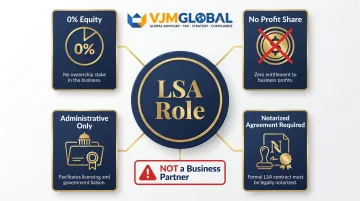
This differs fundamentally from a business sponsor or equity partner. The LSA is a regulatory requirement, not a strategic partner.
Use Cases of Sole Proprietorship for Singapore Entrepreneurs
Sole proprietorships suit solo professionals or consultants entering the UAE market with:
- A defined service offering (e.g., management consulting, IT advisory, creative services)
- Low startup capital and minimal risk exposure
- No immediate plans to raise external funding or bring in partners
- A straightforward entry path with no partners or investors
Cost and Speed Advantages
- Professional license costs start around AED 8,500 (for the license itself), with all-in first-year costs typically ranging from AED 15,000–25,000 depending on emirate, LSA arrangement fees, and office requirements
- Setup can be completed in as little as 3–5 business days
These economics work well at the solo-professional stage. The structure starts to strain once your business scales.
The critical bottleneck: If your business grows beyond personal consulting into trading, hiring staff at scale, or contracting with large corporates, the sole proprietorship becomes a constraint. Converting to an LLC means closing the entity and re-registering, not a simple upgrade. The process involves cancelling VAT registration, drafting a new Memorandum of Association (MOA), and re-establishing banking relationships from scratch.
What is an LLC in the UAE?
A Limited Liability Company (LLC) is a separate legal entity from its owner(s). The company—not the individual—is liable for business debts and obligations. Shareholders risk only the capital they have invested, protecting personal savings, property, and other assets from business-related claims.
For Singapore entrepreneurs, there are two primary LLC pathways:
1. Mainland LLC
Under Federal Decree-Law No. 32 of 2021 (building on reforms from 2020), foreign investors may now own 100% of a mainland LLC in most sectors — ending the long-standing requirement for 51% Emirati ownership. A Negative List of strategic sectors still restricts full foreign ownership, including:
- Security and defense
- Telecommunications
- Banking, exchange houses, financing, insurance
- Commercial agencies
- Hajj and Umrah services
- Fishing and marine resource extraction
For sectors outside this list, Singapore entrepreneurs can establish a mainland LLC with full ownership and no local sponsor required. If a mainland presence isn't the priority, free zones offer a parallel — and often simpler — path.
2. Free Zone LLC
Free zones have always permitted 100% foreign ownership and remain the more straightforward route for most Singapore entrepreneurs. Major free zones include:
- DMCC (Dubai Multi Commodities Centre) – Over 1,000 approved activities across 20 sectors
- DIFC (Dubai International Financial Centre) – Financial services hub
- IFZA (International Free Zone Authority) – SME-friendly zone
- RAKEZ (Ras Al Khaimah Economic Zone) – Low-cost entry point
Free zone LLCs require no LSA and offer broader activity flexibility than mainland sole proprietorships.
Essential LLC Characteristics
Minimum Share Capital:
| Jurisdiction | Minimum Capital | Notes |
|---|---|---|
| Dubai Mainland | AED 50,000 (declared) | No minimum paid-in requirement for most activities |
| DMCC Free Zone | AED 50,000 (refundable) | Depends on activity type |
| DIFC | As low as AED 1,000 | Financial services have higher requirements |
| RAKEZ | Not specified | Up to 50 shareholders permitted |
Governance and Compliance:
- LLCs require a Memorandum of Association (MOA) that must be notarized
- Annual audits are mandatory for mainland LLCs under Federal Law No. 32 of 2021
- Free zone audit requirements vary by authority; DMCC requires statutory audits (AED 2,500–15,000)
- Financial books must be preserved for at least five years
Market Credibility:
LLCs are viewed more favorably by UAE banks, institutional clients, and investors. For Singapore entrepreneurs targeting B2B contracts, regional partnerships, or future fundraising, the LLC structure opens doors that a sole proprietorship typically cannot.
Sole Proprietorship vs LLC in the UAE: Key Differences for Singapore Entrepreneurs
| Dimension | Sole Proprietorship | LLC (Mainland) | LLC (Free Zone) |
|---|---|---|---|
| Legal Liability | Unlimited personal liability | Limited to paid-up capital | Limited to paid-up capital |
| Foreign Ownership | 100% (with LSA) | 100% (most sectors) | 100% (no LSA) |
| Permitted Activities | Professional/service only | Commercial, trading, industrial, professional | Broad range (zone-dependent) |
| First-Year Setup Cost | AED 15,000–25,000 | ~AED 40,000 | AED 14,000 (RAKEZ) to AED 50,000 (DMCC) |
| Setup Timeframe | 3–5 days | 7–14 days | 1–2 weeks |
| Annual Compliance Cost | Lower (no audit) | AED 11,000–25,000+ (renewal + audit) | AED 20,000–35,000+ (zone-dependent) |
| Funding Access | Very limited | Moderate | High (investor-friendly) |
| Exit Options | Dissolution only | Share transfer (notarized SPA + MOA) | Share transfer (notarized SPA + MOA) |
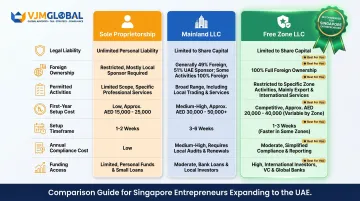
Each structure carries meaningful trade-offs across liability, cost, and long-term flexibility. Here's how they compare across the dimensions that matter most to Singapore-based entrepreneurs.
Liability and Ownership
For Singaporeans, the LLC—particularly a free zone LLC—provides full ownership without an LSA and without personal liability exposure. The sole proprietorship offers neither of these protections. If a business debt arises, sole proprietors risk personal assets; LLC shareholders do not.
Cost and Complexity Trade-off
Sole proprietorships win on initial cost and speed—lower license fees, no audit requirement, faster registration. However, LLCs justify their higher cost through:
- Personal asset protection if business debts arise
- Avoidance of costly structural conversions as the business grows
- Greater credibility with banks, corporate clients, and investors
To make the cost difference concrete, here are indicative first-year figures across common UAE entity types:
- RAKEZ Free Zone LLC: AED 14,000 all-inclusive (trade license, workstation, 1 UAE residence visa)
- DMCC Free Zone LLC: AED 35,000–50,000 (registration, license, flexi-desk, establishment card)
- DIFC LLC: USD 12,000–18,000 for license alone, plus mandatory office at USD 15,000–50,000/year
- Mainland LLC: ~AED 40,000 (registration, license, MOA notarization; office excluded)
- Mainland Sole Establishment: AED 15,000–25,000 all-in
Decision Framework for Singapore Entrepreneurs
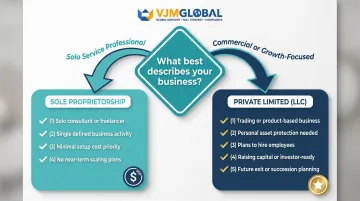
Choose a sole proprietorship if you:
- Are a solo service professional testing the UAE market
- Have a defined professional activity (consulting, IT, creative)
- Want minimal cost and administrative burden
- Do not plan to raise capital, hire a team, or scale beyond personal consulting
Choose an LLC if you:
- Plan to trade, import/export, or engage in commercial activities
- Want to protect personal assets from business liabilities
- Intend to hire employees, raise capital, or serve corporate clients
- Operate in a regulated industry requiring a more formal structure
- Anticipate growth or eventual exit through share sale
Scalability and Exit
For entrepreneurs who anticipate growth, the structural differences above translate directly into exit options. LLCs enable:
- Ownership transfer through a notarized Share Purchase Agreement (SPA) and amended MOA
- Bringing in additional shareholders to raise capital or formalize partnerships
- Structured exit through sale of shares (typical timeline: 60–70 days from transfer notice to updated license)
Sole proprietorships require complete dissolution and re-registration to change structure later—a complication that can delay growth and add unnecessary administrative burden.
VJM Global's cross-border business setup advisory team works with international entrepreneurs to assess which structure fits their specific business model, risk profile, and long-term goals before committing to a UAE entity.
Tax and Compliance: What Singapore Entrepreneurs Need to Know
UAE Corporate Tax
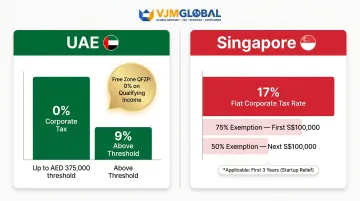
The UAE introduced a 9% corporate tax on business profits above AED 375,000, effective for financial years starting on or after 1 June 2023. Profits at or below that threshold are taxed at 0%.
Qualifying Free Zone Person (QFZP) Rules:
Free zone entities meeting all QFZP conditions benefit from a 0% corporate tax rate on Qualifying Income. Key requirements:
- Maintain adequate substance in the free zone (employees, assets, expenditure)
- Derive Qualifying Income from specified activities (manufacturing, trading, holding, HQ services, shipping, logistics)
- Ensure non-qualifying revenue does not exceed 5% of total revenue or AED 5 million, whichever is lower
- Prepare audited IFRS financial statements
- Comply with transfer pricing documentation
Failure consequence: Loss of 0% benefit for 5 years (year of failure plus next four).
Singapore Comparison:
Singapore's corporate tax rate is a flat 17% on chargeable income — nearly double the UAE's 9%. Start-up exemptions provide 75% relief on the first S$100,000 and 50% relief on the next S$100,000 for the first three consecutive years of assessment, narrowing the gap for early-stage companies.
VAT Obligations
Both sole proprietorships and LLCs must register for UAE VAT (5%) once annual turnover exceeds AED 375,000. Voluntary registration is available from AED 187,500, and late registration carries a AED 10,000 penalty.
Sole proprietors bear VAT obligations personally; LLCs manage VAT through the company entity. Converting from a sole establishment to an LLC requires cancelling the sole establishment's VAT registration and obtaining a new Tax Registration Number (TRN) for the LLC.
UAE-Singapore Double Taxation Agreement (DTA)
Beyond VAT, the bilateral UAE-Singapore DTA, signed 1 December 1995 and in force since 30 August 1996 (amended by 2014 Protocol and 2019 MLI), provides:
- 0% withholding on dividends and interest — taxable only in the state of the recipient
- 5% cap on royalties
- Principal Purpose Test (PPT) anti-abuse provision (introduced via MLI)
Singapore entrepreneurs repatriating profits from a UAE entity face no treaty-level withholding tax in either direction on dividends or interest. The UAE also levies no domestic withholding tax on payments to non-residents, making profit repatriation highly tax-efficient.
One practical risk to watch: the PPT anti-abuse clause can deny treaty benefits if the primary purpose of a structure is obtaining treaty advantages rather than genuine commercial activity — a key consideration when choosing between a sole establishment and an LLC.
Conclusion
The right UAE structure depends on where you are in your business journey. Sole proprietorships offer speed and low entry cost, but carry real constraints for foreign nationals: limited activity scope, full personal liability, and restricted growth options. Free zone LLCs remove most of these barriers and are better suited to Singapore entrepreneurs with medium-to-long-term UAE ambitions or plans to scale.
Key takeaway: Assess your business activity type, growth timeline, and risk tolerance before choosing. If you are a solo professional testing the market with a defined service offering, a sole proprietorship may suffice. If you plan to trade, hire, raise capital, or build a scalable business, start with an LLC to avoid costly conversions later.
VJM Global brings 30+ years of experience in cross-border business setup, tax compliance, and financial advisory for international founders navigating complex multi-jurisdiction decisions. If you're a Singapore entrepreneur evaluating UAE market entry, contact us to discuss entity selection, documentation requirements, and compliance structuring aligned with your business goals.
Frequently Asked Questions
What is a sole proprietorship in the UAE?
A sole proprietorship (officially "sole establishment") is a single-owner business structure where the individual retains full control and profit but bears unlimited personal liability for all debts. For foreign nationals like Singaporeans, it is limited to professional service activities and requires a Local Service Agent.
How much does a sole proprietorship cost in the UAE?
Entry-level sole proprietorship setups typically start from AED 15,000–25,000, including professional license fees (~AED 8,500), LSA arrangement costs, and flexi-desk or office rental. Costs vary by emirate and specific business activity.
Is it better to form an LLC or a sole proprietorship in the UAE?
Sole proprietorships suit solo professionals with a narrow activity scope and low capital needs. LLCs are the stronger choice for those who need liability protection, plan to scale, or want to attract investors — most growing businesses default to the LLC structure for this reason.
Can you have an LLC and be a sole proprietor in the UAE?
Yes, you can hold both license types for separate business activities. Each carries its own license fees, compliance requirements, and renewal costs, so the added overhead is real. In practice, most entrepreneurs pick one structure and build from there.
Can a Singapore citizen own 100% of a UAE company?
Yes. Singapore citizens (as foreign nationals) can own 100% of a UAE company through a free zone LLC without restrictions. Recent mainland reforms also allow full foreign ownership in most sectors (excluding the Negative List), making the UAE one of the most accessible markets for Singapore entrepreneurs.
Do Singapore entrepreneurs need a local sponsor to set up in the UAE?
For a mainland sole proprietorship, a Local Service Agent (LSA) is required, but the LSA holds 0% equity and no profit share. For free zone LLCs, no local sponsor is needed. Under recent mainland reforms, most sectors no longer require a UAE national sponsor for LLCs either—100% foreign ownership is now permitted.