The wrong structure can be costly. A Sole Proprietorship (called a Sole Establishment in the UAE) offers no legal separation between you and your business, leaving your global assets vulnerable to creditors. An LLC, by contrast, provides the limited liability protection Singapore entrepreneurs already know from their Pte Ltd companies at home.
This guide compares these two structures through the lens of a Singapore entrepreneur entering Dubai, covering liability, ownership rules, activity scope, tax treatment, and scalability.
Key Takeaways
- A Sole Establishment means no separate legal entity — you and the business are legally one, with unlimited personal liability
- An LLC is a separate legal entity with limited liability; 100% foreign ownership is now permitted in most sectors under UAE's 2021 reforms
- Sole Establishments are restricted to professional/service activities; LLCs can engage in commercial trading, industrial work, and more
- Both structures face UAE's 9% corporate tax on income above AED 375,000 — check how this interacts with Singapore's territorial tax rules
- For Singapore entrepreneurs used to Pte Ltd protection, an LLC offers the same liability separation in a Dubai context
LLC vs Sole Proprietorship in Dubai: Quick Comparison
| Aspect | Sole Establishment | LLC (Limited Liability Company) |
|---|---|---|
| Legal Status | No separate legal entity; owner IS the business | Separate legal personality independent of shareholders |
| Personal Liability | Unlimited — personal assets globally at risk | Limited to capital contribution only |
| Foreign Ownership | 100% with mandatory Local Service Agent (LSA) | 100% direct ownership in most sectors; no LSA required |
| Permitted Activities | Professional services only (consulting, IT, advisory) | Commercial trading, retail, industrial, professional services |
| Setup Cost Range | AED 25,000–40,000 (first year, estimated) | AED 30,000–45,000 (first year, estimated) |
| Annual Compliance | License renewal, LSA fees, corporate tax registration | License renewal, MOA maintenance, corporate tax registration |
| Tax Treatment | 9% corporate tax above AED 375,000 taxable income | 9% corporate tax above AED 375,000 taxable income |
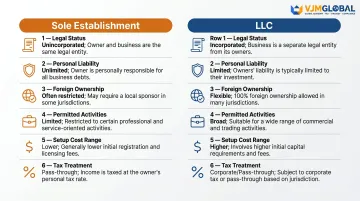
Key insight for Singapore readers: While Singapore's Pte Ltd offers similar protection to a Dubai LLC, a Sole Establishment is closer to a Singapore sole proprietorship — a structure most Singapore entrepreneurs deliberately avoid for its liability exposure.
Setup costs for a Sole Establishment run slightly lower, but that saving comes with unlimited personal liability — your Singapore-held assets included. If you're planning to trade goods, take on contracts, or scale beyond solo consulting, the LLC's broader activity scope and liability cap make it the more practical starting point.
What is a Sole Proprietorship (Sole Establishment) in Dubai?
A Sole Establishment in Dubai is a business structure where the trade licence is issued in the owner's name, with no legal separation between owner and business. When limited to professional activities, it falls outside UAE Federal Decree-Law No. 32 of 2021 (the Commercial Companies Law) and is governed instead by emirate-level trade and civil laws.
Personal liability is unlimited. All business debts, legal claims, and financial obligations fall on you personally — including assets held in Singapore or elsewhere. If your Dubai consulting business is sued or defaults on a contract, creditors can pursue your Singapore property, savings, and investments.
A Local Service Agent (LSA) is mandatory. Foreign nationals, including Singaporeans, must appoint a UAE national who assists with licensing and regulatory processes. The LSA holds no ownership stake, has no management authority, and carries no financial liability. This is a required formality, typically costing AED 8,000–20,000 per year.
Permitted activities are limited to professional services:
- Consulting (business, IT, financial, HR)
- Accounting and auditing
- Legal services
- Engineering and architecture
- Design, marketing, and translation
- Teaching and coaching
Commercial trading, retail, or industrial operations are not permitted under this structure. That constraint actually defines who this structure suits best.
Use Cases for Singapore Entrepreneurs
This structure fits a Singapore-based consultant, IT professional, freelancer, or specialist service provider who wants a low-cost entry point into the Dubai market, has minimal liability exposure, and is not planning commercial trade.
Common scenarios include:
- Testing the Dubai market before committing to an LLC
- Operating as a solo professional without employees
- Running a side venture alongside existing Singapore employment (may require a No Objection Certificate from your employer if on a UAE visa)
What is an LLC in Dubai?
An LLC in Dubai is a separate legal entity governed under UAE Federal Decree-Law No. 32 of 2021, with its own rights and obligations independent of its shareholders. Shareholders' liability is limited to their capital contribution in the company.
Since the 2021 ownership reform, Singapore nationals can own 100% of a mainland LLC in most sectors — no local Emirati partner required. Article 10 of Federal Decree-Law No. 32 of 2021 permits full foreign ownership except for seven strategic impact categories: banking, defence, telecommunications, Hajj services, and a few others.
Ownership and governance:
- Minimum 2 shareholders, maximum 50
- Profits distributed per the Memorandum of Association (MOA)
- Formal management structure required (at least one appointed manager)
- No fixed minimum share capital — must be "sufficient" for the company's purpose
LLCs can conduct commercial trading, industrial operations, retail, and professional services — covering a wider range of activities than a Sole Establishment. That structural flexibility is what makes the LLC the default choice for Singapore entrepreneurs building a serious Dubai presence.
Use Cases for Singapore Entrepreneurs
An LLC suits Singapore entrepreneurs who are:
- Entering Dubai for commercial trade or distribution
- Setting up a regional hub for the Middle East
- Planning to bring on investors or co-founders
- Operating in sectors where credibility with banks, institutions, or government bodies matters
Choose an LLC when:
- You intend to hire staff
- You need to secure financing or win tenders
- You plan to eventually exit through a share sale
- You want the liability protection that a Singapore Pte Ltd provides at home
LLC vs Sole Proprietorship: Key Differences That Matter for Singapore Entrepreneurs
Liability Protection Compared
A Sole Establishment exposes your global personal assets — including Singapore property and savings — to Dubai business creditors. An LLC ring-fences personal assets, limiting risk to the invested capital.
For entrepreneurs used to Pte Ltd protection in Singapore, the sole prop's unlimited liability is a significant departure from your default operating assumption.
Ownership Rights and Control
Both structures allow Singaporeans to retain full operational control.
- Sole Establishment: Requires appointing a Local Service Agent (no ownership, but a cost and dependency)
- LLC: Allows 100% direct foreign ownership in most sectors, with no mandatory local involvement
Business Activity Scope and Restrictions
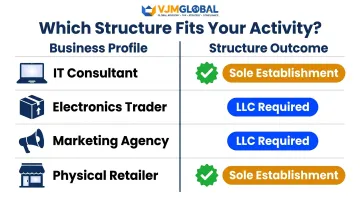
A Sole Establishment is restricted to professional services. If you want to trade goods, open a retail outlet, or operate in commercial sectors, you must choose an LLC.
- Singapore IT consultant: Can use a Sole Establishment (professional services)
- Singapore trader importing electronics: Must use an LLC (commercial trading)
- Singapore marketing agency: Can use a Sole Establishment (professional services)
- Singapore retailer opening a physical store: Must use an LLC (retail)
Tax Treatment and Singapore Cross-Border Considerations
Both structures are subject to UAE's 9% corporate tax on taxable income above AED 375,000. Entities with revenue at or below AED 3 million can elect for Small Business Relief, which treats taxable income as zero.
The Singapore cross-border angle requires separate attention. Singapore taxes income on a territorial and remittance basis — foreign-sourced income is generally taxed only when remitted to Singapore. Under IRAS guidance, the Section 13(8) exemption applies only when the foreign jurisdiction's headline corporate tax rate is at least 15%.
Watch out: UAE's 9% corporate tax rate falls below Singapore's 15% threshold. Dubai-sourced income remitted to Singapore may not automatically qualify for the exemption. Confirm your treatment under the Singapore-UAE Double Taxation Arrangement, which does provide credit relief for taxes paid in the UAE — but the interaction with Section 13(8) requires specific advice.
Scalability, Succession, and Investor Readiness
A Sole Establishment is tied to the individual owner. It cannot be sold, transferred, or passed on without closure and re-registration.
An LLC's shares are transferable, co-investors can be added, and the entity has perpetual succession. For Singapore entrepreneurs with growth ambitions or plans to bring in regional investors, the LLC's scalability is a fundamental structural advantage.
Liability Protection Compared
A Sole Establishment exposes your global personal assets — including Singapore property and savings — to Dubai business creditors. An LLC ring-fences personal assets, limiting risk to the invested capital.
For entrepreneurs used to Pte Ltd protection in Singapore, the sole prop's unlimited liability is a significant departure from your default operating assumption.
Ownership Rights and Control
Both structures allow Singaporeans to retain full operational control.
- Sole Establishment: Requires appointing a Local Service Agent (no ownership, but a cost and dependency)
- LLC: Allows 100% direct foreign ownership in most sectors, with no mandatory local involvement
Business Activity Scope and Restrictions
A Sole Establishment is restricted to professional services. If you want to trade goods, open a retail outlet, or operate in commercial sectors, you must choose an LLC.
- Singapore IT consultant: Can use a Sole Establishment (professional services)
- Singapore trader importing electronics: Must use an LLC (commercial trading)
- Singapore marketing agency: Can use a Sole Establishment (professional services)
- Singapore retailer opening a physical store: Must use an LLC (retail)
Which Structure Should Singapore Entrepreneurs Choose?
Choose a Sole Establishment if:
- You are a solo professional providing services (consulting, IT, design, advisory)
- You have minimal liability exposure
- You want the lowest-cost Dubai entry point
- You are not planning commercial trade or external investment
Choose an LLC if:
- You need liability protection
- You plan to engage in commercial activities
- You want to scale with partners or investors
- You require credibility with banks and large clients
- You foresee hiring a team
The OPC (One Person Company) Middle Ground
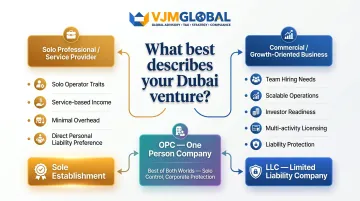
A One Person Company in Dubai allows a single shareholder to enjoy limited liability and a separate legal identity — like an LLC — without needing a second shareholder. Governed under the same Commercial Companies Law as LLCs, it carries the same activity scope and protections — making it a practical option for Singapore solo entrepreneurs who want LLC-level coverage without bringing in a co-founder.
Professional Setup Guidance
Each of these three structures — Sole Establishment, LLC, and OPC — carries distinct implications for taxation, liability, and long-term scalability. The right choice depends on your activity type, ownership plans, and how you're structured back in Singapore.
VJM Global's cross-border advisory services help foreign entrepreneurs work through Dubai's regulatory requirements, covering ownership structure decisions, international tax implications, and compliance obligations as a Singapore-based investor.
Frequently Asked Questions
Is it better to be an LLC or a sole proprietor?
It depends on your business goals. An LLC offers liability protection, broader activity scope, and scalability, making it better for most growth-oriented entrepreneurs. A sole proprietorship suits solo professionals wanting low-cost, low-complexity market entry.
Can my sole proprietorship be an LLC?
You cannot convert directly. The sole proprietorship must be closed and a new LLC incorporated separately, with new trade licences and registration.
What is sole proprietorship in the UAE?
In the UAE, a sole proprietorship is called a Sole Establishment — a single-owner business with no separate legal entity, unlimited personal liability, and restriction to professional service activities.
Can I base my LLC in Dubai but operate remotely from Singapore?
Yes. Singapore entrepreneurs can own and manage a Dubai LLC remotely. You'll need to register for UAE corporate tax, maintain a registered UAE address, and arrange appropriate visas if you plan to work in the UAE in person.
Is an establishment card mandatory in the UAE?
Yes. An establishment card (also called a company card) is issued by the immigration authority and is required for most business entities to process visas and complete government transactions, making it a standard compliance step for both LLCs and Sole Establishments.