Introduction
Dubai continues to cement its position as a global business hub. In 2024, over 43,000 new foreign member companies joined the Dubai Chamber of Commerce, with Iraq, Turkey, and the UK showing growth rates exceeding 14% year-on-year. For Singapore entrepreneurs, this momentum represents an opportunity to tap into a strategic second market that bridges Southeast Asia, the Middle East, and Africa.
The one-person LLC has become the preferred structure for solo Singapore entrepreneurs expanding to Dubai. It delivers 100% ownership and limited liability protection — without requiring a local partner in most business sectors. Under updated UAE commercial law, Singapore nationals can now hold full ownership across more than 1,000 commercial and industrial activities.
This guide covers the full picture: what a one-person LLC is, why Dubai makes sense for Singapore-based founders, eligibility and documentation requirements, the registration process, tax obligations, and pitfalls to avoid.
Key Takeaways
- A one-person LLC lets a single foreign individual own and operate a Dubai business with full limited liability protection
- Singapore nationals can hold 100% ownership in most mainland sectors following the UAE's 2021 legal reforms
- Registration takes 2–4 weeks through Dubai's Department of Economic Development, covering trade name approval through license issuance
- No statutory minimum capital is required, though adequate working capital is essential for day-to-day operations
- Corporate tax is 9% on annual profits above AED 375,000
- VAT registration becomes mandatory once annual taxable revenue exceeds AED 375,000
What Is a One-Person LLC in Dubai?
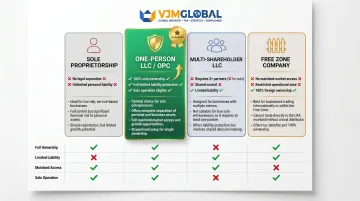
A one-person LLC (also called a One Person Company or OPC) is a legal entity with a single shareholder who enjoys limited liability. Personal assets remain legally separate from business debts, meaning the owner's risk is capped at their capital contribution.
It's designed for solo entrepreneurs — consultants, traders, service providers — who want corporate credibility and liability protection without the complexity of a multi-shareholder structure.
Article 71(2) of Federal Decree-Law No. 32 of 2021 explicitly permits this: "any single natural or legal person may incorporate and own a limited liability company," with liability limited to their share in the company's capital.
How it differs from related structures:
- Sole proprietorship: No legal separation between personal and business assets; the owner bears unlimited personal liability for all debts
- Standard multi-shareholder LLC: Requires two or more shareholders; adds decision-making complexity that makes no sense for a solo operator
- Free zone company: Restricted to operating within the designated free zone; mainland access requires a distributor or dual license
For Singapore entrepreneurs entering Dubai, the OPC is the one structure that gives you full control, capped liability, and the legal standing to operate on the mainland — without needing a local partner.
Why Singapore Entrepreneurs Are Choosing Dubai for Business Setup
Strategic Geographic Positioning
Dubai sits at the intersection of Southeast Asia, South Asia, the Middle East, and Africa. For Singapore businesses, this creates a natural second base for geographic expansion. The UAE's position as a trade and logistics gateway offers Singapore companies access to regional markets that may be harder to serve directly from Southeast Asia.
That geographic advantage translates into concrete bilateral benefits worth examining before you commit to a setup.
Bilateral Advantages and Tax Framework
Singapore-UAE ties deliver practical benefits:
- Singapore passport holders get 90-day visa-free entry to the UAE, removing the visa hurdle for in-person setup visits
- The Singapore-UAE Double Taxation Agreement (modified by the Multilateral Instrument in September 2019) prevents double taxation and provides treaty protections for cross-border income
- Under Section 13(7A)(b) of Singapore's Income Tax Act, UAE-sourced income remitted to Singapore may qualify for foreign-sourced income exemption — consult a tax advisor to confirm your specific position
- Emirates and partner carriers run approximately 105 flights per week between Changi and Dubai International, making the route as routine as any domestic commute
These treaty protections and travel links don't exist in isolation — Singapore's government has also built institutional infrastructure to support this corridor directly.
Institutional Support
The Singapore Business Federation opened a Singapore Enterprise Centre in Dubai in 2025, offering market advice and business-matching for companies exploring the UAE. On the funding side, two programs are worth noting:
- Singapore Business Federation's SEC Dubai — on-the-ground support for market entry and introductions
- Enterprise Singapore's MRA grant — covers up to 70% of eligible market-entry costs from April 2026, capped at S$100,000 per new market
Eligibility and Documents Required for Singapore Nationals
Ownership Rights for Foreign Nationals
Singapore nationals, as foreign individuals, are eligible to own 100% of a one-person LLC in most business sectors. Article 10 of Federal Decree-Law No. 32 of 2021 permits full foreign ownership across more than 1,000 commercial and industrial activities.
Restricted sectors still exist: Strategic Impact Activities including banking (foreign ownership capped at 40%), insurance, security, defence, and oil and gas exploration may require an Emirati partner or specific government approval. Verify your chosen activity with the Department of Economic Development (DED) before applying.
Local Service Agent Requirements
Some professional and commercial activities may require appointing a UAE national as a local service agent (LSA). This is a procedural role only — the LSA holds no ownership stake and receives no share of profits. Their role is to represent the company with government departments and facilitate municipal registrations. Many activities no longer require an LSA following post-2020 reforms, but confirm current requirements when selecting your business activity.
Core Documentation Checklist
Singapore nationals need to prepare:
- Valid Singapore passport copy (minimum six months remaining validity)
- Recent passport-sized photographs meeting UAE specifications
- Proof of Singapore residential address (utility bill, bank statement, or tenancy agreement)
- No Objection Certificate (NOC) if currently employed by a UAE-registered company
- Proposed trade name and brief business activity description
- Attested Memorandum of Association (MOA) once drafted
Document Attestation for Remote Applicants
Since the UAE joined the Hague Apostille Convention in 2021, documents from Singapore (a Hague Convention member) can use the simplified apostille process. Documents must also be attested by the UAE Ministry of Foreign Affairs (MOFA) and legally translated into Arabic, with translation attested by the UAE Ministry of Justice.
Singapore entrepreneurs managing portions of the process remotely may use a Power of Attorney arrangement. Dubai Courts operates a fully digital POA system integrated with UAE PASS, enabling remote signature with the same legal validity as in-person execution.
Choosing Your Business Activity Code
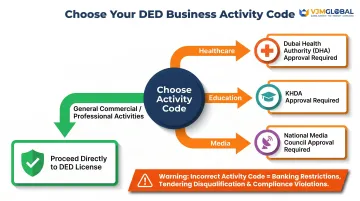
The activity code you select from the DED's approved list defines what your LLC can legally do and determines whether additional ministry approvals are needed. For example:
- Healthcare activities: Require clearance from Dubai Health Authority (DHA)
- Education services: Require approval from Knowledge and Human Development Authority (KHDA)
- Media activities: Require National Media Council approval
A generic code chosen to keep options open creates problems downstream. Sector-specific contracts, banking facilities, and government tenders all require a code that accurately reflects your actual operations — so precision at this stage matters.
Step-by-Step: How to Register a One-Person LLC in Dubai
The registration process flows through Dubai's Department of Economic Development (DED) and typically takes two to four weeks when documentation is complete. Timelines vary based on activity complexity and whether additional ministry approvals are required.
Step 1: Reserve Your Trade Name
Submit your proposed trade name to the DED via the Invest in Dubai portal. The name must comply with UAE naming rules:
- Must be unique in the registry (not already in use)
- Must end with "LLC" per Article 72 of the Commercial Companies Law
- Must match or relate to your business activity
- Cannot contain religious references, offensive language, or political terms
- Must not infringe existing trademarks
Approval can be completed online and takes 1-2 working days. If your first choice is rejected, you'll need to submit an alternative.
Step 2: Draft and Notarize the Memorandum of Association (MOA)
For a one-person company, the MOA covers:
- Sole shareholder's name, nationality, and address
- Business activity and objectives
- Share capital amount and allocation
- Management structure and decision-making authority
- Profit and loss distribution method
The MOA must be in Arabic (the DED accepts bilingual Arabic/English versions, but Arabic prevails in legal disputes). For one-person LLCs, the DED issues the MOA directly following their standard template.
Notarization options:
- In-person at a UAE-registered notary public
- Electronically via DED digital platforms (e-signature)
- Through a Power of Attorney if handling remotely from Singapore
Singapore entrepreneurs managing setup remotely can use Dubai Courts' digital POA system, which integrates with UAE PASS for secure identity verification and carries full legal weight.
Step 3: Obtain Initial Approval and Submit Documents to DED
Submit the following to the DED for initial approval:
- Trade name certificate (from Step 1)
- Notarized MOA
- Passport copy and photographs
- Proof of address
- NOC if applicable
- Sector-specific ministry approvals (if your activity requires them)
The DED reviews your application for completeness and compliance. If your chosen activity requires additional approvals (healthcare, education, media), you must obtain these before proceeding to license issuance.
Step 4: Receive Your Trade License
After fees are paid and documents verified, the DED issues your trade license. The license type is determined by your business activity:
| License Type | Best For | Typical Examples |
|---|---|---|
| Commercial | Trading goods, import/export | General trading, retail, distribution |
| Professional | Intellectual and service work | Consulting, accounting, marketing, legal services |
| Industrial | Manufacturing and production | Processing raw materials into finished goods |
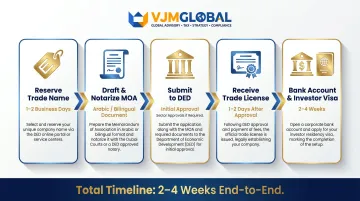
An "Instant License" fast-track option is available for immediate issuance in eligible activity categories. License issuance typically takes 1-2 working days after approval.
Step 5: Open a Corporate Bank Account and Apply for Your Investor Visa
Corporate bank account opening:
Your UAE bank account requires:
- Trade license
- Memorandum of Association
- Passport and Emirates ID (if applicable)
- Proof of business address (Ejari registration)
- Business plan or company profile
- Bank reference letter from your Singapore bank (may be requested)
- Board resolution authorizing account opening
UAE banks conduct thorough due diligence on foreign applicants, and account opening can take several weeks — so research bank options early and prepare complete documentation before submitting. Requirements tend to be stricter for non-resident applicants.
Investor (residency) visa:
With your LLC in place, you can apply for an investor visa to live and work in Dubai. You'll need your trade license, an approved tenancy contract (Ejari), and medical fitness and Emirates ID registration. Processing takes approximately 2-3 weeks after license issuance.
Financial Requirements, Banking, and Tax Obligations
Capital Requirements
Dubai imposes no statutory minimum capital requirement for one-person LLCs. Article 76 of Federal Decree-Law No. 32 of 2021 requires only that capital be "sufficient to achieve the purpose of its incorporation." This gives Singapore entrepreneurs flexibility to size their initial investment according to actual business needs.
Practical capital planning should account for:
- Setup costs: trade license fees, MOA notarization, registration charges
- Physical office requirement: mandatory Ejari-registered premises (flexi-desk or dedicated space)
- Operating expenses: minimum 3-6 months of working capital for salaries, utilities, and overhead
- Bank account maintenance: minimum balance requirements vary by bank
Physical Office Requirement
A physical office with an Ejari-registered tenancy contract is mandatory for mainland license registration. Virtual offices are not accepted. Office options include:
- Dedicated office space
- Flexi-desk in a business centre
- Co-working space with Ejari registration
The office must be registered with Dubai's Real Estate Regulatory Agency (RERA) before license issuance.
VAT Obligations
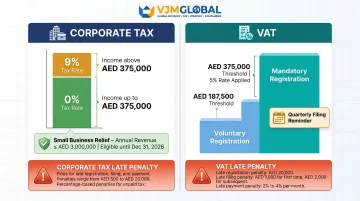
The UAE charges VAT at 5% on applicable goods and services. Mandatory VAT registration applies when annual taxable supplies exceed AED 375,000 over the past 12 months, or are expected to exceed that threshold within the next 30 days. Businesses with revenue between AED 187,500 and AED 375,000 can register voluntarily.
Key points:
- Registration threshold does not apply to foreign businesses operating in the UAE (mandatory registration regardless of turnover)
- Quarterly VAT return filing applies once registered
- Late filing penalties: AED 1,000 for first offence; AED 2,000 for repeat non-compliance within 24 months
Corporate Tax
The UAE introduced federal corporate tax effective June 1, 2023. Rates are:
- 0% on taxable income up to AED 375,000
- 9% on taxable income above AED 375,000
Small Business Relief: Available for businesses with revenue equal to or less than AED 3,000,000. Eligible businesses are treated as having no taxable income. This relief is available for tax periods ending on or before December 31, 2026. Once revenue exceeds AED 3,000,000 in any period, the relief is permanently lost.
Compliance requirements:
- Corporate tax return filing (annual)
- Financial statements audited by a licensed UAE auditor
- Maintenance of proper accounting records
Late filing penalties: AED 500 per month for the first 12 months; AED 1,000 per month from the 13th month onward.
Singapore Tax Considerations
Singapore operates a territorial tax system. Under Section 13(7A)(b) of the Income Tax Act, foreign-sourced income remitted to Singapore is exempt from tax if it meets the beneficial tax exemption condition:
- The foreign jurisdiction has a headline tax rate of at least 15%, or
- The income was already subject to tax in that jurisdiction
UAE-sourced income from your Dubai LLC may qualify for this exemption depending on how income is structured and remitted. Your eligibility will turn on individual tax residency status, the nature of the income, and remittance patterns.
Cross-border tax positions between Singapore and the UAE require careful structuring. VJM Global's international tax team advises on compliance across both jurisdictions — from income classification to remittance planning — so your Dubai LLC operates without unexpected tax exposure back home.
Common Mistakes Singapore Entrepreneurs Make When Setting Up a Dubai LLC
Choosing the Wrong Business Activity Code
Many entrepreneurs select a generic activity code to keep options open, believing it provides flexibility. This creates problems when:
- Applying for sector-specific contracts or government tenders
- Opening corporate bank accounts (banks verify activity alignment)
- Seeking additional licenses or approvals later
- Facing regulatory audits or compliance reviews
The activity code must accurately reflect your company's actual operations. If your business evolves, you can apply to add or modify activities, but starting with the correct code prevents delays and compliance issues.
Underestimating Bank Account Opening Timelines
UAE banks conduct thorough due diligence on foreign applicants, and account opening can take several weeks — sometimes longer than license issuance itself. Applicants who fail to prepare complete documentation face significant delays.
Common documentation gaps:
- Missing or outdated bank reference letters
- Incomplete business plan or company profile
- Unclear source of funds documentation
- Insufficient proof of business address (Ejari)
Research bank options early — some specialize in foreign-owned businesses with streamlined processes, while others impose stricter requirements. Prepare all documentation in advance and build 4-6 weeks into your timeline for account opening.
Ignoring Post-Setup Compliance Obligations
Once the license is issued and the bank account is open, a new set of deadlines begins. First-time LLC owners often focus entirely on setup and miss recurring obligations — and Dubai's compliance regime is strict, with penalties that accumulate quickly.
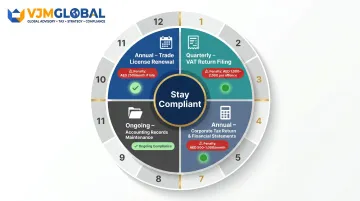
Ongoing requirements:
- Annual trade license renewal (before expiry)
- VAT return filing (quarterly, if registered)
- Corporate tax registration and annual returns
- Audited financial statements (prepared by licensed UAE auditor)
- Accounting records maintained according to UAE standards
Penalties for non-compliance add up fast. Late corporate tax filing carries fines of AED 500–1,000 per month; late VAT returns can cost AED 1,000–2,000 per offence; operating outside your licensed activity risks suspension or cancellation outright.
Set up compliance calendars before your first filing deadline. VJM Global works with foreign-owned entities on UAE corporate tax registration, VAT filings, and annual license renewals — handling the compliance workload so you can focus on running the business.
Frequently Asked Questions
What is a One Person Company (OPC) LLC in the UAE?
An OPC LLC is a legal entity that allows a single individual to act as the sole shareholder with limited personal liability. It combines the operational simplicity of sole proprietorship with the legal protections of a limited liability company, making it ideal for solo entrepreneurs.
Can a Singapore citizen own 100% of a one-person LLC in Dubai?
Yes. Singapore nationals can hold 100% ownership in most mainland sectors under the updated UAE Commercial Companies Law. Certain regulated industries (banking, insurance, strategic sectors) may have restrictions; verify your chosen activity with the DED before applying.
Do I need to be physically present in Dubai to register a one-person LLC?
Not necessarily. Authorities have expanded digital and e-signature options, and a Power of Attorney allows a local representative to act on your behalf for steps like MOA notarization. Confirm the latest remote registration capabilities directly with the DED, as these continue to evolve.
How long does it take to set up a one-person LLC in Dubai?
The process typically takes 2-4 weeks from initial name reservation to trade license issuance, provided all documents are complete and no additional ministry approvals are required. Corporate bank account opening may add another 2-4 weeks.
What are the ongoing compliance requirements for a one-person LLC in Dubai?
Annual trade license renewal, VAT return filing (if registered), corporate tax registration and returns, and maintaining accounting records audited by a licensed auditor. Missing the annual renewal deadline triggers fines starting at AED 250 per month and can result in license cancellation.
How does owning a Dubai LLC affect my tax obligations in Singapore?
Singapore's territorial tax system means UAE-sourced income may qualify for exemption if you structure your entity correctly — but individual circumstances vary. Consult a qualified international tax advisor to confirm your obligations in both jurisdictions before proceeding.
Need expert guidance on cross-border tax compliance and business structuring? VJM Global provides cross-border accounting, tax compliance, and financial advisory services for businesses operating across multiple jurisdictions. With 30+ years of experience and a team of 100+ professionals, VJM Global can support your compliance needs — including if your Dubai operations connect to India-side business activities. Contact [email protected] or call +91 9891576441 to speak with a cross-border tax advisor.