Introduction
Dubai attracts Singapore entrepreneurs for good reason: zero personal income tax, no currency controls, full profit repatriation, and direct access to markets across the Middle East, Africa, and South Asia. Its modern ports, airports, and logistics networks make it a practical hub for regional expansion.
But the first legal hurdle every founder must clear is choosing the right business license.
In Dubai, your license determines what your business can legally do, where it can operate, and how it must be structured. Choosing the wrong type leads to compliance issues, operational restrictions, or expensive amendments.
According to the Dubai Department of Economic Development (DED), operating outside your licensed scope carries penalties starting at AED 2,000 — with serious violations resulting in business closure, banking restrictions, and visa complications.
This guide breaks down the types of business licenses available in Dubai, clarifies the Mainland vs. Free Zone distinction, and provides practical guidance for Singapore entrepreneurs navigating this critical setup decision.
Key Takeaways
- Dubai issues three primary license types — Commercial, Professional, and Industrial — each tied to specific business activities
- Specialized licenses exist for tourism, education, e-commerce, and media sectors
- Singapore entrepreneurs must choose between Mainland (full UAE market access) and Free Zone (100% foreign ownership, international focus) setups — jurisdiction shapes everything
- The right license depends on your activity type, target market, and ownership structure — not on cost or popularity
- Mismatched activity codes are a leading cause of costly setup delays — confirm yours before submitting any application
What Is a Business License in Dubai?
A business license in Dubai is a legal permit issued by government authorities that authorizes a company to conduct specific commercial activities within the emirate. Unlike generic business registrations, Dubai licenses are activity-specific and jurisdiction-specific — your license explicitly defines what you can and cannot do.
Two Main Issuing Authorities:
- Department of Economic Development (DED) — Issues licenses for Mainland businesses, allowing operations anywhere in the UAE and direct access to the local market
- Free Zone Authorities — Each Free Zone (e.g., DMCC, IFZA, DIFC, Dubai Internet City) issues its own licenses, which typically restrict operations to within the zone or internationally
Every Dubai business license is tied to an approved activity list. The Ministry of Economy maintains over 2,000 approved business activities, and DED recognizes over 3,000 activity codes. You must select the specific activities your business will perform from this list when applying.
Operating outside your licensed activities is a violation — even if unintentional. Penalties start at AED 2,000 for scope violations and AED 5,000 for unlicensed activities. Additional consequences can include:
- Business closure orders
- Blacklisting from government contracts
- Banking restrictions
- Visa complications
You can search approved activities using the official DED activity search portal.
Types of Business Licenses in Dubai
Dubai does not issue a single generic "business license." The type you apply for is determined entirely by the nature of your operations. Broadly, there are three primary types, with several specialized categories for niche sectors.
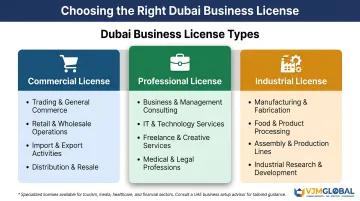
Commercial License
A commercial license covers businesses that buy, sell, or trade physical goods — whether locally or across borders. This includes retail shops, wholesale distributors, import/export companies, and general trading firms.
This license suits Singapore entrepreneurs who:
- Run product-based businesses (consumer goods, electronics, foodstuff, textiles)
- Want to use Dubai as a regional distribution hub
- Engage in commodity or real estate brokerage
Key activities covered:
- General trading (allows multiple unrelated product categories under one license)
- Retail and wholesale operations
- Import and export
- E-commerce platforms selling physical goods
- Commodity trading
Cost considerations:
- DMCC commercial license: AED 20,285 annually (license only), with total setup costs ranging from AED 35,484 to AED 43,780
- Mainland DED commercial license: AED 15,000 to AED 50,000+ depending on activities and approvals required
Additional approvals required:
Depending on your product category, you'll need sector-specific approvals:
- Dubai Municipality — Food items, consumer goods
- Dubai Health Authority (DHA) — Healthcare products, pharmaceuticals, medical devices
- Ministry of Interior — Transport-related goods, security equipment
- Food Safety Department — Foodstuff import, distribution, or retail
Professional License
A professional license applies to individuals and companies whose revenue comes from knowledge, expertise, or services — not the sale of physical goods. It's the go-to choice for consultants, agencies, and service-based startups.
This license suits Singapore entrepreneurs who:
- Operate in management consulting, IT services, marketing, legal advisory, accounting, design, healthcare, or education
- Are relocating or expanding a service business to Dubai
- Want to offer professional services without trading physical products
Key activities covered:
- Business and management consultancy
- IT and software services
- Marketing and PR agencies
- Legal and accounting services
- Medical and healthcare services
- Training and education providers
- Event management
- Engineering and technical consultancy
Many professional activities now qualify for 100% foreign ownership in both Mainland and Free Zone setups, following UAE reforms in 2021.
Cost considerations:
- License fee: AED 10,000 to AED 15,000
- Local Service Agent (LSA) fee for Mainland professional licenses: AED 5,000 to AED 10,000 annually (note: LSA has no ownership stake, unlike traditional sponsors)
Critical limitation:
A professional license does not permit the holder to trade or sell physical goods. If your business combines consultancy with product sales (e.g., an IT firm that also sells hardware), you'll need either a dual-license structure or a commercial license with professional activities added.
Industrial License
An industrial license is required when your business manufactures, processes, assembles, or physically transforms raw materials into finished products. This covers factories, processing plants, and production units.
This license suits Singapore entrepreneurs who:
- Operate in food processing, packaging, garment or textile manufacturing, chemical production, or light electronics assembly
- Want to take advantage of Dubai's industrial zones and proximity to global shipping routes
- Plan to establish manufacturing operations in the UAE
Key requirements:
Industrial license holders must:
- Operate from designated industrial zones (e.g., Dubai Industrial City, JAFZA, Dubai South)
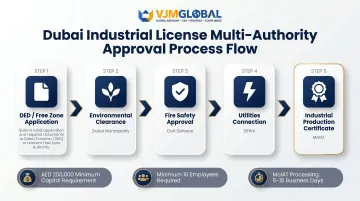
- Obtain approvals from multiple authorities: Dubai Municipality (environmental clearance), Civil Defence (fire safety), DEWA (utilities)
- Meet minimum capital requirements: AED 250,000 for the Ministry of Industry and Advanced Technology (MoIAT) industrial production certificate
- Employ a minimum of 10 employees (MoIAT requirement)
Sectors covered in Dubai Industrial City:
- Food and beverage
- Base metals and machinery
- Transport equipment
- Chemicals and mineral products
Cost and timeline:
- Setup cost: AED 20,000 to AED 50,000 in the first year (excluding machinery and facility fit-out)
- MoIAT processing time: 5 to 15 business days for federal industrial production license
Critical limitation:
Industrial setup requires significant capital investment in equipment, facilities, and compliance infrastructure. This license is not suitable for businesses that only intend to sell manufactured goods without on-ground production in Dubai.
Tourism, E-Commerce, and Specialized Licenses
Beyond the three primary types, Dubai issues specialized licenses for specific sectors. These are worth knowing — particularly if your business doesn't fit cleanly into the commercial, professional, or industrial categories.
Tourism License:
- Issued by Dubai Tourism and Commerce Marketing (DTCM) and DED
- Covers travel agencies, hotels, tour operators, and tourism-related services
- Available on both Mainland and certain Free Zones (e.g., IFZA)
E-Commerce License:
- CommerCity offers a standalone e-commerce license for online-only retail businesses
- On Mainland, e-commerce businesses typically obtain a commercial license with e-commerce activity codes
- E-Trader licenses are also available for smaller-scale online sellers
Educational Licenses:
- Issued through Dubai Knowledge Park and other education-focused Free Zones
- Covers training institutes, consultancies, HR training, and professional education providers
Media Licenses:
- Issued by Dubai Media City for content creation, broadcasting, and publishing businesses
- Processing time: approximately 7 working days
License availability varies by jurisdiction — some specialized licenses are exclusive to specific Free Zones tailored to each sector (such as Dubai Internet City for tech and Dubai Media City for media).
Mainland vs. Free Zone Licenses: What Singapore Entrepreneurs Must Know
For Singapore entrepreneurs, the choice between a Mainland and Free Zone license shapes nearly every aspect of your Dubai operation — from who owns the business to which customers you can legally serve.
Fundamental Distinction:
- Mainland license (issued by DED): Allows you to operate anywhere in the UAE and trade directly with the local UAE market
- Free Zone license: Restricts operations to within the Free Zone or internationally — to sell into the UAE mainland market, Free Zone companies typically need a local distributor or a separate mainland entity
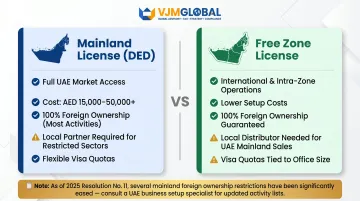
However, Resolution No. 11 of March 2025 now allows certain Free Zone companies to obtain mainland permits, easing previous restrictions.
Ownership Implications
Historically, mainland setups required a UAE national as a local sponsor holding 51% of shares. UAE reforms in 2021 opened up 100% foreign ownership for over 1,000 business activities on Mainland.
Activities that still require a local partner (UAE national ownership):
- Oil and gas exploration
- Banking (40% foreign ownership cap)
- Insurance
- Arms and military equipment
- Security services
- Hajj and Umrah services
- Domestic worker recruitment agencies
For most commercial and professional activities, 100% foreign ownership is now available on Mainland.
Free Zones take this further — 100% foreign ownership is guaranteed for every activity, with no restricted categories.
Free Zone Advantages for Singapore Entrepreneurs
- 100% foreign ownership guaranteed across all Free Zones
- No personal income tax and full profit repatriation
- Simplified setup process with faster approvals
- Sector-specific ecosystems tailored to industries
Popular Free Zones for Singapore-Based Entrepreneurs:
| Free Zone | Best For | License Types Supported |
|---|---|---|
| DMCC | Trading, commodities, gold | Service, Trading, Commercial, Industrial (1,000+ activities) |
| DIFC | Financial services | Banking, Advisory, FinTech, Innovation |
| IFZA | SMEs, cost-conscious startups | Commercial, Professional, E-commerce |
| Dubai Internet City | Tech, IT services | IT and technology licenses |
Cost and Visa Considerations
Free Zone licenses:
- Generally faster and cheaper to obtain
- DMCC setup: ~2 weeks, fully digital process
- IFZA: AED 12,900 (zero visa package) to AED 20,900 (4 visas)
Mainland licenses:
- Typically cost AED 15,000 to AED 50,000+ depending on activities
- More flexibility in headcount scaling
- Visa quotas not tied to office space size
Practical Recommendation:
For most service-based and consulting businesses, a Free Zone professional license offers the easiest and most affordable entry point. For businesses that need direct UAE market access from day one (such as retail or B2B sales to UAE companies), a Mainland commercial license is worth the additional complexity.

How to Choose the Right Dubai Business License
Three decisions drive your license choice: what activities your business will conduct, whether your customers are in the UAE mainland or international markets, and how you want to structure ownership — full foreign control or a joint venture arrangement.
Common Mistakes Singapore Entrepreneurs Make
Avoid these pitfalls:
- Choosing the cheapest option can restrict market access or operational scope in ways that cost more long-term
- Too few activity codes limits what you can legally do; too many raises compliance flags and inflates licensing fees
- Free Zones are easier to set up but won't work if your business depends on direct UAE mainland sales
Once you've identified the right license type, run through this checklist before submitting your application.
Practical Checklist Before Applying
Before submitting your application, verify:
- Your activity codes are on the approved activity list for your chosen authority
- Your activity doesn't require additional government approvals (e.g., healthcare, food, education)
- Your sector allows 100% foreign ownership on Mainland (if applicable)
- Your UAE employee visa needs match your minimum office space requirement and budget
Conclusion
Dubai offers a structured, activity-based licensing system with three primary types — Commercial, Professional, and Industrial — alongside specialized categories for tourism, e-commerce, education, and media. Each license type serves a distinct business model, and choosing the right one is foundational to legal, operational, and financial success.
For Singapore entrepreneurs, Dubai's pro-business reforms — including 100% foreign ownership in most sectors and fully digitized DED licensing portals — have reduced the friction of cross-border expansion considerably. That said, selecting the wrong license type or jurisdiction can trigger costly restructuring. Getting these decisions right before incorporation, with guidance from advisors who understand both Singapore and UAE regulatory frameworks, is far easier than correcting them afterward.
Frequently Asked Questions
What are the different types of business license in Dubai?
Dubai issues three primary license types: Commercial (for trading and selling physical goods), Professional (for knowledge-based services and consultancy), and Industrial (for manufacturing and production). Specialized licenses also exist for tourism, e-commerce, education, and media activities, each tied to specific business activities and issued by relevant authorities.
What do Category 3 and Category 4 business license categories mean in Dubai?
Category 3 and Category 4 refer to the DIFC (Dubai International Financial Centre) licensing tiers for financial services. Category 3 covers asset management and fund operations, while Category 4 covers advisory and arranging services — both with lower capital requirements (US$10,000–50,000) compared to full banking licenses. These DIFC categories don't apply to standard DED mainland licenses.
What are the 9 business sectors in Dubai?
Dubai's licensing authorities recognize nine broad sectors: trading, services, industrial, tourism, agriculture, craftsmanship, media, education, and financial services. Each sector maps to one or more license types, with distinct activity codes that determine which authority issues your license and what approvals you'll need.
Can Singapore entrepreneurs own 100% of a Dubai business?
Yes, 100% foreign ownership is available for most activities in all Free Zones, and increasingly on Mainland following the 2021 UAE FDI reforms. However, certain regulated sectors still require a local partner, including oil and gas exploration, banking (40% foreign cap), insurance, arms and military equipment, and Hajj/Umrah services.
How long does it take to get a business license in Dubai?
Free Zone licenses can be issued in as little as 7 days to 2 weeks for straightforward activities. Mainland licenses typically take 2 to 4 weeks. Industrial licenses require 1 to 3 months due to multi-authority approvals, including MoIAT processing (5–15 business days) plus environmental and safety clearances.