But "easy" doesn't mean simple for a non-EU founder. Australians face unfamiliar territory: Danish entity types, CVR registration, MitID digital signatures, work permits, and the prospect of dual tax obligations spanning two hemispheres.
This guide walks through the visa requirements, business structures, step-by-step registration process, and where to find expert support so your entry into Denmark doesn't stall on paperwork.
Key Takeaways
- Australians are non-EU/EEA nationals and generally need a residence or work permit before registering a Danish business
- The ApS (private limited company) fits most foreign-owned SMEs: limited liability and modest capital
- Register online via Virk.dk; the Danish Business Authority typically processes filings in 2–4 weeks
- Corporate tax is a flat 22%; VAT (moms) is 25% and required above DKK 50,000 turnover
- Handle Danish registration, tax IDs, and Australia–Denmark compliance in one coordinated setup
Can Australians Legally Start a Business in Denmark?
Australia isn't part of the EU or EEA, so Australian citizens are treated as third-country nationals under Danish immigration law. You can own a Danish company from Sydney or Melbourne without ever setting foot there, but ownership alone doesn't grant you the right to live and work in Denmark.
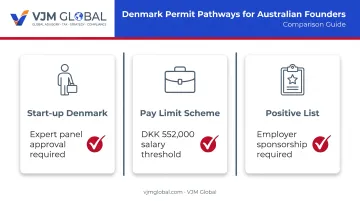
Main permit routes for Australian founders:
- Start-up Denmark visa — primary self-employment route; requires expert-panel approval from the Danish Business Authority before you apply for the residence permit
- Pay Limit Scheme — employment-based, requiring a Danish job offer with an annual salary of at least DKK 552,000 (2026 threshold)
- Positive List — also employment-based, tied to shortage occupations and a Denmark-registered employer
Start-up Denmark requires active participation in the business, not just a shareholding. Teams can include up to three founders, and the scheme caps annual permits at 75 people.
Clearing Up the "5-Year Rule"
Many founders hear about a five-year path to permanent residency and assume it applies to them. It doesn't. That rule is specific to EU/EEA citizens.
As an Australian on a standard non-EU permit, the ordinary path requires 8 years of uninterrupted legal residence, though this can shorten to 4 years if you meet all supplementary and basic eligibility requirements. Always verify current criteria directly with SIRI (Danish Immigration Service) before planning around any timeline.
If you already control an EU/EEA-registered company, or you're partnered with a Danish citizen, your path to residence may be considerably more direct.
One more practical wrinkle: you can't obtain a MitID (the digital signature required for business registration) until your residence permit is approved. Plan the sequence as permit first, MitID second, then company registration—ownership from Australia does not unlock MitID on its own.
Getting the Right Visa or Permit
Australian founders typically apply through Start-up Denmark, which grants residence permits to innovative business founders. Before you apply, gather:
- A valid passport (copies of every page, including blank ones and covers)
- A detailed business plan demonstrating economic benefit to Denmark
- Proof of funds covering your first year, plus any accompanying family
- Evidence of the paid application fee
Stated processing time is 2 months, or up to 4 months if SIRI requests more information. Initial permits run up to two years, with extensions available in three-year blocks.
Check Denmark's official New to Denmark portal and Australia's Smartraveller advisory before committing to travel or relocation plans. The standard 90-day Schengen visa-free entry is a short-stay allowance only — it doesn't substitute for a work or residence permit.
Choosing the Right Danish Business Structure
Denmark offers five common structures, each with different capital and liability implications.
| Structure | Liability | Minimum Capital | Best For |
|---|---|---|---|
| Enkeltmandsvirksomhed (Sole Proprietorship) | Personal, unlimited | None | Solo freelancers |
| ApS (Private Limited) | Limited to capital | DKK 20,000 | Most foreign-owned SMEs |
| A/S (Public Limited) | Limited to capital | DKK 400,000 | Larger ventures, formal governance |
| I/S (Partnership) | Personal, joint | None | Two-plus partners sharing risk |
| Branch of a foreign company | Parent company liable | None (parent-dependent) | Testing the market first |
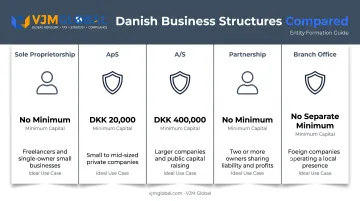
For most Australian founders, the ApS is the sensible default. It fits most foreign-owned SMEs for three practical reasons:
- Caps personal liability at the capital you subscribe
- Keeps the minimum capital at DKK 20,000
- Avoids the two-tier governance an A/S requires
A branch office works if you already run a company in Australia and want to test Danish demand without a separate legal entity. The Australian parent remains legally responsible for the branch's obligations.
Choosing the wrong structure can create liability and tax exposure that follows you home.
An Australian sole trader operating informally in Denmark, for instance, could face unlimited personal liability there and unexpected reporting obligations back in Australia. Get cross-border entity-formation advice before you file — fixing structure later costs more than choosing well at the start.
Step-by-Step: Registering Your Business in Denmark
Registration follows a fixed sequence. Complete the steps in order—several filings only open after earlier approvals are in place.
Step 1: Prepare Documents and Get Your Digital ID
Have your passport, business plan, and proof of funds ready before you apply for MitID Erhverv (the business version of Denmark's digital signature). MitID Erhverv only becomes available once your residence permit is approved.
Step 2: Register on Virk.dk and Get Your CVR Number
Virk.dk, run by the Danish Business Authority, is the online portal for company registration. For capital companies like the ApS, you'll submit formation documents, articles of association, and ownership/management details. Processing typically takes 2–4 weeks for ApS, A/S and branch filings. Plan around this timeline rather than expecting an overnight turnaround.
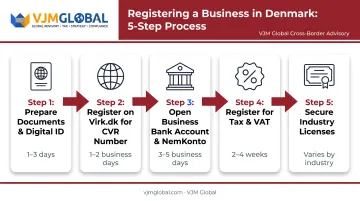
Step 3: Open a Danish Business Bank Account and NemKonto
Banks require your CVR number, identification and company documents before opening an account. This step can take several weeks due to KYC checks, so start early; don't leave it until you're ready to invoice your first client.
Every registered business also needs a NemKonto for receiving public-sector payments. A foreign bank account can be designated for this via application to the Danish Agency for Digital Government.
Step 4: Register for Tax and VAT
Register with Skattestyrelsen (the Danish Tax Agency). Key figures to know:
- Corporate tax: 22% flat rate on taxable profit
- VAT (moms): 25%, mandatory once taxable turnover exceeds DKK 50,000 in a 12-month period
- Most businesses under DKK 5 million in annual VAT-taxable revenue file every six months
Step 5: Secure Industry-Specific Licenses
Some sectors need additional approval beyond standard registration:
- Food and hygiene businesses require registration or approval from the Danish Veterinary and Food Administration (confirmation typically within four weeks)
- Financial services (credit, investment, insurance) need Danish FSA authorisation
- Healthcare professionals must appear in the national Authorisation Register
Managing Tax, Compliance, and Cross-Border Finances
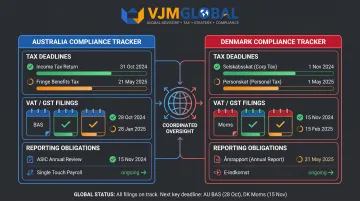
Setting up in Denmark doesn't end your obligations at home. The Australia-Denmark tax treaty, dating back to 1981, governs how business profits are taxed across both jurisdictions. Whether you have a permanent establishment in Denmark is the key factor the ATO uses when applying treaty taxation. Ongoing Danish compliance includes:
- Annual financial statements due six months after your financial year ends
- VAT filings every six months (or quarterly for larger businesses)
- Digital Post — Danish businesses are legally required to monitor and respond to official correspondence via Virk, e-Boks or mit.dk Juggling Danish MOMS (VAT) filings alongside Australian GST and BAS reporting is where many founders get tripped up. A cross-border partner such as VJM Global can cover entity formation, tax compliance and accounting for Australian businesses expanding abroad, so dual-jurisdiction reporting stays handled while you run the business.
Hiring Staff and Understanding Danish Labor Rules
Hiring Staff and Understanding Danish Labour Rules
Denmark's "flexicurity" model, as described by the OECD, balances flexible hiring and firing with strong income protection for workers who lose their jobs. In practice, this means straightforward termination procedures paired with clear ongoing employer obligations.
As an employer in Denmark, you'll need to handle:
- Written employment contracts (not optional, even for casual arrangements)
- ATP pension contributions — the employer pays two-thirds of the contribution, deducting the remaining third from the employee's salary
- Monthly payroll reporting of pay, withheld A-tax and labour market contributions through the eIndkomst system
For Australian companies not yet ready to establish a full Danish entity, an Employer of Record (EOR) arrangement offers a way to hire compliantly without incorporating locally first. Confirm Danish-market coverage with your provider before you commit—not every EOR network covers every country.
Frequently Asked Questions
Can a foreigner start a business in Denmark?
Yes. Non-EU/EEA foreigners, including Australians, typically need a work or residence permit first. Once that's secured, you can register the business online via Virk.dk.
Can I work in Denmark as an Australian?
You need a valid work and/or residence permit, since Australia sits outside the EU/EEA. Common routes include the Start-up Denmark visa for entrepreneurs or a Positive List job offer for employees.
Which business is best in Denmark?
Cleantech, life sciences, digital technology and food/biosolutions are strong sectors backed by government support and research infrastructure. The right structure and industry ultimately depend on your capital and goals.
What is the 5-year rule for foreigners in Denmark?
The five-consecutive-year rule applies to EU/EEA citizens, not Australians. Non-EU founders typically face an 8-year path to permanent residency, shortened to 4 years if all eligibility requirements are met.
What is the 48-hour rule in Denmark?
There's no official 48-hour guarantee. The Danish Business Authority currently quotes 2–4 weeks for processing ApS, A/S and branch registrations.
How can VJM Global help Australian businesses expand into Denmark?
VJM Global supports entity formation, tax compliance and accounting for cross-border expansion, with experience serving 250+ Australian businesses. Confirm Denmark-specific service scope directly with the firm before engagement.