
Introduction
Business ties between the UAE and Israel have grown steadily since the 2020 Abraham Accords, with bilateral trade reaching $3.209 billion in 2025 under the CEPA framework, according to the UAE Embassy in Israel. UAE investors are now looking past trade and into Israel's innovation economy directly.
Why now? Israel offers deep R&D talent, a startup ecosystem few countries can match, and a natural bridge to European and US markets. That pull isn't limited to tech founders—UAE trading companies, private investors, and established firms are exploring entry too.
Still, many UAE founders underestimate Israeli entity choice, banking setup, and tax compliance. This guide walks through each step—and the friction points that slow first-time entrants down.
TL;DR
- Israel permits 100% foreign ownership with no residency requirement for shareholders or directors
- Registration takes days; full operational readiness (banking, tax, payroll) takes 3-6 months
- Private limited company (Ltd / בע״מ) is the standard vehicle; branches and EOR are alternatives
- UAE-issued documents need notarization and Apostille certification before filing
- Foreign-owned entities need a local Israeli tax representative; bank approval takes extra time
What Does Starting a Business in Israel from the UAE Actually Involve?
Under Israel's Companies Law, UAE nationals, residents, and companies can register an Israeli entity without any residency requirement attached to shareholders or directors.
A single foreign individual can legally act as sole owner and sole director, according to a 2025 Israeli law-firm guide on foreign startup formation.
Common structures UAE founders consider:
- Private limited company (Ltd/בע״מ) — the standard vehicle, comparable to an LLC
- Branch of the UAE parent company — useful if you want to keep the legal entity abroad
- Employer of Record (EOR) — lets you hire and test the market in Israel without incorporating at all
One caveat: despite normalized relations, the diplomatic and regulatory landscape can shift. Confirm current recognition status and any sector-specific restrictions before committing capital or signing leases.
What to Know Before You Start
Registration paperwork is fast. Everything after it usually isn't. That's the gap that catches most UAE founders off guard.
This section isn't about whether you should enter Israel. It's about setting realistic expectations for how long it takes to become fully operational.
Key areas to plan around:
- Name reservation and incorporation documents move quickly once assembled
- Most foreign owners work with an Israeli lawyer or accountant rather than going DIY
- Budget 3-6 months before banking, VAT, and tax registrations are all complete
- Many businesses can operate remotely from the UAE at first, depending on sector and local hiring
- An EOR arrangement lets you validate demand before you incorporate and take on ongoing compliance
Why Start a Business in Israel from the UAE? (When It Makes Sense)
Entering Israel makes sense under specific conditions: you need access to specialised tech talent, you can benefit from R&D incentives, or you want a foothold connecting Middle Eastern, European, and Asian markets. It's not a guaranteed win for every business type.
The numbers behind the opportunity:
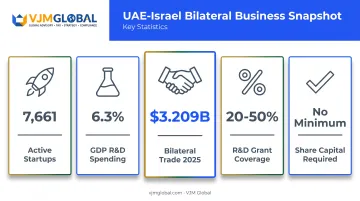
- Israel's live startup database currently tracks 7,661 active startups, per Start-Up Nation Central's Finder
- Israel's R&D spending sits at 6.3% of GDP, among the highest R&D intensities tracked by the OECD
- UAE-Israel bilateral trade hit $3.209 billion in 2025, with Q1 2026 trade already up 4.8% year over year
- Israel Innovation Authority grants can cover 20%–50% of approved R&D costs for up to 24 months under a 2025–2026 collaboration programme
- Most sectors permit 100% foreign ownership with no minimum share capital requirement
That last point matters more than it sounds. You're not tying up capital just to open the door.
Early Decisions That Matter for UAE Founders
Most friction UAE companies hit comes from underestimating how complex banking and compliance become once foreign ownership enters the picture.
Areas frequently overlooked:
- True total cost — legal fees, certified translation, and Apostille authentication of UAE documents add up beyond the government registration fee
- Realistic timeline — registration takes days; full operational readiness takes 3–6 months
- Local tax representative — foreign-owned entities generally need one appointed for compliance purposes
- Banking delays — corporate account approval needs AML/KYC review of the full foreign shareholder structure; timing varies by bank and risk profile
- Incorporate or test first — an EOR or local partner arrangement can validate demand before you commit to full incorporation
Skipping any one of these doesn't stop registration. It just delays the point where your business can actually operate.
How to Start a Business in Israel from the UAE – Step by Step
The process breaks into distinct stages. The most common mistakes: assuming a registration certificate equals an operational business, skipping the local representative appointment, and underestimating how long banking takes.
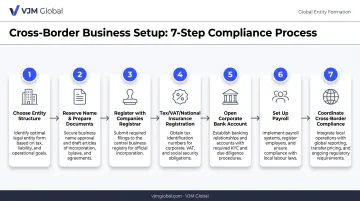
Step 1 – Choose the Right Entity Structure
Compare your three main options:
| Structure | Best for | Ownership |
|---|---|---|
| Private Ltd (Ltd/בע״מ) | Long-term Israeli operations | 100% foreign ownership permitted |
| Branch of UAE parent | Keeping the legal entity abroad | Follows parent company structure |
| EOR/market testing | Validating demand first | No entity needed |
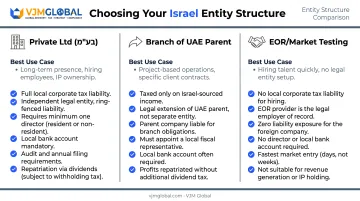
At least one director is required, and that director doesn't need to be an Israeli resident. Many founders still jump straight to full incorporation when an EOR arrangement could validate demand faster and cheaper.
Step 2 – Reserve Company Name and Prepare Documents
Reserve a unique company name with the Registrar of Companies. It stays valid for 60 days.
You'll also need:
- Articles of Association
- Form 1 registration document
- Director and shareholder declarations
UAE-issued documents typically require notarization, certified translation, and Apostille authentication before Israeli authorities will accept them. Confirm the exact legalization route for each document type before you submit anything.
Step 3 – Register with the Companies Registrar
File incorporation documents online or through a local representative. Professional guidance suggests roughly four business days after submission, though this is an indicative benchmark rather than a guaranteed government SLA.
The common miss: treating this certificate as proof the business is operational. It isn't. It's just step one.
Step 4 – Complete Tax, VAT, and National Insurance Registrations
Three separate registrations follow incorporation:
- Israel Tax Authority — corporate tax registration
- VAT registration — the standard rate rose to 18% as of January 1, 2025, per an Israeli government decision
- Bituach Leumi (National Insurance) — mandatory before hiring any staff, even a single employee
Foreign-owned businesses generally need a local Israeli tax representative appointed for compliance purposes. This isn't optional paperwork you can defer.
Step 5 – Open a Corporate Bank Account
This is typically the longest bottleneck for foreign-owned entities. Banks review:
- Incorporation and signatory identity records
- Beneficial owners and controllers
- Intended business activity
- Source of funds
- Overall risk profile

Timing depends heavily on the bank and your shareholder structure. Treat banking as a parallel workstream from day one—not a quick task you leave until after incorporation.
Step 6 – Set Up Payroll and Employment Compliance
Once you're hiring, Israeli labor law requires written notice of employment terms, generally within 30 days of a new hire's start date. This covers role, pay, hours, rest days, and benefits.
You'll manage dual reporting:
- Income Tax withholding through your deductions file
- Monthly Bituach Leumi filings (Form 102)
Plan for Hebrew-language documentation, and remember these two compliance tracks run separately—not as one combined filing.
Step 7 – Coordinate Cross-Border Compliance from the UAE
Israeli filings don't replace whatever reporting obligations your UAE parent company retains. Corporate tax, VAT registrations, and Bituach Leumi filings in Israel need to run alongside your existing UAE compliance calendar, not as an afterthought.
VJM Global supports companies of any origin entering a new market using that market's own regulators, tax instruments, and entity rules. For UAE founders running two systems at once, that means one team tracking the Israel and UAE calendars together—so Israeli setup does not push UAE filings into arrears.
Conclusion
Starting a business in Israel from the UAE is achievable. There's no residency barrier standing in your way, and foreign ownership is welcomed in most sectors. The real constraint is the timeline: registration takes days, but full operational readiness takes 3-6 months.
Success comes down to a few early decisions:
- Which entity structure fits your goals
- Whether you appoint the right local representation
- How early you start banking relative to incorporation
Treat tax, banking, and compliance as parallel workstreams from day one, not sequential boxes to tick after the certificate arrives. Map those workstreams before you file, and you avoid the delays that stall most cross-border setups.
Frequently Asked Questions
How much does it cost to register a company in Israel?
The government charges a filing fee for incorporation, but total setup costs run higher once you add legal fees, certified translation, and Apostille authentication for UAE documents. Budget beyond the base registration fee.
Is there an LLC in Israel?
Israel's closest equivalent is the private limited company, known as Ltd or בע״מ. There's no minimum share capital requirement, making it accessible for foreign founders.
Does the UAE accept Israel as a country?
Yes. The 2020 Abraham Accords normalised diplomatic and trade relations between the UAE and Israel, and the relationship now operates under the CEPA trade framework.
What is Israel's biggest money maker?
Technology and R&D. High-tech output represented 18.3% of GDP in 2025 and contributed roughly half of the country's economic growth, according to the Israel Innovation Authority.
How long does it take to register a company in Israel from abroad?
Registration itself can take under two weeks. Becoming fully operational, including banking and tax registrations, realistically takes 3-6 months.
Do UAE companies need a local representative in Israel?
Generally, yes. Foreign-owned businesses typically must appoint an Israeli tax representative to handle compliance filings and act as a point of contact with local authorities.