Entrepreneurs no longer need to weigh foreign incorporation risk against tax savings. Since Puerto Rico is a US territory, mainland founders can register a business there without visas, foreign entity status, or a separate immigration process.
Interest is coming from several directions: remote-first founders chasing Act 60 savings, export-services companies, manufacturing operations looking at Caribbean cost bases, and investors optimizing personal tax residency. This guide walks through the entire process step by step, from choosing an entity type to staying compliant year over year.
TL;DR
- Puerto Rico is a US territory, so mainland citizens face no immigration barriers or foreign entity status
- LLCs and Corporations are the most common structures, registered through the Puerto Rico Department of State
- Act 60 offers a 4% income-tax rate for qualifying export businesses, but residency and activity conditions apply
- Registration runs through the Department of State, IRS, SURI, and municipal licensing in sequence
- Dual US federal and Puerto Rico local rules mean multi-agency compliance from day one
What Does It Mean to Start a Business in Puerto Rico from the USA?
Starting a business in Puerto Rico means forming a legal entity recognized under both US federal law and Puerto Rico's own local statutes. It isn't like filing in a new US state.
Puerto Rico runs its own registration and tax infrastructure:
- Department of State — handles entity formation (the Registry of Corporations and Legal Entities)
- SURI (Sistema Unificado de Rentas Internas) — Puerto Rico's Treasury tax platform, separate from the IRS
- Municipal governments — issue local operating licenses independently of the island-wide system
Common structures include:
- Corporation — filed as a for-profit corporation with the Department of State
- LLC — filed as a Certificate of Organization (taxed as a corporation by default in Puerto Rico)
- Sole Proprietorship — unincorporated business with no Department of State filing; municipal licenses and tax registration still apply
Decide early whether the business will run fully remotely from the mainland or needs actual Puerto Rico residency. That choice affects Act 60 eligibility later.
What to Know Before You Start a Business in Puerto Rico
Many mainland entrepreneurs underestimate how layered this process is. Before you file anything, get clear on the constraints below so your timeline and tax assumptions stay realistic.
Key things to understand upfront:
- Bona fide residency isn't automatic. Act 60 personal tax benefits require IRS Publication 570's presence, tax-home, and closer-connection tests. One path is 549 days in Puerto Rico over three years, with at least 60 days each year
- Multiple agencies, multiple filings. Expect to deal with the Department of State, SURI, the IRS, and your municipality, each with separate forms and requirements
- Timing varies by stage. No single agency publishes an end-to-end timeline, but registration, EIN issuance, SURI onboarding, and municipal licensing typically stack up over several weeks
- Export vs. local sales matters. Only export-oriented service or goods businesses qualify for the 4% Act 60 rate; purely local Puerto Rico sales don't
- Entity formation ≠ operating business. Forming an LLC for banking or tax optimization is a different exercise than building an active, staffed operation on the island
Why Start a Business in Puerto Rico? (When It Makes Sense)
Puerto Rico makes sense for certain business models, not every one. Here's what tips the scale:
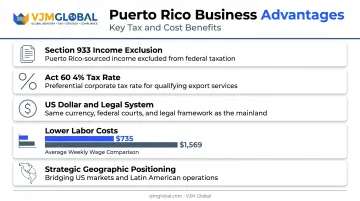
- Section 933 income exclusion: Bona fide residents can exclude Puerto Rico-source income from the US federal return, subject to strict residency tests
- Act 60 export incentive: 4% tax on qualifying export services or goods income, plus 75% property-tax and 100% dividend exemptions under the current decree
- US dollar, US legal system: No currency conversion risk, no foreign court system, simpler banking relationships than a fully offshore jurisdiction
- Lower labor costs: Puerto Rico's average weekly wage was $735 in Q4 2025, compared to $1,569 nationally — a meaningful gap for labor-intensive operations
- Geographic positioning: Bridges US and Latin American markets, with existing manufacturing and tech infrastructure already in place
None of this applies automatically. The 4% rate requires a decree application and ongoing compliance — it's not Puerto Rico's default corporate tax rate.
Early Decisions That Matter When Starting a Business in Puerto Rico
Most early missteps come from underestimating the compliance layers. A few areas trip up mainland founders repeatedly:
- Budget past formation day: a for-profit corporation filing runs $150, an LLC Certificate of Organization $250, and annual fees of $150 are due by April 15.
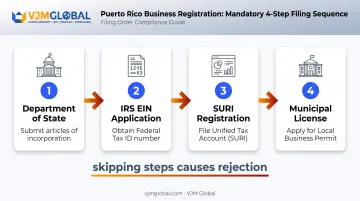
- File in order—Department of State → EIN → SURI → municipal license. Skipping ahead triggers rejections.
- Treat Act 60 as conditional. Only specific export activities qualify; incorporation alone does not unlock the incentive.
- Plan for dual compliance: a federal EIN plus a separate Puerto Rico Treasury registration.
- Lock in local relationships early. A resident agent and a working local bank relationship are practically required before you operate.
How to Start a Business in Puerto Rico – Step by Step
These are the practical stages a mainland founder actually walks through. Common mistakes include filing out of sequence, assuming Act 60 applies automatically, and underestimating bank KYC timelines.
Step 1 – Choose Your Business Structure and Verify Fit
Compare your options:
| Structure | Liability | Default Tax Treatment |
|---|---|---|
| LLC | Limited | Taxed as a corporation unless pass-through election filed |
| Corporation | Limited | Corporate tax rates apply |
| Sole Proprietorship | Unlimited | Personal tax filing, no separate entity |
Common miss: Assuming a Puerto Rico LLC gets automatic pass-through treatment like a mainland LLC. It doesn't, unless you file the election.
Step 2 – Reserve Your Business Name and Appoint a Registered Agent
Search the Department of State's Registry of Corporations for name availability, then reserve it — $10 for a corporation, $75 for an LLC, valid up to 120 days.
Your registered agent must have a physical Puerto Rico address. A mainland US address or agent doesn't satisfy this requirement, and it's one of the most common filing rejections for out-of-state founders.
Step 3 – File Formation Paperwork with the Department of State
File your Certificate of Formation (LLC) or Articles of Incorporation (Corporation), including the entity name, purpose, designated Puerto Rico office, and resident agent details.
Follow this order strictly: Department of State → IRS (EIN) → SURI → Municipality. Filing out of sequence is one of the most frequent causes of processing delays.
Step 4 – Obtain Your EIN and Register with SURI
Apply for your federal EIN directly through IRS.gov — it's free, and approved online applications receive the EIN immediately.
Then register as a new merchant through SURI to get your Merchant's Registration Certificate. This has been mandatory since 2016 for anyone starting a business in Puerto Rico.
Common miss: Trying to register with SURI before the EIN is issued. SURI registration depends on having that number in hand.
Step 5 – Secure Municipal Licenses and Permits
You'll need:
- The Permiso Unico (Single Permit), which consolidates use, health, fire-prevention, and environmental-compliance authorizations
- The Patente Municipal, registered with your specific municipality
Common miss: Missing the registration window after operations begin. In Arroyo, for example, businesses must register within 30 days of starting operations, with a provisional license fee around $25 for the first semester. Fees and windows vary by municipality, so check locally.

Step 6 – Open a Business Bank Account and Set Up Payroll
Local Puerto Rico banks apply thorough, document-heavy KYC processes. Build in extra time compared to a typical mainland account opening.
If you're hiring, register payroll with the Puerto Rico Department of Labor separately from your federal payroll obligations.
Common miss: Assuming mainland account-opening speed applies here. It usually doesn't.
Step 7 – Understand and Apply for Act 60 Tax Incentives (If Eligible)
Confirm your business genuinely qualifies — export of services or goods to foreign clients, minimum employment conditions, and, for individuals claiming personal benefits, bona fide residency.
Applications go through DDEC's Incentives Portal, and a local CPA or advisory firm typically handles the decree application and ongoing documentation.
Common miss: Assuming incorporation alone qualifies you. It doesn't — the decree, residency, and employment conditions all matter independently.
Step 8 – Maintain Ongoing Compliance
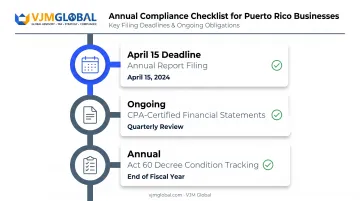
- File your annual report/statement with the Department of State by April 15
- Keep CPA-certified financial statements if revenue crosses required thresholds
- Track decree conditions annually if you hold an Act 60 incentive
VJM Global supports entity formation and multi-jurisdiction compliance for US companies expanding into Puerto Rico, so you can manage federal and local requirements without running two systems alone.
Common miss: Missing the April 15 annual filing deadline, which risks administrative dissolution of the entity.
Conclusion
Starting a business in Puerto Rico from the US mainland pairs a familiar federal framework with a distinct local compliance layer. You need both.
Getting the entity structure right, confirming real Act 60 eligibility, and following the correct filing sequence matters more than speed. After formation, stay on top of ongoing filings and revisit your tax strategy as the business grows—paperwork at launch is only the first step.
Frequently Asked Questions
How much does it cost to start an LLC in Puerto Rico?
The Certificate of Organization costs $250, with an optional name reservation at $75. LLCs also pay a $150 annual fee due by April 15.
How do I register my business in Puerto Rico?
File with the Department of State first, then get your federal EIN, register with SURI as a new merchant, and finally secure your municipal license and permits, in that order.
What is the 549-day rule for Puerto Rico?
It's one alternative under the IRS presence test for bona fide residency: spending at least 549 days in Puerto Rico across the current and two prior tax years, with a minimum of 60 days each year.
Can a US citizen start a business in Puerto Rico?
Yes. Since Puerto Rico is a US territory, citizens need no visa or passport to enter, and no foreign entity registration to start a business there.
Is Puerto Rico a good place to start a business?
It offers real tax incentives, US legal alignment, and lower labor costs, but the local market is smaller than mainland metros. It suits export-focused and remote-capable businesses best.
What is the best business to start in Puerto Rico?
Export services (consulting, software, finance) that qualify for the 4% Act 60 rate fit best, along with manufacturing-adjacent and tourism-related businesses tied to the local economy.