Dutch entrepreneurs are paying attention for good reason. Rwanda offers East African market access, a low corruption perception, a genuinely multilingual business environment, and an active push for foreign investment. The interest isn't coming from one type of founder either.
You'll find:
- Dutch SMEs looking to diversify beyond the EU
- Consultants and freelancers wanting a low-cost operating base
- Agri-tech and import-export businesses eyeing regional supply chains
- NGOs and impact-driven founders drawn to Rwanda's development sectors
This guide walks through the legal requirements, realistic costs, and step-by-step registration process specifically from a Dutch founder's perspective.
TL;DR
- Rwanda allows 100% foreign ownership with no local partner requirement for most business types
- Registration runs digitally through RDB/ORG and can complete within hours
- Passport, proof of address, and activity details suffice; sole proprietorships need no minimum capital
- VAT registration only applies above the turnover threshold
- Cross-border advisors can handle entity choice, tax, and compliance while you operate from the Netherlands
What Is It Like to Start a Business in Rwanda as a Foreigner?
In practical terms, starting a business in Rwanda as a non-citizen means registering either an Individual Enterprise (sole proprietorship) or a Private Limited Company through the Rwanda Development Board's Office of the Registrar General.
Rwanda doesn't restrict foreign ownership. A Dutch national can hold every share in a Rwandan company without bringing in a local partner, a rule that sets it apart from several neighbouring markets.
There are two common structures:
- Individual Enterprise – owner-operated, unlimited personal liability, simplest to set up
- Private Limited Company – separate legal entity, limited liability, better suited to hiring staff or raising investment
Which one fits depends entirely on what you're building, not on your passport.
What to Know Before You Start a Business in Rwanda
Many Dutch founders assume that because registration is fast, everything else moves at the same speed. It doesn't. Set realistic expectations before you file anything.
Managing From the Netherlands vs. Being on the Ground
Remote management is genuinely possible for consultancy-style or trading businesses. But sectors requiring physical presence, like agri-export or hospitality, usually need a local representative or periodic visits.
Immigration and Timing Realities
If you plan to relocate, work permits and residence authorisation run on a separate track from company registration. Rwanda's One Stop Centre handles investor visa facilitation, but expect this process to take longer than the registration itself.
The Real Timeline
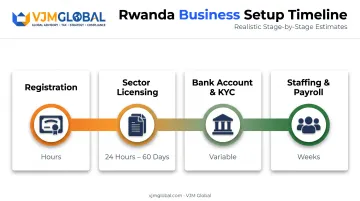
Registration might take hours. Operating fully doesn't:
- Sector licenses range from 24 hours to 60 days depending on the activity
- Bank account opening depends on KYC checks with no fixed timeline
- Staffing and payroll setup add further weeks
Those post-registration steps also shape which entity you choose. A sole proprietorship suits testing the market with minimal commitment. A limited company suits anyone planning to hire, raise capital, or scale beyond a one-person operation.
Why Start a Business in Rwanda? (When It Makes Sense for Dutch Entrepreneurs)
Rwanda fits some Dutch ventures better than others. Treat the points below as a filter before you commit capital or time.
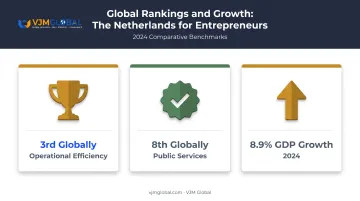
Rwanda ranked 3rd globally for Operational Efficiency and 8th for Public Services in the World Bank's 2024 B-READY report, a strong signal for anyone worried about bureaucratic drag.
Concrete reasons Dutch founders shortlist Rwanda:
- Free, fast digital registration reduces entry friction compared with many African markets
- EAC market access: one Rwandan entity can, subject to sector safeguards, reach the wider East African Community
- Growing sectors like agri-tech, ICT, tourism, and exports show genuine demand for foreign capital and expertise
- Investor-friendly incentives in select sectors and Special Economic Zones — confirm terms with RDB and the Rwanda Revenue Authority before you model returns
Rwanda's economy grew 8.9% in real GDP terms in 2024, according to the World Bank's April 2025 Rwanda Economic Update. For a market of this size, that growth rate is material.
Early Decisions That Matter When Starting a Business in Rwanda
Most early-stage problems come from underestimating compliance complexity. Get these decisions right early and you'll avoid the usual delays.
- Structure choice: Weigh liability exposure, hiring plans, and outside-capital needs before defaulting to the cheapest option.
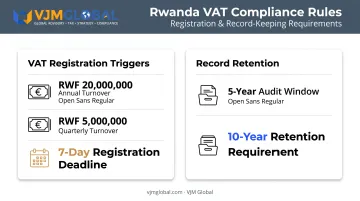
- VAT thresholds: Mandatory registration triggers at RWF 20,000,000 in annual turnover or RWF 5,000,000 in a quarter. Track this from your first invoice, not after you cross it.
- Immigration status: Physical presence, an investor visa, or a fully remote structure each carry different compliance footprints. Decide which applies before committing to a lease or a hire.
- Currency and repatriation: Confirm current foreign-exchange rules with your bank and the National Bank of Rwanda before assuming profits move freely back to the Netherlands.
- Founder dependency: Remote operation from the Netherlands often means the business leans heavily on you in the early months—plan for that bottleneck.
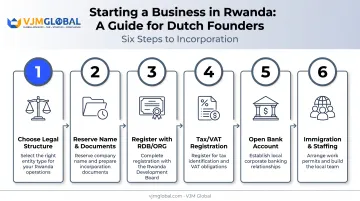
How to Start a Business in Rwanda – Step by Step
Registration itself is quick. Being ready to trade is a different milestone. The most common mistake Dutch founders make is treating the registration certificate as a finish line rather than a starting point — skipping tax registration or underestimating banking delays that follow.
Step 1 – Confirm Eligibility and Choose Your Legal Structure
Dutch nationals face no ownership restriction in Rwanda. Choose between an Individual Enterprise and a Private Limited Company.
Consider:
- Your exposure to personal liability
- Whether you'll hire staff in year one
- Long-term plans to raise investment or bring in partners
Common miss: picking a sole proprietorship for a business that will eventually need investors or limited liability protection. Switching structures later costs more time than choosing correctly upfront.
Step 2 – Prepare and Reserve Your Business Name and Documents
Reserve your business name through the RDB/ORG online portal. Gather:
- Passport
- Proof of address
- Business activity description
- Shareholder and director details (for a company)
Common miss: submitting incomplete documentation. The digital system is fast, but it isn't forgiving of gaps. Expect delays if anything is missing.
Step 3 – Register with RDB/ORG
Complete registration through the Business Procedures portal. This step is typically free and, if your application is compliant, processed within hours. You'll receive a Business Registration Certificate and a Taxpayer Identification Number.
Common miss: assuming a Netherlands-based accountant will know RDB's filing requirements. Cross-border advisory support helps here. VJM Global's entity formation team coordinates document preparation and works with local processes so founders aren't navigating an unfamiliar portal alone from Amsterdam or Rotterdam.
Step 4 – Register for Tax and Understand VAT Thresholds
Your TIN registers automatically through the integrated ORG/RRA system when you register your business. From there, monitor your turnover:
- RWF 20,000,000 over 12 months, or
- RWF 5,000,000 in a preceding quarter
Cross either threshold and you must register for VAT within 7 days.
Common miss: not budgeting for record-keeping obligations. Businesses above the turnover threshold must maintain proper accounting records, and the Rwanda Revenue Authority can audit back five years, with a ten-year retention requirement.
Step 5 – Open a Local Bank Account and Set Up Operations
You'll need your registration certificate, trading licence, and signatory documentation to open a Rwandan business account. Beyond banking, decide whether day-to-day operations run remotely from the Netherlands or need a local manager.
Common miss: underestimating how KYC checks can slow down an otherwise fast setup. Registration might take hours; the bank account can take considerably longer.
Step 6 – Plan for Immigration, Staffing, and Compliance
Determine early whether you're relocating, using a visitor visa for periodic visits, or hiring a local manager to run things day-to-day.
If you hire:
- Register the employee with RSSB within 7 working days of employment
- Set up PAYE withholding and remit within 15 days after month-end
- Confirm statutory contribution obligations before the first payroll run
Common miss: hiring before understanding Rwandan labour and social security obligations. Payroll compliance isn't optional and penalties compound quickly if ignored.
Conclusion
Starting a business in Rwanda as a Dutch national is accessible. Fast, free digital registration and full foreign ownership rights remove two of the biggest barriers founders face elsewhere in Africa.
Success still depends on getting the fundamentals right: choosing the correct legal structure, tracking VAT thresholds from day one, and planning for the gap between "registered" and "operational." That gap is where most delays actually happen.
Working with a cross-border partner such as VJM Global on entity formation and local regulatory coordination can cut that friction, especially when you are managing the process from Amsterdam rather than Kigali.
Frequently Asked Questions
How much does it cost to start a business in Rwanda as a foreigner?
Digital registration itself is typically free. Budget separately for notary fees on company documents, a registered business address, banking setup, and any advisory support you bring in.
What are the legal requirements to start a business in Rwanda as a foreigner?
You'll need a passport, proof of address, and business activity details, then register through RDB/ORG. There's no minimum capital requirement for a sole proprietorship.
Can a foreigner from the Netherlands own a business in Rwanda?
Yes. Rwanda permits 100% foreign ownership with no local partner requirement, though you'll still need to meet standard immigration and residency rules if relocating.
What types of businesses are most profitable in Rwanda?
Agri-processing and export, ICT, tourism, and trade/logistics all show strong demand. Profitability ultimately comes down to execution and how well you've researched your specific market.
How long does it take to register a business in Rwanda?
Digital registration often completes within hours to a few days. Banking setup and sector licensing typically add extra time before you're fully operational.
Do I need to live in Rwanda to run my business there?
Many founders manage remotely from the Netherlands, particularly for consultancy or trading models. A local presence becomes more important once you're hiring staff or running a business that needs hands-on management.