The financial reality of launching in Singapore spans far beyond the basic government registration fee. Foreign founders often face nominee director requirements, work pass commitments, and recurring compliance obligations that local entrepreneurs never encounter. These hidden costs can transform a seemingly affordable SGD 315 registration into a first-year budget exceeding SGD 20,000.
This guide breaks down every major cost category for 2026 — from ACRA fees to office space, staffing, and ongoing compliance — helping you build a realistic budget before signing incorporation documents.
Key Takeaways
- Government registration starts at SGD 315 (name application + incorporation)
- First-year costs for foreign-owned businesses typically range SGD 8,000–20,000+ with professional services
- Annual recurring costs — secretary, compliance, office, payroll — routinely run SGD 5,000–15,000+, often surpassing your initial setup spend
- Foreign founders pay extra: nominee director fees run SGD 1,000–5,000/year, EntrePass applications cost SGD 330, and the mandatory salary commitment is SGD 5,600/month minimum
- Startup SG Founder grants offer up to SGD 50,000 in co-matching capital — a meaningful offset for qualifying early-stage founders
How Much Does It Cost to Start a Business in Singapore?
There is no single fixed cost to start a business in Singapore. Your total spend depends on:
- Business structure: Sole proprietorship vs. private limited company
- Founder residency: Singapore citizen/PR vs. foreign national
- Professional services: DIY filing vs. full corporate service package
- Operational scale: Virtual office vs. CBD office suite, employee count, and compliance complexity
The most common budgeting mistake is focusing only on ACRA registration fees. Corporate secretary services, registered address renewal, nominee director fees, and first-year payroll costs routinely push first-year spend well above the headline registration number — sometimes by 10x or more.
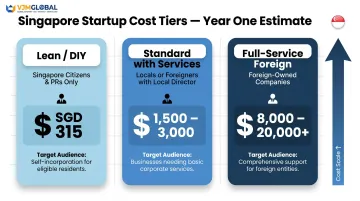
Here's how costs typically break down across three setup tiers.
Lean / DIY Setup
What's included: ACRA name application (SGD 15) + company registration (SGD 300) = SGD 315 total
This bare-minimum approach covers only government fees. You must self-file via BizFile+, which requires SingPass authentication.
Best for: Singapore citizens or PRs registering a simple sole proprietorship or private limited company without immediate need for professional guidance. Foreign nationals cannot use this route.
Standard Setup with Professional Services
What's included:
- ACRA fees: SGD 315
- Corporate secretary service: SGD 300–1,000/year
- Incorporation service provider: SGD 100–500
- Registered office address: SGD 100–500/year
Total first-year estimate: SGD 1,500–3,000
Best for: Local entrepreneurs or foreigners who already have a Singapore-resident director and want guided compliance support. Does not include nominee director costs.
Full-Service Setup for Foreign-Owned Companies
What's included:
- All standard setup costs above
- Nominee local director: SGD 2,000–5,000/year
- Corporate service provider package: SGD 800–2,000
- EntrePass application: SGD 105 (application) + SGD 225 (issuance)
- Work pass salary commitment: minimum SGD 5,600/month (SGD 67,200/year)
Total first-year estimate: SGD 8,000–20,000+ (including office space, initial staffing, and marketing)
Ideal for: Foreign entrepreneurs and multinational companies setting up a Singapore subsidiary without a pre-existing local director.
Quick Cost Comparison
| Setup Tier | Who It's For | First-Year Estimate |
|---|---|---|
| Lean / DIY | Singapore citizens & PRs only | SGD 315 |
| Standard with Services | Locals or foreigners with local director | SGD 1,500–3,000 |
| Full-Service (Foreign) | Foreign-owned companies, no local director | SGD 8,000–20,000+ |
Full Cost Breakdown: Registration, Operations, and Compliance
The total cost of starting a business in Singapore extends well beyond the initial ACRA filing. Founders must budget for one-time setup fees plus recurring annual obligations that begin in year one.
Registration & Incorporation (One-Time)
Government fees from ACRA:
- Name application: SGD 15
- Sole proprietorship registration (1 year): SGD 100
- Sole proprietorship registration (3 years): SGD 160
- Private limited company incorporation: SGD 300
Combined cost for Pte Ltd: SGD 315
Additional one-time costs to factor in:
- Special Unique Entity Number (SUN): SGD 1,000 (Tier Two) or SGD 3,000 (Tier One) for a memorable company number — standard UENs are assigned free
- Corporate service provider packages: SGD 300–2,000 for document preparation, submission support, and setup compliance guidance
Professional Services & Compliance (Recurring)
These annual obligations create the real cost of maintaining a Singapore company:
| Service | Annual Cost (SGD) | Notes |
|---|---|---|
| Corporate secretary | 300 – 1,200 | Legally required for all companies |
| Registered office address | 300 – 500 | Must be accessible during business hours |
| Annual return filing fee | 60 | Paid to ACRA each year |
| Nominee director (foreign-owned only) | 1,000 – 5,000 | Required if no local co-founder exists |
| Audit (if not exempt) | 5,000 – 30,000 | Most startups qualify for audit exemption |
Late filing penalties escalate quickly: SGD 300 if you're under three months late, SGD 600 beyond that. Missing the deadline turns a SGD 60 filing into a SGD 660 penalty.
Audit exemption: Private companies meeting two of three thresholds qualify to skip statutory audits: revenue ≤ SGD 10M, assets ≤ SGD 10M, and ≤ 50 employees. Most early-stage companies qualify, saving SGD 5,000–30,000 annually.
Foreign-owned companies managing compliance across multiple markets often work with cross-border accounting specialists — such as VJM Global — to stay on top of filing deadlines and corporate secretary requirements across jurisdictions.
Once compliance costs are accounted for, the next major recurring expense is physical or virtual workspace.
Office Space & Infrastructure (Recurring)
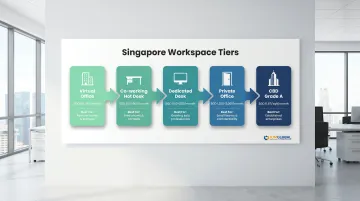
Singapore's workspace market offers options from virtual addresses to Grade A CBD towers:
| Workspace Type | Monthly Cost (SGD) | Best For |
|---|---|---|
| Virtual office address | 50 – 150 | Compliance-only (registered address) |
| Co-working hot desk | 300 – 600 | Solo founders, flexible location |
| Dedicated desk | 500 – 900 | Small teams (1-3 people) |
| Private office (2 pax) | 1,200 – 2,000 | Startups needing meeting space |
| CBD Grade A space | ~SGD 11.67/sqft/month | Established companies with investor expectations |
Major providers include JustCo, WeWork, Servcorp, and The Working Capitol. Non-CBD locations (one-north, Paya Lebar, Jurong) typically offer 20–30% discounts versus Raffles Place or Marina Bay.
Virtual office services meet ACRA's registered office requirement at SGD 50–100/month, making them ideal for digital-first startups without physical teams.
Staffing & Payroll (Recurring)
2026 salary benchmarks (monthly, gross):
- Entry-level roles: SGD 3,500 – 5,500
- Mid-level professionals (3-5 years): SGD 5,500 – 10,000
- Senior/specialist roles (5-10+ years): SGD 8,000 – 18,000+
Fresh graduates secured median starting salaries of SGD 4,500 in 2025, with tech and finance roles commanding premiums.
Employer CPF contributions add real overhead for local hires:
- 17% of gross wages for employees aged 55 and below (effective 1 January 2026)
- Does not apply to Employment Pass or EntrePass holders
Example: Hiring a mid-level professional at SGD 6,000/month costs the employer SGD 7,020/month (SGD 6,000 + 17% CPF) for a Singapore citizen or PR.
Additional payroll costs:
- Skills Development Levy (SDL): 0.25% of monthly wages (capped at SGD 11.25)
- Recruitment fees: up to 20% of annual salary for senior hires
- Work pass fees: SGD 105 application + SGD 225 issuance per Employment Pass or EntrePass
Employment Pass minimum salary: SGD 5,600/month (SGD 10,700 for financial services sector). This mandatory threshold means foreign founders must budget at least SGD 67,200 in annual salary commitments to secure their own work pass.
Marketing & Technology (Recurring)
Digital marketing budgets for early-stage startups: SGD 2,000–10,000/month depending on industry and growth stage.
Cloud and SaaS tools: SGD 500–3,000/month for AWS/Google Cloud hosting, CRM platforms, collaboration software, and project management tools.
The EDB's business setup guide provides additional resources for modeling first-year estimates across these categories.
Key Factors That Affect Your Total Startup Cost in Singapore
While the base registration cost remains fixed at SGD 315, several variables shape your total first-year spend.
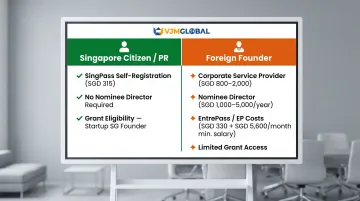
Founder's Residency Status
Singapore citizens and PRs can self-register via BizFile+ at the minimum SGD 315 cost. They qualify for:
- Direct access to SingPass for online filing
- No nominee director requirement
- Eligibility for Startup SG Founder and other grants requiring 30–51% local equity
Foreign founders face:
- Mandatory corporate service provider engagement (adding SGD 800–2,000)
- Nominee director fees (SGD 1,000–5,000/year)
- EntrePass or Employment Pass costs (SGD 330 application + issuance, plus SGD 5,600/month minimum salary)
- Limited grant access without local co-founders
Under Section 145 of the Companies Act, every Singapore company must appoint at least one director who is "ordinarily resident" in Singapore (a Citizen, Permanent Resident, or Employment Pass/EntrePass holder with a local residential address).
Business Structure and Entity Type
Sole proprietorship:
- Registration cost: SGD 115 (1 year) or SGD 175 (3 years)
- No limited liability protection
- Simpler tax filing (personal income tax)
- Cannot issue shares or raise venture capital
- Not eligible for most work passes
Private limited company (Pte. Ltd.):
- Registration cost: SGD 315
- Limited liability protection for shareholders
- Corporate tax rate (17% with startup exemptions)
- Can issue shares and raise external funding
- Eligible for Employment Pass sponsorship
- Required for foreign ownership in most sectors
The SGD 200 difference between sole proprietorship and Pte. Ltd. is modest relative to the liability protection and fundraising flexibility a Pte. Ltd. provides — which is why most foreign investors and growth-focused founders default to it.
Industry-Specific Licensing Requirements
Certain sectors require additional licenses before commencing operations:
Food & Beverage: Singapore Food Agency (SFA) permits required
- Food Shop Licence: SGD 195/year
- Food Stall Licence: SGD 32/year
- Temporary Fair Permit: SGD 60 (one-off)
Fintech and Payment Services: Monetary Authority of Singapore (MAS) approval
- Money-Changing Licence: SGD 500
- Standard Payment Institution (SPI): SGD 1,000 base + SGD 400 per service
- Major Payment Institution (MPI): SGD 1,500 base + SGD 1,000 per service
These figures cover application fees only. Ongoing AML/CFT compliance systems, annual reporting obligations, and minimum capital requirements typically add tens of thousands in annual costs for regulated fintech operators.
Other regulated industries: Education, media and broadcasting, real estate, and legal services face sector-specific licensing. Check the GoBusiness licensing portal for current requirements.
DIY Registration vs. Using Professional Services: What's the Real Cost Difference?
The core trade-off is simple: DIY via BizFile+ costs only SGD 315 in government fees, but it's available only to Singapore residents with SingPass. Everyone else must engage a professional firm.
What Professional Services Include
Beyond registration, corporate service packages typically cover:
- Registered office address — required under ACRA compliance rules
- Company secretary appointment (legally mandatory within 6 months of incorporation)
- Annual return filing, including the SGD 60 filing fee paid on your behalf
- Corporate structure advisory: entity selection, shareholder agreements, and share allocation
- Ongoing compliance calendar management to track filing deadlines and statutory requirements
The catch with budget "SGD 500 all-in" packages: they tend to cut corners on KYC compliance, miss filing deadlines, and offer little post-incorporation support. Late annual return penalties alone run SGD 300–600 — wiping out whatever you saved upfront.
The Value Calculation
A reliable mid-tier provider charging SGD 800–1,500/year delivers:
- Zero missed filing deadlines with calendar-managed compliance
- Professional registered address (not a UPS Store box)
- Qualified company secretary with ACRA track record
- Time savings of 10-20 hours per year on filings and paperwork
That value calculation matters most for foreign founders: without a Singapore-issued SingPass, DIY registration isn't even an option. The real decision isn't DIY versus professional help — it's choosing between a budget provider that may cost you more in penalties and a mid-tier firm that actually keeps you compliant.
What Most Founders Miss When Budgeting for Singapore
Ongoing Compliance Stack Exceeds Setup Costs
The SGD 315 incorporation fee is the smallest expense. Realistic year-one compliance costs:
- Corporate secretary: SGD 300–1,000
- Registered address: SGD 300–500
- Annual return filing: SGD 60
- Nominee director (foreign-owned): SGD 1,000–5,000
Total: SGD 1,660–6,560 in recurring costs before any business operations begin.
Payroll-Linked Costs Beyond Base Salary
Employers often overlook:
- CPF contributions: 17% overhead for local hires aged 55 and below
- Skills Development Levy: 0.25% of wages (capped at SGD 11.25/employee)
- Work pass costs: SGD 330 per foreign hire, plus minimum salary commitments
- Recruitment fees: up to 20% of annual salary for senior positions
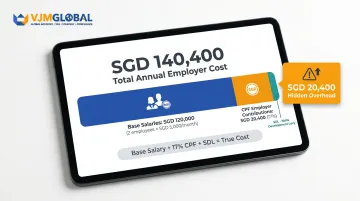
A team of two local employees at SGD 5,000/month each costs SGD 140,400/year in total compensation (SGD 120,000 base + SGD 20,400 CPF), not just SGD 120,000.
Unclaimed Government Support
Singapore offers substantial grant programmes — most founders qualify for at least one, but applications are consistently underutilised.
Startup SG Founder: Up to SGD 50,000 in co-matching capital
- Founder contributes SGD 10,000
- Government matches with up to SGD 50,000
- Includes 12 months of mentorship from Accredited Mentor Partners
- Eligibility: Singapore-registered Pte Ltd incorporated <6 months, at least 51% equity held by Singapore Citizens or PRs, at least one first-time founder working full-time
For businesses beyond the startup stage, the Enterprise Development Grant covers broader transformation costs.
Enterprise Development Grant (EDG): Up to 50% co-funding for business transformation projects
- Enhanced to 70% for sustainability initiatives (until 31 March 2026)
- Requires at least 30% local equity
- Covers core capabilities, innovation, productivity, and market access
Critical timing note: EDG, PSG, and MRA will transition to a new consolidated EDGE grant in the second half of 2026. Apply for existing grants before this transition — new eligibility criteria have not been confirmed.
Corporate Income Tax Rebate (YA 2026): Enhanced 50% CIT rebate (capped at SGD 40,000) plus SGD 2,000 cash grant for companies that employed at least one local employee in 2025.
Frequently Asked Questions
How much does it cost to start a business in Singapore?
The minimum government cost is SGD 315 for ACRA registration (name application + incorporation fee). However, realistic first-year costs for a foreign-owned company with professional services, compliance support, and basic operations range from SGD 8,000 to SGD 20,000 or more, depending on office requirements and staffing.
What are common startup costs for a business in Singapore?
Key cost categories include: ACRA registration (SGD 315), corporate secretary services (SGD 300–1,200/year), registered office address (SGD 300–500/year), nominee director fees (SGD 1,000–5,000/year), office space (SGD 400–1,500/month), employee salaries with 17% CPF contributions, and digital marketing. Compliance and staffing typically dominate year-one spend.
Can a foreigner start and fully own a company in Singapore?
Yes, Singapore allows 100% foreign ownership of a private limited company in most industries. However, the company must appoint at least one Singapore-resident director (Citizen, PR, or valid Employment Pass/EntrePass holder). Foreign founders without a local contact must hire a nominee director through a corporate service provider at SGD 1,000–5,000/year.
What business expenses are fully tax-deductible in Singapore?
Singapore allows deduction of revenue expenses incurred wholly and exclusively in producing business income — including rent, salaries, professional fees, and marketing. New companies also benefit from the Startup Tax Exemption Scheme (SUTE), which reduces effective tax to approximately 5.3% on the first SGD 200,000 of profit for the first three years.
What budgeting rules should startups follow (e.g., 50/30/20)?
The 50/30/20 rule applies to personal finance. For early-stage businesses, a practical split allocates 40–60% of operating expenses to payroll, 10–15% to marketing and customer acquisition, and the remainder to compliance, technology, and overheads. Maintain a cash reserve covering 3–6 months of operating costs to cover slow months and unexpected expenses.