Introduction
Singapore has become a premier destination for UK businesses expanding into Asia-Pacific, and for good reason. The city-state ranked #2 globally in the 2025 IMD World Competitiveness Ranking, offering a transparent regulatory environment, a legal system rooted in English common law, and strong bilateral trade ties. The UK-Singapore Free Trade Agreement, which took effect on 1 January 2021, has further strengthened economic connections between the two nations.
That opportunity comes with real setup costs — and they're easy to underestimate. The official government registration fee through the Accounting and Corporate Regulatory Authority (ACRA) is just SGD 315, but that figure rarely tells the full story.
Once nominee director services, professional fees, corporate secretary requirements, and ongoing compliance are factored in, first-year costs typically range between SGD 3,500–4,000+. Many UK founders budget only for the government fee, then find themselves facing compliance gaps once operations begin.
This guide walks through every cost component — what's mandatory, what's optional, and what to watch out for — so you can plan your Singapore setup with a clear budget in hand.
Key Takeaways
- The minimum government fee (ACRA) is SGD 315, but UK businesses should budget SGD 3,500–4,000+ for year one including professional services
- Appointing a local resident director is legally required for foreign owners and the single biggest cost driver at SGD 2,000–5,000/year
- A corporate secretary must be appointed within six months of incorporation, adding SGD 300–800/year to your compliance costs
- Ongoing annual compliance costs typically range from SGD 3,000–5,000/year
- Singapore allows 100% foreign (UK) ownership of a Private Limited Company—no local equity partner required
What Does It Cost to Register a Company in Singapore?
Singapore company registration doesn't have a single fixed price — and for UK nationals, the range is narrower than it looks. UK businesses cannot self-file via the government portal (it requires a SingPass ID, unavailable to foreign nationals), so the real choice is between a standard professional package and a full-service foreign entrepreneur setup. Picking the wrong tier is the most common reason UK businesses hit unexpected compliance costs after incorporation.
Entry-Level: DIY / Government Fees Only (SGD 315)
What's Included:
- ACRA name reservation fee: SGD 15
- Company incorporation fee: SGD 300
- Total government fees: SGD 315
Best For: In practice, this route is unavailable to UK nationals. The BizFile+ portal requires a SingPass ID — restricted to Singapore citizens, Permanent Residents, and certain pass holders. UK business owners must engage a Corporate Service Provider (CSP), formerly known as a Registered Filing Agent, to file on their behalf.
Mid-Range: Standard Professional Package (SGD 800–1,500/year)
What's Included:
- Incorporation filing by a CSP
- Company constitution drafting
- Corporate secretary services
- Registered office address
Best For: UK businesses that already have a Singapore-resident employee or director who satisfies the local director requirement. Note that nominee director services are not included — if you have an existing team member with Singapore residency (citizen, PR, or valid work pass holder), this package covers professional filings without the full setup stack.
This tier works well when the local director problem is already solved. If it isn't, the full-service package below is the more practical starting point.
Full-Service Foreign Entrepreneur Package (SGD 3,000–4,000+)
What's Included:
- Everything in the mid-range package
- Nominee local resident director service
- Employment Pass application support
- Bank account opening assistance
- Accounting and tax compliance setup for year one
Best For: Most UK businesses registering in Singapore for the first time without a local team already in place. This is the realistic baseline cost — roughly £1,750–£2,350 at current exchange rates — if you're starting from scratch.
Breaking Down Every Cost UK Businesses Face
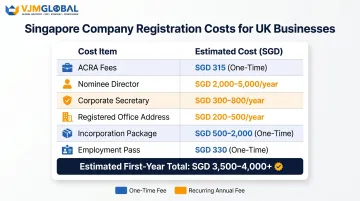
The ACRA registration fee is just the entry ticket. Recurring costs — nominee director, secretary, and registered address — will outweigh it every year. Here's the full picture:
| Cost Item | Type | Estimated Cost (SGD) |
|---|---|---|
| ACRA Name Reservation + Incorporation | One-time government fee | 315 |
| Nominee Local Resident Director | Recurring annual fee | 2,000–5,000 |
| Corporate Secretary Services | Recurring annual fee | 300–800 |
| Registered Office Address | Recurring annual fee | 200–500 |
| Professional Incorporation Package | One-time service fee | 500–2,000 |
| Employment Pass (if relocating) | One-time government fee | 330 |
ACRA Name Reservation + Incorporation Fee
Cost: SGD 315 (fixed, non-negotiable)
This is the only fixed cost in the process. Per ACRA's official fee schedule, the breakdown is:
- Name reservation: SGD 15
- Company incorporation: SGD 300
This fee is payable regardless of which service provider you use.
Nominee Local Resident Director
Cost: SGD 2,000–5,000/year (recurring)
This is mandatory for UK businesses and represents the single largest ongoing cost. According to Section 145 of the Singapore Companies Act, every company must have at least one director who is ordinarily resident in Singapore—meaning a Singapore citizen, Permanent Resident, or valid work pass holder with a Singapore residential address.
The nominee director is a legal compliance role, not an operational one. They don't run day-to-day business but serve to satisfy regulatory requirements. Costs vary based on:
- Provider's professional liability exposure
- Scope of service (basic compliance vs. advisory support)
- Security deposit requirements (some providers require SGD 2,000–10,000 refundable deposits)
Corporate Secretary Services
Cost: SGD 300–800/year (recurring)
Under the Singapore Companies Act, a company secretary must be appointed within six months of incorporation. Leaving the position vacant beyond that window can result in a fine of up to SGD 1,000 for directors.
Services typically include:
- Annual return filing
- Maintenance of statutory registers
- Regulatory compliance support
- Corporate governance guidance
Registered Office Address
Cost: SGD 200–500/year (recurring)
Every Singapore company must maintain a physical registered office address (P.O. boxes are not accepted). The address must:
- Be a physical location in Singapore
- Be accessible to the public for at least three hours on each business day
- Be able to receive official communications and legal documents
Most UK businesses use a virtual registered address service provided by their incorporation agent rather than renting physical office space.
Professional Incorporation Package / Agent Fees
Cost: SGD 500–2,000 (one-time)
This covers:
- Document preparation and verification
- ACRA filing and submission
- Company constitution drafting
- Post-incorporation documents (share certificates, registers, etc.)
- Initial compliance guidance
For most UK businesses, a mid-range provider at SGD 800–1,500 offers the best value. Budget providers (SGD 300 and under) frequently cut corners on KYC compliance or miss filing deadlines, which can attract fines of SGD 300–600. At the other end, specialist firms charge SGD 4,000+ — often more than the work justifies.
Employment Pass (if relocating to Singapore)
Cost: SGD 330 (one-time government fee)
If you plan to personally work in Singapore (not just own the company remotely), you'll need an Employment Pass. Fees breakdown:
- Application fee: SGD 105
- Issuance fee: SGD 225
Processing time is approximately 10 business days for online applications. This is separate from company registration. You can own a Singapore company without one if you manage operations from the UK.
Factors That Affect Your Singapore Registration Costs
Three variables drive most of the cost difference UK businesses encounter: whether you need a nominee director, which entity structure you choose, and which service provider you engage.
Whether a Nominee Director is Required
This is the biggest single variable for UK businesses. If you don't have a Singapore-resident director available in-house, you must engage a nominee director service at SGD 2,000–5,000/year.
Why the price variation?
- Premium providers charge more due to higher professional liability insurance
- More rigorous vetting processes and compliance frameworks
- Dedicated account management and responsive support
- Quality of legal protection and indemnity coverage
Entity Type and Structure
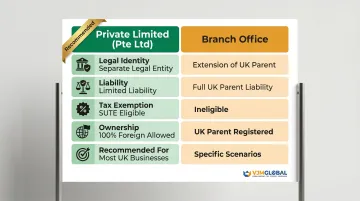
A Private Limited Company (Pte Ltd) is the recommended structure for most UK businesses—all costs above apply to this structure. Other options include:
Sole Proprietorship/Partnership offers lower registration costs but comes with unlimited personal liability — rarely suitable for UK businesses expanding internationally.
Branch Office is an extension of your UK parent company, not a separate legal entity. This means different costs and compliance obligations:
- The UK parent company must be registered with ACRA
- No separate legal identity — the UK parent bears all liability
- Does not qualify for Singapore's Start-up Tax Exemption (SUTE)
- Subject to the same 17% corporate tax rate but without startup benefits
Most UK businesses prefer the Pte Ltd structure for liability protection and tax advantages.
Choice of Service Provider
Incorporation package prices range from SGD 300 (budget/volume providers) to SGD 4,000+ (specialized firms). Budget providers cut costs by cutting corners:
Budget providers (SGD 300–600) often:
- Use automated, template-based processes with minimal customization
- Miss filing deadlines, attracting ACRA penalties of SGD 300–600
- Provide slow or unresponsive customer support
- Outsource work to third parties without transparency
- Offer no post-incorporation advisory support
Premium providers justify the higher fee with hands-on service and accountability:
Premium providers (SGD 1,500–4,000+) typically:
- Assign dedicated account managers familiar with UK business needs
- Provide proactive compliance reminders and deadline management
- Offer bank introduction services with established relationships
- Include post-incorporation advisory (tax structuring, Employment Pass support)
- Maintain professional indemnity insurance and robust KYC processes
Best value: Mid-tier providers at SGD 800–1,500 offer quality service, responsive support, and compliance reliability without the overhead of a full-service firm.
Ongoing Annual Costs to Budget For
Registration is a one-time event, but operating a Singapore company generates recurring compliance costs. On top of nominee director and corporate secretary fees, UK businesses should budget SGD 3,000–5,000/year for ongoing compliance obligations.
Annual Return Filing (ACRA)
Cost: SGD 60/year (fixed government fee)
All companies must file an annual return with ACRA. Late filing incurs penalties:
- SGD 300 if filed within 3 months of the due date
- SGD 600 if filed more than 3 months overdue
Accounting, Bookkeeping, and Tax Filing
Cost: SGD 500–5,000/year (depending on complexity)
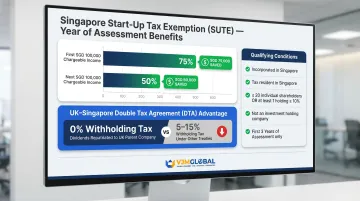
Singapore's corporate tax rate is a flat 17%, but UK-owned startups benefit from the Start-up Tax Exemption (SUTE) for the first three years:
| Chargeable Income Band | Exemption Rate | Maximum Exemption |
|---|---|---|
| First SGD 100,000 | 75% | SGD 75,000 |
| Next SGD 100,000 | 50% | SGD 50,000 |
Do UK-owned companies qualify? Yes, provided:
- The company is incorporated in Singapore (not a branch)
- It's a tax resident of Singapore
- Total shareholders number no more than 20
- At least one shareholder is an individual holding 10%+ of shares
UK-Singapore Double Taxation Agreement (DTA): Singapore and the UK have a comprehensive DTA with a 0% withholding tax rate on both portfolio and direct investment dividends. This means profits repatriated from your Singapore subsidiary to your UK parent company face no withholding tax in Singapore—keeping your repatriation costs at zero rather than the 5–15% rates common under other tax treaties.
GST Registration and Filing
Mandatory threshold: SGD 1 million annual revenue
GST registration is mandatory once annual turnover exceeds SGD 1 million. The current GST rate is 9% (effective 1 January 2024). Filing is required quarterly with prescribed periods:
- Jan–Mar: due 30 April
- Apr–Jun: due 31 July
- Jul–Sep: due 31 October
- Oct–Dec: due 31 January
There's no government registration fee to register for GST, but once you cross the SGD 1 million threshold, quarterly filing adds meaningfully to your accounting workload. Build this into your budget projections before you reach that revenue point.
Bank Account Opening and Ongoing Banking
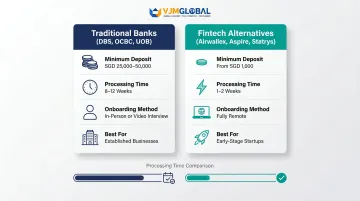
Opening a corporate bank account is a critical post-incorporation step, but timelines and requirements differ widely:
Traditional Banks (DBS, OCBC, UOB):
- Minimum initial deposit: SGD 25,000–50,000
- Processing time: 8–12 weeks
- Documentation: Certified passports, ACRA Business Profile, proof of address, business plan, source of funds declaration, bank reference letters
- May require video compliance interview or in-person visit
Fintech Alternatives (Airwallex, Aspire, Statrys):
- Fully remote onboarding (no in-person visit)
- Processing time: 1–2 weeks
- Minimum deposit: As low as SGD 1,000
- Multi-currency accounts with competitive FX rates
- Ideal for early-stage startups and e-commerce businesses
Plan banking in parallel with incorporation to avoid operational delays. If your team is based in the UK with no plans to visit Singapore in person, fintech providers are often the practical first choice.
Common Mistakes UK Businesses Make When Budgeting for Singapore
Focusing Only on the SGD 315 Government Fee
Many UK founders see "SGD 315 registration fee" and treat it as the total cost. This figure applies only to Singapore residents who self-file via BizFile+ with SingPass. For UK businesses engaging a professional service provider, the first-year cost is 10–12x higher once nominee director, corporate secretary, and professional fees are included.
Overlooking the Nominee Director as a Recurring Annual Cost
UK businesses often treat the nominee director as a one-time setup expense and are surprised to find it must be renewed annually. This is the largest recurring line item in your compliance budget—typically SGD 2,000–5,000/year.
Failing to Account for the Employment Pass Separately
If you want to personally manage operations in Singapore, an Employment Pass is a separate, additional process with its own costs (SGD 330), processing time (approximately 10 business days), and eligibility criteria. Not factoring this in delays your timeline and inflates your total setup cost.
Choosing a Service Provider Solely on Lowest Price
Budget providers may not include a dedicated account manager, may miss filing deadlines, or lack flexibility to handle non-standard queries. For UK businesses unfamiliar with Singapore's regulatory environment, personalized support is worth the premium.
What to look for in a provider:
- Dedicated account manager with Singapore compliance experience
- Proactive filing reminders and deadline tracking
- Clear scope of what's included (and what isn't) in the quoted fee
- Transparent pricing with no hidden renewal costs
Across any international expansion, the right professional guidance pays for itself by preventing compliance failures and budget surprises that cheap providers rarely flag in advance.
Frequently Asked Questions
What are 5 common startup costs when registering a company in Singapore?
The five key startup costs are: ACRA incorporation fee (SGD 315), nominee director service (SGD 2,000–5,000), corporate secretary fee (SGD 300–800), registered office address (SGD 200–500), and professional incorporation/agent fees (SGD 500–2,000). Together, these typically total SGD 3,500–4,000 for foreign founders.
Can a UK business own 100% of a Singapore Private Limited Company?
Yes, Singapore allows 100% foreign ownership of a Pte Ltd with no local equity partner required. However, at least one resident director (Singapore citizen, PR, or valid work pass holder) must be appointed, which most UK businesses satisfy via a nominee director service.
Do UK business owners need to be physically present in Singapore to register a company?
No, physical presence is not required. UK founders can register a Singapore company entirely remotely by engaging a Corporate Service Provider. However, some traditional banks may require an in-person visit or video interview for corporate account opening.
How long does it take to register a company in Singapore from the UK?
ACRA typically approves incorporation within 1–3 business days once documents are submitted. Full setup — including a working bank account — takes 2–4 weeks with fintech providers, or 8–12 weeks with traditional banks.
Is there a Double Taxation Agreement between the UK and Singapore?
Yes, the UK and Singapore have a comprehensive Double Taxation Agreement with a 0% withholding tax rate on dividends. This means profits earned by a UK-owned Singapore company are not taxed twice when repatriated. Consult a tax adviser to understand how the DTA applies to your specific structure and dividend plans.
What is the difference between a Singapore subsidiary and a branch office for UK businesses?
A subsidiary (Pte Ltd) is a separate legal entity that limits the UK parent's liability and qualifies for Singapore's startup tax exemptions. A branch office is an extension of the UK parent — it carries no separate legal identity, exposes the UK parent to full liability, and is ineligible for those same tax incentives.