Many Indian founders want global credibility, tax efficiency, and a launchpad into ASEAN. What they're unsure about is whether Singapore actually delivers on that promise, or whether it's just a compliance headache waiting to happen.
This article breaks down the real strategic reasons Indian businesses set up in Singapore, plus the FEMA and RBI compliance steps founders can't skip.
Key Takeaways
- Secure 100% foreign ownership in Singapore with no local shareholding requirement
- Cut early-year tax via Singapore's flat 17% corporate rate and startup exemptions
- Reach ASEAN's market of over 690 million people from a Singapore base
- Clear FEMA/RBI Overseas Direct Investment (ODI) rules before remitting capital abroad
Tax Efficiency and Financial Benefits for Indian Businesses
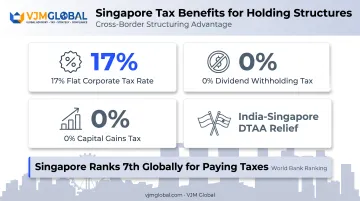
Singapore's corporate tax rate sits flat at 17% of chargeable income, applying equally to local and foreign-owned companies, per IRAS. That's the headline number. Qualifying startups can reduce their effective rate further under Singapore's start-up tax exemption scheme, applicable for the first three Years of Assessment.
Additional financial advantages include:
- No withholding tax on dividends paid by Singapore companies, according to IRAS
- No capital gains tax in most cases, which helps Indian investors using holding structures
- India-Singapore DTAA cuts withholding tax on cross-border dividends and prevents the same income being taxed twice
- Broad DTA and FTA network extends similar treatment to trade with dozens of other countries
Why This Matters for Holding Structures
If you're structuring an investment holding company or regional treasury function, the combination of zero dividend withholding tax and no capital gains tax is hard to beat. That tax design is paired with a compliance system built for cross-border groups. Singapore ranked 7th globally for Paying Taxes in the World Bank's Doing Business 2020 dataset, with a score of 91.6. The World Bank has since moved to its Business Ready framework, but the score still reflects how the system is set up.
At VJM Global, we regularly see Indian founders underestimate how much the DTAA structure alone can save on repatriated profits, particularly for companies planning to reinvest earnings rather than distribute them immediately.
Strategic Access to ASEAN and Global Markets
Singapore is the operational gateway into a 10-member ASEAN bloc that ASEAN's statistics office pegs at 693.2 million people in 2025. That is a market larger than the entire European Union.
What makes Singapore the practical entry point:
- Port access: Ranked first overall among 160 ports in the inaugural Leading Container Ports of the World report
- Air hub: Changi handled 69.4 million international passengers in 2025, fourth busiest worldwide for international traffic
- Trade cover: The India-Singapore CECA (2005) was India's first comprehensive trade pact and Singapore's first with a South Asian country
Indian majors already treat Singapore as their regional HQ. Tata Group, Mahindra & Mahindra, Reliance Industries, Infosys, and Wipro all keep a Singapore base.
For smaller and mid-sized businesses, the same logic holds at a different scale: a Singapore entity signals seriousness to international clients, investors, and banks in a way an India-only address often does not.

Full Ownership, Simple Structures and Strong Legal Protections
Unlike many jurisdictions that require a local partner or shareholding minimum, Singapore permits full foreign control. ACRA confirms that a foreign company can be the sole shareholder of a Singapore private limited entity, subject to the same requirements as a local company.
Structures stay lean as well: one shareholder and one director are enough in most cases, with no meaningful minimum paid-up capital.
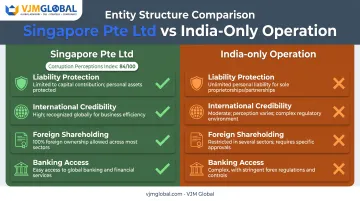
Private Limited Company vs. running solely from India:
| Factor | Singapore Pte Ltd | India-only operation |
|---|---|---|
| Liability | Limited to share capital | Depends on entity type |
| International credibility | High — recognised structure | Limited outside India |
| Foreign shareholding | 100% permitted | Subject to FDI sector caps |
| Access to global banking | Easier | Often more restrictive |
Legal certainty backs that structure. Singapore scored 84 out of 100 and ranked 3rd of 182 countries in Transparency International's 2025 Corruption Perceptions Index, which matters when you weigh contract enforcement, IP protection, and rule-of-law risk.
Compliance Considerations Indian Founders Must Address
Setting up in Singapore doesn't remove your Indian obligations. It adds a parallel set.
India side — capital remittance and ongoing ODI:
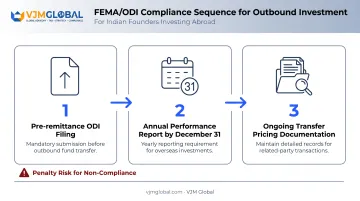
- Complete FEMA/RBI Overseas Direct Investment (ODI) filings under the Foreign Exchange Management (Overseas Investment) Rules and Regulations, 2022, before remitting capital
- File an Annual Performance Report (APR) each year the investment remains active, generally due by 31 December
- Keep ODI reporting current and maintain transfer pricing documentation for related-party transactions
Founders holding under 10% equity with no control and no further financial commitment are typically exempt from the APR requirement.
Singapore side — incorporation and statutory filings:
- Appoint at least one Singapore-resident director and a registered filing agent (Indian founders cannot self-incorporate through ACRA's BizFile+)
- File ACRA annual returns within 7–8 months of financial year-end
- Submit IRAS filings, including Estimated Chargeable Income and Form C-S or Form C
Skipping this isn't a minor paperwork risk. FEMA violations have resulted in penalties running into crores of rupees in documented cases involving unauthorised remittance channels.
How VJM Global helps:
- FEMA/ODI advisory and filings for outbound investment from India
- Master Files, Local Files, and transfer pricing studies aligned with OECD BEPS
- Singapore entity compliance so founders aren't juggling two regulators' deadlines
Is Singapore the Right Move for Your Business?
A Singapore company is the right move in specific scenarios—not for every Indian business.
Usually a strong fit for:
- SaaS and tech companies exporting services to global clients who expect an offshore billing entity
- Trading companies moving goods through ASEAN or re-exporting to third markets
- Businesses establishing a regional headquarters to manage Southeast Asian operations
- Founders building an investment holding structure to consolidate international shareholdings
Less compelling if:
- Your business is purely domestic with no export or investor-facing need
- You lack the capital to sustain dual-jurisdiction compliance costs
- Your buyers, investors, or tax-treaty needs point more clearly to another jurisdiction
If Singapore fits, the next step is clean execution on both sides of the structure. VJM Global handles entity formation, accounting, tax, and compliance across 100+ countries, including Singapore and India, so founders work with one team instead of two disconnected advisors.
Frequently Asked Questions
Is it worth moving to Singapore from India?
It depends on your model. Tax efficiency, ASEAN access, and credibility are real gains—but only if they outweigh relocation cost and dual-jurisdiction compliance. Export-oriented and investment-holding businesses usually see the strongest case.
Can Indians do business in Singapore?
Yes. Singapore allows 100% foreign ownership for Indian founders, subject to appointing a locally resident director and a registered filing agent, since self-incorporation isn't permitted.
What is the minimum investment needed to start a business in Singapore from India?
Singapore’s ACRA (Accounting and Corporate Regulatory Authority) requires only S$1 in minimum share capital, plus government fees for name application and registration. Professional and setup costs vary by structure.
Do I need to relocate to Singapore to run my company?
No. You can own and direct the company remotely by appointing a nominee resident director. Relocating is only necessary if you want to personally manage operations via an EntrePass or Employment Pass.
What Indian regulatory approvals are needed before investing in a Singapore company?
Indian founders must comply with FEMA’s Overseas Direct Investment (ODI) rules before remitting capital, and file an Annual Performance Report for each year the investment remains active.
How does the India-Singapore tax treaty benefit Indian company owners?
The India–Singapore DTAA (double tax treaty) reduces withholding tax on cross-border dividends and stops the same income being taxed twice. With Singapore’s zero domestic dividend withholding tax, repatriation is more efficient overall.