The pull factors are concrete: a 20.6% corporate tax rate, no restrictions on foreign ownership, and a direct gateway into the EU's 450 million-consumer single market, according to the European Commission. This isn't just startup founders chasing venture capital either. Tech founders, e-commerce sellers, consultants, and established Australian SMEs are all looking at Sweden as a serious European entry point.
This guide walks through exactly what's involved: choosing a structure, sorting banking and share capital, registering with the right authorities, and understanding visas if you plan to relocate.
TL;DR
- Australians can own 100% of a Swedish company with no residency requirement for shareholders
- Four entry routes: new AB, ready-made AB, Swedish branch, or short-term project registration
- Banking and the SEK 25,000 share capital, not government processing, are the real bottlenecks
- Realistic timeline from Australia: 6–10 weeks end-to-end; visas are a separate process
- Early help with formation, F-skatt, and VAT avoids expensive mistakes
What Does Starting a Business in Sweden From Australia Actually Involve?
It means registering a legal entity or presence in Sweden while you're still based in Australia. That could be an AB (aktiebolag, Sweden's limited company), a branch of your existing Australian company, or a short-term project registration.
Here's the part most people get wrong: you don't need to live in Sweden to own a Swedish company. Ownership and operations are two different things. You can hold 100% of the shares from Sydney or Perth.
Running day-to-day operations physically inside Sweden is separate. That requires its own residence or work permit.
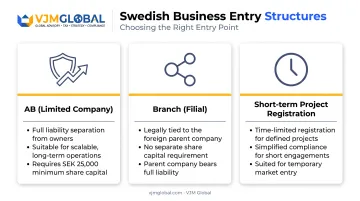
Three structures dominate:
- AB (limited company): Most common, scalable choice with liability separation
- Branch (filial): Extension of your Australian company; no separate share capital, liability stays with the parent
- Short-term project registration: Time-limited work without forming a full entity
What Australian Founders Should Know Before Starting in Sweden
Most Australian founders underestimate how much time-zone friction and Swedish banking slow the first months. Neither is fatal, but both catch people off guard—and they sit alongside a few other decisions you should lock in early.
Key considerations before you start:
- Time zone gap — AEST sits 8–9 hours ahead of CET, so overlap with Bolagsverket, banks, and local advisors is only a few hours a day
- Remote vs. relocation — decide early whether you're running this from Australia long-term or planning to move under a residence permit
- Realistic timeline — expect 6–10 weeks before you're fully operational (registration + banking + tax registration), not the "instant company" some services advertise
- Language barrier — filings with Bolagsverket and Skatteverket are in Swedish, so a bilingual or local partner is essential
- Formed ≠ operational — having a registered AB doesn't mean you can invoice, hire, or trade compliantly yet
Skip any of these and you'll likely hit delays in month two, right when you thought you were done.
Why Sweden Makes Sense for Australian Entrepreneurs
Sweden isn't automatically the right EU entry point for every business, but the conditions are genuinely strong for certain founders.
Sweden ranks 2nd out of 139 economies in the WIPO Global Innovation Index 2025, trailing only Switzerland. For tech and green-energy ventures, that's a meaningful signal about ecosystem depth, talent, and research infrastructure.
Other advantages worth weighing:
- Single EU registration gives access to the EU single market for goods, services, capital, and people
- 20.6% corporate tax is among the lowest in the Nordics
- No nominee director requirement and no restriction on Australian or other foreign ownership
- GDP per capita of US$63,133 in 2025, reflecting a wealthy, stable consumer base
That said, Sweden works best as a deliberate entry point, not a default one. If your product needs a large domestic market before EU expansion, other jurisdictions might suit better. Sweden shines when innovation credibility and EU access matter more than raw market size.
Early Decisions Australian Founders Often Get Wrong
Delays almost never come from Bolagsverket's registration process itself. They come from what happens around it.
The Banking Bottleneck
Opening a Swedish bank account remotely from Australia can take weeks, and sometimes an in-person visit is unavoidable. Without a bank certificate confirming your share capital deposit, Bolagsverket won't register your AB at all. Plan for this before you plan anything else.
Share Capital and Board Composition
Founders regularly underestimate two structural requirements:
- SEK 25,000 minimum share capital for an AB, which must be deposited and certified by an EEA-based bank or credit institution
- EEA-resident board rule — at least half of directors and deputies, plus the managing director, must reside in the EEA, unless Bolagsverket grants a dispensation
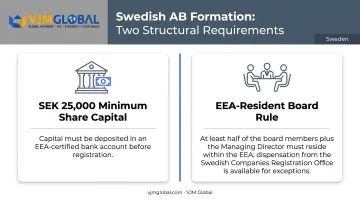
An all-Australian board isn't automatically disqualified, but it does need advance planning or a formal exemption application.
Tax Registration Timing
Register for F-skatt early. If you don't, Swedish clients are legally required to withhold 30% of your invoice value until you're approved. This single oversight causes real cash-flow pain for founders who assumed tax registration could wait until "later."
How to Start a Business in Sweden From Australia – Step by Step
Here's the practical sequence, broken into stages that matter for someone operating remotely from Australia.
Step 1 – Choose Your Structure and Entry Route
| Route | Best for | Key consideration |
|---|---|---|
| New AB | Long-term commitment, liability separation | Needs SEK 25,000 capital + bank certificate |
| Ready-made AB | Speed, but verify thoroughly | Not an official fast-track — private market product |
| Branch | Existing Australian companies | No independent capital, but parent carries liability |
| Short-term project | Testing the market briefly | May qualify for a registration exemption |
Match the structure to your intent. Testing demand calls for something lighter than committing to full AB formation.
Step 2 – Validate the Market and Pricing From Australia
Before committing capital, check demand through Swedish trade bodies or Business Sweden. Sanity-check your pricing against Sweden's 25% standard VAT rate, since that materially affects your competitiveness against local suppliers.
Step 3 – Handle Banking and Share Capital
You'll need to deposit SEK 25,000 and obtain a bankintyg (bank certificate) before Bolagsverket will register your AB. Traditional Swedish banks can take 2–6 weeks for remote account opening; fintech alternatives sometimes move faster, but confirm in writing that they can actually issue the required certificate. Not all can.
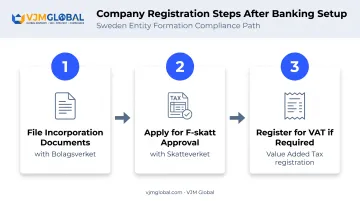
Step 4 – Register With Bolagsverket and Skatteverket
Once banking is sorted:
- File incorporation documents (in Swedish) with Bolagsverket
- Apply for F-skatt approval through Skatteverket to avoid the 30% withholding
- Register for VAT if your turnover requires it
Step 5 – Sort Out Visas and Residence (If Relocating)
Owning shares in a Swedish company grants zero residency rights on its own. Staying beyond 90 days requires a residence permit. If you're applying as self-employed, Migrationsverket expects proof of personal funds along these lines:
- SEK 200,000 for you
- SEK 100,000 for an accompanying spouse
- SEK 50,000 per child
Step 6 – Set Up Local Support and Compliance
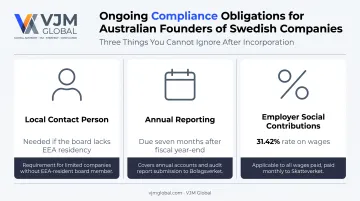
Plan local support early. Typical gaps for remote Australian founders include:
- A designated local contact person if the board does not meet the EEA-residency rule
- Ongoing accounting support for annual reporting (due seven months after financial year-end)
- Payroll budgeting for the 31.42% employer social contribution rate on staff wages
This is where a lot of Australian founders bring in outside help rather than trying to manage Swedish-language filings solo. VJM Global works with Australian businesses on cross-border entity formation and compliance, and can help founders work through sequencing before they commit capital.
Conclusion
Starting a business in Sweden from Australia isn't complicated in theory, but it punishes bad sequencing. Get the structure, banking, and registration order right, and the Swedish side moves fairly quickly. Rush registration before securing a bank account, or ignore the EEA board rule, and you'll lose weeks untangling avoidable problems.
Long-term success depends on staying compliant after setup, not only on the initial paperwork:
- Annual filings
- Payroll contributions
- Tax obligations that don't pause because you're based in Australia
VJM Global supports cross-border entity formation, tax compliance, and ongoing accounting so sequencing and post-setup filings stay manageable from day one.
Frequently Asked Questions
How much does it cost to start a business in Sweden?
Budget at least SEK 25,000 for AB share capital, plus Bolagsverket registration fees and any professional service costs for formation and compliance support. The capital itself is company equity, not a government charge.
Can Australians start a business in Sweden?
Yes. Australians can own 100% of a Swedish company with no residency requirement for shareholders. Relocating to run the business day-to-day, however, requires a separate residence permit.
What businesses are profitable in Sweden?
Business Sweden identifies software, applied AI, green energy and battery production, and life sciences as priority growth sectors. These aren't guaranteed profitability benchmarks, but they reflect where Sweden's ecosystem and investment support are strongest.
What is the 6-month rule in Sweden?
There's no universal six-month safe harbour. Permanent establishment risk under tax treaties often triggers between six and twelve months of project activity, depending on the treaty terms. That is separate from Bolagsverket's one-year branch registration exemption.
Do I need to move to Sweden to own a Swedish company?
No. Ownership doesn't require residency. You can hold shares and direct the company from Australia, but operating it physically inside Sweden on an ongoing basis requires a residence or work permit.
How long does it take to register a company in Sweden from Australia?
Realistically, 6–10 weeks once you factor in banking delays. Bolagsverket's own processing can be as quick as 11 working days, but that clock doesn't start until your bank certificate is sorted.