Introduction
US consultants who want UK and EU clients often hit the same obstacles: how to present a local entity, invoice in sterling, and stay on the right side of tax and banking rules without moving abroad. Remote-friendly norms, steady UK and EU demand, and a company registration process that often takes days rather than months have made that path more practical than it once was.
Consultants, coaches, advisors, and agency owners are forming UK entities to serve British and European clients without relocating. Solo practitioners and US firms entering the market typically follow the same setup route.
This guide covers the legal, tax, banking, and visa realities of launching a UK consultancy while you remain based in the United States.
Key Takeaways
- You can own 100% of a UK limited company and serve as director without living in the UK
- A UK registered office address is required for incorporation, even if you never set foot there
- The UK-US tax treaty prevents double taxation, but US reporting duties (Form 5471, FBAR) still apply
- No visa is required for remote ownership; visas only matter if you physically relocate to work
- Registration takes days; banking, tax setup, and compliance take considerably longer
What Is a UK Consultancy Business — And Can a US Resident Own One?
A UK consultancy business is simply an advisory or expert-services company registered under UK company law and tax rules, usually serving UK or European clients. It operates within the Companies House and HMRC framework rather than the IRS/state system US founders are used to.
Here's the part that surprises most Americans: you don't need to live in the UK, hold a UK visa, or even visit the country to own and run one.
GOV.UK is explicit that a director must simply be at least 16 years old — residency in the UK isn't a condition. A sole shareholder can hold 100% of the shares. Combine those facts, and a US resident can be sole director and sole owner of a UK Ltd from a laptop in Austin or Chicago.
Business Structures Available to a Non-Resident Founder
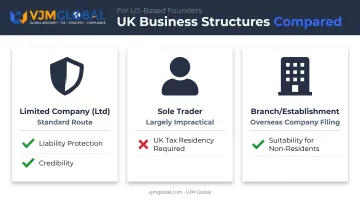
Three structures are technically available, but they aren't equally practical:
- Limited Company (Ltd) — the standard route. A separate legal entity that protects your personal assets, with a UK company number and registered address clients recognise as credible.
- Sole Trader — largely impractical for a US-based founder. It ties to personal UK tax residency and self-assessment, which doesn't fit non-UK tax residents.
- UK Branch/Establishment — register your existing US LLC or Corporation as an overseas company. Companies House filing only applies once you have a physical UK place of business—not merely UK clients.
Most US-based consultants choose a new UK Ltd over the branch route. It keeps liability cleaner between the US and UK sides of the business, and ongoing compliance is usually simpler than overseas-company filings for a branch.
Why Start a UK Consultancy From the USA (When It Makes Sense)
A UK entity isn't automatically the right move for every US consultant with a British client or two. It's worth the extra complexity when a few specific conditions line up.
Signs it's worth the effort:
- You have recurring UK or European client demand, not a one-off project
- Clients or procurement teams have hesitated over invoicing from a US entity
- You want to price and invoice in GBP rather than pushing FX risk onto clients
- You're planning to hire in the UK eventually, or build toward a UK-based team
The market opportunity backs this up. The Management Consultancies Association reports that UK consulting export earnings grew 9% in the most recent reporting year. Member firms forecast continued revenue growth of 6% in 2026 and 8% in 2027. That's a market still expanding its appetite for outside expertise.
A local UK entity also solves a subtler problem: payment friction. Invoicing in GBP through a UK company removes the currency-conversion guesswork that comes with a US-dollar invoice, and it matches how UK finance departments expect to pay local vendors. None of this requires relocating. It just requires the right entity sitting behind your client contracts.
Key Decisions and Cross-Border Considerations Before You Start
For a US-based founder, the real complexity sits in the overlap between two tax systems, two banking systems, and two compliance regimes. Here's what tends to get missed.
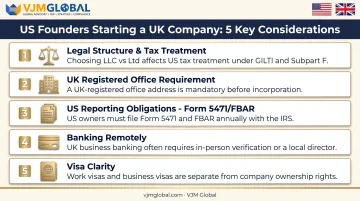
Legal structure and tax treatment. A UK Ltd is treated as a foreign corporation under US tax rules, not as a pass-through entity like a US LLC. HMRC separately classifies US LLCs as opaque entities for UK tax purposes. These aren't interchangeable structures, and assuming otherwise causes filing headaches later.
The UK registered office requirement. Companies House mandates a physical UK address (not a PO box) where post can be received and acknowledged. Founders who aren't physically present typically use a formation agent or registered office service. Cross-border firms such as VJM Global can handle this as part of a UK entity-formation engagement.
US-side reporting obligations. Owning a UK company doesn't exempt you from US filing duties. A US person who owns at least 10% of a foreign corporation, and whose ownership contributes to more than 50% US ownership overall, generally falls into Form 5471 filing categories under IRS rules. A 100% US-owned UK Ltd will typically meet that test.
GILTI and Subpart F inclusion rules may also apply depending on the company's income. The UK-US double tax treaty helps prevent double taxation on the same income, but it doesn't remove the US reporting requirement itself.
Banking, remotely. Many UK high-street banks set eligibility rules, such as requiring a UK resident applicant with a UK mobile number, that a US-based director simply can't meet. Fintech and EMI providers like Wise are generally more accessible for non-resident directors. Wise isn't a bank: customer funds are protected through safeguarding rather than FSCS deposit insurance.
Visa clarity. Owning shares or holding a director title creates zero immigration rights. Standard visitor rules permit limited business activities during a visit, but actively working in the UK requires an appropriate visa. The Innovator Founder route is one example, and only relevant if you plan to relocate and run the business on the ground.
Common miss: assuming incorporation grants a right to live or work in the UK, or discovering US reporting obligations for the first time at tax season instead of planning for them upfront.
How to Start a UK Consultancy Business From the USA — Step by Step
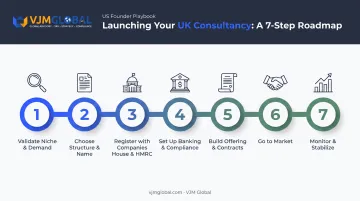
These seven steps take you from validating demand to a stable, compliant UK operation. The most common (and most avoidable) mistake is leaving registered office and banking arrangements until after incorporation, which stalls momentum right when you want to be signing clients.
Step 1 – Validate Your Niche and UK Market Demand
Confirm real UK or European demand exists. Don't assume success with US clients automatically translates.
- Run a few introductory calls with UK-based contacts to test willingness to pay in GBP
- Consider a small pilot project before committing to full entity setup
- Check whether your terminology, credentials, or regulatory framing need adjusting for a UK audience
Common miss: assuming US credentials carry the same weight in the UK without checking local expectations.
Step 2 – Choose Your Business Structure and Company Name
Decide between a new UK Ltd (the common route) or registering a branch of your existing US entity.
- Search the Companies House register for name availability and reserve it
- Avoid a US-style LLC mindset: the UK has no direct LLC equivalent, and Ltd companies work differently
Step 3 – Register Your Company with Companies House and HMRC
- Appoint at least one director (you, the US founder, can hold this role) and provide a UK registered office address
- Register for Corporation Tax with HMRC once the company becomes active
- Standard online incorporation currently costs £100 and is typically processed within 24 hours; postal filings take longer and cost more
Firms that specialize in cross-border entity formation, including VJM Global, can manage the registered office, Companies House filing, and HMRC Corporation Tax registration end to end. That support matters when you can't be physically present for paperwork or verification.
Step 4 – Set Up Banking, Tax and Compliance Basics
- Open a UK business bank account, or a compliant EMI/fintech account built for non-resident directors
- Check the VAT registration threshold and assess whether registering early benefits your consultancy
- Confirm US-side obligations (Form 5471, and FBAR where account values exceed $10,000) and stay current in both jurisdictions
Step 5 – Build Your Offering, Pricing and Contracts
- Define your scope of services and pricing model (hourly, project, or retainer) matched to UK client norms
- Put UK-compliant consultancy agreements in place, covering IP ownership and confidentiality
- Don't just reuse US contract templates; UK default IP ownership rules and confidentiality clause conventions differ from US practice
Common miss: assuming a US NDA or services agreement translates directly into UK contract law.
Step 6 – Go to Market and Land Your First UK Clients
- Lean on your UK company number, UK address, and any locally relevant case studies as credibility signals
- Use LinkedIn, referrals, and UK industry bodies to reach early prospects
- Track which channels actually convert UK leads, and put more effort behind those
Step 7 – Monitor, Stabilize and Decide on Physical Presence
- Track compliance deadlines: the annual confirmation statement, annual accounts, cash flow, and client feedback
- Decide whether to stay fully remote or explore a visa route later if you plan to relocate and work in the UK directly
- Hold off on UK hiring or expanded presence until compliance and cash flow are genuinely stable
Conclusion
Succeeding as a US-based founder of a UK consultancy comes down to getting the structure, registered office, and cross-border tax picture right early, not just registering fast. The compliance layer is heavier than what a UK-based founder faces because you're managing two systems at once.
Front-loading that work (banking access and US reporting obligations alongside your UK registered office) before you're mid-engagement with a UK client prevents rework that eats into time and margin. Ongoing attention to UK filings and US reporting requirements is what keeps the structure sustainable—not a one-time setup task.
If you need help with UK company formation, cross-border tax, or ongoing filings, VJM Global supports US founders setting up and running UK consultancy entities.
Frequently Asked Questions
Can a US citizen own a UK limited company?
Yes. A US citizen or resident can be a 100% shareholder and director of a UK Ltd company, with no UK residency or visa requirement, provided the company has a valid UK registered office address.
Do I need a UK visa to start a consultancy business in the UK from the US?
No visa is needed to remotely own or direct a UK company. A visa only becomes necessary if you plan to physically live in the UK and actively work there.
What is the rule of 3 in consulting?
It's most commonly used as a communication heuristic: grouping ideas, pricing tiers, or recommendations into three logical buckets for clarity. Interpretations vary by consultant, so treat it as a framework rather than a fixed rule.
How long does it take to register a UK company from the USA?
Company registration itself can be completed within days once documents and ID verification are ready. Banking setup and tax registration typically take additional time beyond that.
Will I be taxed twice on my UK consultancy income as a US citizen?
The UK-US double tax treaty is designed to prevent double taxation on the same income. However, you still need to meet US reporting requirements, such as Form 5471, for owning a foreign company.
Do I need a UK business address to register a company?
Yes. A UK registered office address is mandatory for Companies House registration. Non-resident founders typically arrange this through a formation agent or registered office service.