Introduction
The global fragrance industry has moved well past its department-store roots, and the UK's niche and indie perfume scene is a big part of that shift. Mintel projects the UK fragrance market will exceed £2 billion by 2029, recovering steadily after a soft patch in retail sales.
That growth is pulling US entrepreneurs toward the UK. Cross-border e-commerce means you don't need a shop on Bond Street to reach British customers. The real hurdles are choosing the right entity, meeting UK cosmetic compliance rules, and getting tax and registration right from day one.
Solo indie perfumers, established US fragrance brands, and private-label DTC founders all hit the same cross-border setup questions. This guide walks through exactly what a US-based founder needs to set up, register, and legally sell perfume in the UK.
Key Takeaways
- UK perfume sales require a UK-established Responsible Person, not just a US business licence
- Companies House can register a UK Ltd in as little as 24 hours, but compliance readiness takes far longer
- Overseas sellers supplying goods into the UK may need VAT registration even below the standard turnover threshold
- Alcohol-based fragrance ships as dangerous goods (UN1266), limiting carriers and raising freight costs
- Post-Brexit, an EU-based Responsible Person no longer meets UK rules—you need a UK-based RP
What Is a Perfume Business (Run From the USA, Sold Into the UK)?
A perfume business run from the USA and sold into the UK means sourcing or formulating fragrance, branding it, and selling to UK consumers or retailers while your core operations stay in the United States. The scent story matters, but only if the bottle can legally sit on a UK shelf.
The real deliverable is a compliant, sellable product, not only a brand narrative. UK regulators focus on safety files and labels, not social aesthetics.
Common entity structures founders choose include:
- US-owned UK limited company: full UK entity, GBP invoicing, and local credibility
- Direct export from a US entity: no UK company, with a heavier compliance burden per shipment
- UK subsidiary of an established US brand: formal UK distribution when the brand already has traction
Sales model is a separate choice: DTC through your own site versus wholesale to UK retailers. Each path has different margin and compliance implications.
What to Know Before You Start (and Why It Makes Sense)
Many US founders underestimate how much dual compliance adds to the timeline. A UK perfume launch means running the brand while also managing a UK entity, a UK-based compliance partner, and a five-hour time difference.
The Real Timeline
Company registration itself is fast. Companies House typically processes an online private limited company within 24 hours, and the UK government's own investment service notes that setting up a subsidiary usually takes about one day.
But registration isn't the same as being ready to sell. Before your first legal UK sale, you still need:
- A UK-established Responsible Person appointed
- A signed Cosmetic Product Safety Report (CPSR)
- A completed Product Information File
- Notification through the OPSS portal
- Compliant labels printed and ready
No government or industry source publishes a standard "registration to first sale" benchmark for fragrance businesses, because that middle stretch depends entirely on how fast your safety assessor and Responsible Person work.
Why It's Still Worth Doing
Despite the extra steps, the market case is strong. UK prestige beauty sales grew 10.7% year on year in 2024, and Statista's UK fragrance outlook flags rising demand for personalised, artisanal scents as a defining trend.
What still makes the move worthwhile:
- Steady UK demand for niche and indie fragrance beyond mass-market brands
- GBP pricing that protects margin instead of absorbing currency swings
- E-commerce reach without a physical UK storefront
- US brand equity that often transfers to UK buyers already familiar with American indie perfume
Early Decisions That Matter When Starting a UK Perfume Business From the USA
The costliest mistakes usually come from underestimating how many separate cross-border pieces need to lock into place at once.
Budgeting for the True Costs
Build your budget around these line items:
- UK company registration — digital incorporation through Companies House costs £50 as of May 2024, rising to £100 from 1 February 2026
- Responsible Person retainer — no standard published rate exists; quotes vary by SKU count and scope of duties
- CPSR and safety assessment fees — priced per formula, driven by ingredient data availability and assessor time
- Cross-border shipping and customs duties — hazardous-liquid freight quotes are shipment-specific, not flat-rate
Entity Structure: UK Ltd vs. Exporting Directly
You have two realistic paths:
- Register a UK limited company via Companies House with a UK registered office. This builds local credibility, lets you invoice in GBP, and simplifies VAT and Corporation Tax handling.
- Operate under your existing US entity and export directly. This avoids a second entity but adds friction to every shipment and can look less established to UK wholesale buyers.
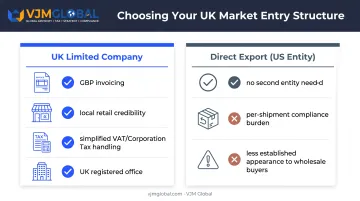
A UK Ltd generally wins on tax clarity and retail credibility. Direct export can work for early-stage testing, but most founders outgrow it fast.
The Responsible Person Problem
This is the compliance point US founders miss most often. Since Brexit, a Responsible Person based in the EU no longer satisfies UK requirements. The UK now requires its own UK-established Responsible Person for any cosmetic sold in Great Britain. A mail-forwarding address or PO box doesn't qualify as "established."
If your brand already has EU CPNP notifications, treat GB as a fully separate regulatory track.
Banking as a Non-Resident Director
Opening a UK business bank account as a non-resident director can be difficult. Many high-street banks want an in-person visit. Alternatives worth exploring:
- EMI (Electronic Money Institution) accounts, which typically onboard remotely
- Operating through a UK subsidiary with a local director who can complete in-branch verification
A cross-border firm can handle this layer for you. VJM Global works with US founders on UK company formation, registered office and agent services, and multi-jurisdiction tax coordination, so you're not learning UK banking and Companies House rules from scratch while launching a fragrance line.
How to Start a Perfume Business in the UK From the USA – Step by Step
Running a US-based perfume operation that sells into the UK means working through stages US cosmetic rules do not cover. Common mistakes include assuming US rules transfer directly, skipping the Responsible Person requirement, underestimating shipping timelines for a flammable liquid, and launching before UK registration is finalised.
Step 1 – Define Your Perfume Concept and Validate the UK Market
Pin down your scent profile and target UK customer before you spend on formulation. UK consumers increasingly favour distinctive, artisanal fragrances over mass-market names, according to Statista's UK outlook data.
Validate before you commit budget:
- Run social listening on UK-specific fragrance communities and forums
- Price competitors in GBP, not converted USD, to understand real positioning
- Test demand with a UK-facing landing page and pre-orders
Common miss: carrying over US pricing assumptions. UK price sensitivity and retail habits differ enough that a straight conversion often misprices your product.
Step 2 – Choose Your UK Business Structure and Register the Company
Decide between forming a UK Ltd through Companies House or exporting through your existing US entity. If you choose the Ltd route, you'll need:
- A UK registered office address (physical, not a PO box)
- Director identity verification (a legal requirement as of 18 November 2025)
- A SIC code identifying your business activity
- At least one shareholder, who can also be the director
Directors don't need to live in the UK, but the company must maintain a genuine UK registered office. Firms like VJM Global handle this end-to-end for US-owned businesses, which cuts down both registration time and the risk of a rejected filing.
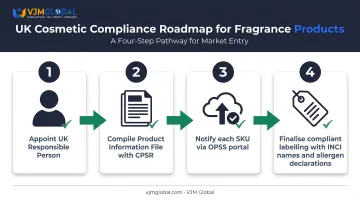
Step 3 – Meet UK Cosmetic and Fragrance Compliance Requirements
This is the step that separates a legal UK launch from an accidental regulatory violation.
- Appoint a UK-based Responsible Person who takes legal accountability for product safety
- Compile a Product Information File (PIF) including your CPSR, manufacturing method, and effect claims
- Notify each SKU through the UK Cosmetic Products Notification portal before it goes on sale
- Finalise labelling: INCI ingredient names, allergen declarations above 0.001% for leave-on products, net quantity, and required warnings
Common miss: assuming an existing EU CPNP notification covers UK sales. It doesn't, post-Brexit. GB requires its own notification, full stop.
Step 4 – Source Production, Packaging, and Manage Cross-Border Logistics
Decide whether to use UK-based contract filling or ship finished perfume from the US. Either way, alcohol-based fragrance is classified as UN1266 (a flammable liquid dangerous good), which limits your carrier options and raises freight cost.
Factor in:
- A GB EORI number, required for any UK import
- A correct commodity code to determine duty and VAT treatment
- Dangerous-goods documentation: SDS/MSDS, commercial invoice, Dangerous Goods Declaration, certificate of origin
Common miss: budgeting for standard parcel shipping when hazardous-liquid freight requires a dangerous-goods-certified carrier and considerably more lead time.
Step 5 – Set Pricing, Tax Registration, and Financial Setup
VAT registration isn't optional once you're trading meaningfully in the UK. The current threshold is £90,000 of taxable turnover in the previous 12 months. Overseas businesses supplying UK goods must register regardless of turnover in many cases, so check this early rather than assuming you have runway.
For pricing, build GBP prices around landed cost, not currency conversion:
- Add import duty and VAT before setting your retail price
- Leave margin room for UK-specific promotions and returns
The US-UK tax treaty generally taxes business profits only in the US unless you have a UK permanent establishment. Forming a UK subsidiary can still trigger US reporting duties, including IRS Form 5471. This is worth a proper cross-border tax review rather than guesswork.
Common miss: pricing purely off exchange rate. Duty and VAT erode margin fast if you haven't priced for them upfront.
Step 6 – Go to Market, Build UK Distribution, and Scale
UK fragrance sales are growing across multiple retail formats — Circana data cited by the British Beauty Council shows fragrance sales up 8% in department stores and 12% across other retail channels year over year.
Channels worth prioritising:
- UK-based fragrance and beauty influencers, not just US-facing creators
- Relevant UK marketplaces alongside your own DTC site
- Trade events such as London beauty industry gatherings, which run annually and draw retail buyers
Track UK-specific KPIs separately from US metrics: conversion rate by region and repeat purchase rate matter more here than raw traffic.
Common miss: running the identical US ad creative and pricing structure in the UK without localising currency, messaging, or promotional timing around UK shopping habits.
Conclusion
Starting a perfume business in the UK from the USA means mastering two things at once: the product itself, and a separate compliance system that doesn't care how well things work back home.
Getting the entity structure and Responsible Person requirement right matters more than moving fast. A rushed launch that skips notification or mislabels allergens can get pulled from sale entirely.
UK regulations tied to post-Brexit rules keep shifting. Review your costs, compliance obligations, and demand signals regularly rather than treating this as a one-time setup task.
VJM Global helps US founders with UK entity formation, tax registration, and ongoing compliance so you can focus on the product and the market.
Frequently Asked Questions
How do I start a perfume business in the UK?
Define your niche and target customer, then decide whether to register a UK entity or export directly. Meet cosmetic compliance requirements (Responsible Person and product notification), and set up sourcing and go-to-market plans.
Do I need a license to sell perfume in the UK?
There's no standalone "perfume license." Instead, products must be notified through the UK Cosmetic Products Notification portal and meet safety assessment and labelling rules under UK cosmetic regulations before sale.
How much does it cost to start a perfume business?
Costs span formulation and production, UK compliance work (Responsible Person, safety assessment), packaging, and entity registration. Companies House incorporation alone runs £50–£100, with compliance and freight costs quoted separately per shipment.
Can a US citizen or company own a business in the UK?
Yes. There's no restriction on foreign ownership of UK companies. You'll need a compliant UK registered office address and director identity verification, but US ownership itself isn't limited.
Do I need to be a UK resident to register a UK company?
No. UK residency isn't required for directors or shareholders. You do need a UK registered office address and completed identity verification for all directors and persons with significant control.
What is a Responsible Person for cosmetics in the UK, and do I need one?
A Responsible Person is a UK-established party legally accountable for a cosmetic product's safety and compliance. It's mandatory for every cosmetic, including perfume, sold in Great Britain — an EU-based one no longer qualifies.