For US founders, the UK is often the obvious first stop outside home turf. Shared language, established retail and ecommerce channels, and easy proximity to the wider EU beauty market make it a low-friction testing ground — at least on the surface.
Interest comes from all directions: home-based formulators who've outgrown Etsy, established US skincare brands eyeing overseas revenue, and first-time entrepreneurs building a UK-only brand from scratch. What none of them can skip is this — entering the UK market involves a distinct regulatory and business setup process that doesn't resemble anything you've dealt with at home.
This guide walks through exactly what that process looks like, step by step.
TL;DR
- Register a UK company, appoint a UK/EU Responsible Person, complete a CPSR, and notify OPSS before any legal sale
- Rebuild ingredients, labelling, and safety docs under UK Cosmetics Regulation; US FDA compliance does not transfer
- Stay US-based if you want—local compliance and accounting support is enough to operate remotely
- Budget several weeks to a few months from incorporation to first legal sale, depending on formulation complexity
What Is a Natural Skincare Business, and Why Do US Entrepreneurs Target the UK Market?
A natural skincare business develops, formulates, and sells products marketed around natural, organic, or "clean" ingredient positioning. Sales channels typically include direct-to-consumer, wholesale accounts, and retail stockists.
Two structural decisions shape everything downstream:
- Sourcing model: private-label/white-label products you rebrand, versus custom in-house formulation you own outright
- Production scale: home-based, small-batch manufacturing versus contract manufacturing at volume
Both paths are viable in the UK, but they carry very different compliance workloads.
The UK's natural and organic cosmetics segment was valued at around £221 million in 2020, according to Statista's UK natural and organic cosmetics data. That figure is a historical benchmark rather than a live snapshot, yet it confirms an established category with real purchasing power.
Why the UK, Specifically
- Strong ecommerce beauty infrastructure across DTC sites, Amazon, and TikTok Shop
- Consumers who respond to substantiated ingredient claims, not vague marketing language
- A practical stepping stone to the wider EU market, where much of the compliance groundwork overlaps
Founder profiles vary widely: indie formulators seeking a second market, established US brands testing overseas demand, and entrepreneurs building a brand purely for UK shelves. The regulatory path is the same regardless of which category you fall into.
What US Entrepreneurs Must Know Before Starting a UK Skincare Business
The single biggest misconception US founders bring into this process: assuming US regulatory and business experience transfers directly. It doesn't. UK Cosmetics Regulation is a separate legal regime with its own safety, labelling, and notification requirements, built on retained EU Regulation 1223/2009, as amended for Great Britain.
Set your expectations accordingly. Appointing a compliant Responsible Person and completing product notification can realistically take longer than registering the company itself.
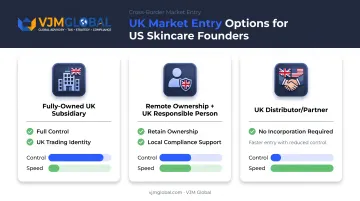
Choosing Your Market Entry Structure
You've got three main options:
- A fully-owned UK limited company (subsidiary): gives you full control and a UK trading identity
- Remote ownership with a locally appointed Responsible Person: you own the company, but designate UK-based compliance support
- Working through a UK distributor or partner without incorporating at all
Founders who want control and a path to scale usually land on option one or two. Option three trades control for speed, which works for testing demand but rarely scales well.
Do You Need to Be UK-Resident?
No. Most compliance and banking steps can be handled remotely with the right local support in place. You don't need a UK visa, a UK address of your own, or a flight booked.
Running the setup from the US is workable. How wide you launch on day one is a separate call.
There's a real difference between being "compliant to notify" a single hero product and being "ready to scale" a full range. Many founders validate demand with one SKU before taking on formulation, testing, and notification costs across a wider line.
How to Start a Natural Skincare Business in the UK From the USA – Step by Step
A non-resident US founder follows a different path from a UK-resident founder. You are handling entity formation, compliance, and banking without being physically present.
Three mistakes come up repeatedly:
- Assuming a US LLC can trade in the UK without separate registration
- Delaying Responsible Person appointment until "later"
- Notifying products before UK-compliant labelling is actually finalised
Here's how to avoid all three.
Step 1 – Register Your UK Company with Companies House and HMRC
Incorporating a UK limited company as a non-resident director is straightforward on paper: you'll need a registered UK office address (this can't be a PO box) and completed director identification.
Where things slow down is banking. Opening a UK business bank account as a non-resident founder is often the biggest bottleneck in the entire setup process. Many high-street banks want in-person verification or extensive documentation that non-resident applicants struggle to provide alone. This is typically where local assistance earns its fee.
Once incorporated, you'll register for Corporation Tax with HMRC and receive a Unique Taxpayer Reference. Keep an eye on the VAT registration threshold too — it's easy to miss as revenue climbs, and retroactive registration is a headache nobody wants.
Step 2 – Appoint a UK/EU-Based Responsible Person for Your Cosmetics
Every cosmetic product sold in Great Britain needs an appointed Responsible Person (RP), and this is non-negotiable. The RP must have a genuinely UK-established address; a mail-forwarding service or PO box doesn't qualify, according to OPSS guidance on making cosmetic products available in Great Britain.
A US-based founder generally cannot self-appoint from abroad. Your main options:
- A UK-based employee of your company
- A compliance/RP-as-a-service provider
- A UK manufacturer or distributor willing to take on the role
Common miss: shipping product to the UK before the RP is formally designated. This legally blocks any sale — no exceptions, no grace period.
Step 3 – Formulate, Safety-Test, and Document Your Products for UK Compliance
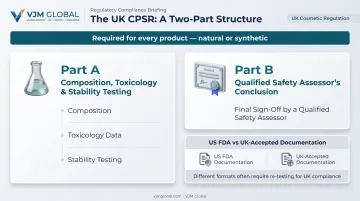
Every product needs a Cosmetic Product Safety Report (CPSR) before it touches the UK market. This has two parts: Part A covers composition, toxicology, and stability data; Part B is the qualified assessor's actual safety conclusion.
Here's the part that trips up US founders most: "natural" or "organic" doesn't reduce this burden. The same CPSR, safety assessment, and Good Manufacturing Practice evidence apply whether you're selling a synthetic retinol serum or a three-ingredient rosehip oil.
Your US FDA-compliant formulation isn't automatically UK-compliant either. Banned and restricted ingredient lists differ between jurisdictions — a preservative that's fine under FDA rules might sit on the UK's restricted list, or vice versa.
Common miss: relying on US lab documentation that a UK safety assessor simply won't accept, forcing a costly re-test cycle you didn't budget for.
Step 4 – Notify Products via the OPSS Submit Cosmetic Product Notification (SCPN) Portal
Once the CPSR is complete, your Responsible Person must file each product through the SCPN portal before any UK sale can legally happen.
Labelling has to be UK-specific, covering:
- A UK contact address for complaints
- English-language ingredient lists
- Allergen declarations and batch identification
Common miss: notifying a product, then having to re-notify because labelling or formulation changed late in the process. Lock your label and formula before you notify, not the other way around.
Step 5 – Set Up Cross-Border Tax, Accounting, and Banking Compliance
This is where a lot of the day-to-day complexity actually lives. US-UK double tax treaty provisions affect how you're taxed on UK company profits or dividends flowing back to you personally. Getting this wrong can mean paying more tax than necessary on both sides of the Atlantic.
UK statutory accounts and Companies House annual filing obligations also work differently from US bookkeeping norms:
| UK Framework | US Framework |
|---|---|
| Companies House annual accounts + Confirmation Statement | Secretary of State (state-level) annual report |
| HMRC Corporation Tax return (Form CT600) | Federal return (1120, 1120-S, or 1065) |
| UK beneficial ownership registers | FinCEN beneficial ownership reporting |
Firms like VJM Global handle UK company formation, HMRC tax registration, and ongoing compliance for founders who don't want to relocate or learn a second accounting system from scratch. That includes Corporation Tax registration, statutory accounts preparation, and Confirmation Statement filing: the recurring obligations that are easy to miss from 3,000 miles away.
Step 6 – Launch: Distribution, E-commerce, and Building UK Customer Trust
Now the fun part. You'll choose between direct-to-consumer e-commerce, UK retailer/stockist partnerships, or marketplace listings. Most brands end up using a combination.
UK e-commerce in beauty has been outgrowing several other retail categories, with smaller, more frequent orders spreading across Amazon, TikTok Shop, and DTC sites, per Cosmetics Business's 2026 supply chain report.
UK consumers expect specific credibility signals:
- Substantiated cruelty-free or vegan claims (third-party verification helps)
- A visible UK-based contact or Responsible Person address
- Verified customer reviews, not just curated testimonials
Common miss: marketing language that inadvertently triggers medicinal product classification. Claiming your serum "treats acne" rather than "reduces the appearance of blemishes" can push you into MHRA borderline-product territory, a very different regulatory conversation than cosmetics.
Costs, Timelines, and Common Pitfalls for US Founders Entering the UK Market
Budget across four categories: UK company registration, Responsible Person service fees, CPSR/safety testing, and product notification. These costs shift significantly depending on your route:
- Lean private-label launch — lower testing costs since formulations are often pre-validated by the manufacturer, but you'll still need your own CPSR and RP arrangement
- Custom-formulation launch — higher upfront safety testing and assessment costs, since you're building safety documentation from zero
Incorporation itself can take days. Responsible Person appointment, safety testing, and notification typically add several weeks to a few months before your first legal UK sale—this is the part founders consistently underestimate.
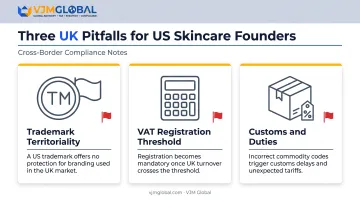
Watch for these UK-specific pitfalls:
- Assuming a US trademark protects UK branding — it doesn't. Trademark rights are territorial, so you'll need a separate UK filing or Madrid Protocol designation
- Missing the VAT registration threshold — once taxable turnover crosses the limit, registration is mandatory and changes how you price and invoice UK sales
- Underestimating customs and duties on skincare shipments between the US and UK — commodity codes, customs value, and tariffs all apply, and there's no flat "skincare rate"
Conclusion
Launching a natural skincare business in the UK from the US is entirely achievable. Plenty of founders have done it without ever setting foot in London. But it only works when you treat the UK as a distinct regulatory market, not a copy-paste extension of your US operation.
Sequencing is everything. Entity formation, Responsible Person appointment, and product testing have to happen in the right order, or you'll pay for delays twice: once in time, once in re-testing fees.
Partnering with cross-border specialists like VJM Global for UK entity setup and ongoing tax and accounting obligations frees you to focus on product, customers, and growth instead of rework on filings and testing.
Frequently Asked Questions
Do I need a licence to sell skincare products in the UK?
There's no single "skincare licence." Instead, every product needs an appointed Responsible Person, a completed CPSR, and OPSS notification before it can legally be sold.
How much money do I need to start a skincare business in the UK?
Costs vary significantly between private-label and custom-formulation routes, covering incorporation, Responsible Person fees, safety testing, and initial inventory. Get formal quotes early—costs depend on your entity structure and product range.
Can a US citizen own a UK limited company remotely?
Yes. A US citizen can be a 100% shareholder and director of a UK limited company without residing in the UK, provided you have a registered UK office address and compliant banking arrangements.
Do I need to live in the UK to run my skincare business there?
No. Most founders manage their UK business remotely from the US, relying on a local Responsible Person, accountant, and manufacturing or logistics partner for on-the-ground compliance.
What is a UK Responsible Person, and can I be my own?
The Responsible Person must be established within the UK. A US-resident founder generally can't self-appoint and needs to designate a UK-based individual or service instead.
How long does it take to legally sell skincare products in the UK from the US?
Incorporation can take days, but Responsible Person appointment, safety testing, and notification typically add several weeks to a few months, depending on formulation complexity.